A minimal note-taking method for language learners
Most language notebooks are write-only memory: written into, never read out of. This piece takes the note-taking research — including the fact that longhand beats laptop failed to replicate twice — and reduces it to a four-field template you can run in five minutes a day.
AI Aggregated source·August 4, 2026·10 min read·Words & skills
Nearly every language learner has owned a vocabulary notebook. Nearly all of them share a fate: thirty beautifully written pages, the rest blank, and not one page ever reopened.
That is not a discipline problem. It is a design problem. Most notebooks are write-only memory — written into but never read out of — and such a system costs effort and returns nothing.
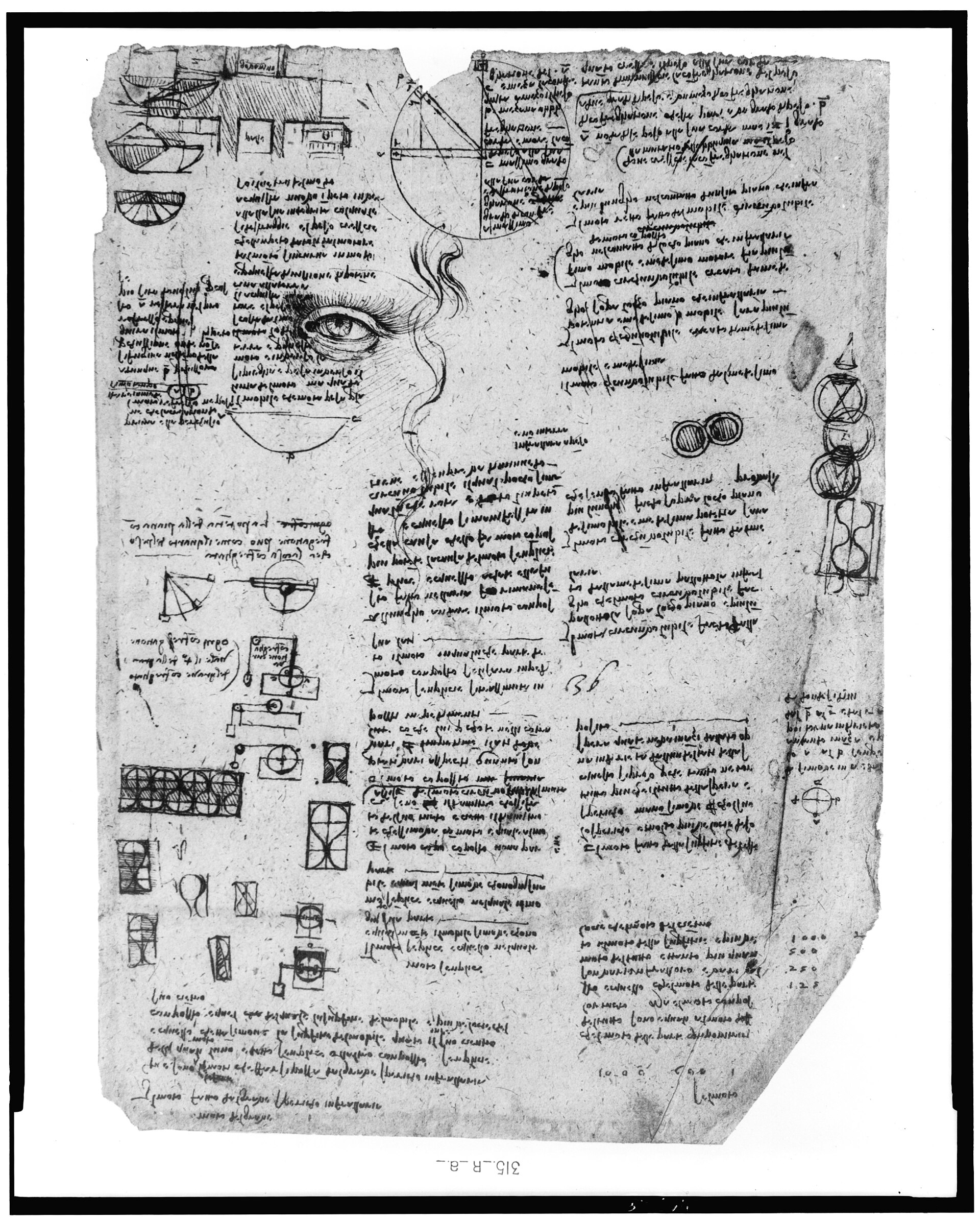
Leonardo's notebooks are famous for what they contain, but the useful lesson is the shape: nothing was written to be filed. Every page was made to be gone back to, and a note nobody returns to is not a note, it is a receipt.Source: Leonardo, da Vinci, 1452-1519. — Public domain, Wikimedia Commons
This piece reduces the note-taking research to a short template, and states plainly what is worth recording and what is not.
Notes do two jobs, and people only use one
The foundational study by Di Vesta and Gray (1972) splits note-taking into two distinct functions.
The encoding function. The act of writing forces processing: deciding what matters, rephrasing, choosing what to leave out. The benefit occurs while writing, even if you never look at the notes again.
The storage function. The notebook is an external store to return to. The benefit occurs on review.
What matters is that the two demand different kinds of notes, and optimising for one usually damages the other. Complete notes serve storage but weaken encoding, because copying everything means selecting nothing.
The commonest error among language learners is to write for storage — carefully, completely, attractively — and then never perform the storage step. You pay both costs and collect neither benefit.
An honest note: longhand beats laptop failed to replicate
Before any advice, something has to be dealt with, because nearly every article on note-taking cites it.
Mueller and Oppenheimer (2014) published a study with a memorable title — the pen is mightier than the keyboard — reporting that students taking notes by hand understood material better than students typing. It has been cited thousands of times and became default advice everywhere.
However:
Morehead, Dunlosky and Rawson (2019) ran a replication with a larger sample and found no longhand advantage on conceptual tests.
Urry and colleagues (2021) conducted a direct replication of the original study plus mini meta-analyses across similar work, and also found no such effect.
So the advice write by hand because it is better does not hold in that form. If you prefer a pen, use one — but do not imagine a keyboard is sabotaging your learning.
What survived is the mechanism, not the headline. Even in the replications, typists transcribed more verbatim — and verbatim transcription genuinely does harm, because it skips the processing step. Bui, Myerson and Hale (2013) showed this cleanly: typists instructed to take organised notes substantially outperformed typists transcribing.
The correct conclusion is not pick up a pen. It is stop copying — whatever the tool.
Why rephrasing beats copying
One memory effect explains this compactly.
Slamecka and Graf (1978) described the generation effect: material you produce yourself is remembered substantially better than material you merely read, even when the content is identical.
In the original experiments, one group read complete word pairs while another had to generate the second word from a cue. The generating group remembered more — despite seeing less text.
The application to notebooks is direct. A line copied from a dictionary is something you read. A line written in your own words — a definition you paraphrased, an example sentence you composed — is something you produced.
The second takes longer per word. That is precisely why it works, and precisely why you should record fewer words.
The decision rule: what to record and what to skip
This is the most useful part here, and it comes from a theory little known outside research.
Laufer and Hulstijn (2001) proposed the involvement load hypothesis: how well a word is retained depends on three components of the task you performed with it.
Need. Do you actually need this word for something? Self-imposed need counts for more than need imposed by an exercise.
Search. Did you have to look up its meaning or form, or was it handed to you?
Evaluation. Did you have to decide something about it — compare it with a near-synonym, choose which sense fits this context, construct a sentence where it sits properly?
Hulstijn and Laufer (2001) tested this and found tasks with higher involvement load produced better retention, at comparable time cost.
This gives you a very practical rule:
If recording a word required no decision at all, the recording was close to useless.
Copying apple — quả táo involves no need, no search, no evaluation. It is a mechanical act. By contrast, recording a word because you have now met it a third time, having chosen between two senses and invented your own example — that has all three.
What knowing a word contains — and why you must choose
Nation (2013) lists what actually goes into knowing a word: spoken form, written form, word parts, meaning, associations, the concepts it covers, grammatical function, collocations, and register constraints.
Nine aspects. No notebook can hold all of that, and none should try.
Webb (2007) adds something useful: these aspects do not grow at the same rate. For the same number of encounters, recognition of written form rises much faster than the ability to use the word in speech. Pigada and Schmitt (2006), tracking one learner across months of extensive reading, found the same shape: spelling was picked up quickly, meaning and use far more slowly.
The consequence for note-taking: do not record what is already growing fast. Record what grows slowly.
Spelling and basic meaning will arrive from repeated encounters. What does not arrive by itself is use: what the word goes with, when it is appropriate, how it differs from its near-synonym. That is where the notebook earns its keep.
The four-field template
Pulling all of that together, here is the minimal template I think survives scrutiny. Four fields, no more.
Field 1 — the word, in the form you met it. Not the dictionary headword but the real form in the sentence you read. For verbs, include the preposition. For German or Greek nouns, include the article.
Field 2 — the sentence you met it in, trimmed. Not a dictionary example. A real sentence from a real source, because you already have the context for it in your head. Cut to five or ten words.
Field 3 — the meaning, in your own words. Not the dictionary gloss. This is where the generation effect operates. If you cannot rephrase it, you have not understood it, and that is useful information.
Field 4 — one usage note, only when there is one. What it collocates with, how it differs from a near-synonym, what register it belongs to. This field is often empty, and that is fine. When it has content, it is the most valuable part of the card.
There is no pronunciation field. No part-of-speech field. No date field. Every field you add reduces the number of words you can actually process.
The keyword method: it works, with limits
Atkinson (1975) proposed the keyword method: link the foreign word to a similar-sounding native word, then build an image connecting the two meanings. It has been studied extensively, and it genuinely works.
But it has a limit, and the limit matters.
Sagarra and Alba (2006) compared three approaches with beginning learners of Spanish: rote repetition, semantic mapping, and the keyword method. The result had two layers: keyword won on the immediate test, but on the delayed test the methods involving deeper semantic processing did better.
The sensible reading: the keyword trick is a hook for getting a word into memory initially. It does not substitute for meeting the word in real contexts. Use it on stubborn words that will not stick, not as the main method.
Does the format matter
Many note-taking systems get promoted — Cornell, mind maps, Zettelkasten. The evidence for any specific system is much thinner than its popularity suggests.
What does have evidence is a general principle. Kiewra and colleagues (1991) compared linear notes with matrix notes — a grid with rows and columns — and found matrices produced better learning of the relationships between items, though not of individual items.
For language learners this suggests a specific use: when you need to distinguish several near-synonyms, do not write them as four separate lines — write them as a four-column table. The differences are what you need, and a grid forces you to write the differences down.
Kiewra (1985) states the covering conclusion: what decides the outcome is not the format but the depth of processing that format compels.
A notebook only pays when reopened
This is where most systems die.
Karpicke, Butler and Roediger (2009) asked university students what they do when studying alone. Only about 11% chose self-testing; the great majority reread.
With notebooks, rereading is worse still, because you are rereading your own writing — maximum familiarity, and therefore maximum fluency illusion. Bjork, Dunlosky and Kornell (2013) describe exactly this trap: familiarity mistaken for mastery.
The fix is simple and unpleasant: when you open the notebook, cover the meaning field.
Look at the word and the example, recall the meaning, then check. That is retrieval, and per Roediger and Karpicke (2006) it strengthens memory far more than rereading — with the gap widening when measured a week later.
Also, do not review in the order you wrote things. Cepeda and colleagues (2006) confirm that the same time split into spaced sessions retains longer. If you use spaced-repetition software, it already does this. On paper, open at random.
Dunlosky and colleagues (2013), ranking ten study techniques by evidence, put practice testing and distributed practice at the top — and highlighting and rereading at the bottom.
The minimal system: one page, five minutes
Here is the whole procedure.
While reading or listening: do not stop. Mark, underline, screenshot. Stopping to take notes breaks the flow, and the flow is what teaches you most.
Afterwards: choose three to five words. Not everything you marked. Choose words you have met before, or words you can see yourself using. This is the need step in Laufer and Hulstijn’s frame.
Write four fields, five minutes. If it takes more than ten, you are recording too many words.
Review by covering, not by reading. A few minutes, spaced, in shuffled order.
Prune regularly. A word you have got right four or five times running no longer needs to be in the book. The leaner the book, the likelier it is to be opened.
Four things to stop recording
Stop writing improvised phonetic respellings. Writing an approximation in your own alphabet instead of learning the phonetic symbols is a debt. It helps today and damages your pronunciation for years, because it forces foreign sounds into native moulds.
Stop writing full parallel translations. Original and full translation side by side means your eye will always slide to the native column. Record the original, and put the meaning in a separate field you can cover.
Stop recording words you will never use. A technical term met once in a lifetime does not deserve a card. Mark it and move on.
Stop beautifying the notebook. Time spent decorating is time that feels like study without being study. It is the purest form of the fluency illusion.
What is actually being built
There is a paradox worth stating at the end.
The largest value of note-taking, per Di Vesta and Gray, sits in the encoding function — that is, in the moment of writing. But most of the effort people expend targets the storage function: complete, tidy, systematic, for later. And later usually never comes.
If you accept that, the practical conclusion is rather liberating: a thin notebook that gets used is worth far more than a thick one that gets kept.
Three to five words a day, four fields, five minutes, and one pass with your hand over the meaning. Across a year that is around a thousand words that passed through your hands with all three components of involvement — need, search, evaluation.
More than that and you are copying. And copying, as the replications showed, is the one part of note-taking the evidence actually argues against.
Read the simple version
The same article, told in plain words — for younger readers, or for anyone who wants the point quickly.
Nearly every language learner has owned a vocabulary notebook. Nearly all of them share a fate: thirty beautifully written pages, the rest blank, and not one page ever reopened.
That is not a discipline problem. It is a design problem. Most notebooks are write-only memory — written into but never read out of — and such a system costs effort and returns nothing.
Notes do two jobs, and people only use one
Di Vesta and Gray (1972) split note-taking into two distinct functions.
The encoding function. The act of writing forces processing: deciding what matters, rephrasing, choosing what to leave out. The benefit occurs while writing, even if you never look at the notes again.
The storage function. The notebook is an external store to return to. The benefit occurs on review.
What matters is that the two demand different kinds of notes, and optimising for one usually damages the other. Complete notes serve storage but weaken encoding, because copying everything means selecting nothing.
The commonest error among language learners is to write for storage — carefully, completely, attractively — and then never perform the storage step. You pay both costs and collect neither benefit.
An honest note: longhand beats laptop failed to replicate
Before any advice, something has to be dealt with, because nearly every article on note-taking cites it.
Mueller and Oppenheimer (2014) published a study with a memorable title — the pen is mightier than the keyboard — reporting that students taking notes by hand understood material better than students typing. It has been cited thousands of times and became default advice everywhere.
However: Morehead, Dunlosky and Rawson (2019) ran a replication with a larger sample and found no longhand advantage on conceptual tests. Urry and colleagues (2021) conducted a direct replication of the original plus mini meta-analyses across similar work, and also found no such effect.
So the advice write by hand because it is better does not hold in that form. If you prefer a pen, use one — but do not imagine a keyboard is sabotaging your learning.
What survived is the mechanism, not the headline. Even in the replications, typists transcribed more verbatim — and verbatim transcription genuinely does harm, because it skips the processing step. Bui, Myerson and Hale (2013) showed this cleanly: typists instructed to take organised notes substantially outperformed typists transcribing.
The correct conclusion is not pick up a pen. It is stop copying — whatever the tool.
Why rephrasing beats copying
Slamecka and Graf (1978) described the generation effect: material you produce yourself is remembered substantially better than material you merely read, even when the content is identical. In the original experiments one group read complete word pairs while another had to generate the second word from a cue. The generating group remembered more — despite seeing less text.
The application is direct. A line copied from a dictionary is something you read. A line written in your own words is something you produced.
The second takes longer per word. That is precisely why it works, and precisely why you should record fewer words.
The decision rule: what to record and what to skip
Laufer and Hulstijn (2001) proposed the involvement load hypothesis: how well a word is retained depends on three components of the task you performed with it.
Need. Do you actually need this word for something? Self-imposed need counts for more than need imposed by an exercise. Search. Did you have to look up its meaning or form, or was it handed to you? Evaluation. Did you have to decide something about it — compare it with a near-synonym, choose which sense fits, construct a sentence where it sits properly?
Hulstijn and Laufer (2001) tested this and found tasks with higher involvement load produced better retention, at comparable time cost.
This gives a very practical rule: if recording a word required no decision at all, the recording was close to useless.
Copying apple — quả táo involves no need, no search, no evaluation. It is a mechanical act. By contrast, recording a word because you have now met it a third time, having chosen between two senses and invented your own example — that has all three.
What knowing a word contains — and why you must choose
Nation (2013) lists what actually goes into knowing a word: spoken form, written form, word parts, meaning, associations, the concepts it covers, grammatical function, collocations, and register constraints. Nine aspects. No notebook can hold all of that, and none should try.
Webb (2007) adds something useful: these aspects do not grow at the same rate. For the same number of encounters, recognition of written form rises much faster than the ability to use the word in speech. Pigada and Schmitt (2006), tracking one learner across months of extensive reading, found the same shape: spelling was picked up quickly, meaning and use far more slowly.
The consequence: do not record what is already growing fast. Record what grows slowly.
Spelling and basic meaning will arrive from repeated encounters. What does not arrive by itself is use: what the word goes with, when it is appropriate, how it differs from its near-synonym. That is where the notebook earns its keep.
The four-field template
Field 1 — the word, in the form you met it. Not the dictionary headword but the real form in the sentence you read. For verbs, include the preposition.
Field 2 — the sentence you met it in, trimmed. Not a dictionary example. A real sentence from a real source, because you already have the context for it in your head. Cut to five or ten words.
Field 3 — the meaning, in your own words. Not the dictionary gloss. This is where the generation effect operates. If you cannot rephrase it, you have not understood it, and that is useful information.
Field 4 — one usage note, only when there is one. What it collocates with, how it differs from a near-synonym, what register it belongs to. This field is often empty, and that is fine. When it has content, it is the most valuable part of the card.
There is no pronunciation field. No part-of-speech field. No date field. Every field you add reduces the number of words you can actually process.
The keyword method: it works, with limits
Atkinson (1975) proposed the keyword method: link the foreign word to a similar-sounding native word, then build an image connecting the two meanings. It has been studied extensively, and it genuinely works.
But it has a limit. Sagarra and Alba (2006) compared three approaches with beginning learners of Spanish: rote repetition, semantic mapping, and the keyword method. The result had two layers: keyword won on the immediate test, but on the delayed test the methods involving deeper semantic processing did better.
The sensible reading: the keyword trick is a hook for getting a word into memory initially. It does not substitute for meeting the word in real contexts. Use it on stubborn words that will not stick, not as the main method.
Does the format matter
Many note-taking systems get promoted — Cornell, mind maps, Zettelkasten. The evidence for any specific system is much thinner than its popularity suggests.
What does have evidence is a general principle. Kiewra and colleagues (1991) compared linear notes with matrix notes — a grid with rows and columns — and found matrices produced better learning of the relationships between items, though not of individual items.
For language learners this suggests a specific use: when you need to distinguish several near-synonyms, do not write them as four separate lines — write them as a four-column table. The differences are what you need, and a grid forces you to write the differences down.
Kiewra (1985) states the covering conclusion: what decides the outcome is not the format but the depth of processing that format compels.
A notebook only pays when reopened
Karpicke, Butler and Roediger (2009) asked university students what they do when studying alone. Only about 11% chose self-testing; the great majority reread.
With notebooks, rereading is worse still, because you are rereading your own writing — maximum familiarity, and therefore maximum fluency illusion. Bjork, Dunlosky and Kornell (2013) describe exactly this trap: familiarity mistaken for mastery.
The fix is simple and unpleasant: when you open the notebook, cover the meaning field. Look at the word and the example, recall the meaning, then check. That is retrieval, and per Roediger and Karpicke (2006) it strengthens memory far more than rereading — with the gap widening when measured a week later.
Also, do not review in the order you wrote things. Cepeda and colleagues (2006) confirm that the same time split into spaced sessions retains longer. On paper, open at random.
Dunlosky and colleagues (2013), ranking ten study techniques by evidence, put practice testing and distributed practice at the top — and highlighting and rereading at the bottom.
The minimal system: one page, five minutes
While reading or listening: do not stop. Mark, underline, screenshot. Stopping to take notes breaks the flow, and the flow is what teaches you most.
Afterwards: choose three to five words. Not everything you marked. Choose words you have met before, or words you can see yourself using. This is the need step.
Write four fields, five minutes. If it takes more than ten, you are recording too many words.
Review by covering, not by reading. A few minutes, spaced, in shuffled order.
Prune regularly. A word you have got right four or five times running no longer needs to be in the book. The leaner the book, the likelier it is to be opened.
Four things to stop recording
Stop writing improvised phonetic respellings. Writing an approximation in your own alphabet instead of learning the phonetic symbols is a debt. It helps today and damages your pronunciation for years, because it forces foreign sounds into native moulds.
Stop writing full parallel translations. Original and full translation side by side means your eye will always slide to the native column. Record the original, and put the meaning in a separate field you can cover.
Stop recording words you will never use. A technical term met once in a lifetime does not deserve a card. Mark it and move on.
Stop beautifying the notebook. Time spent decorating is time that feels like study without being study. It is the purest form of the fluency illusion.
What is actually being built
There is a paradox worth stating at the end.
The largest value of note-taking, per Di Vesta and Gray, sits in the encoding function — that is, in the moment of writing. But most of the effort people expend targets the storage function: complete, tidy, systematic, for later. And later usually never comes.
If you accept that, the practical conclusion is rather liberating: a thin notebook that gets used is worth far more than a thick one that gets kept.
Three to five words a day, four fields, five minutes, and one pass with your hand over the meaning. Across a year that is around a thousand words that passed through your hands with all three components of involvement — need, search, evaluation.
More than that and you are copying. And copying, as the replications showed, is the one part of note-taking the evidence actually argues against.
Sources & further reading
These articles summarize well-established research in learning science and linguistics. Key sources and further reading:
Di Vesta, F. J., & Gray, G. S. (1972). Listening and note taking. Journal of Educational Psychology, 63(1), 8–14.
Mueller, P. A., & Oppenheimer, D. M. (2014). The pen is mightier than the keyboard: Advantages of longhand over laptop note taking. Psychological Science, 25(6), 1159–1168.
Morehead, K., Dunlosky, J., & Rawson, K. A. (2019). How much mightier is the pen than the keyboard for note-taking? A replication and extension of Mueller and Oppenheimer (2014). Educational Psychology Review, 31, 753–780.
Urry, H. L., Crittle, C. S., Floerke, V. A., et al. (2021). Don’t ditch the laptop just yet: A direct replication of Mueller and Oppenheimer’s (2014) study 1 plus mini meta-analyses across similar studies. Psychological Science, 32(3), 326–339.
Bui, D. C., Myerson, J., & Hale, S. (2013). Note-taking with computers: Exploring alternative strategies for improved recall. Journal of Educational Psychology, 105(2), 299–309.
Slamecka, N. J., & Graf, P. (1978). The generation effect: Delineation of a phenomenon. Journal of Experimental Psychology: Human Learning and Memory, 4(6), 592–604.
Laufer, B., & Hulstijn, J. (2001). Incidental vocabulary acquisition in a second language: The construct of task-induced involvement. Applied Linguistics, 22(1), 1–26.
Hulstijn, J. H., & Laufer, B. (2001). Some empirical evidence for the involvement load hypothesis in vocabulary acquisition. Language Learning, 51(3), 539–558.
Nation, I. S. P. (2013). Learning Vocabulary in Another Language (2nd ed.). Cambridge: Cambridge University Press.
Webb, S. (2007). The effects of repetition on vocabulary knowledge. Applied Linguistics, 28(1), 46–65.
Pigada, M., & Schmitt, N. (2006). Vocabulary acquisition from extensive reading: A case study. Reading in a Foreign Language, 18(1), 1–28.
Atkinson, R. C. (1975). Mnemotechnics in second-language learning. American Psychologist, 30(8), 821–828.
Sagarra, N., & Alba, M. (2006). The key is in the keyword: L2 vocabulary learning methods with beginning learners of Spanish. Modern Language Journal, 90(2), 228–243.
Kiewra, K. A. (1985). Investigating notetaking and review: A depth of processing alternative. Educational Psychologist, 20(1), 23–32.
Kiewra, K. A., DuBois, N. F., Christian, D., McShane, A., Meyerhoffer, M., & Roskelley, D. (1991). Note-taking functions and techniques. Journal of Educational Psychology, 83(2), 240–245.
Roediger, H. L., & Karpicke, J. D. (2006). Test-enhanced learning: Taking memory tests improves long-term retention. Psychological Science, 17(3), 249–255.
Karpicke, J. D., Butler, A. C., & Roediger, H. L. (2009). Metacognitive strategies in student learning: Do students practise retrieval when they study on their own? Memory, 17(4), 471–479.
Cepeda, N. J., Pashler, H., Vul, E., Wixted, J. T., & Rohrer, D. (2006). Distributed practice in verbal recall tasks: A review and quantitative synthesis. Psychological Bulletin, 132(3), 354–380.
Dunlosky, J., Rawson, K. A., Marsh, E. J., Nathan, M. J., & Willingham, D. T. (2013). Improving students’ learning with effective learning techniques. Psychological Science in the Public Interest, 14(1), 4–58.
Bjork, R. A., Dunlosky, J., & Kornell, N. (2013). Self-regulated learning: Beliefs, techniques, and illusions. Annual Review of Psychology, 64, 417–444.