You are not short of resolve, you are short of an appointment
No time, no talent, too old — those are explanations, not causes. What can be measured is duller: one sentence with a time, a place and a first action in it, which nobody has written down.
AI Aggregated source·August 22, 2026·5 min read·Habits & method
Everyone knows the list of reasons: no time, no talent, too old, bad memory. The trouble is that those are answers to the question why have I not started, not causes of it. The things that can actually be measured are much duller — and much easier to remove.
The gap is not in wanting
Webb and Sheeran gathered the experiments that genuinely succeeded in changing people's intentions, then looked at whether behaviour followed. Intentions moved a good deal; behaviour moved about half as far. Wanting is necessary, and wanting is the part you already have.
Which means the inspirational articles are pouring more into the barrel that is already full. The empty one is further along: the step from wanting to doing.
What fills that gap has been measured
Gollwitzer and Sheeran pooled 94 independent tests of an intervention so small it is almost comic: having people write down a sentence of the form when X happens, I will do Y. The effect on reaching the goal came out medium-to-large. Very few things that cheap measure that clearly.
The mechanism is no mystery either. The sentence hands the decision over from your will to an outside signal. You stop having to decide again every day; the situation decides for you.
A mechanical alarm clock. This is the whole idea of an if-then plan in one object: something outside you decides when, so that you do not have to decide again every morning.Source: Santeri Viinamäki — CC BY-SA 4.0, Wikimedia Commons
For a language learner the sentence has to be specific to the point of being boring. Not I am going to learn Chinese, but once I have poured the morning coffee, I open the app and do fifteen minutes, sitting at the kitchen table. A time, a place, a first action.
And the barrier everybody assumes is one
That would be choosing the method. It feels obvious that too many options paralyse people. But when Scheibehenne and colleagues pooled 50 experiments covering more than five thousand people, the average effect came out at virtually zero. The idea that abundant choice freezes us does not stand up as well as it is assumed to.
That does not make choosing harmless. It harms you in a duller way: time spent comparing courses is time not spent learning. The first week spent reading ten app comparisons is precisely the first week in which nothing was learned.
A Linguaphone English course, sold in Hong Kong with Chinese explanatory notes. Courses like this have been bought for a century by people who were about to begin. The covers here are almost unworn — which is the point.Source: 何玲卡峯 — CC BY-SA 4.0, Wikimedia Commons
So let us say it plainly: almost any serious method works if it is used regularly. What decides the outcome is not choosing right, it is being done choosing.
The number that makes people flinch
The third barrier is a number read wrongly. The language school of the US State Department estimates roughly 600 to 750 classroom hours for French, and around 2,200 for Chinese or Japanese. People look at that, divide it by the time they have, and conclude that it is hopeless.
But the number measures the level at which you can work in the language. It does not measure your tomorrow. And nobody starts by finishing: the only thing you are actually deciding is the next twenty minutes.
How long a habit really takes, and a very durable myth
The twenty-one days to a habit figure is invented; no study stands behind it. Lally and colleagues followed real people for twelve weeks: the median was 66 days for a behaviour to become automatic, and the range ran from 18 to 254 days. You cannot know in advance which part of that range you are in.
But their most valuable finding is elsewhere: missing a single day did not damage the curve. What kills beginners is not a day off. It is the all-or-nothing rule they impose on themselves and then lose to.
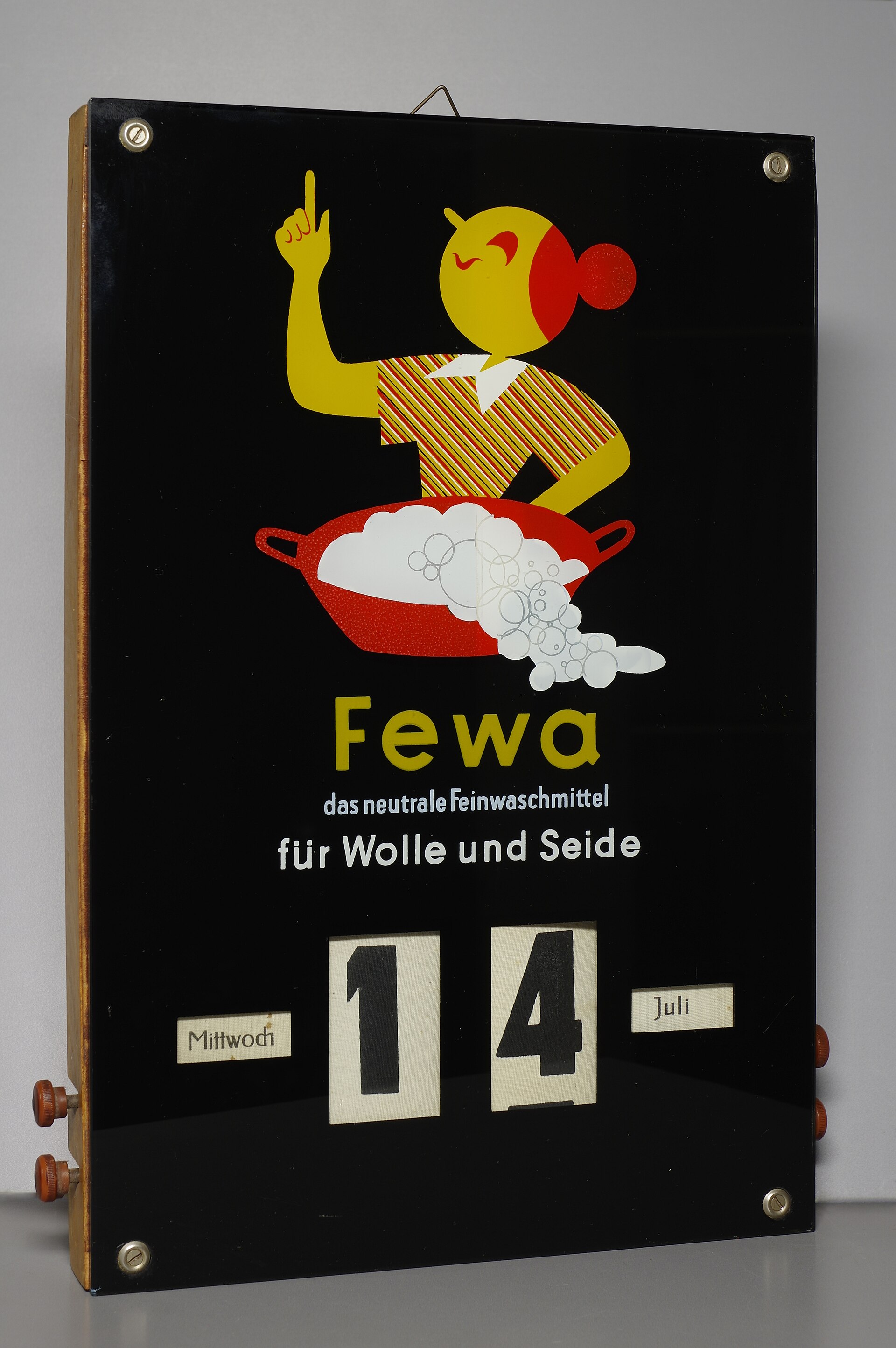
An adjustable wall calendar, probably 1950s, carrying an advert for a wool-and-silk detergent. Somebody had to turn it by hand every single day. In the habit study the median was 66 days, the range ran from 18 to 254 — and forgetting to turn it once did no measurable harm.Source: Berthold Werner — CC BY-SA 4.0, Wikimedia Commons
The slot that is already occupied
There is one more barrier few people name, because naming it means giving something up: the hour you meant to study in already has somebody sitting in it. An hour is an hour. Until you can say what you are dropping, you do not actually have an hour.
And in fairness: some people genuinely have no slack — shift work, small children, someone ill at home. For them the barrier really is time, and telling them to want it more is an insult. What is left for them is very small gaps, and the real consolation is that small gaps still add up.
The only thing to decide today
Put together, the prescription is suspiciously short. Pick a language and stop comparing. Write one sentence with a time, a place and a first action in it. Set the dose so small that doing it needs no deliberation. And accept in advance that you will miss days, and that after a missed day you carry on rather than starting the count again.
What is stopping you is not a flaw somewhere inside you. It is a decision nobody has made yet: tomorrow, at what time, sitting where. Answer those three and everything else finally gets its chance to begin.
Read the simple version
The same article, told in plain words — for younger readers, or for anyone who wants the point quickly.
Everybody can recite the list: no time, no talent, too old, bad memory. But those are answers to the question of why you have not started, not the reasons why. The real ones are duller — and easier to shift.
Start with wanting. Webb and Sheeran collected the experiments that really did change what people intended to do, then checked whether the doing followed. Intentions moved a lot. Behaviour moved about half as much. So wanting is not the thing you are missing. You already have that.
Which means all those articles designed to fire you up are pouring water into a barrel that is already full. The empty barrel is one step further on: the step from wanting to doing.
Something does fill that step, and it has been measured. Gollwitzer and Sheeran gathered 94 separate tests of one tiny thing: getting people to write a sentence shaped like when X happens, I will do Y. The effect on actually reaching the goal was medium-to-large. Almost nothing that cheap shows up that clearly.
Why it works is not mysterious. That sentence takes the decision away from your willpower and hands it to a signal outside you. You no longer decide every day. The situation decides.
For a language, the sentence has to be boringly exact. Not I am going to learn Chinese, but after I pour my morning coffee I open the app and do fifteen minutes at the kitchen table. A time, a place, a first move.
Now the barrier everyone assumes is real: choosing a method. It feels obvious that too many options freeze people. But Scheibehenne and colleagues pooled 50 experiments with more than five thousand people, and the average effect came out at about zero. The freezing story is not as solid as people think.
That does not make choosing harmless. It costs you in a plainer way: time spent comparing courses is time not spent learning. A first week spent reading ten app comparisons is exactly a first week in which you learned nothing.
So, plainly: almost any serious method works if you use it regularly. What matters is not choosing right. It is being finished choosing.
The third barrier is a number that gets misread. The US State Department's language school reckons roughly 600 to 750 class hours for French, and about 2,200 for Chinese or Japanese. People see that, divide it by the time they have, and decide it is hopeless. But that number describes the level at which you can work in the language. It says nothing about tomorrow. Nobody starts by finishing — the only thing you are deciding right now is the next twenty minutes.
Then there is the twenty-one-days idea. It was invented; no study supports it. Lally and colleagues followed real people for twelve weeks. The median time for something to become automatic was 66 days, and the range ran from 18 to 254 days. You cannot know in advance where you will fall in that range.
Their best finding is elsewhere, though: missing one day did not damage the curve. What defeats beginners is not a day off. It is the all-or-nothing rule they set for themselves and then lose to.
And one more barrier people avoid naming, because naming it costs something: the hour you planned to study in already has something sitting in it. An hour is an hour. Until you can say what you are dropping, you do not really have one.
To be fair, some people genuinely have no spare hour at all — shift work, small children, someone ill at home. For them the barrier really is time, and telling them to want it more is rude. What is left is very small gaps, and the honest consolation is that small gaps still add up.
So the whole prescription is suspiciously short. Choose a language and stop comparing. Write one sentence containing a time, a place and a first action. Make the dose small enough that doing it needs no thinking. Expect to miss days, and when you do, carry on the next day instead of starting the count again.
What is stopping you is not something broken inside you. It is a decision nobody has made yet: tomorrow, at what time, sitting where.
Sources & further reading
These articles summarize well-established research in learning science and linguistics. Key sources and further reading:
Webb, T. L., & Sheeran, P. (2006). Does changing behavioral intentions engender behavior change? A meta-analysis of the experimental evidence. Psychological Bulletin, 132(2), 249–268.
Gollwitzer, P. M., & Sheeran, P. (2006). Implementation Intentions and Goal Achievement: A Meta-Analysis of Effects and Processes. Advances in Experimental Social Psychology, 38, 69–119.
Iyengar, S. S., & Lepper, M. R. (2000). When choice is demotivating: can one desire too much of a good thing? Journal of Personality and Social Psychology, 79(6), 995–1006.
Scheibehenne, B., Greifeneder, R., & Todd, P. M. (2010). Can There Ever Be Too Many Options? A Meta-Analytic Review of Choice Overload. Journal of Consumer Research, 37(3), 409–425.
Lally, P., van Jaarsveld, C. H. M., Potts, H. W. W., & Wardle, J. (2010). How are habits formed: Modelling habit formation in the real world. European Journal of Social Psychology, 40(6), 998–1009.
Locke, E. A., & Latham, G. P. (2002). Building a practically useful theory of goal setting and task motivation: A 35-year odyssey. American Psychologist, 57(9), 705–717.
Foreign Service Institute, School of Language Studies. Foreign Language Training. U.S. Department of State.