Measured across 8,853 learners, being outgoing does relate to success — weakly, and behind curiosity. What it buys is the number of times you open your mouth, and that only pays when somebody corrects you.
There is a belief in staffrooms that almost nobody argues with: the child who talks a lot will get to the language faster than the child who sits quietly. The belief is half right. The other half is wrong, and it is the wrong half that keeps talkative learners standing still at a low level for decades.
Measured, the number is smaller than expected
A 2021 synthesis pooled 31 studies spanning forty years, from 24 countries, covering 8,853 learners, to see how the five broad personality traits relate to success in a second language. Extraversion — the trait closest to being talkative — does relate to it, but weakly: it accounts for something like one and a half per cent of the differences between learners.
And it is not the leading trait. That is openness to experience — curiosity, appetite for the unfamiliar, tolerance for not yet understanding — which accounts for nearly four times as much of the spread as extraversion does. Conscientiousness comes second: doing enough, and doing it regularly. The portrait the data points at is not the talkative student. It is the curious one, and the one who sits down.
So what does being talkative actually do
Dewaele and Furnham went back through 33 studies that included extraversion and found a tidy pattern: on anything measured in writing, no systematic relationship at all; on anything measured in speech, the relationship shows up clearly. In other words, extraversion is not an advantage in learning. It is an advantage in speaking.
Giovanni Boldini, Conversation at the Café. This is the unit the advantage is actually counted in: one table, one exchange, one afternoon. The talkative learner does not do this better than anyone else. They do it more often.Source: Giovanni Boldini — Public domain, Wikimedia Commons
More concretely: under time pressure and under the pressure of a person sitting opposite, extraverts produce more, pause less, and reach a word faster. Which is precisely the situation in which language learners seize up.
Three things a quick tongue really does buy
The first is the count. The field has a name for it — willingness to communicate — and the striking thing is that it predicts how often somebody speaks, not how well. But counts compound.
The second is feedback. Every time you open your mouth, somebody may answer strangely, misunderstand you, or repair what you said. Silence returns no data.
The third is the pressure to produce. Swain pointed out that comprehension can be managed on meaning alone, while saying something forces you to build the syntax. She drew that from French immersion classrooms in Canada, where children understood beautifully and still produced badly. The grammar you do not have sits there undisturbed until you have to speak it — undetected by anyone, yourself included.
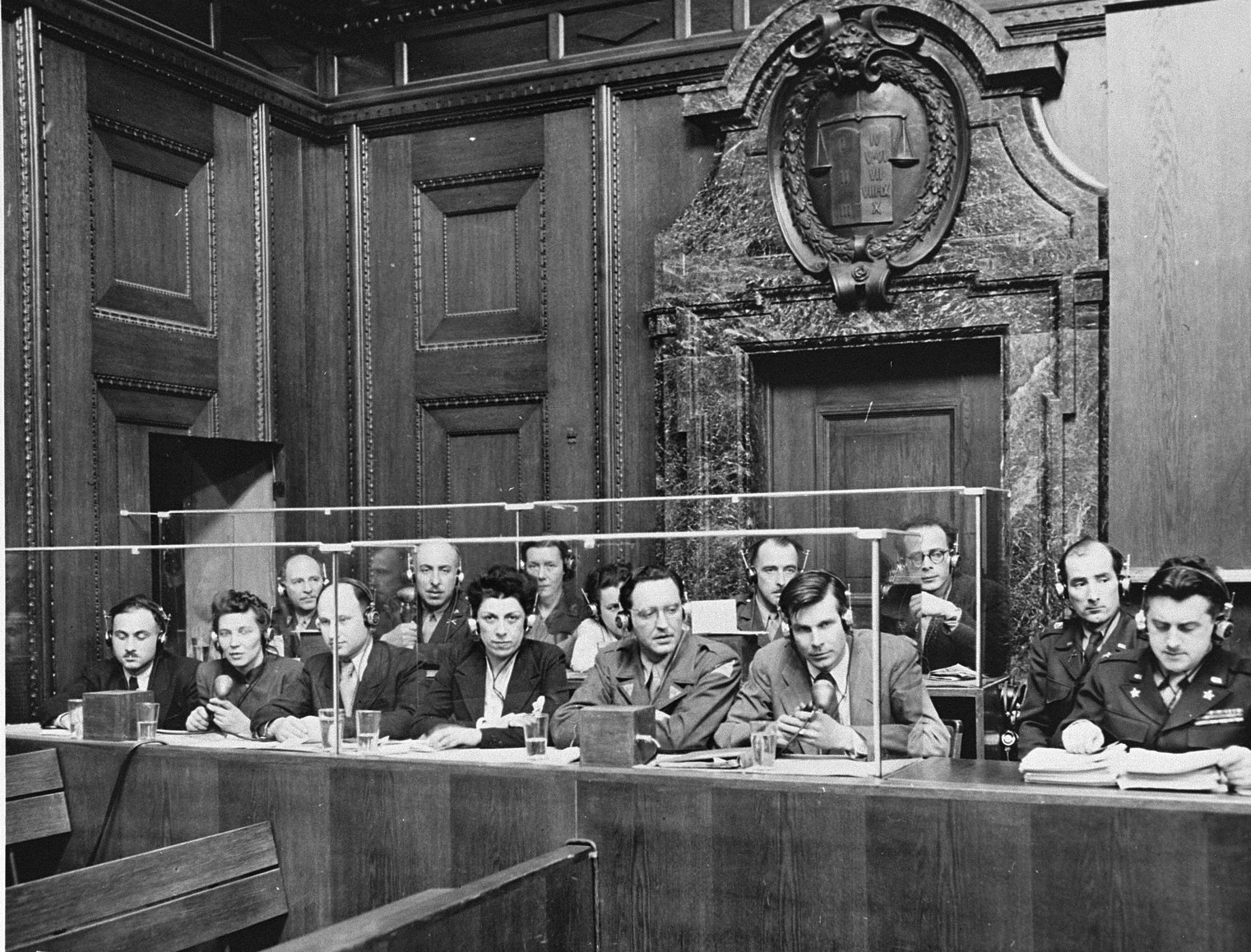
The interpreters at the Nuremberg trials, behind a glass screen with headphones and microphones. This is production under the heaviest time pressure a language can be put under. Understanding is not enough here: the syntax has to be built and spoken in the same breath.Source: Raymond D'Addario — Public domain, Wikimedia Commons
And the price attached
The price sits inside the advantage. In 1982 Busch tested 80 junior college students and 105 adult learners of English in Japan with a standardised test and a personality inventory, plus 45 oral interviews rated by two judges independently. The hypothesis on trial was that extraverts would be more proficient because they exploit the rare chances to speak with native speakers. The result rejected it.
Look closely and the reason is easy to see. What a talkative person is good at is getting the message through. And once the message is through, nothing pressures you to be exact any more. Fluent-and-wrong is an extremely stable state. It can hold for twenty years.
There is one more thing few people notice: talkative learners are rated above what they are. When Bosker and colleagues separated out what makes listeners hear somebody as fluent, the deciding factors were the number of pauses, their length, and speech rate — while self-corrections contributed almost nothing. The impression of fluency is built out of exactly what a talkative person already has, independently of whether they are right.
What the quiet learner loses, and does not lose
The quiet learner loses the count, not the capacity. No data says quiet people learn worse: where things are measured in writing, extraversion does not show up at all, and Busch's study found no advantage for either side.
Besides, one of the strongest predictors of learning new words has nothing to do with the mouth: phonological short-term memory, the ability to hold an unfamiliar string of sounds in your head long enough to repeat it. Baddeley, Gathercole and Papagno put it at the centre of vocabulary learning, and a quiet person can have a great deal of it.
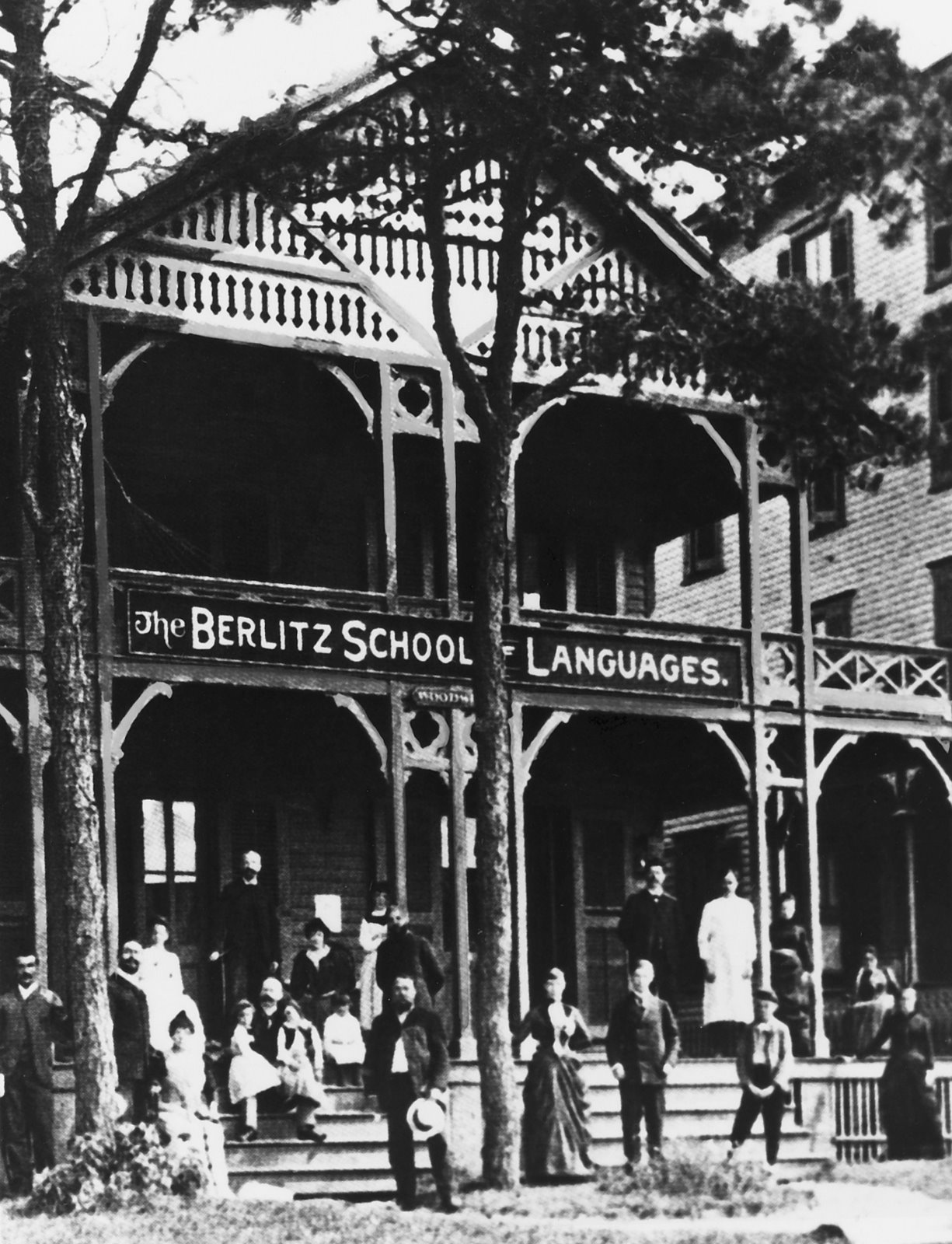
The first Berlitz school, Providence, Rhode Island, 1878. Berlitz threw the mother tongue out of the room and filled the hour with nothing but talking. It was the first business built on selling the talkative person’s advantage to everybody else.Source: http://www.berlitz.si/sl/o_podjetju/jezikovne/ — Public domain, Wikimedia Commons
Turning the advantage into proficiency
If you are talkative by nature, do not throw that away — bolt a correction loop onto it. One rule is enough: after every conversation, write down two things you wanted to say and could not. That turns fluency into a list of gaps, which is the only form the thing can be repaired in.
And recruit one person as your marker. Tell them plainly: correct me even where you understood me. If you do not ask, nobody will — for the simple reason that you made yourself understood.
How the quiet learner buys the same thing
The talkative person's advantage is a count, and counts can be bought. Set a quota of exchanges per week. Written chat counts, because writing is production too and forces the same syntax, at a much lower cost in nerve. Talking aloud to yourself counts. Recording yourself and listening back replaces part of what a corrector does.
In the end, being talkative is a running start on the first day, not an advantage on the last. It shortens the distance to your first conversation and lengthens the distance to your last mistake. What it buys is repetitions. What teaches you is what you do with them.
Read the simple version
The same article, told in plain words — for younger readers, or for anyone who wants the point quickly.
Teachers tend to believe the chatty child will learn a language faster than the quiet one. Half of that is true. The other half costs the chatty child years.
In 2021 researchers pooled 31 studies from 24 countries, covering 8,853 learners over forty years, and asked how personality relates to success in a second language. Being outgoing did relate to it — but only weakly. It accounted for about one and a half per cent of the differences between learners.
It was not even the strongest trait. That was openness: curiosity, a liking for unfamiliar things, the ability to sit with not understanding yet. Openness accounted for nearly four times as much. Next came conscientiousness — doing enough, and doing it regularly. The picture the numbers paint is not the talkative student. It is the curious one who also sits down and works.
So what does talking a lot actually do? Dewaele and Furnham looked back through 33 studies. Wherever the thing being measured was written, extraversion showed no consistent relationship at all. Wherever it was spoken, the relationship appeared. Extraversion is not an advantage in learning. It is an advantage in speaking.
Under time pressure, with a person sitting opposite, outgoing speakers say more, pause less, and find a word faster. That is exactly the moment when language learners freeze.
Three things a quick tongue genuinely buys. The first is the number of times you speak. Researchers call the thing underneath it willingness to communicate, and the point is that it predicts how often you speak, not how well. But numbers add up.
The second is feedback. Every time you speak, somebody might answer oddly, misunderstand you, or fix what you said. Silence gives you nothing back.
The third is being forced to produce. Swain noticed that you can understand a sentence from meaning alone, but to say one you have to build the grammar. She saw it in French immersion schools in Canada: the children understood beautifully and still spoke badly. Grammar you do not have stays hidden until you have to use it.
Now the price, which is hidden inside the benefit. In 1982 Busch tested 80 college students and 105 adults learning English in Japan, with a written test, a personality questionnaire, and 45 spoken interviews scored by two separate judges. The idea being tested was that extraverts would be better because they grab the rare chances to talk. The result said no.
The reason is not mysterious. What a talkative person is good at is getting the message across. Once the message gets across, nothing pushes you to be correct. Being fluent and wrong is a very stable place to be. People stay there for twenty years.
There is a second, quieter problem: talkative learners get marked too high. Bosker and colleagues took apart what makes a listener judge somebody fluent. It came down to how often the speaker paused, how long the pauses were, and how fast they spoke; self-corrections barely mattered. So the impression of fluency is built out of exactly what a talkative person already has, whether or not what they say is right.
What does the quiet learner lose? The count, not the ability. Nothing in the data says quiet people learn worse. On written measures extraversion does not show up at all, and Busch's study found no advantage on either side. And one of the strongest predictors of learning new words has nothing to do with the mouth: it is being able to hold an unfamiliar string of sounds in your head long enough to repeat it. A very quiet person can be excellent at that.
If you are the talkative one, keep the talking and bolt on a repair loop. After each conversation, write down two things you wanted to say and could not. That turns fluency into a list of holes, and a list of holes can be filled. Then ask one person to be your corrector, and say it out loud: correct me even when you understood me. Otherwise nobody will, because you made yourself understood.
If you are the quiet one, remember that the advantage is a number, and numbers can be bought. Set a quota of exchanges per week. Typed chat counts, because writing forces the same grammar and costs far less nerve. Talking aloud to yourself counts. Recording yourself and listening back does part of a corrector's job.
Being talkative is a running start on day one, not an advantage on the last day. It shortens the distance to your first conversation and lengthens the distance to your last mistake. It buys you repetitions. What teaches you is what you do with them.
Sources & further reading
These articles summarize well-established research in learning science and linguistics. Key sources and further reading:
Chen, X., He, J., Swanson, E., Cai, Z., & Fan, X. (2022). Big Five Personality Traits and Second Language Learning: a Meta-analysis of 40 Years' Research. Educational Psychology Review, 34(2), 851–887.
Dewaele, J.-M., & Furnham, A. (1999). Extraversion: The Unloved Variable in Applied Linguistic Research. Language Learning, 49(3), 509–544.
Dewaele, J.-M., & Furnham, A. (2000). Personality and speech production: a pilot study of second language learners. Personality and Individual Differences, 28(2), 355–365.
Busch, D. (1982). Introversion-Extraversion and the EFL Proficiency of Japanese Students. Language Learning, 32(1), 109–132.
MacIntyre, P. D., Dörnyei, Z., Clément, R., & Noels, K. A. (1998). Conceptualizing Willingness to Communicate in a L2: A Situational Model of L2 Confidence and Affiliation. The Modern Language Journal, 82(4), 545–562.
Swain, M. (1985). Communicative competence: some roles of comprehensible input and comprehensible output in its development. In S. Gass & C. Madden (Eds.), Input in Second Language Acquisition (pp. 235–253). Rowley, MA: Newbury House.
Bosker, H. R., Pinget, A.-F., Quené, H., Sanders, T., & de Jong, N. H. (2013). What makes speech sound fluent? The contributions of pauses, speed and repairs. Language Testing, 30(2), 159–175.
Baddeley, A., Gathercole, S., & Papagno, C. (1998). The phonological loop as a language learning device. Psychological Review, 105(1), 158–173.