In the brain, learning a language happens on four timescales
Not one event but four, running on clocks a billion-fold apart: a wave at 400 milliseconds, a word locked in overnight, activation shrinking over months, structure shifting over years.
Not one event but four, running on clocks a billion-fold apart: a wave at 400 milliseconds, a word locked in overnight, activation shrinking over months, structure shifting over years.
This question can be answered precisely, but the answer is not where people usually look for it. There is no one thing that happens in the brain when you learn a language. There are four kinds of thing, running on four timescales that differ from one another by a factor of a billion: thousandths of a second, one night, a few months, a few years. Mixing those four together is where most of what we read about the brain goes wrong.
Functional MRI does not see neurons. It measures blood flow, each voxel lumping together several hundred thousand to a few million neurons, and the signal only peaks several seconds after the event is over. EEG is the opposite: it catches every millisecond and can barely tell you where the signal came from.
So no machine sees learning. Each one sees a shadow of it at a different scale. Which gives the word precisely a very concrete meaning here: at each scale, what has been measured over and over, and what rests on a single study.
When a word arrives, two landmarks turn up reliably on the EEG. Around 400 milliseconds after the word, a wave called the N400 appears, and it grows when the meaning does not fit where the word is standing. Around 600 milliseconds, another wave called the P600 grows when the structure of the sentence is wrong. Two different jobs, and they separate cleanly.
Here is the part that matters to a learner. McLaughlin, Osterhout and Kim followed adults who had just started French. After a mere fourteen hours of classroom instruction, their brains told real French words from invented ones by the N400 — while the same people, asked outright which words were real, answered at chance.
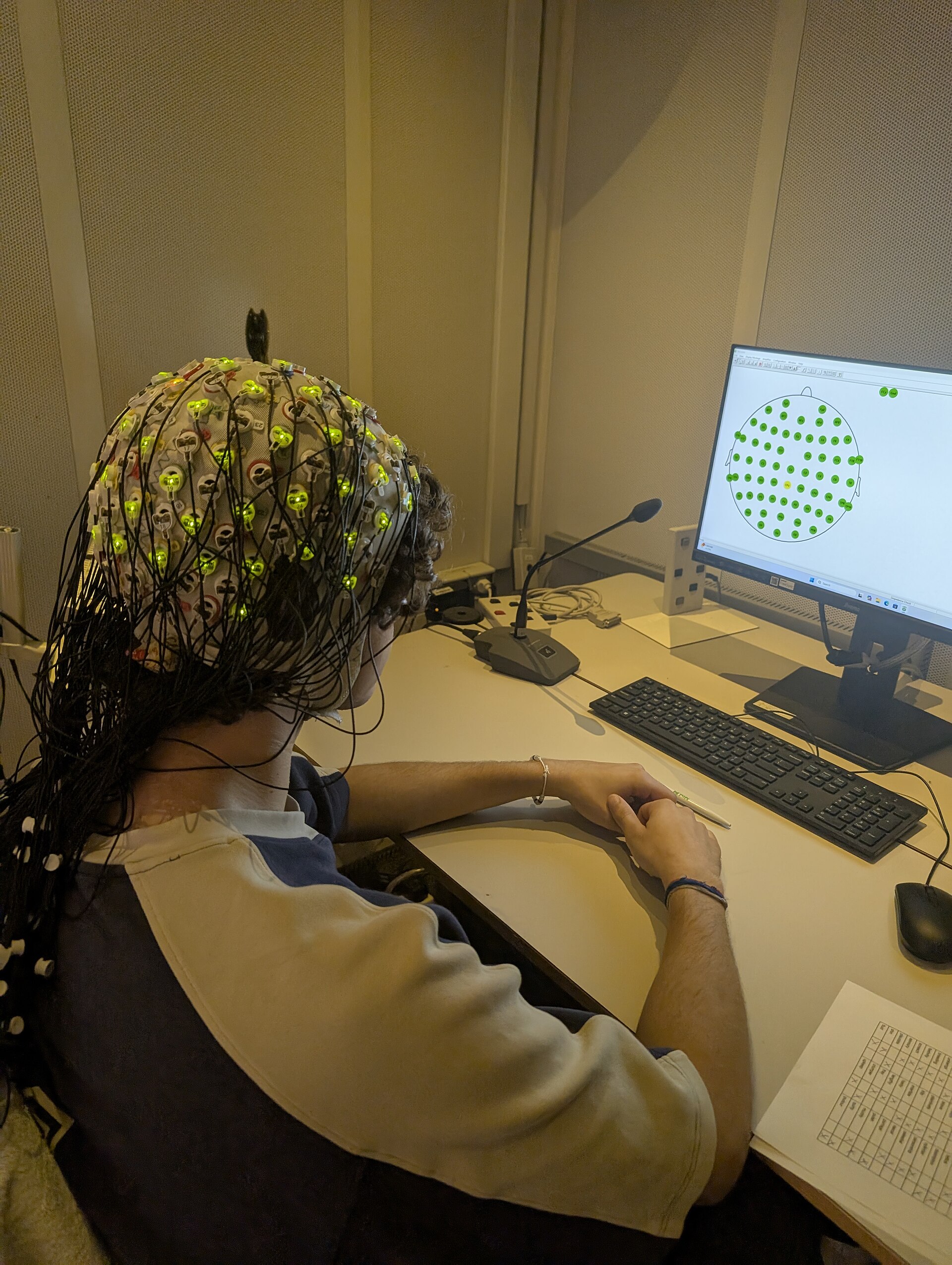
That is not magic; it is a warning about measurement. Behavioural tests have a floor. The feeling that nothing is going in during the first few weeks often only means that what went in is not yet strong enough to show up in a conscious answer.
A new word is held at first by the hippocampus as an episode, stuck to the chair you sat in and the page you were looking at. To become an entry in your vocabulary it has to be taken into the cortical network. There is an unusually clean experiment on exactly this.
Dumay and Gaskell taught people invented words. The sign that a word has genuinely gone in is that it starts competing with existing words that sound close to it. The group who learned at eight in the evening: no competition straight afterwards, but twelve hours later — with a night's sleep in between — yes. The group who learned at eight in the morning: after twelve waking hours, still nothing; only at twenty-four hours, once they had slept, did it appear.
To say it precisely: it was not the passage of time that did this. Sleep did. It is one of very few places in learning science where the mechanism and the advice land on exactly the same spot.
On the scale of months, what changes is how much of the brain has to get involved. Pool the imaging studies and the picture is fairly consistent: a second language uses very nearly the network of the first, with no private district issued to it.
The difference is one of quantity. Beginners, and people who started late, activate more widely — especially in regions that handle control, the part that has to strain to hold the right language open. As proficiency rises, the activation shrinks back towards the shape of the first language. Which means getting better makes the brain work less, not more, the exact opposite of the blazing-brain picture the press likes.
On the same scale there is a second shift. A rule sits at first in declarative memory — the kind you can recall and explain. Used often enough, it moves across into the procedural system, where riding a bicycle is kept. That is why people who know the rule still get it wrong while speaking: it has not yet arrived where it is needed.
Only at the scale of years does structure become measurable. Mechelli and colleagues found grey-matter density in the left inferior parietal cortex higher in bilinguals, higher with proficiency and lower the later the language was started.
But that is a single snapshot, so it cannot separate cause from effect: learning may change the brain, or that kind of brain may make learning easier. What answers the question is following people over time. Schlegel and colleagues scanned monthly through a nine-month intensive Chinese course, and found the white matter joining the language regions changing across exactly that period.
The most repeated brain claim is the weakest one: that knowing two languages improves executive function. Lehtonen and colleagues pooled 891 effect sizes from 152 studies of adults. Before correcting for publication bias there was a very small advantage; after correcting, nothing was left. On naming words, bilinguals came out slightly worse.
None of that erases the three scales above. It separates two claims that get run together: whether learning a language changes how the brain handles language has been measured many times over; whether it changes the mind in general has not held up.
Put together, they give an unromantic but accurate piece of advice: do not measure yourself by the day. On day one, what changed shows up only on a machine that counts milliseconds. Something is locked in every night, but only if you sleep. Months change how much work a sentence costs your brain. Structure changes over years. The four scales run in parallel, and the only one of them you hold in your hand is how often you feed them something to work on.
The same article, told in plain words — for younger readers, or for anyone who wants the point quickly.
Here is a question with a precise answer — but the answer is not one thing. When you learn a language, four different kinds of change happen in your brain, and they run on clocks that are wildly far apart: thousandths of a second, one night, a few months, a few years.
Before any of that, an honest note about the machines. An fMRI scanner does not see brain cells. It measures blood flow, each little cube it measures holds hundreds of thousands of cells, and the signal arrives seconds late. An EEG is the opposite: it catches every thousandth of a second but can hardly say where in the head the signal came from. No machine watches you learn. Each one catches a shadow of it.
Thousandths of a second. When a word reaches you, two bumps show up on the EEG almost every time. About 400 milliseconds later comes a wave called the N400, which gets bigger when the meaning does not fit. About 600 milliseconds later comes another, the P600, which gets bigger when the sentence is built wrongly. Meaning and grammar: two jobs, separating cleanly.
Here is the part that should cheer you up. McLaughlin, Osterhout and Kim followed adults who had just started French. After only fourteen hours of class, their brains were already telling real French words from made-up ones by the N400. Yet when those same people were asked straight out which words were real, they did no better than guessing.
That is not magic. It is a fact about tests: a test can be too blunt to see something small. The feeling that nothing is going in during the first weeks often just means that what went in is not strong enough yet to reach a conscious answer.
One night. A new word is held at first by the hippocampus like the memory of an event — attached to the chair you sat in and the page you were looking at. To become a proper entry in your vocabulary it has to move into the wider network of the cortex. There is a beautifully clean experiment about exactly this.
Dumay and Gaskell taught people invented words. The test of whether a word has really gone in is whether it starts competing with real words that sound similar. People who learned in the evening showed no competition straight away, but did twelve hours later, after a night's sleep. People who learned in the morning showed nothing after twelve waking hours, and only showed it at twenty-four hours, once they had slept.
So it was not time that did the work. It was sleep. This is one of very few places in learning science where the mechanism and the practical advice turn out to be the same thing.
A few months. On this scale, what changes is how much of your brain has to help. Put the scanning studies together and they broadly agree: your second language uses almost exactly the same network as your first. There is no separate room for it.
The difference is how much switches on. Beginners, and people who started late, use a wider area — especially the parts that do control work, holding the right language open. As you get better, the area shrinks back towards the shape your first language makes. So getting better means your brain does less work, not more. That is the opposite of the glowing-brain picture in the newspapers.
Something else moves on this scale too. A rule starts out in the memory you can talk about: you can recall it and explain it. Use it enough and it shifts across into the system that holds riding a bicycle. That is why someone who knows a rule perfectly still breaks it while speaking — it has not arrived where it is needed yet.
A few years. Only now does the physical structure change enough to measure. Mechelli and colleagues found a region low on the left side of the brain to be denser in bilinguals: denser the more skilled they were, and less dense the later they had started.
But that was one photograph, taken once. It cannot tell you which way round it goes — maybe learning changed the brain, or maybe that kind of brain made learning easier. To answer that you have to follow the same people over time. Schlegel and colleagues scanned learners every month through a nine-month intensive Chinese course, and saw the wiring between language regions change across exactly those months.
Now the claim to be careful with, because it is the one you have heard most: that speaking two languages makes you better at controlling your attention in general. Lehtonen and colleagues gathered 891 results from 152 studies of adults. Before correcting for the fact that surprising results get published more often, there was a tiny advantage. After correcting, there was none. At naming words, bilinguals came out slightly worse.
That does not undo the rest. It separates two different claims: that learning a language changes how your brain handles language has been measured over and over; that it upgrades your mind in general has not held up.
What all this means for you is unglamorous but true. Do not judge yourself by the day. On day one, the change shows up only on a machine that counts milliseconds. Every night something gets locked in — but only if you sleep. Over months, the same sentence starts costing your brain less. Over years, the structure itself shifts. The four clocks run side by side, and the only one you hold is how often you give them something to work on.
These articles summarize well-established research in learning science and linguistics. Key sources and further reading:
The question assumes focus is a muscle you train. The strongest evidence says the training barely carries over, and the...
No time, no talent, too old — those are explanations, not causes. What can be measured is duller: one sentence with a ti...
Measured across 8,853 learners, being outgoing does relate to success — weakly, and behind curiosity. What it buys is th...


