Why AI and Language Teachers Each Have Their Own Beauty, According to the Science of Learning
App or teacher, AI or human? The science of learning dissolves the rivalry. Learning is half cognition and half heart — AI is beautiful at the tireless, personalised practice; the teacher is beautiful at connection, communication, and meaning. You need both.
We are often asked to choose. Is it better to learn a language from an app or from a teacher — from artificial intelligence or from a human being? The question sets up a rivalry that the science of learning quietly dissolves. Learning a language is at once a cognitive task and a deeply human, social one, and it turns out that AI and the language teacher are each beautiful at a different half of it. Neither replaces the other; each does something the other simply cannot.
Learning has two halves
Acquiring a language is partly a matter of cognition — memory, practice, feedback, and a great flood of input — and partly a matter of the heart — motivation, connection, communication, and meaning. Any honest account of how we learn has to hold both. And these two halves, as it happens, play to two very different sets of strengths.
The beauty of AI: the tireless, personal coach
Infinite patience. An AI never tires, never sighs, never judges. It will repeat the same explanation a hundred times, at any hour, at whatever pace you need. That patience is not just kind; it is effective, because it lowers the anxiety and fear of embarrassment that quietly block learning — a calm learner takes in more than a frightened one.
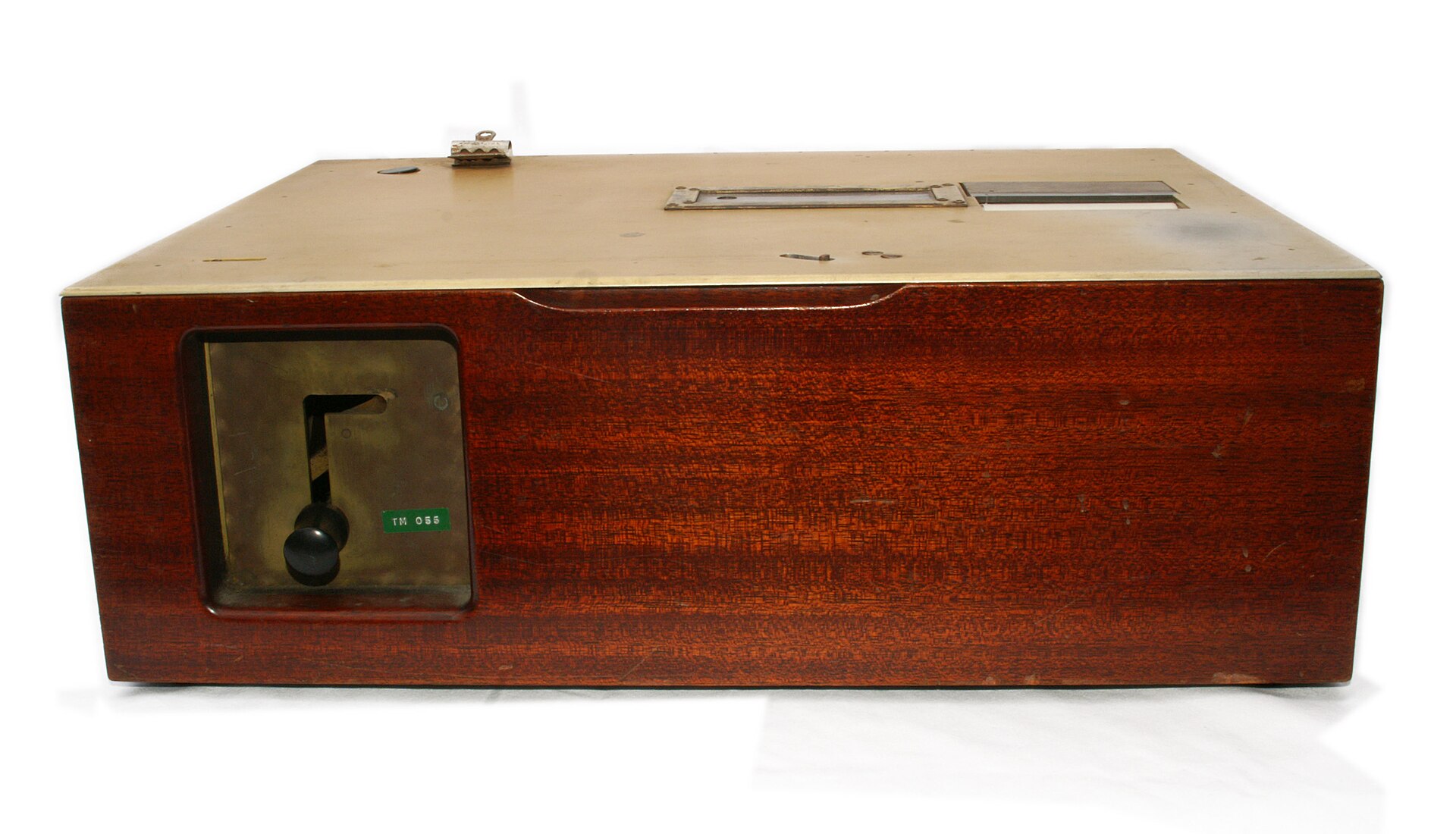
Infinite patience is not new. This machine had it too — it never tired, never sighed, never judged. What it could not do is notice that a learner had stopped caring, and that is still the part of the job that has not been automated.Source: Silly rabbit — CC BY 3.0, Wikimedia Commons
Perfect practice, tuned to you. This is where AI shines brightest. It can time your spaced reviews precisely, track exactly what you are forgetting, generate endless examples, and answer the instant you ask. In other words, it can deliver the spacing, the retrieval practice, and the immediate feedback that memory research prizes most — personalised to you alone, in unlimited supply.
Practice for everyone. Being tireless and nearly free, AI can put rich, responsive practice into the hands of a learner anywhere — a village as easily as a city. There is a quiet fairness in that. In short, AI is beautiful at the reps: the patient, precise, personalised practice that a language demands in enormous quantity, and that no human could ever supply around the clock.
The beauty of the teacher: the guide who makes it matter
Real communication. Language is social to its very core, and a human is a true partner in it — reading your intent, negotiating meaning when you stumble, responding in ways you cannot predict, and giving you a genuine reason to speak. This authentic, unscripted interaction is exactly the soil in which language acquisition thrives, and it cannot be faked.
Attunement. A good teacher senses what a screen cannot: your confusion, your boredom, the flicker of fear before you try. They adjust not only to your level but to your mood, your personality, your culture — knowing, in a way no metric captures, when to push you and when to simply reassure you.
Culture and lived wisdom. A teacher carries the humour, the stories, the what a native would actually say, the register and the unwritten rules that no textbook holds — the living texture of a language, passed from one human to another.
Motivation and meaning. Perhaps the deepest gift of all. A teacher who believes in you, whose encouragement carries real emotional weight, can make you fall in love with a language and give the whole long effort a direction. Motivation is one of the most powerful forces in all of language learning — and it is kindled, more than anywhere else, human to human. In short, the teacher is beautiful at the heart: connection, communication, and meaning, which no algorithm can counterfeit.
Why the science says you need both
Set side by side, the two are not competitors but complements. The research on memory says learning needs well-timed, effortful, repeated practice — and there AI is extraordinary. The research on motivation, on anxiety, and on interaction says learning also needs relationship, real communication, and a reason to care — and there the human is irreplaceable. To ask which one you need is a little like asking a runner whether they need legs or lungs.
The beautiful future: not rivalry, but a division of labour
The most hopeful possibility is not AI replacing teachers but AI freeing them. Let the machine carry the tireless work it does so well — the spaced review, the endless examples, the instant correction — so that the human teacher is released to do what only a human can: inspire, connect, converse, and give the learning meaning. The patient coach and the human guide, each doing precisely what it was made for.
The takeaway
So we do not have to choose. The app that never sleeps and the teacher who truly sees you are not rivals but two kinds of beauty, each suited to a different part of how we learn. Give a learner both — the tireless precision of the machine and the irreplaceable warmth of a human being — and you give them the whole of what the science of learning quietly asks for.
Read the simple version
The same article, told in plain words — for younger readers, or for anyone who wants the point quickly.
Which do you need — the app that never sleeps, or the teacher who truly sees you?
The question is a little like asking a runner whether they need legs or lungs.
What the machine is beautiful at
It never runs out of patience. An AI never tires, never sighs, never judges. It will give you the same explanation a hundred times, at any hour, at whatever pace you need.
That patience is not only kind — it works, because it lowers the fear of looking foolish, and a calm learner takes in more than a frightened one.
It is superb at the repetitions. It can time your reviews precisely, track exactly what you are forgetting, make endless examples, and answer the instant you ask. Spacing, testing, immediate feedback — the three things memory research values most — in unlimited supply, shaped to you alone.
And it reaches everyone. Being tireless and nearly free, it can put good practice into the hands of a learner in a village as easily as in a city. There is a quiet fairness in that.
What the teacher is beautiful at
Real communication. Language is social to its core. A person reads what you meant, works out your meaning when you stumble, answers in ways you cannot predict, and gives you an actual reason to speak. That cannot be faked.
Noticing. A good teacher senses what a screen cannot: your confusion, your boredom, the flicker of fear just before you try. They adjust not only to your level but to your mood — knowing when to push you and when to simply reassure you.
The living texture. The humour, the stories, what a person would actually say, the unwritten rules no textbook holds.
And meaning. Perhaps the deepest one. A teacher who believes in you, whose encouragement carries real weight, can make you fall in love with a language and give the whole long effort a direction.
Why you need both
Set side by side, they are not rivals. They answer different halves of the same science.
Memory research says learning needs well-timed, effortful, repeated practice. There the machine is extraordinary.
Research on motivation and on real conversation says learning also needs relationship, and a reason to care. There the human cannot be replaced.
The hopeful version of the future
Not AI replacing teachers, but AI freeing them.
Let the machine carry the tireless work it does so well — the spaced review, the endless examples, the instant correction — so the teacher is released to do what only a person can: to converse, to notice, to encourage, and to make the whole thing matter.
So we do not have to choose. Give a learner both — the tireless precision of the machine and the warmth of a human being — and you have given them everything the science quietly asks for.
Sources & further reading
These articles summarize well-established research in learning science and linguistics. Key sources and further reading:
Krashen, S. D. (1982). Principles and Practice in Second Language Acquisition. Pergamon.
Long, M. H. (1996). The role of the linguistic environment in second language acquisition. In Handbook of Second Language Acquisition.
Dörnyei, Z. (2001). Motivational Strategies in the Language Classroom. Cambridge University Press.
Vygotsky, L. S. (1978). Mind in Society: The Development of Higher Psychological Processes. Harvard University Press.
Dunlosky, J., Rawson, K. A., Marsh, E. J., Nathan, M. J., & Willingham, D. T. (2013). Improving students' learning with effective learning techniques. Psychological Science in the Public Interest.