The Beauty of Understanding Linguistics When You Learn a Language
You do not need linguistics to learn a language — but a little understanding of how language works transforms the journey. How it turns an arbitrary pile of rules into an ordered system, explains the hard parts, connects every language, and turns struggle into wonder.
You do not need to study linguistics to learn a language — children prove that every day, without a single technical term. But a little understanding of how languages actually work quietly transforms the journey. It turns a bewildering heap of rules into a system with logic and history; it turns a chore into an exploration; and it turns struggle into something closer to wonder. There is a quiet beauty in learning a language with your eyes open to the science of language itself.
From arbitrary to ordered
This is the first and greatest gift. Without any frame, a new language looks like a random pile of unrelated facts — strange sounds, unpredictable words, rules that seem invented to trip you up. A little linguistics reveals the hidden order beneath the chaos: that sounds follow a system, that words are built from meaningful parts, that grammar runs on patterns, and that even the irregularities usually have reasons buried in the language's past. When you understand why a language behaves as it does, it stops being a list to memorise and becomes a structure to comprehend — and what we comprehend, we remember.
It shows you why the hard things are hard
A grasp of phonetics tells you exactly why a particular sound defeats you — not because your mouth is wrong, but because your native language never trained it. A little contrastive grammar shows you where your first language will lend a hand and where it will quietly mislead you. Instead of being mystified and discouraged by your own mistakes, you begin to diagnose them: ah, this is hard because my language marks time with words, not endings. Understanding the source of a difficulty is the first step to dissolving it.
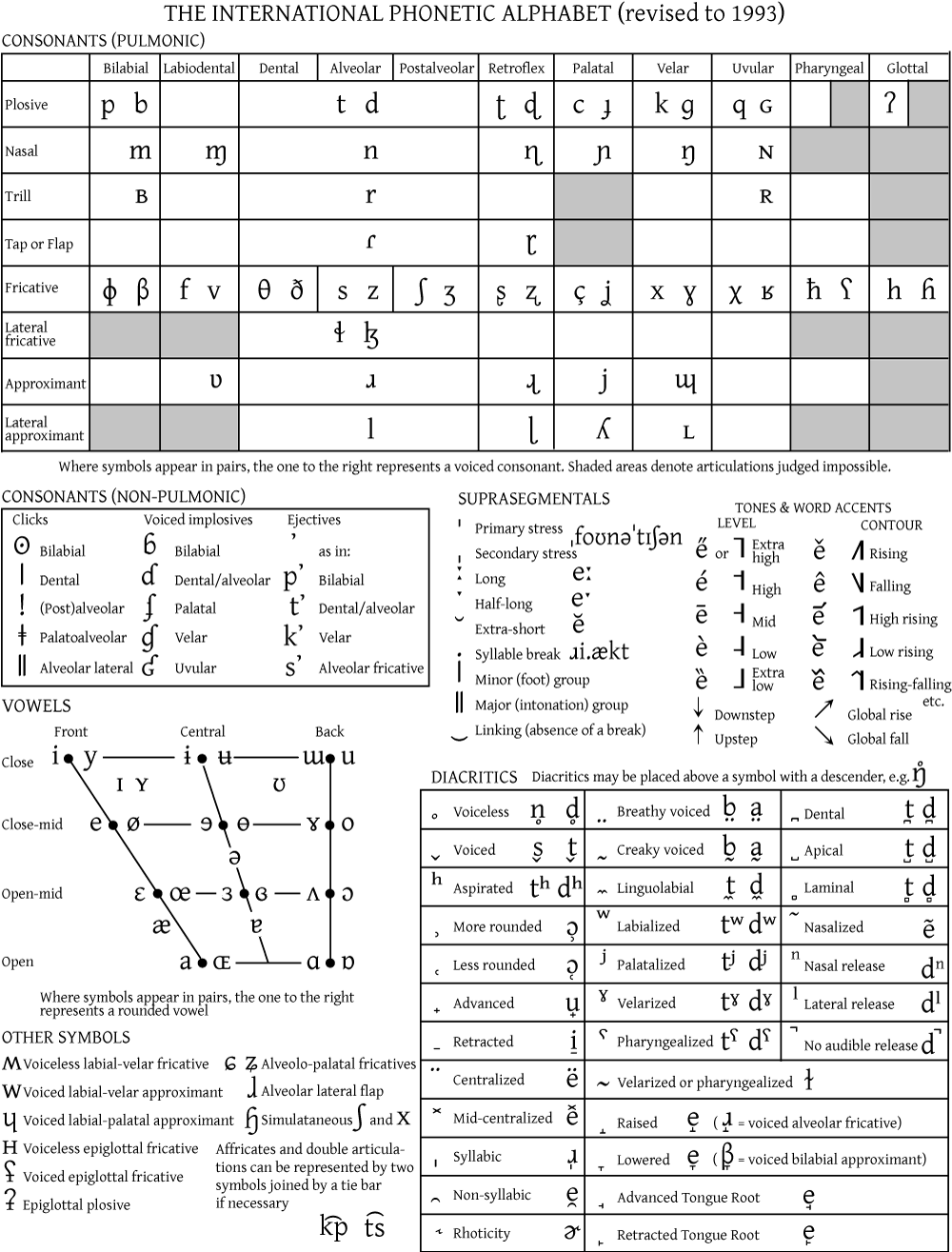
The consonant chart is a map of the mouth: columns are places the tongue touches, rows are what it does there. A sound you cannot make is not a personal failing but a cell you have never had to visit — and the chart tells you which neighbour to start from.Source: Nohat — CC BY-SA 3.0, Wikimedia Commons
It makes vocabulary less arbitrary
Morphology and etymology reveal that words are not random noises but constructions with parts and histories. English words assemble from Latin and Greek roots; Chinese characters build from radicals; and for a Vietnamese speaker, the Hán-Việt layer connects the two worlds. Once you can see the pieces a word is made of — and where it came from — it stops being an isolated sound to cram and becomes something meaningful, connected, and far easier to hold in mind.
It connects every language — including your own
Linguistics reveals the vast web that binds languages together: the families they descend from, the words they have borrowed, the deep patterns that all human languages share. Each language you come to understand illuminates the others — and, remarkably, studying language often lets you understand your own mother tongue clearly for the first time. What you spoke unconsciously all your life suddenly has structure you can see.
It makes you kinder to yourself
Perhaps the gentlest gift. The science of how languages are acquired tells you that your halting, error-filled attempts are not failures but a natural, necessary stage — a whole system of its own on the way to fluency. It tells you that plateaus are real and expected, and that the reason your accent lags behind your grammar is a matter of biology, not effort. Knowing this, you can meet your own struggles with patience instead of shame. The difficulty is the process, not a verdict on you.
The deeper beauty: language as a window
Beyond all the usefulness lies something more. To glimpse linguistics is to see language for the astonishing thing it truly is — arguably the crowning achievement of the human mind, and every single language a different way of carving up the world. Learning a new one stops being merely practical and becomes a window: into another people's way of thinking, and into the deep design that all of humanity's languages share. You are not just acquiring a tool; you are exploring one of the great wonders of being human.
An honest balance
A caution, though, because the gift can be misused. You do not need a linguistics degree, and knowing about language is no substitute for using it — children reach perfect grammar with no theory at all, and over-analysing can quietly become a sophisticated way of avoiding the harder work of speaking. The sweet spot is a little linguistic awareness, applied: enough to see the patterns and choose good methods, never so much that studying language replaces living in it. Linguistics is a lens that enriches the doing — not a stand-in for it.
The takeaway
You can learn a language by brute repetition, eyes down, and it will work. But learn it with a little understanding of how language itself works, and something shifts: the drudgery lifts, the scattered pieces cohere, your mistakes begin to make sense, and a foreign tongue becomes not a wall of arbitrary facts but a beautiful, intelligible system you are slowly coming to know. That is the quiet gift of linguistics. It does not merely help you learn a language — it lets you fall in love with how language works.
Read the simple version
The same article, told in plain words — for younger readers, or for anyone who wants the point quickly.
You can learn a language by brute repetition, eyes down. It works.
But learn it with a little understanding of how language itself works, and something shifts.
Random becomes ordered
With no frame at all, a new language looks like a pile of unrelated facts: strange sounds, unpredictable words, rules that seem designed to trip you.
A little linguistics shows the order underneath. Sounds follow a system. Words are built from meaningful parts. Grammar runs on patterns. Even most of the irregular things have reasons, buried in the language's past.
Once you understand why a language behaves as it does, it stops being a list to memorise and becomes a structure to understand — and what we understand, we remember.
It tells you why the hard things are hard
A little phonetics explains exactly why one sound defeats you: not because your mouth is wrong, but because your first language never trained it.
A little comparing of grammars shows where your own language will lend a hand and where it will quietly mislead you. Instead of being baffled by your own mistakes, you start to diagnose them: ah — this is hard because my language marks time with words, not endings.
Knowing where a difficulty comes from is the first step to dissolving it.
It makes vocabulary less arbitrary
Words are not random noises. They are built things with parts and histories. English words assemble from Latin and Greek roots. Chinese characters build from radicals. And for a Vietnamese speaker, the Hán-Việt layer joins the two worlds together.
Once you can see the pieces, a word stops being an isolated sound to cram.
It hands you your own language back
This is the surprising one. Studying how language works often lets you see your mother tongue clearly for the first time. What you spoke unconsciously your whole life suddenly has a structure you can look at.
It makes you kinder to yourself
Perhaps the gentlest gift.
Your halting, error-filled attempts are not failures. They are a natural stage — a whole working system of its own, on the way to fluency. Plateaus are real and expected. Your accent lags behind your grammar for reasons of biology, not effort.
Knowing that, you can meet your own struggle with patience instead of shame. The difficulty is the process, not a verdict on you.
An honest warning
You do not need a linguistics degree, and knowing about a language is no substitute for using it. Children arrive at perfect grammar with no theory whatsoever.
Worse, over-analysing can quietly become a sophisticated way of avoiding the harder work of opening your mouth. The sweet spot is a little awareness, applied — enough to see the patterns and choose good methods, never so much that studying the language replaces living in it.
Linguistics is a lens that enriches the doing. It is not a stand-in for it.
Sources & further reading
These articles summarize well-established research in learning science and linguistics. Key sources and further reading:
Pinker, S. (1994). The Language Instinct: How the Mind Creates Language. William Morrow.
Crystal, D. (2010). The Cambridge Encyclopedia of Language (3rd ed.). Cambridge University Press.
Deutscher, G. (2010). Through the Language Glass: Why the World Looks Different in Other Languages. Metropolitan Books.
Selinker, L. (1972). Interlanguage. International Review of Applied Linguistics in Language Teaching.
Yule, G. (2016). The Study of Language (6th ed.). Cambridge University Press.