Radicals (部首): The Story, the Science, and How to Remember Them
The radical (部首 / bộ thủ) is the component a character is filed under — its category and its clue. Where the system came from, why it works with your memory, and a practical way to learn them.
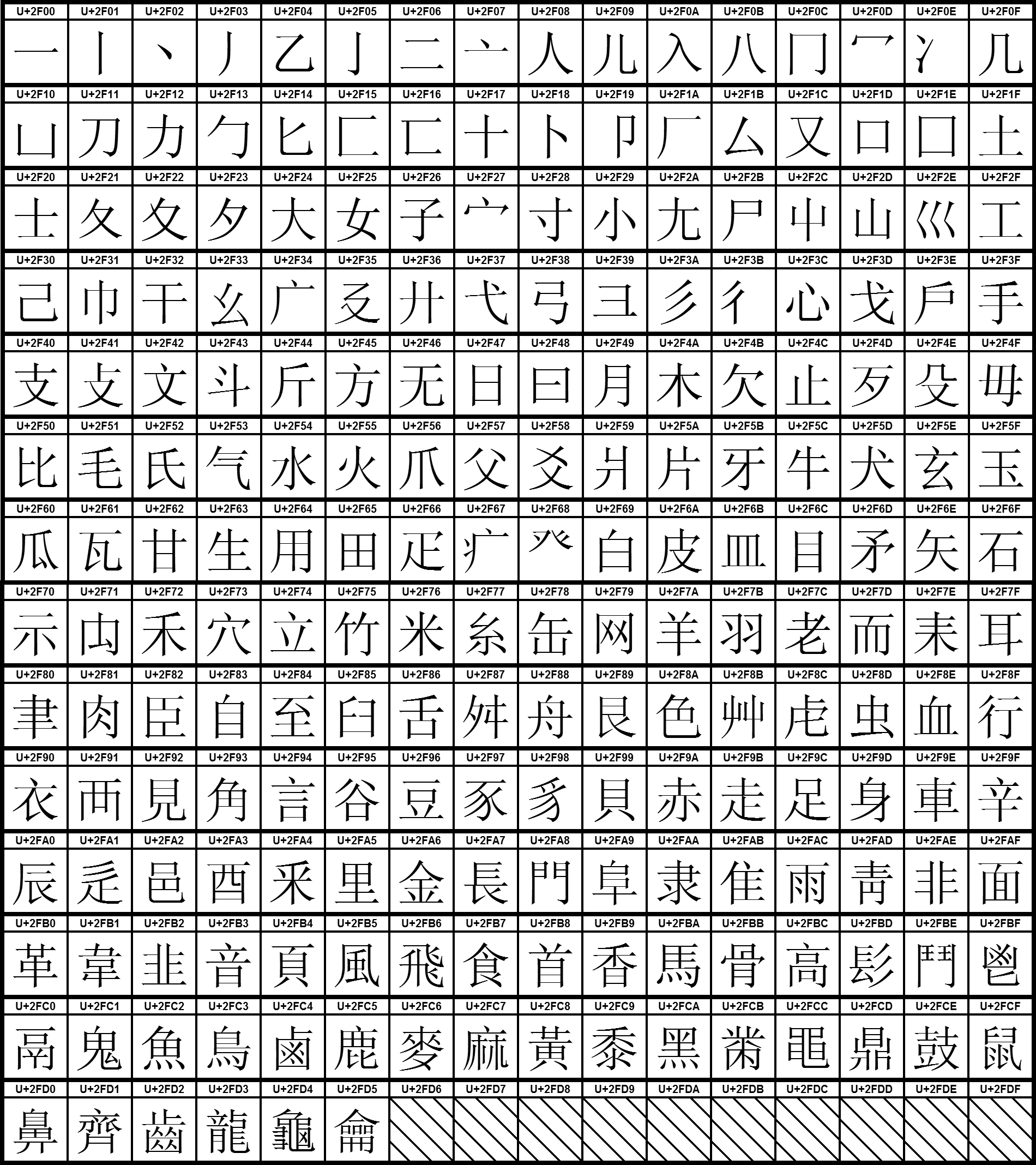
If Chinese characters are built from reusable parts, then 部首 (bùshǒu in Mandarin, bộ thủ in Vietnamese — radicals) are the most important parts of all. A radical is the component a character is filed under: its category, its clue, and very often its meaning. Learn to see radicals and the writing system stops being a wall of strokes and becomes something with structure — a structure you can actually use to remember.
The 214 Kangxi radicals, ordered by stroke count. Not a list to be memorised in one sitting — it is the set of parts the characters are assembled from, and knowing even a few dozen turns strokes into pieces.Source: ÅñtóñSûsî (Ð) — CC BY 3.0 de, Wikimedia Commons
The story: how do you alphabetise a language with no alphabet?
Two thousand years ago, Chinese scholars faced a real problem. They had thousands of characters and no A-to-Z to sort them by. How do you build a dictionary — how do you even find a character — with no alphabet?
The answer came around 100 CE, when the scholar Xu Shen (許慎) compiled the first great character dictionary, the Shuowen Jiezi (說文解字). His insight was elegant: group characters by a shared component. He identified 540 of these organising parts. Centuries later, the imperial Kangxi Dictionary (康熙字典, 1716) refined the system to 214 radicals — and that set is still the backbone of paper and digital dictionaries today. The word 部首 says it plainly: 部 means section and 首 means head — the radical is the section header a character lives under.
The science: why radicals make characters learnable
Radicals are not just a filing trick. They line up almost perfectly with how memory works.
They cut the load through chunking. A character seen as twelve strokes overwhelms working memory. Seen as the water radical plus a part you already know, it is just two pieces. Your mind handles a few meaningful chunks far more easily than a dozen raw strokes.
They carry meaning. Most radicals are semantic — they signal what family a character belongs to. Everything with 氵(the water radical) tends to concern water: 河 (river), 海 (sea), 湖 (lake), 洗 (to wash). Spot the radical and you already have half the meaning before you know anything else.
They team up with sound. Here is the fact that changes everything: roughly 80–90% of Chinese characters are phono-semantic compounds (形声字). One part — usually the radical — hints at the meaning; the other part hints at the pronunciation. In 妈 (mā, mother), 女 gives the meaning (woman) and 马 (mǎ) gives the sound. In 河 (hé, river), 氵gives the meaning (water) and 可 (kě) points at the sound. Once you know the pattern, thousands of characters become half-guessable rather than fully memorised — exactly the kind of predictable structure the brain loves to encode.
They build families. Grouping characters by their radical creates clusters of related meaning, and related items are recalled together through spreading activation. Learn one water word and you have a hook for the next twenty.
How to remember 部首 — a practical method
Learn the common ones first. You do not need all 214. Around 100 radicals cover the vast majority of everyday characters. Start there and the returns are enormous.
Give each radical a keyword and a picture. Many are pictographs at heart: 木 is a tree, 火 is fire, 山 is a mountain, 口 is a mouth, 人 is a person, 心 is a heart. Anchor each radical to a vivid mental image and it sticks.
Learn the squashed forms too. Radicals change shape to fit: 水 (water) becomes 氵on the left; 人 (person) becomes 亻; 心 (heart) becomes 忄; 手 (hand) becomes 扌; 火 can become 灬 at the bottom. Recognising these variants is half the battle.
Notice the position. A radical tends to sit in a fixed place — 氵on the left, 艹 (grass) on top, 辶 (movement) wrapping the bottom-left. Position itself becomes a memory cue.
Guess before you check. Meet a new character, find the radical, and predict its meaning family before looking it up. That act of retrieval — right or wrong — burns the character in far deeper than passive reading.
Build radical families. Keep a running list per radical (氵: 河 海 湖 流 洗…). Reviewing them as a group reinforces the shared thread.
A gift for Vietnamese learners
If you speak Vietnamese, you have a hidden advantage. Each radical has a Hán-Việt name — bộ thuỷ (水, water), bộ mộc (木, wood), bộ hoả (火, fire), bộ tâm (心, heart) — and those readings connect straight to Sino-Vietnamese words you already half-know. The radical for water is not a foreign squiggle; it is thuỷ, as in thuỷ triều (tide). Leaning on that bridge turns radicals from something to memorise into something to recognise.
The takeaway
Radicals are the closest thing Chinese has to an alphabet — not of sounds, but of meaning. Learn to see them, tie each to an image, use them to predict, and review them spaced out over time, and the thousands of characters resolve into a few hundred parts arranged in sensible ways. That is the difference between memorising a language and understanding how it is built.
Read the simple version
The same article, told in plain words — for younger readers, or for anyone who wants the point quickly.
Radicals (部首) are the closest thing Chinese has to an alphabet — not an alphabet of sounds, but of meaning.
They tell you the family
Most radicals signal what a character is about. Anything carrying 氵— the water radical — tends to concern water:
河 river · 海 sea · 湖 lake · 洗 to wash
Spot the radical and you already have half the meaning before you know anything else.
And they team up with sound
Here is the fact that changes everything. Roughly 80–90% of Chinese characters are built the same way: one part hints at the meaning, the other hints at the pronunciation.
妈 (mā, mother) = 女 (woman, the meaning) + 马 (mǎ, the sound)
河 (hé, river) = 氵 (water, the meaning) + 可 (kě, pointing at the sound)
Once you see that pattern, thousands of characters become half-guessable instead of fully memorised.
How to learn them
Learn the common ones first. You do not need all 214. About 100 radicals cover the vast majority of everyday characters.
Give each one a picture. Many are pictures at heart: 木 is a tree, 火 is fire, 山 is a mountain, 口 is a mouth, 人 is a person, 心 is a heart.
Learn the squashed forms too. Radicals change shape to fit: 水 becomes 氵on the left, 人 becomes 亻, 心 becomes 忄, 手 becomes 扌, and 火 can become 灬 along the bottom. Recognising these variants is half the battle.
Notice where it sits. A radical usually keeps a fixed place — 氵 on the left, 艹 (grass) on top, 辶 (movement) wrapping round the bottom-left. The position itself becomes a clue.
Guess before you check. Meet a new character, find the radical, and predict its meaning family before looking it up. That guess — right or wrong — burns it in far deeper than reading the answer.
Keep families. One running list per radical (氵: 河 海 湖 流 洗…). Reviewing them together strengthens the shared thread.
A gift if you speak Vietnamese
You have a hidden advantage. Each radical has a Hán-Việt name — bộ thuỷ (水, water), bộ mộc (木, wood), bộ hoả (火, fire), bộ tâm (心, heart) — and those readings run straight into Sino-Vietnamese words you already half know.
The water radical is not a foreign squiggle. It is thuỷ, as in thuỷ triều (tide). Leaning on that bridge turns radicals from something to memorise into something to recognise.
Learn to see them, and the thousands of characters resolve into a few hundred parts, arranged in ways that make sense.
Sources & further reading
These articles summarize well-established research in learning science and linguistics. Key sources and further reading:
Xu Shen (許慎) (c. 100 CE). Shuowen Jiezi (說文解字).
Kangxi Dictionary (康熙字典) (1716).
DeFrancis, J. (1984). The Chinese Language: Fact and Fantasy. University of Hawai'i Press.
Miller, G. A. (1956). The magical number seven, plus or minus two. Psychological Review.