How meditation improves learning — and how much of that holds up
You will read that meditation rewires the brain, boosts memory and sharpens focus. The evidence tells a narrower and more interesting story: the best-supported effect of meditation on learning is indirect. It does not enlarge your cognitive capacity — it clears out something that was taking up room in it.
AI Aggregated source·August 2, 2026·9 min read·Habits & method
Open any meditation app and you will meet the same list of promises: better focus, improved memory, a rewired brain, faster learning.
There is a real effect here. But it is not the effect being advertised, and its mechanism is quite different. The honest answer is narrower and more modest — and, in practice, more useful.
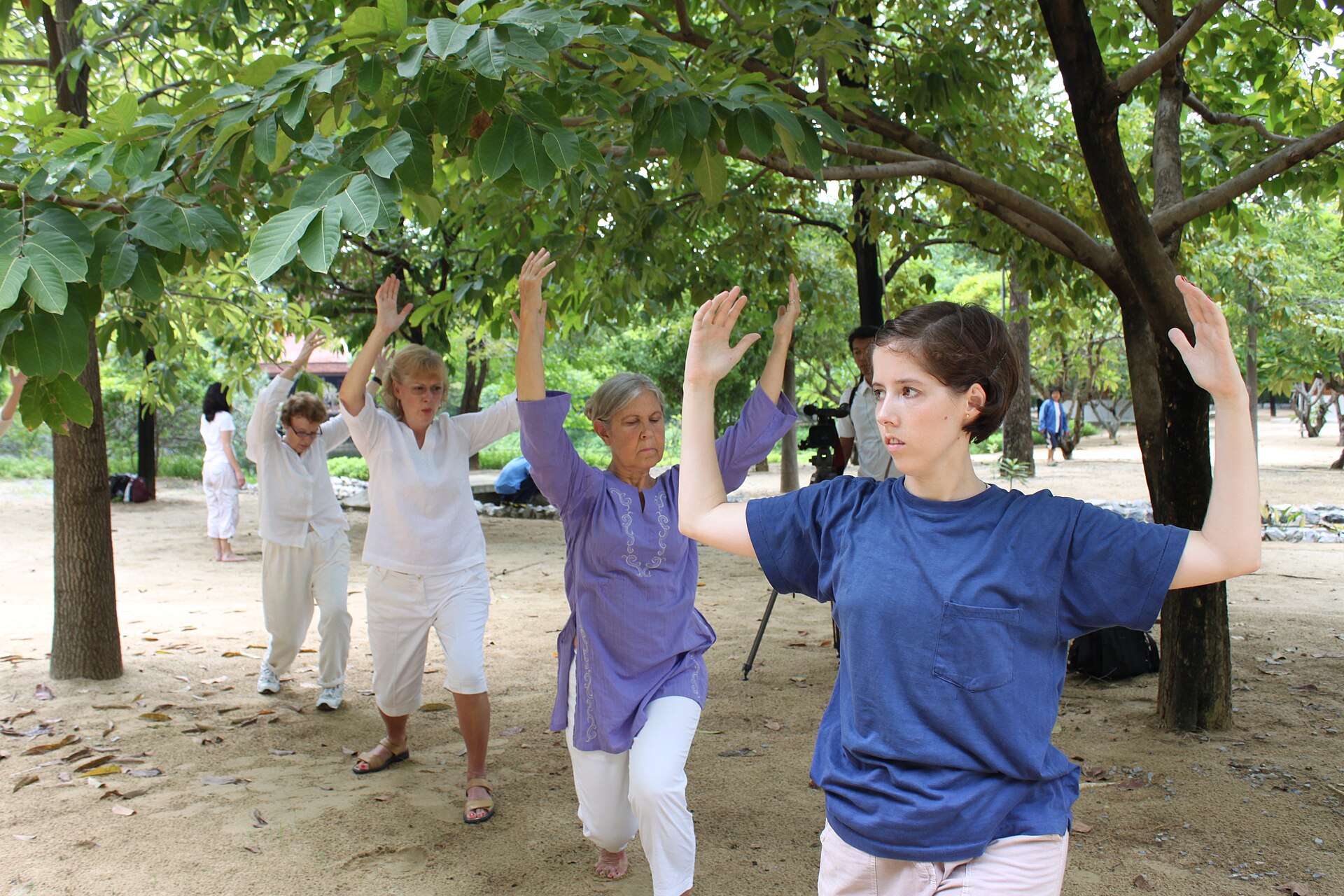
The practice is old and the claims made for it are new. Something here does hold up under measurement — but it is not the list on the app's front page, and knowing which part survives is worth more than the promise that all of it does.Source: Patrickasb — CC BY-SA 4.0, Wikimedia Commons
Problem one: meditation is not one thing
Before any evidence, we have to say what is being measured, because this is where most of the confusion starts.
Focused attention practice (holding attention on the breath, returning it when it drifts) and open monitoring (noticing whatever arises without fixing on it) are different exercises recruiting different mechanisms. Loving-kindness practice is a third thing. The eight-week MBSR programme is a whole intervention package: meditation, gentle yoga, psychoeducation and a group.
The doses differ wildly too. One study might be ten minutes a day on a phone for two weeks. Another might be a three-month silent retreat at ten hours a day. Both get published under the label meditation.
Van Dam and colleagues (2018) wrote an influential critique of exactly this: loose definitions, inconsistent measures, and claims running well ahead of the data. It is the required starting point for reading this literature seriously.
Problem two, and it is bigger: the control group
This is the single most important technical detail in this article.
A great many meditation studies compare the meditation group against a waitlist — that is, against people doing nothing. But the meditation group spent eight weeks doing something new, in a group, with an instructor, and they believed it would help.
If they then report less stress, you cannot tell whether that came from the meditation, the expectation, the attention of other people, or simply having a regular commitment.
To isolate meditation you need an active control: some other activity taking the same time, with the same group contact and the same expectation.
And when that is done properly, the picture changes.
What survives against active controls
Goyal and colleagues (2014) published in JAMA Internal Medicine a systematic review restricted to randomised trials with active controls. It remains one of the more careful assessments of this field, and the results are striking.
Moderate evidence for improvements in anxiety, depression and pain. For anxiety the effect was around 0.38 at eight weeks, falling to around 0.22 at three to six months. Not large, but real.
Low or insufficient evidence for attention, positive mood, sleep, eating habits, substance use and weight.
And one further conclusion that is rarely quoted: meditation programmes were not shown to be better than other active treatments — medication, exercise, or other behavioural therapies.
Read that list carefully. What holds up is in the affective domain. What does not hold up is exactly what every advertisement emphasises: attention.
So how does meditation help learning?
This is where the answer gets interesting, because no reliable effect on attention does not mean no effect on learning.
Recall the mechanism of anxiety. Attentional control theory (Eysenck and colleagues, 2007) showed that anxiety does not block information at the door — it occupies working memory. Thoughts like I am about to get this wrong and everyone is watching run alongside the task and consume exactly the resource the task needs.
Put the two together and the mechanism appears:
Meditation does not widen your channel. It stops something else from filling it.
That is a far more modest claim than meditation boosts working memory. It is also far better evidenced. And for a language learner it happens to land exactly on the sore spot.
Because foreign language anxiety is not a minor factor. Horwitz and colleagues (1986) argued it is a distinct kind of anxiety rather than general nervousness. And the meta-analysis by Teimouri, Goetze and Plonsky (2019) found a moderate negative correlation between language anxiety and achievement — around −0.36 — with speaking the most anxiety-provoking skill of all.
If a practice reduces anxiety by about 0.38, and anxiety is costing you about 0.36 of your achievement, the line between those two numbers is where meditation can help you learn. Not by making you cleverer. By returning bandwidth that worry was consuming.
The second route: mind-wandering
There is another plausible mechanism, with weaker evidence.
Everyone knows the experience: you read a whole page and reach the bottom having absorbed nothing. The eyes moved; the mind was elsewhere.
Smallwood, Fishman and Schooler (2007) called this an under-recognised influence on educational performance, and showed that mind-wandering during reading directly predicts poorer comprehension. Killingsworth and Gilbert (2010) sampled real life and found people's minds wander for a very large share of waking hours.
Meditation is, descriptively, the exercise of noticing that the mind has wandered and bringing it back. So the hypothesis is natural.
Mrazek and colleagues (2013) tested it: two weeks of mindfulness training improved GRE reading comprehension scores and working memory capacity while reducing mind-wandering. The study is cited constantly.
But be honest about the scale: the sample was small, 48 people. And when Cásedas and colleagues (2020) meta-analysed randomised trials of meditation and executive function, the effects were small and shrank against active controls.
The fair conclusion: this route is mechanistically plausible and not firmly established.
What did not survive: the brain-structure story
This needs saying plainly, because it is the most-cited argument and it has collapsed.
In 2011, Hölzel and colleagues reported that eight weeks of MBSR was associated with changes in grey matter density in several regions including the hippocampus. It travelled around the world's press and became the meditation rewires your brain line still repeated today.
In 2022, Kral and colleagues published in Science Advances the largest and most rigorously controlled test yet: two three-arm randomised trials combined, 218 meditation-naïve participants, randomly assigned to eight-week MBSR, a validated and matched active control, or a waitlist. All had structural MRI scans before and after.
They found no evidence of structural brain change.
The most telling detail: the senior author of the 2022 paper was Richard Davidson — whose own laboratory produced much of the earlier positive work. When a research group publishes a well-powered null that undercuts its own line of work, that is science functioning correctly. And it means the claim that meditation restructures your brain in eight weeks currently has no foundation.
Dose: a distinction that gets deliberately blurred
Some studies do find genuine changes in attention. Slagter and colleagues (2007) showed participants improved on the attentional blink — the ability to catch a second target appearing right after a first.
But look at the dose: that was after a three-month intensive retreat.
That is not the same intervention as ten minutes each morning on a phone. Results from three-month retreats being used to market ten-minute apps is one of the larger slippages in how this field gets communicated.
The part almost nobody mentions: meditation is not always benign
Honesty runs in this direction too.
Farias and colleagues (2020) systematically reviewed adverse events in meditation practices and meditation-based therapies, and found a rate of adverse events of roughly 8% — about one participant in twelve. That is comparable to side-effect rates in many other psychological therapies, so it is not cause for alarm; but it is certainly not zero.
Lindahl and colleagues (2017) documented the texture of this in a mixed-methods study of Western practitioners: increased anxiety, feelings of unreality, difficult memories surfacing, disrupted sleep. These were more common with intensive practice and among people with histories of trauma.
None of that means do not meditate. It means that if you sit down and feel worse rather than better, that is a documented phenomenon, not you doing it wrong.
And a fair question: is it worth twenty minutes?
This part rarely gets asked.
If you have twenty spare minutes and the goal is learning better, meditation has to compete with the alternatives — and some of them have substantially stronger evidence.
Testing yourself instead of rereading (Roediger and Karpicke, 2006) is among the most secure findings in learning science. So is spacing your review (Cepeda and colleagues, 2006). And sleep — Walker and Stickgold (2006) reviewed its role in memory consolidation — almost certainly matters more than anything you can do in twenty waking minutes.
Put bluntly: if you are sleeping five hours a night and revising by rereading, twenty minutes of meditation is not the largest lever you are failing to pull.
But if you sleep enough, revise by retrieval, and the remaining problem is that you are too frightened to open your mouth in class — then meditation is aimed precisely at what is in your way.
What to do, concretely
Use it for the job it has evidence for. Anxiety regulation, not cognitive enhancement. Five minutes before a speaking class, before an oral exam, before a conversation with a native speaker — those are the moments the evidence supports.
Put it before the hard task, not after. If the mechanism is clearing room in working memory, the room has to be cleared immediately before you need it.
Do not expect a memory boost. If you meditate for eight weeks and your vocabulary retention is unchanged, you are not doing it wrong. That is what the data predicts.
Keep the dose small and regular. Ten minutes a day will not give you the results of a three-month retreat, but the anxiety half — the evidenced half — does not require monastic quantities.
And if it makes you feel worse, stop. That outcome is in the literature. Pushing through is not a virtue here.
A closing note, and it matters
This entire article has judged meditation against a single criterion: does it make you learn better?
It is worth saying plainly that this is a very narrow criterion, and not the one the tradition set for itself.
Meditation in the Buddhist traditions was not designed to improve test scores or working memory span. It was developed for entirely different purposes: seeing the nature of mind clearly, reducing suffering, changing one's relationship to one's own thoughts.
Measuring a two-thousand-year-old practice with a GRE reading comprehension score is a category error. If the result is small, indirect effect, that says more about the question we asked than about the practice.
For a learner, though, the honest answer stands and remains useful: meditation does not expand your capacity, it clears out what was occupying it. That is a much smaller effect than the marketing claims — and for someone too anxious to speak, it may be exactly the right one.
Read the simple version
The same article, told in plain words — for younger readers, or for anyone who wants the point quickly.
Open any meditation app and you will meet the same list of promises: better focus, improved memory, a rewired brain, faster learning.
There is a real effect here. But it is not the effect being advertised, and its mechanism is quite different. The honest answer is narrower and more modest — and, in practice, more useful.
Problem one: meditation is not one thing
Before any evidence, we have to say what is being measured, because this is where most of the confusion starts.
Focused attention practice (holding attention on the breath, returning it when it drifts) and open monitoring (noticing whatever arises without fixing on it) are different exercises using different mechanisms. Loving-kindness practice is a third thing. The eight-week MBSR programme is a whole package: meditation, gentle yoga, teaching and a group.
The doses differ wildly too. One study might be ten minutes a day on a phone for two weeks. Another might be a three-month silent retreat at ten hours a day. Both get published under the label meditation.
Van Dam and colleagues (2018) wrote an influential critique of exactly this: loose definitions, inconsistent measures, and claims running well ahead of the data.
Problem two, and it is bigger: the control group
This is the single most important technical detail here.
A great many meditation studies compare the meditation group against a waitlist — that is, against people doing nothing. But the meditation group spent eight weeks doing something new, in a group, with an instructor, and they believed it would help.
If they then report less stress, you cannot tell whether that came from the meditation, the expectation, the attention of other people, or simply having a regular commitment.
To isolate meditation you need an active control: some other activity taking the same time, with the same group contact and the same expectation. And when that is done properly, the picture changes.
What survives against active controls
Goyal and colleagues (2014) published in JAMA Internal Medicine a systematic review restricted to randomised trials with active controls. The results are striking.
Moderate evidence for improvements in anxiety, depression and pain. For anxiety the effect was around 0.38 at eight weeks, falling to around 0.22 at three to six months. Not large, but real.
Low or insufficient evidence for attention, positive mood, sleep, eating habits, substance use and weight.
And one further conclusion that is rarely quoted: meditation programmes were not shown to be better than other active treatments — medication, exercise, or other behavioural therapies.
Read that list carefully. What holds up is in the emotional domain. What does not hold up is exactly what every advertisement emphasises: attention.
So how does meditation help learning?
Here the answer gets interesting, because no reliable effect on attention does not mean no effect on learning.
Recall the mechanism of anxiety. Attentional control theory (Eysenck and colleagues, 2007) showed that anxiety does not block information at the door — it occupies working memory. Thoughts like I am about to get this wrong and everyone is watching run alongside the task and consume exactly the resource the task needs.
Put the two together and the mechanism appears:
Meditation does not widen your channel. It stops something else from filling it.
That is a far more modest claim than meditation boosts working memory. It is also far better evidenced. And for a language learner it lands exactly on the sore spot.
Because foreign language anxiety is not a minor factor. Horwitz and colleagues (1986) argued it is a distinct kind of anxiety rather than general nervousness. And the meta-analysis by Teimouri, Goetze and Plonsky (2019) found a moderate negative correlation between language anxiety and achievement — around −0.36 — with speaking the most anxiety-provoking skill of all.
If a practice reduces anxiety by about 0.38, and anxiety is costing you about 0.36 of your achievement, the line between those two numbers is where meditation can help you learn. Not by making you cleverer. By returning bandwidth that worry was consuming.
The second route: mind-wandering
There is another plausible mechanism, with weaker evidence.
Everyone knows the experience: you read a whole page and reach the bottom having absorbed nothing. The eyes moved; the mind was elsewhere.
Smallwood, Fishman and Schooler (2007) called this an under-recognised influence on educational performance, and showed that mind-wandering during reading directly predicts poorer comprehension. Killingsworth and Gilbert (2010) sampled real life and found people's minds wander for a very large share of waking hours.
Meditation is, descriptively, the exercise of noticing that the mind has wandered and bringing it back. So the hypothesis is natural.
Mrazek and colleagues (2013) tested it: two weeks of mindfulness training improved GRE reading comprehension scores and working memory capacity while reducing mind-wandering. The study is cited constantly.
But be honest about the scale: the sample was 48 people. And when Cásedas and colleagues (2020) meta-analysed randomised trials of meditation and executive function, the effects were small and shrank against active controls.
The fair conclusion: this route is mechanistically plausible and not firmly established.
What did not survive: the brain-structure story
This needs saying plainly, because it is the most-cited argument and it has collapsed.
In 2011, Hölzel and colleagues reported that eight weeks of MBSR was associated with changes in grey matter density in several regions including the hippocampus. It travelled around the world's press and became the meditation rewires your brain line still repeated today.
In 2022, Kral and colleagues published in Science Advances the largest and most rigorously controlled test yet: two three-arm randomised trials combined, 218 meditation-naïve participants, randomly assigned to eight-week MBSR, a validated and matched active control, or a waitlist. All had structural MRI scans before and after.
They found no evidence of structural brain change.
The most telling detail: the senior author of the 2022 paper was Richard Davidson — whose own laboratory produced much of the earlier positive work. When a research group publishes a well-powered null that undercuts its own line of work, that is science functioning correctly. And it means the claim that meditation restructures your brain in eight weeks currently has no foundation.
Dose: a distinction that gets deliberately blurred
Some studies do find genuine changes in attention. Slagter and colleagues (2007) showed participants improved on the attentional blink — the ability to catch a second target appearing right after a first.
But look at the dose: that was after a three-month intensive retreat.
That is not the same intervention as ten minutes each morning on a phone. Results from three-month retreats being used to market ten-minute apps is one of the larger slippages in how this field gets communicated.
The part almost nobody mentions: meditation is not always benign
Honesty runs in this direction too.
Farias and colleagues (2020) systematically reviewed adverse events in meditation practices and meditation-based therapies, and found a rate of roughly 8% — about one participant in twelve. That is comparable to side-effect rates in many other psychological therapies, so it is not cause for alarm; but it is certainly not zero.
Lindahl and colleagues (2017) documented the texture of this among Western practitioners: increased anxiety, feelings of unreality, difficult memories surfacing, disrupted sleep. These were more common with intensive practice and among people with histories of trauma.
None of that means do not meditate. It means that if you sit down and feel worse rather than better, that is a documented phenomenon, not you doing it wrong.
And a fair question: is it worth twenty minutes?
This part rarely gets asked.
If you have twenty spare minutes and the goal is learning better, meditation has to compete with the alternatives — and some of them have substantially stronger evidence.
Testing yourself instead of rereading (Roediger and Karpicke, 2006) is among the most secure findings in learning science. So is spacing your review (Cepeda and colleagues, 2006). And sleep — Walker and Stickgold (2006) reviewed its role in memory consolidation — almost certainly matters more than anything you can do in twenty waking minutes.
Put bluntly: if you are sleeping five hours a night and revising by rereading, twenty minutes of meditation is not the largest lever you are failing to pull.
But if you sleep enough, revise by retrieval, and the remaining problem is that you are too frightened to open your mouth in class — then meditation is aimed precisely at what is in your way.
What to do, concretely
Use it for the job it has evidence for. Anxiety regulation, not cognitive enhancement. Five minutes before a speaking class, before an oral exam, before a conversation with a native speaker — those are the moments the evidence supports.
Put it before the hard task, not after. If the mechanism is clearing room in working memory, the room has to be cleared immediately before you need it.
Do not expect a memory boost. If you meditate for eight weeks and your vocabulary retention is unchanged, you are not doing it wrong. That is what the data predicts.
Keep the dose small and regular. Ten minutes a day will not give you the results of a three-month retreat, but the anxiety half — the evidenced half — does not require monastic quantities.
And if it makes you feel worse, stop. That outcome is in the literature. Pushing through is not a virtue here.
A closing note, and it matters
This entire article has judged meditation against a single criterion: does it make you learn better?
It is worth saying plainly that this is a very narrow criterion, and not the one the tradition set for itself.
Meditation in the Buddhist traditions was not designed to improve test scores or working memory span. It was developed for entirely different purposes: seeing the nature of mind clearly, reducing suffering, changing one's relationship to one's own thoughts.
Measuring a two-thousand-year-old practice with a reading comprehension score is a category error. If the result is small, indirect effect, that says more about the question we asked than about the practice.
For a learner, though, the honest answer stands and remains useful: meditation does not expand your capacity, it clears out what was occupying it. That is a much smaller effect than the marketing claims — and for someone too anxious to speak, it may be exactly the right one.
Sources & further reading
These articles summarize well-established research in learning science and linguistics. Key sources and further reading:
Goyal, M., Singh, S., Sibinga, E. M. S., et al. (2014). Meditation programs for psychological stress and well-being: A systematic review and meta-analysis. JAMA Internal Medicine, 174(3), 357–368.
Kral, T. R. A., Davis, K., Korponay, C., et al. (2022). Absence of structural brain changes from mindfulness-based stress reduction: Two combined randomized controlled trials. Science Advances, 8(20), eabk3316.
Hölzel, B. K., Carmody, J., Vangel, M., et al. (2011). Mindfulness practice leads to increases in regional brain gray matter density. Psychiatry Research: Neuroimaging, 191(1), 36–43.
Van Dam, N. T., van Vugt, M. K., Vago, D. R., et al. (2018). Mind the hype: A critical evaluation and prescriptive agenda for research on mindfulness and meditation. Perspectives on Psychological Science, 13(1), 36–61.
Mrazek, M. D., Franklin, M. S., Phillips, D. T., Baird, B., & Schooler, J. W. (2013). Mindfulness training improves working memory capacity and GRE performance while reducing mind wandering. Psychological Science, 24(5), 776–781.
Cásedas, L., Pirruccio, V., Vadillo, M. A., & Lupiáñez, J. (2020). Does mindfulness meditation training enhance executive control? A systematic review and meta-analysis of randomized controlled trials in adults. Mindfulness, 11, 411–424.
Smallwood, J., Fishman, D. J., & Schooler, J. W. (2007). Counting the cost of an absent mind: Mind wandering as an underrecognized influence on educational performance. Psychonomic Bulletin & Review, 14(2), 230–236.
Killingsworth, M. A., & Gilbert, D. T. (2010). A wandering mind is an unhappy mind. Science, 330(6006), 932.
Eysenck, M. W., Derakshan, N., Santos, R., & Calvo, M. G. (2007). Anxiety and cognitive performance: Attentional control theory. Emotion, 7(2), 336–353.
Slagter, H. A., Lutz, A., Greischar, L. L., et al. (2007). Mental training affects distribution of limited brain resources. PLoS Biology, 5(6), e138.
Farias, M., Maraldi, E., Wallenkampf, K. C., & Lucchetti, G. (2020). Adverse events in meditation practices and meditation-based therapies: A systematic review. Acta Psychiatrica Scandinavica, 142(5), 374–393.
Lindahl, J. R., Fisher, N. E., Cooper, D. J., Rosen, R. K., & Britton, W. B. (2017). The varieties of contemplative experience: A mixed-methods study of meditation-related challenges in Western Buddhists. PLoS ONE, 12(5), e0176239.
Horwitz, E. K., Horwitz, M. B., & Cope, J. (1986). Foreign language classroom anxiety. The Modern Language Journal, 70(2), 125–132.
Teimouri, Y., Goetze, J., & Plonsky, L. (2019). Second language anxiety and achievement: A meta-analysis. Studies in Second Language Acquisition, 41(2), 363–387.
Roediger, H. L., & Karpicke, J. D. (2006). Test-enhanced learning: Taking memory tests improves long-term retention. Psychological Science, 17(3), 249–255.
Cepeda, N. J., Pashler, H., Vul, E., Wixted, J. T., & Rohrer, D. (2006). Distributed practice in verbal recall tasks: A review and quantitative synthesis. Psychological Bulletin, 132(3), 354–380.
Walker, M. P., & Stickgold, R. (2006). Sleep, memory, and plasticity. Annual Review of Psychology, 57, 139–166.