You wave your hands while hunting for a word, even on the phone where nobody can see you. That observation leads to one of the boldest ideas in cognitive science — and one of the hardest hit by the replication crisis. What survives is narrower, and genuinely usable.
Watch yourself next time you are hunting for a Chinese word that will not come. Your hands will probably move — tracing strokes in the air, or making some vague shape.
The strange part is that we do it on the phone too, where nobody can see. The gesture is not for communicating. It seems to be part of the thinking itself.
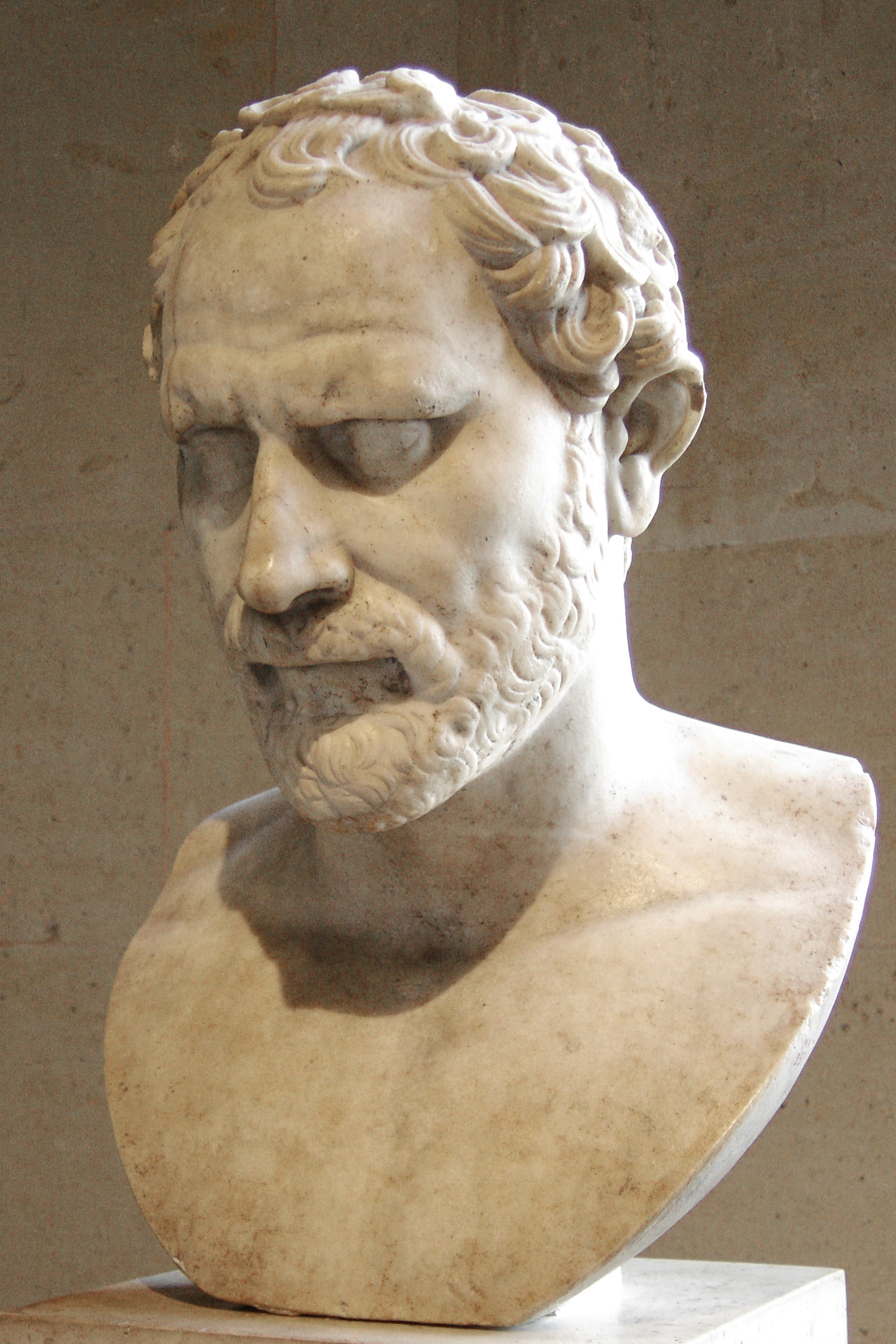
Even in marble, the hands are doing something. Ancient teachers of rhetoric drilled gesture as part of speech rather than decoration on it — a position the last fifty years of cognitive science has been slowly arriving back at.Source: Copy of Polyeuktos — CC BY-SA 2.5, Wikimedia Commons
That observation leads to one of the boldest ideas in cognitive science of the last fifty years: embodied cognition — the claim that thinking does not happen neatly inside the skull, but is shaped by the body and its movement.
It is also one of the ideas most damaged by psychology's replication crisis. So this article has to do two jobs: say what the idea claims, and say which parts of it are still standing.
The idea
The traditional view treats the mind as software: the brain manipulates abstract symbols, and the body is input and output — eyes deliver data, hands execute commands.
Embodied cognition rejects that split. On this view, when you understand the word kick, the motor system that controls your leg is involved. When you think about the future, you reuse spatial processing — which is why the future is ahead. Abstract concepts, argued Lakoff and Johnson, are built on metaphors rooted in the body: more is up, affection is warmth, understanding is grasping.
It is elegant, it explains a lot, and to a teacher it sounds promising: if thinking is grounded in the body, bring the body into the classroom.
The part that collapsed
This needs saying first, because a great deal of popular writing still cites studies that no longer stand.
The action-sentence compatibility effect. In 2002 Glenberg and Kaschak published an experiment that became the field's emblem: people responded faster when the direction of their hand movement matched the direction of the action described in a sentence. It was cited thousands of times.
In 2022 a pre-registered replication across 18 laboratories tried again. Not one found the effect. The meta-analytic estimate was essentially zero.
The bodily priming studies. Holding a warm coffee makes you judge someone as warmer; recalling a misdeed makes you want to wash; two minutes in a power pose changes your hormones. All three were famous, and all three failed to replicate at larger scale.
The lesson is not that science was wrong. It is science correcting itself. But it does mean that the strongest and most appealing versions of embodiment — the body quietly steering abstract judgement — currently have no solid foundation.
The contested middle
In between sits an unsettled area that deserves an honest description.
Brain imaging shows that when people read action verbs like lick, pick and kick, the motor cortex regions for tongue, hand and leg increase activity — following the map of the body. That finding (Hauk and colleagues, 2004) is reasonably solid as measurement.
The open question is whether that activity is necessary for comprehension, or a consequence that follows it. You could understand kick first, with the association spreading to motor areas afterwards — without the motor areas doing the understanding.
Since the 2022 non-replication, researchers in this area are openly discussing a replication crisis for action semantics. Some groups argue that understanding action words does not rely on motor simulation; others hold that the motor system does play a role but one heavily dependent on context and perspective. This is a state of we do not know, not a state of refuted.
What is still standing — and it is the usable part
The interesting thing is that the most practical findings turned out to be the most durable. They say nothing about the philosophy of mind; they say only that doing something with your body while learning helps you remember it.
Gesture lightens cognitive load.Susan Goldin-Meadow and colleagues had children explain how they solved a maths problem while holding a list in memory. Those allowed to gesture remembered substantially more than those told to keep their hands still. Gesture seems to carry part of the work, freeing working memory for something else. This has replicated repeatedly and is used in real classrooms.
Doing beats hearing.Engelkamp's subject-performed task effect is robust: if you actually perform fold the paper, you remember the phrase far better than if you only read it. The body leaves an extra memory trace alongside the verbal one.
Saying it aloud beats reading silently.MacLeod and colleagues call this the production effect, and it replicates well. The explanation is distinctiveness: a spoken word acquires its own motor and auditory record, so it stands out at retrieval.
Handwriting leaves a motor trace.Longcamp's research found children who practised writing letters by hand recognised them better than those who only typed. The act of writing takes part in recognising the shape.
What these four have in common: none of them requires you to believe abstract thought is grounded in the body. They need something much simpler — memory is strengthened by multiple channels, and the body is one channel.
What to do as a language learner
Attach a gesture to a new word.Manuela Macedonia studied exactly this with language learners: words learned with a gesture the learner performs themselves are retained better than words only heard or seen. The key is performing it, not watching someone else.
Read aloud rather than silently. This is the cheapest application of the production effect. For learners of Chinese it does double duty: it strengthens memory and rehearses tone at the same time. Shadowing is the strongest version of this.
Write characters by hand, at least at first. In the age of pinyin input many learners drop writing entirely. There is a practical case for keeping some: the act forces attention to stroke order and component structure, which is exactly what distinguishes look-alike characters. You do not need a hundred repetitions — a few at first encounter earn their place.
Act verbs out. This is the idea behind James Asher'stotal physical response from 1969: learners hear a command and perform the action. The evidence supports it reasonably well for concrete vocabulary early on — and much less well as a complete method for everything.
And do not sit still for too long. This is not really embodied cognition so much as plain physiology: physical activity benefits attention and memory. Walking while reviewing flashcards is a sensible combination.
Limits worth keeping in mind
Not every word has a body.Jump, hold and push take gestures naturally. However, concept and policy do not — and inventing an arbitrary gesture for them is more likely to add load than to help.
Do not turn everything into charades. If the physical activity takes attention that should be on the language, it becomes extraneous load — precisely what cognitive load theory warns about. Gesture helps when it is tied to meaning, not when it merely makes a class lively.
And be sceptical of large promises. If you read that a body posture will change how you think, or that holding something warm will make you learn better, remember that this is exactly the branch that did not survive testing.
So what is the answer?
If the question is whether all thought is rooted in the body — there is not enough evidence to say yes, and several of the pillars that once supported that answer have fallen.
But if the question is whether the body takes part in learning — the answer is yes, modestly and reliably. Gesturing while explaining leaves you remembering more. Saying it aloud beats reading it silently. Performing an action beats hearing about it. Writing by hand improves recognition of the shape.
That is a much smaller claim than the original slogan. But it has the advantage of being true — and it tells you exactly what to do tonight when you sit down with a deck of cards.
Read the simple version
The same article, told in plain words — for younger readers, or for anyone who wants the point quickly.
You may have read that thinking happens in the body, not only in the head. Some of that is real. A famous part of it collapsed.
The part that collapsed
This needs saying first, because a great deal of popular writing still cites studies that no longer stand.
In 2002 an experiment became the field's emblem: people responded faster when the direction of their hand movement matched the direction of the action in a sentence. It was cited thousands of times.
In 2022, a careful replication across 18 laboratories tried again. Not one found the effect. The pooled estimate was essentially zero.
The same happened to a family of famous results: that holding a warm coffee makes you judge someone as warmer, that recalling a misdeed makes you want to wash, that two minutes in a power pose changes your hormones. All failed to replicate at larger scale.
The lesson is not that science was wrong. It is science correcting itself. But it does mean the most appealing version of this idea — the body quietly steering abstract judgement — currently has no solid foundation.
The contested middle
Brain scans do show that when people read verbs like lick, pick and kick, the motor areas for tongue, hand and leg become more active, following the map of the body. That measurement is reasonably solid.
The open question is whether that activity is necessary for understanding, or a consequence that follows it. You could understand kick first, with the activity spreading to motor areas afterwards.
This is a state of we do not know, not a state of refuted.
What is still standing — and it is the usable part
The interesting thing is that the most practical findings turned out to be the most durable. They say nothing about the philosophy of mind. They say only that doing something with your body while learning helps you remember it.
Gesture lightens the load. Children explaining a maths problem while holding a list in memory remembered substantially more if they were allowed to gesture than if told to keep their hands still.
Doing beats hearing. If you actually perform fold the paper, you remember the phrase far better than if you only read it.
Saying it aloud beats reading silently. A spoken word acquires its own motor and auditory record, so it stands out when you go looking for it.
Handwriting leaves a trace. Children who practised letters by hand recognised them better than those who only typed.
What these four share: none of them requires you to believe that abstract thought lives in the body. They need something much simpler — memory is strengthened by multiple channels, and the body is one channel.
What to do as a language learner
Attach a gesture to a new word — and perform it yourself. Watching someone else do it is not the same.
Read aloud rather than silently. For a learner of Chinese this does double duty: it strengthens memory and rehearses tone at once. Shadowing is the strongest version.
Write characters by hand, at least at first. The act forces attention to stroke order and component structure — exactly what tells look-alike characters apart. You do not need a hundred repetitions; a few at first encounter earn their place.
Act verbs out, especially concrete ones, early on.
And do not sit still too long. This is plain physiology rather than anything exotic: movement helps attention and memory. Walking while reviewing cards is a sensible combination.
One limit worth keeping in mind
Not every word has a body.Jump, hold and push take gestures naturally. However, concept and policy do not — and inventing an arbitrary gesture for them is more likely to add load than to help.
Sources & further reading
These articles summarize well-established research in learning science and linguistics. Key sources and further reading:
Hauk, O., Johnsrude, I., & Pulvermüller, F. (2004). Somatotopic representation of action words in human motor and premotor cortex. Neuron, 41(2), 301–307.
Glenberg, A. M., & Kaschak, M. P. (2002). Grounding language in action. Psychonomic Bulletin & Review, 9(3), 558–565.
Morey, R. D., Kaschak, M. P., Díez-Álamo, A. M., et al. (2022). A pre-registered, multi-lab non-replication of the action-sentence compatibility effect (ACE). Psychonomic Bulletin & Review, 29(2), 613–626.
Goldin-Meadow, S., Nusbaum, H., Kelly, S. D., & Wagner, S. (2001). Explaining math: Gesturing lightens the load. Psychological Science, 12(6), 516–522.
Engelkamp, J., & Zimmer, H. D. (1994). The Human Memory: A Multimodal Approach. Seattle: Hogrefe & Huber.
MacLeod, C. M., Gopie, N., Hourihan, K. L., Neary, K. R., & Ozubko, J. D. (2010). The production effect: Delineation of a phenomenon. Journal of Experimental Psychology: Learning, Memory, and Cognition, 36(3), 671–685.
Macedonia, M., & Knösche, T. R. (2011). Body in mind: How gestures empower foreign language learning. Mind, Brain, and Education, 5(4), 196–211.
Asher, J. J. (1969). The total physical response approach to second language learning. The Modern Language Journal, 53(1), 3–17.
Longcamp, M., Zerbato-Poudou, M.-T., & Velay, J.-L. (2005). The influence of writing practice on letter recognition in preschool children. Acta Psychologica, 119(1), 67–79.
Lakoff, G., & Johnson, M. (1980). Metaphors We Live By. Chicago: University of Chicago Press.
Chabris, C. F., Heck, P. R., Mandart, J., Benjamin, D. J., & Simons, D. J. (2019). No evidence that experiencing physical warmth promotes interpersonal warmth. Social Psychology, 50(2), 127–132.