Neuroplasticity: How Learning a Language Rewires Your Brain
The adult brain was never set like concrete. Neuroplasticity — its lifelong ability to physically rewire — is what makes learning a language possible at any age. What it is, how you can see it reshape the brain, its rules, and why it means it is never too late.
For most of history, people believed the adult brain was fixed — set like concrete once childhood was over. We now know that is simply wrong, and the discovery is quietly revolutionary for anyone learning a language. The brain is not rigid hardware but something closer to living clay, reshaping itself with every hour of practice. That capacity has a name — neuroplasticity — and it is, quite literally, what makes learning a language possible at any age.
What neuroplasticity is
Neuroplasticity is the brain's lifelong ability to physically change in response to experience. Every time you learn something, real, tangible things happen inside your head: connections between neurons are strengthened, unused ones are weakened and pruned away, new links sprout, and with enough practice the very structure of tissue shifts. The old slogan captures it well — neurons that fire together, wire together. Learning of any kind is not information poured into a fixed container; it is the container rebuilding itself.
You can watch it happen
Language learning is one of the clearest demonstrations of this power, because scientists can actually see the brain change. Studies have found that learning a second language increases the density of grey matter in language-related regions, strengthens the white-matter pathways that connect them, and — after intensive study — can even enlarge the hippocampus, the brain's memory hub. This is not a metaphor. Every word you commit to memory and every hour you spend practising is a small act of physical construction, laying down a little more neural structure than was there the day before.
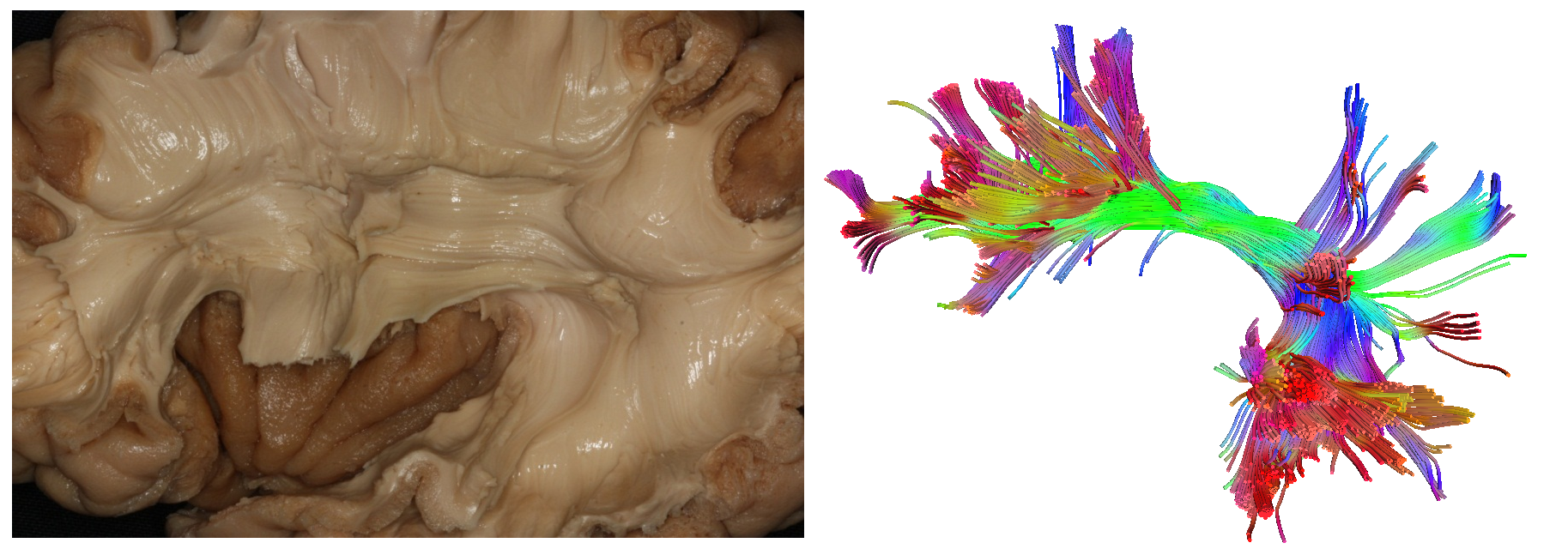
The arcuate fasciculus — the cable between the two language regions — dissected on the left, reconstructed from a living brain on the right. This is what it means to say the change can be seen.Source: Fang-Cheng Yeh, Timothy D. Verstynen, Yibao Wang, Juan C. Fernández-Miranda, Wen-Yih Isaac Tseng — CC BY 2.5, Wikimedia Commons
The rules of plasticity — and how to work with them
Plasticity is not automatic magic that rewards mere presence. It follows rules, and each rule is a lever you can pull.
Use it, or lose it. The connections you activate are kept and reinforced; those you neglect fade. This is why an unpractised language slips away — the circuits are literally weakening — and why regular use and review are not optional but essential.
Repetition builds it. A single exposure leaves only a faint, fragile trace; durable rewiring requires repeated activation over time. This is the deep reason spaced repetition works — it supplies the repeated firing that plasticity needs, timed to do the most good.
Effort and attention drive it. The brain rewires most for practice that is focused and effortful, at the edge of your ability — not for passive exposure you barely notice. Actively recalling a word changes the brain more than glancing at it again.
Sleep locks it in. A great deal of the physical consolidation of the day's changes happens while you sleep, which is why what you learn is only half-built until you have slept on it.
Meaning and emotion amplify it. Reward, curiosity, and personal relevance release brain chemicals that switch plasticity on. Caring about what you learn is not a soft extra; it chemically deepens the physical change.
The headline: it is never too late
Here is the conclusion that matters most. Plasticity is lifelong. The belief that adults cannot learn languages because the brain has hardened is false — the adult brain rewires too, throughout life. What truly changes with age is not whether plasticity works but how freely its conditions are handed to you. A child immersed in a language receives endless repetition, attention, meaning, and sleep almost for free; an adult must supply those conditions deliberately. Do so, and your brain will remodel just as surely. There is one honest caveat: some plasticity, especially for the fine sounds of speech, is heightened in an early sensitive period and reduced later — which is why accent is the hardest thing to master as an adult. But reduced is not gone, and everything else remains richly changeable for as long as you live.
Why the science of learning works, in a single idea
Step back and something elegant appears. Nearly every effective language-learning method — spacing, retrieval practice, sleep, immersion, deliberate practice, daily consistency — is really just a way of delivering the conditions plasticity requires: repeated, effortful, meaningful, well-rested activation of the right circuits. They work because they rewire the brain efficiently. This also explains the dreaded plateau: even when your progress feels invisible on the surface, the plasticity continues quietly underneath, reorganising and strengthening, until the next visible leap arrives.
The takeaway
Your brain is not a finished object but a lifelong work in progress, and a language is one of the richest things you can build inside it. Every hour of practice lays down a little more structure — a stronger connection, a thicker pathway, a new circuit that was not there before. Give plasticity what it asks for — repetition, effort, sleep, and meaning, again and again — and it will do the rest, quietly and physically turning a foreign language into a permanent part of who you are. The concrete was never set. It never is.
Read the simple version
The same article, told in plain words — for younger readers, or for anyone who wants the point quickly.
Your brain is not a finished object. It is a lifelong work in progress — and a language is one of the richest things you can build inside it.
This is not a metaphor. Scientists can watch it happen. Learning a second language increases the density of tissue in the language regions, strengthens the pathways connecting them, and after intensive study can even enlarge the hippocampus, the brain's memory hub.
Every hour you practise lays down a little more structure than was there the day before.
The rules, and how to work with them
This rebuilding is not magic that rewards merely showing up. It follows rules — and each rule is a lever you can pull.
Use it or lose it. Connections you activate are kept and reinforced. Ones you neglect fade. This is why an unpractised language slips away — the circuits are literally weakening — and why review is not optional.
Repetition builds it. One exposure leaves a faint, fragile trace. Durable rewiring needs repeated firing over time. That is the deep reason spaced repetition works.
Effort drives it. The brain rewires most for practice that is focused and hard, at the edge of what you can do — not for exposure you barely notice. Actively recalling a word changes the brain more than glancing at it again.
Sleep locks it in. Much of the day's physical change is finished while you sleep. What you learn is only half-built until you have slept on it.
Meaning amplifies it. Curiosity, reward and personal relevance release chemicals that switch the rebuilding on. Caring about what you learn is not a soft extra — it chemically deepens the physical change.
The part that matters most: it is never too late
This rebuilding is lifelong. The belief that adults cannot learn languages because the brain has hardened is simply false.
What changes with age is not whether it works, but how freely its conditions are handed to you. A child immersed in a language gets endless repetition, attention, meaning and sleep almost for free. An adult has to supply those conditions on purpose. Do that, and your brain remodels just as surely.
One honest caveat: some of this flexibility, especially for the fine sounds of speech, is heightened early in life and reduced later — which is why accent is the hardest thing to master as an adult. But reduced is not gone, and everything else stays richly changeable for as long as you live.
Why all the good methods work
Step back and something elegant appears. Spacing, self-testing, sleep, immersion, deliberate practice, daily consistency — nearly every method that works is really just a way of delivering the conditions this rebuilding requires: repeated, effortful, meaningful, well-rested activation of the right circuits.
It also explains the plateau. Even when progress feels invisible on the surface, the rebuilding continues quietly underneath, until the next visible leap arrives.
Give it what it asks for — repetition, effort, sleep, meaning, again and again — and it will do the rest.
The concrete was never set. It never is.
Sources & further reading
These articles summarize well-established research in learning science and linguistics. Key sources and further reading:
Kleim, J. A., & Jones, T. A. (2008). Principles of experience-dependent neural plasticity: Implications for rehabilitation after brain damage. Journal of Speech, Language, and Hearing Research.
Draganski, B., Gaser, C., Busch, V., Schuierer, G., Bogdahn, U., & May, A. (2004). Neuroplasticity: Changes in grey matter induced by training. Nature.
Mårtensson, J., et al. (2012). Growth of language-related brain areas after foreign language learning. NeuroImage.
Li, P., Legault, J., & Litcofsky, K. A. (2014). Neuroplasticity as a function of second language learning: Anatomical changes in the human brain. Cortex.
Hebb, D. O. (1949). The Organization of Behavior: A Neuropsychological Theory. Wiley.