Is Anyone Truly 'Not Gifted at Languages'? What Neuroscience Says
I just don't have a talent for languages feels like a fact — but is it? What neuroscience actually says about language aptitude, brain plasticity, and why no talent is almost always about method, exposure, and belief, not the brain.
I just don't have a talent for languages. It may be the most common thing learners say — and one of the most defeating. It sounds like a simple statement of fact, a fixed limit written into the brain. But is it true? Under the lens of neuroscience, the answer is clear and, happily, encouraging: almost certainly not, at least not in the way people mean it.
Your brain is built for language — and you have already proved it
Start with the strongest evidence of all: you are reading this. Every neurologically typical human being masters a first language, effortlessly and completely, as a small child — an astonishingly complex feat of sound, grammar, and meaning that no computer fully matches. The brain comes equipped with dedicated machinery for language, and that machinery is universal. Whatever else is true, the hardware for learning a language is standard issue in our species. Nobody who acquired a mother tongue is missing the equipment for a second one.
The brain rewires itself to learn — at any age
Learning a new language is not just storing words; it physically reshapes the brain. Brain-imaging studies have watched it happen: after months of intensive language study, learners show measurable growth in the grey matter of language-related regions and stronger white-matter connections. This is neuroplasticity — the brain's lifelong ability to rewire with practice. Crucially, it does not switch off in adulthood. The adult brain remains plastic, which is precisely why an adult can still build new language circuits, given the input and the effort.
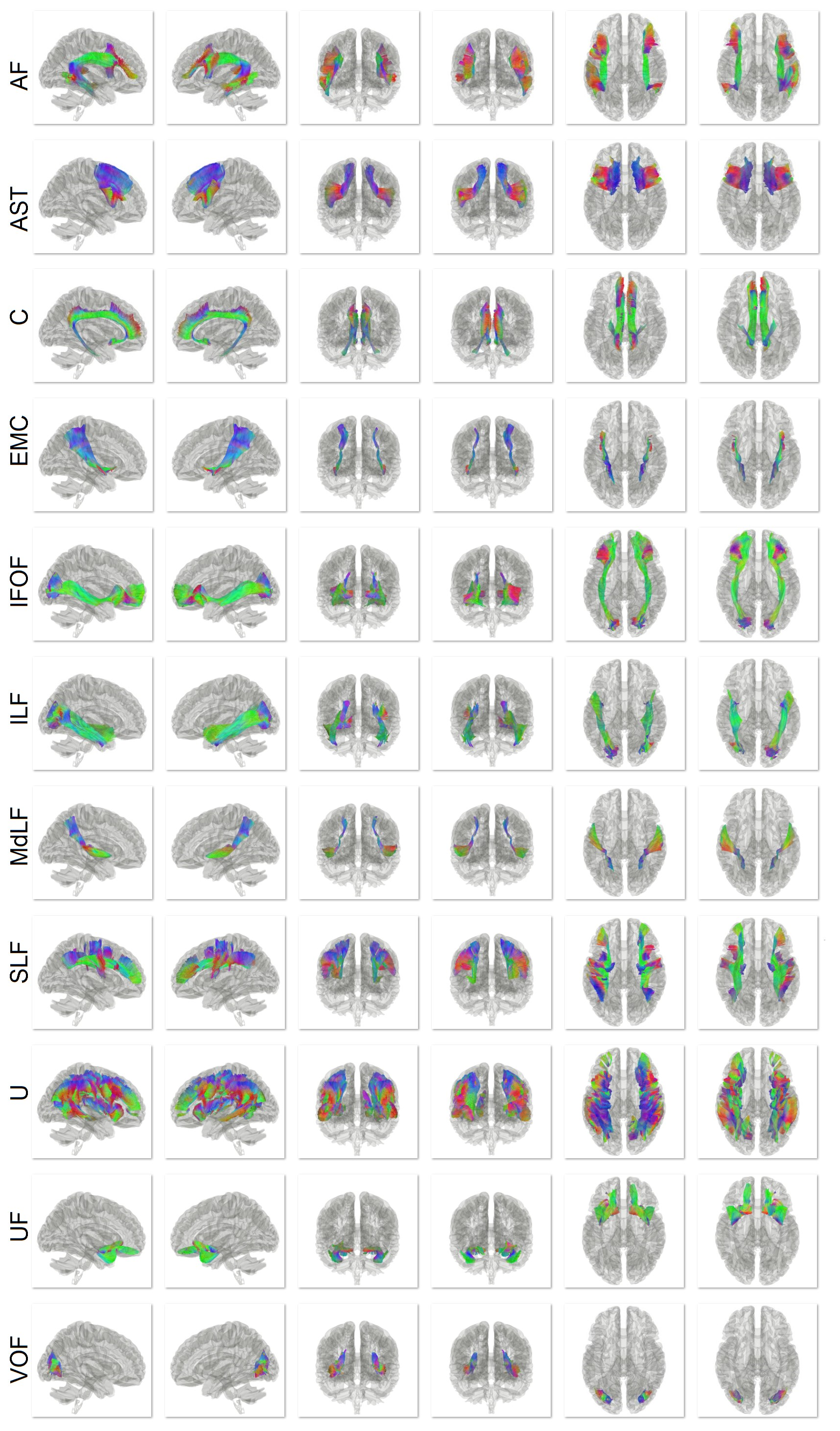
The brain's association pathways, averaged across many people. Everyone in that average already runs a full language system — which is the trouble with saying you have no talent for it.Source: Yeh, F. C., Panesar, S., Fernandes, D., Meola, A., Yoshino, M., Fernandez-Miranda, J. C., ... & Verstynen, T. (2018). Population-averaged atlas of the macroscale human structural connectome and its network topology. NeuroImage, 178, 57-68. — CC BY-SA 4.0, Wikimedia Commons
So do differences in aptitude exist? Yes — but read carefully
Here is where honesty matters. People are not identical, and language aptitude is real. Some brains are quicker at hearing and reproducing unfamiliar sounds; some hold more in phonological working memory, the mental scratchpad for new words; some spot grammatical patterns faster. Researchers can even see anatomical hints of this — the structure of certain brain regions partly predicts how easily someone picks up foreign speech sounds.
But notice what these differences actually do. They affect the speed and ease of learning, not whether it is possible. Aptitude is a tilt, not a wall. A person with average aptitude reaches the same destinations as a natural — they simply take a somewhat different, sometimes longer road. No study has ever found a healthy brain that is incapable of learning a second language.
So why do some people seem to have no talent?
If the brain is capable, why does the feeling of hopelessness ring so true for so many? Because talent is usually standing in for other things that are far more decisive — and far more changeable:
Method. Years of dull grammar drills teach almost anyone to believe they are bad at languages. The problem was the approach, not the brain.
Exposure and time. Language is built from thousands of hours of contact. Many untalented learners have simply never had enough input — nothing can grow from too little.
Mindset. This one is quietly powerful. Believing you cannot learn becomes self-fulfilling: it lowers effort, raises anxiety, and — as research on anxiety and learning shows — a stressed brain literally takes in less. The label no talent helps create the failure it predicts.
Unfair comparisons. People measure three months of casual study against someone who grew up bilingual or lived abroad for years, then conclude they lack the gift. It is not a fair race.
A hidden head start. The people who seem effortlessly gifted have very often already learned one or two languages. Aptitude compounds — success builds the very skills that make the next language easier.
The verdict from neuroscience
Put together, the science does not support the idea of a person who is simply not a language person. The brain that mastered your mother tongue carries the full toolkit for another, and it stays plastic enough to build one for the rest of your life. Differences in aptitude are real but modest; they shape the pace of the journey, not the ability to make it. The far larger levers — method, exposure, consistency, and belief — are all things you can change.
What to do with this
Retire the label. Swap I'm bad at languages for I haven't yet found the right method or put in the hours. It is more accurate, and it changes what you do next.
Learn to your profile. Weaker ear for sounds? Lean harder on listening and repetition. Shaky memory for words? Use spaced repetition and vivid images. Play to your strengths and prop up your weaknesses.
Show up, and lower the stakes. Consistency beats talent, and a relaxed learner absorbs more than an anxious one. Be willing to be a beginner.
The real answer
Are some people truly incapable of learning a foreign language? Almost never. You are not bad at languages — you are a human being, and human beings are, by design, language-learning machines. The question was never whether your brain can. It only ever was whether you would give it the method, the exposure, and the belief it needs.
Read the simple version
The same article, told in plain words — for younger readers, or for anyone who wants the point quickly.
I just don't have a talent for languages.
It may be the most common thing learners say, and one of the most defeating. It sounds like a plain fact — a limit written into the brain. Is it true?
Almost certainly not, at least not in the way people mean it.
You have already proved your brain can do this
Start with the strongest evidence there is: you are reading this.
Every neurologically typical person masters a first language, effortlessly and completely, as a small child — an astonishingly complex feat of sound, grammar and meaning that no computer fully matches.
The machinery for language is standard issue in our species. Nobody who acquired a mother tongue is missing the equipment for a second one.
And the brain still rebuilds itself, at any age
Learning a language does not just store words. It physically reshapes the brain — after months of intensive study, learners show measurable growth in the language regions and stronger connections between them.
Crucially, this does not switch off in adulthood.
So does talent exist? Yes — but read carefully
Here is where honesty matters. People are not identical. Some brains are quicker at hearing unfamiliar sounds; some hold more new words in mind at once; some spot patterns faster. Researchers can even see hints of this in brain anatomy.
But look at what those differences actually do. They affect the speed and ease of learning, not whether it is possible.
Aptitude is a tilt, not a wall. Someone with average aptitude reaches the same destinations as a natural — by a somewhat different, sometimes longer road. No study has ever found a healthy brain incapable of learning a second language.
So why does no talent feel so true?
Because the word is usually standing in for other things — things that are far more decisive, and far more changeable:
Method. Years of dull grammar drills teach almost anyone to believe they are bad at languages. The problem was the approach, not the brain.
Hours. A language is built from thousands of hours of contact. Many untalented learners have simply never had enough input. Nothing grows from too little.
Belief. This one is quietly powerful. Thinking you cannot learn becomes self-fulfilling: it lowers effort, raises anxiety, and a stressed brain literally takes in less. The label helps create the failure it predicts.
Unfair comparisons. People measure three months of casual study against someone who grew up bilingual or lived abroad for years, then conclude they lack the gift. It was never a fair race.
A hidden head start. The people who seem effortlessly gifted have very often already learned one or two languages. Success builds the very skills that make the next one easier.
What to do with this
Retire the label. Swap I'm bad at languages for I haven't yet found the right method, or put in the hours. It is more accurate, and it changes what you do next.
Learn to your own shape. Weaker ear? Lean harder on listening and repetition. Shaky memory for words? Use spaced repetition and vivid images.
Show up, and lower the stakes. Consistency beats talent, and a relaxed learner absorbs more than an anxious one. Be willing to be a beginner.
You are not bad at languages. You are a human being, and human beings are, by design, language-learning machines.
The question was never whether your brain can. Only whether you would give it the method, the hours, and the belief it needs.
Sources & further reading
These articles summarize well-established research in learning science and linguistics. Key sources and further reading:
Mårtensson, J., et al. (2012). Growth of language-related brain areas after foreign language learning. NeuroImage.
Li, P., Legault, J., & Litcofsky, K. A. (2014). Neuroplasticity as a function of second language learning: Anatomical changes in the human brain. Cortex.
Golestani, N., Molko, N., Dehaene, S., LeBihan, D., & Pallier, C. (2007). Brain structure predicts the learning of foreign speech sounds. Cerebral Cortex.
Linck, J. A., Osthus, P., Koeth, J. T., & Bunting, M. F. (2014). Working memory and second language comprehension and production: A meta-analysis. Psychonomic Bulletin & Review.
Carroll, J. B., & Sapon, S. M. (1959). Modern Language Aptitude Test (MLAT). The Psychological Corporation.
Dweck, C. S. (2006). Mindset: The New Psychology of Success. Random House.