One hour a day on a phone from age six: what actually changes in a child's brain
No study answers the question in the form you asked it. But one mechanism is barely disputed: an hour is an hour, and what it displaced is what changes.
No study answers the question in the form you asked it. But one mechanism is barely disputed: an hour is an hour, and what it displaced is what changes.
The question arrives in a particular form, usually from a parent, usually with some anxiety behind it: my child is six, they get about an hour a day on a phone or a tablet, what is that doing to their brain?
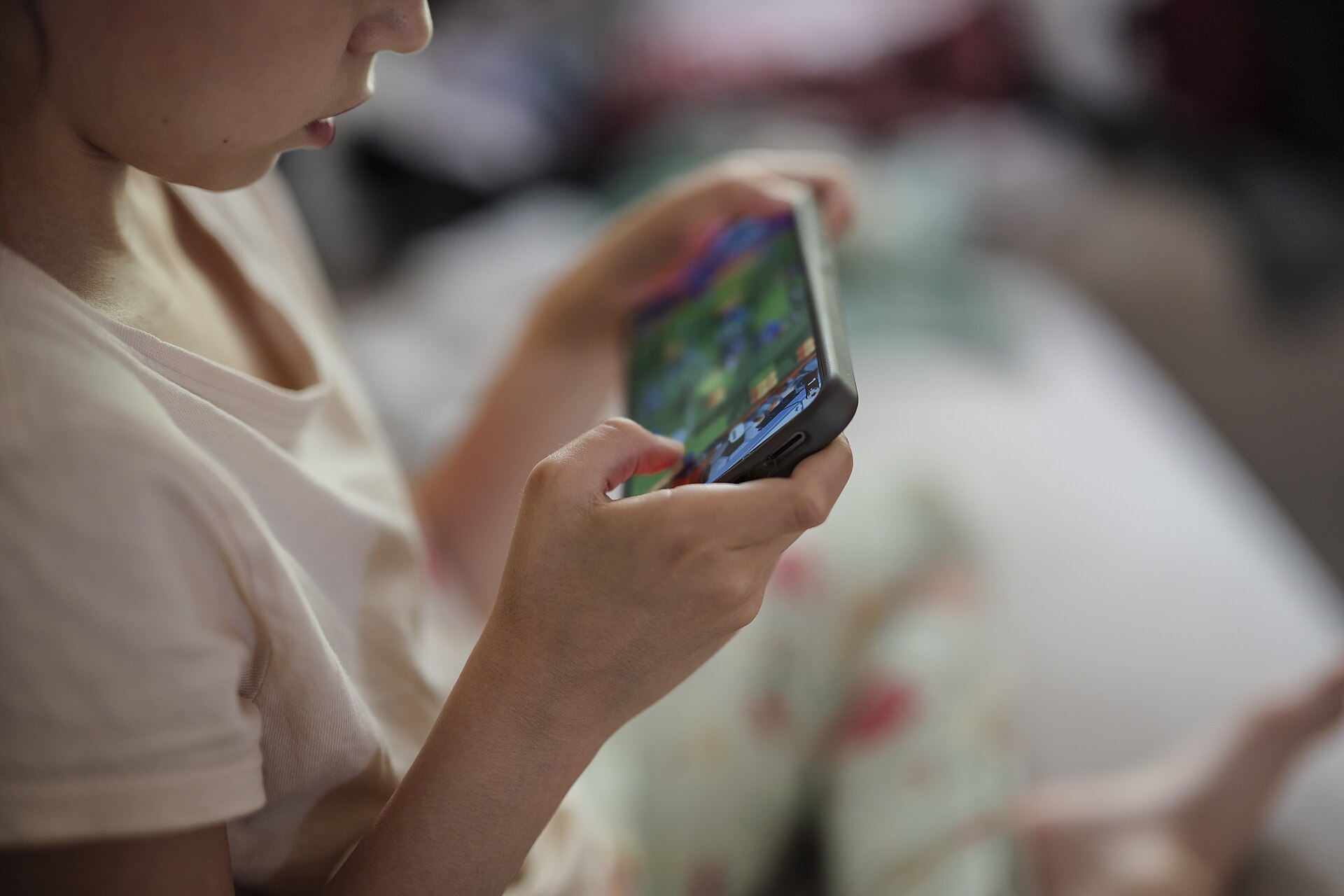
It deserves a straight answer, and the straight answer has three parts. Something is measurable. It is far smaller than the headlines say. And the part that matters most for a child growing into language is not the screen at all — it is what the hour replaced.
Everything below is sourced. Where the evidence is weak, this piece says so, because a parent making a decision is better served by an honest small number than a confident large one.
No study has ever taken a six-year-old, given them an hour a day for a decade, and scanned the result against a twin who got none. What exists is a great many studies measuring how children who use screens more differ, on average, from children who use them less — and those are not the same claim.
The size of the average difference is the part that gets lost. Orben and Przybylski (2019) took three large datasets covering more than 350,000 adolescents and asked how much of the variation in well-being digital technology use actually explains. The answer was at most 0.4 per cent. They benchmarked that against other things measured in the same surveys, and technology use landed in the company of items nobody writes headlines about — including, famously, eating potatoes.
The same paper explains why the field looks so contradictory. Across those three datasets there were over six hundred million defensible ways to run the analysis: which variables to include, which to control for, how to define screen time at all. Choose your path and you can produce a worrying result, a reassuring result, or nothing, entirely honestly. That is not a scandal; it is what happens when an effect is small and the data are rich.
So when someone tells you confidently what an hour a day will do to your child, they are not reporting a finding. They are reporting a path through one.
The imaging studies are real, and they are worth reading properly rather than through a headline.
Hutton and colleagues (2020) scanned 47 children aged three to five and found that higher scores on a screen-use questionnaire went with lower fractional anisotropy and higher radial diffusivity in white-matter tracts — among them the left arcuate, inferior longitudinal and uncinate fasciculi, which support language and emerging literacy. That is a genuine finding, and in exactly the tracts a language-minded parent would worry about. It is also forty-seven children, measured once, with no way to tell which came first.
Takeuchi and colleagues (2018) did something harder and more informative. They followed children of mean age eleven for about three years. Cross-sectionally they found nothing at all. Longitudinally, more frequent internet use went with a decrease in verbal intelligence and smaller increases in grey and white matter volume across widespread regions, including language areas. The lesson is not only the result — it is that the snapshot and the film disagreed, and the snapshot is what most studies take.
And the recurring caution: a brain that spent an hour on one thing differs from a brain that spent it on another. That is what brains are for. Different is a measurement; damaged is an interpretation, and the imaging literature does not license the step.
Here is the mechanism almost nobody disputes, and it has nothing to do with screens being toxic. An hour is an hour. Whatever it displaces is the thing that changes.
Sleep is the best-documented casualty. Hale and Guan (2015) reviewed sixty-seven studies and found screen time related to poorer sleep in the large majority of them. But even here the honest number is smaller than the alarm: Przybylski (2019), in a preregistered cohort study, found the association between screen use and children's sleep real but modest — an hour of use corresponded to a few minutes of sleep, not an hour of it.
For a six-year-old the timing matters more than the total. An hour after school and an hour in the half-hour before bed are the same number and not the same decision.
The second thing displaced is harder to see, and for anyone raising a child into language it is the one that counts.
Language does not arrive through exposure. It arrives through exchange.
Romeo and colleagues (2018) gave that a precise form. Recording children's home language environments and then scanning them, they found that the number of conversational turns — back-and-forth exchanges, not words heard — predicted activation in Broca's area during language processing, and that turn-taking, rather than sheer word count, accounted for the relationship between family income and children's language scores. What builds the language brain is the turn.
Which is why the displacement finding is sharper than it looks. Christakis and colleagues (2009) put recorders on 329 children aged 2 to 48 months for whole days and found that each hour of audible television was associated with roughly 770 fewer adult words heard by the child — between 500 and 1,000 per hour — along with reductions in the child's own vocalisations and in conversational turns. Kirkorian and colleagues (2009) showed the same in the lab: background television reduced both the quantity and the quality of parent–child interaction, even when nobody was watching it.
Zimmerman and colleagues (2009) closed the loop from the other side: adult–child conversation was associated with children's language development several times more strongly than adult speech the child merely overheard.
So the sentence a parent actually needs is not an hour of screens is bad. It is: an hour that costs turns costs more than an hour that costs anything else. A tablet used beside an adult who talks about it is a different intervention from the same tablet used alone in the next room.
Direction of causation is the usual objection — perhaps children who are already developing slowly get given more screen time. Madigan and colleagues (2019) tested it directly, following 2,441 children in Calgary at 24, 36 and 60 months with a cross-lagged panel model. Screen time at 24 and 36 months predicted poorer developmental screening scores at 36 and 60 months. The reverse path was not observed. The coefficient was small — but it pointed one way.
Massaroni and colleagues (2024) reviewed the language-development literature specifically and reached the conclusion the field keeps reaching: more screen time is associated with weaker early language outcomes, and the association weakens or reverses when the content is educational and an adult is co-viewing.
Content and company again, doing more work than the clock.
This one is squarely a learning question, and the evidence is unusually consistent.
Delgado and colleagues (2018) meta-analysed 54 studies and found reading comprehension better on paper than on screen — a small but consistent edge — with three qualifications worth knowing. The disadvantage showed up for expository text, the kind used in school, and not for narrative. It got worse under time pressure. And it did not shrink in younger cohorts: growing up with screens conferred no immunity. Clinton (2019) reviewed the question independently and found the same pattern.
For a six-year-old that converts into something concrete: a story on a screen is roughly a story. Reading to learn is better on paper, and will still be better on paper when they are sixteen.
Three reasons, and knowing them makes the disagreement much easier to read.
Measurement. Most studies use self-reported or parent-reported screen time, which corresponds only loosely to logged use. An entire literature is built on an estimate.
Analytic freedom, as above — six hundred million paths. And publication incentives: a study finding harm is news, a study finding nothing is a file drawer. Odgers and Jensen (2020), reviewing the field, concluded that the evidence for a strong link between digital technology and adolescent mental health was far weaker than public debate assumed. Odgers (2024), reviewing the most influential popular book on the subject in Nature, put it more bluntly: the causal story had outrun the data. Ferguson and colleagues (2022) reached a comparable conclusion by meta-analysis.
And one inconvenient result worth carrying. Paulich and colleagues (2021), using the ABCD cohort of 11,875 nine- and ten-year-olds, found screen time associated with worse mental health, more behavioural problems, poorer academic performance and worse sleep — but also with higher quality of peer relationships. And across every one of those outcomes, socioeconomic status was more strongly associated than screen time was. That is the real size of the lever you are holding.
In February 2026 the American Academy of Pediatrics replaced its previous media guidance with a new policy statement (Munzer and colleagues). It sets no universal hour limit. The Academy states plainly that there is not enough evidence that specific screen-time limits produce a benefit, and recommends attending to the quality of a child's interactions with digital media rather than the quantity alone.
That sounds more permissive. It is actually harder. An hour is easy to count. The things below are not, and they are what the evidence actually supports.
Protect sleep first. Keep the hour out of the bedroom and out of the run-up to bedtime. It is the best-documented effect and the most controllable one.
Then protect the turns. An hour spent beside an adult who talks about it is not an hour lost. An hour in the next room is. If the choice is between trimming the time and sitting down with them, sit down.
And separate the two kinds of reading. Stories on a screen are fine. Reading to learn goes on paper. As for the original question — an hour a day from age six, with sleep protected and someone to talk to, is almost certainly not the most consequential thing in that child's week. That is what the honest evidence says, and saying so is a reassurance rather than a permission.
The same article, told in plain words — for younger readers, or for anyone who wants the point quickly.
The question usually arrives from a parent, usually with some anxiety behind it: my child is six, they get about an hour a day on a phone or a tablet, what is that doing to their brain?
It deserves a straight answer, and the straight answer has three parts. Something is measurable. It is far smaller than the headlines say. And the part that matters most for a child growing into language is not the screen at all — it is what the hour replaced.
Everything below is sourced. Where the evidence is weak, this says so, because a parent making a decision is better served by an honest small number than a confident large one.
No study has ever taken a six-year-old, given them an hour a day for ten years, and scanned the result against a twin who got none. What exists is a great many studies measuring how children who use screens more differ, on average, from children who use them less. Those are not the same claim.
The size of the average difference is the part that gets lost. Orben and Przybylski (2019) took three large datasets covering more than 350,000 adolescents and asked how much of the variation in well-being digital technology use actually explains. The answer was at most 0.4 per cent. They compared it against other things measured in the same surveys, and technology use landed among items nobody writes headlines about — including, famously, eating potatoes.
The same paper explains why the field looks so contradictory. Across those three datasets there were over six hundred million defensible ways to run the analysis: which variables to include, which to control for, how to define screen time at all. Choose your path and you can produce a worrying result, a reassuring result, or nothing — entirely honestly. That is not a scandal. It is what happens when an effect is small and the data are rich.
So when someone tells you confidently what an hour a day will do to your child, they are not reporting a finding. They are reporting one path through one.
The imaging studies are real, and worth reading properly rather than through a headline.
Hutton and colleagues (2020) scanned 47 children aged three to five and found that higher scores on a screen-use questionnaire went with changes in white-matter tracts — among them tracts that support language and emerging literacy. That is a genuine finding, and in exactly the places a language-minded parent would worry about. It is also forty-seven children, measured once, with no way to tell which came first.
Takeuchi and colleagues (2018) did something harder and more informative. They followed children of average age eleven for about three years. In the snapshot they found nothing at all. Over time, more frequent internet use went with a decrease in verbal intelligence and smaller increases in grey and white matter across widespread regions, including language areas. The lesson is not only the result. It is that the snapshot and the film disagreed — and the snapshot is what most studies take.
And the caution that keeps returning: a brain that spent an hour on one thing differs from a brain that spent it on another. That is what brains are for. Different is a measurement; damaged is an interpretation, and the imaging literature does not license the step.
Here is the mechanism almost nobody disputes, and it has nothing to do with screens being toxic. An hour is an hour. Whatever it displaces is the thing that changes.
Sleep is the best-documented casualty. Hale and Guan (2015) reviewed sixty-seven studies and found screen time related to poorer sleep in the large majority of them. But even here the honest number is smaller than the alarm: Przybylski (2019), in a preregistered cohort study, found the link between screen use and children's sleep real but modest — an hour of use corresponded to a few minutes of sleep, not an hour of it.
For a six-year-old the timing matters more than the total. An hour after school and an hour in the half-hour before bed are the same number and not the same decision.
The second thing displaced is harder to see, and for anyone raising a child into language it is the one that counts.
Language does not arrive through exposure. It arrives through exchange.
Romeo and colleagues (2018) gave that a precise form. Recording children's home language environments and then scanning them, they found that the number of conversational turns — back-and-forth exchanges, not words heard — predicted activation in Broca's area during language processing. And it was turn-taking, rather than sheer word count, that accounted for the relationship between family income and children's language scores. What builds the language brain is the turn.
Which is why the displacement finding is sharper than it looks. Christakis and colleagues (2009) put recorders on 329 children aged 2 to 48 months for whole days and found that each hour of audible television was associated with roughly 770 fewer adult words heard by the child — between 500 and 1,000 per hour — along with reductions in the child's own vocalisations and in conversational turns. Kirkorian and colleagues (2009) showed the same in the lab: background television reduced both the quantity and the quality of parent–child interaction, even when nobody was watching it.
Zimmerman and colleagues (2009) closed the loop from the other side: adult–child conversation was associated with children's language development several times more strongly than adult speech the child merely overheard.
So the sentence a parent actually needs is not an hour of screens is bad. It is: an hour that costs turns costs more than an hour that costs anything else. A tablet used beside an adult who talks about it is a different intervention from the same tablet used alone in the next room.
Direction of causation is the usual objection — perhaps children who are already developing slowly get given more screen time. Madigan and colleagues (2019) tested it directly, following 2,441 children in Calgary at 24, 36 and 60 months. Screen time at 24 and 36 months predicted poorer developmental screening scores at 36 and 60 months. The reverse path was not observed. The coefficient was small — but it pointed one way.
Massaroni and colleagues (2024) reviewed the language-development literature specifically and reached the conclusion the field keeps reaching: more screen time is associated with weaker early language outcomes, and the association weakens or reverses when the content is educational and an adult is watching alongside.
Content and company again, doing more work than the clock.
This one is squarely a learning question, and the evidence is unusually consistent.
Delgado and colleagues (2018) meta-analysed 54 studies and found reading comprehension better on paper than on screen, with three qualifications worth knowing. The disadvantage showed up for expository text — the kind used in school — and not for narrative. It got worse under time pressure. And it did not shrink in younger cohorts: growing up with screens conferred no immunity. Clinton (2019) reviewed the question independently and found the same pattern.
For a six-year-old that converts into something concrete: a story on a screen is roughly a story. Reading to learn is better on paper, and will still be better on paper when they are sixteen.
Three reasons, and knowing them makes the disagreement much easier to read.
Measurement. Most studies use screen time reported by the parent or the child, which corresponds only loosely to logged use. An entire literature is built on an estimate.
Analytic freedom, as above — six hundred million paths.
Publication incentives. A study finding harm is news; a study finding nothing is a file drawer. Odgers and Jensen (2020), reviewing the field, concluded that the evidence for a strong link between digital technology and adolescent mental health was far weaker than public debate assumed. Odgers (2024), reviewing the most influential popular book on the subject in Nature, put it more bluntly: the causal story had outrun the data. Ferguson and colleagues (2022) reached a comparable conclusion by meta-analysis.
And one inconvenient result worth carrying. Paulich and colleagues (2021), using a cohort of 11,875 nine- and ten-year-olds, found screen time associated with worse mental health, more behavioural problems, poorer academic performance and worse sleep — but also with higher quality of peer relationships. And across every one of those outcomes, socioeconomic status was more strongly associated than screen time was. That is the real size of the lever you are holding.
In February 2026 the American Academy of Pediatrics replaced its previous media guidance with a new policy statement. It sets no universal hour limit. The Academy states plainly that there is not enough evidence that specific screen-time limits produce a benefit, and recommends attending to the quality of a child's interactions with digital media rather than the quantity alone.
That sounds more permissive. It is actually harder. An hour is easy to count. The things below are not, and they are what the evidence actually supports.
Protect sleep first. Keep the hour out of the bedroom and out of the run-up to bedtime. It is the best-documented effect and the most controllable one.
Then protect the turns. An hour spent beside an adult who talks about it is not an hour lost. An hour in the next room is. If the choice is between trimming the time and sitting down with them, sit down.
And separate the two kinds of reading. Stories on a screen are fine. Reading to learn goes on paper.
As for the original question — an hour a day from age six, with sleep protected and someone to talk to, is almost certainly not the most consequential thing in that child's week. That is what the honest evidence says, and saying so is a reassurance rather than a permission.
These articles summarize well-established research in learning science and linguistics. Key sources and further reading:
The question assumes focus is a muscle you train. The strongest evidence says the training barely carries over, and the...
No time, no talent, too old — those are explanations, not causes. What can be measured is duller: one sentence with a ti...
Not one event but four, running on clocks a billion-fold apart: a wave at 400 milliseconds, a word locked in overnight,...
