At which stage does a vocabulary notebook actually earn its keep?
Almost every language learner has bought a vocabulary notebook, filled it for three weeks and abandoned it. The right question is not whether notebooks work, but at which stage they earn their keep. The answer is reasonably clear, and it rests on the arithmetic of word frequency.
AI Aggregated source·August 2, 2026·11 min read·Words & skills
Almost every language learner has owned one. Bought, ruled into neat columns, filled diligently for about three weeks, then left in a drawer.
The usual reaction is self-blame: I lack discipline.
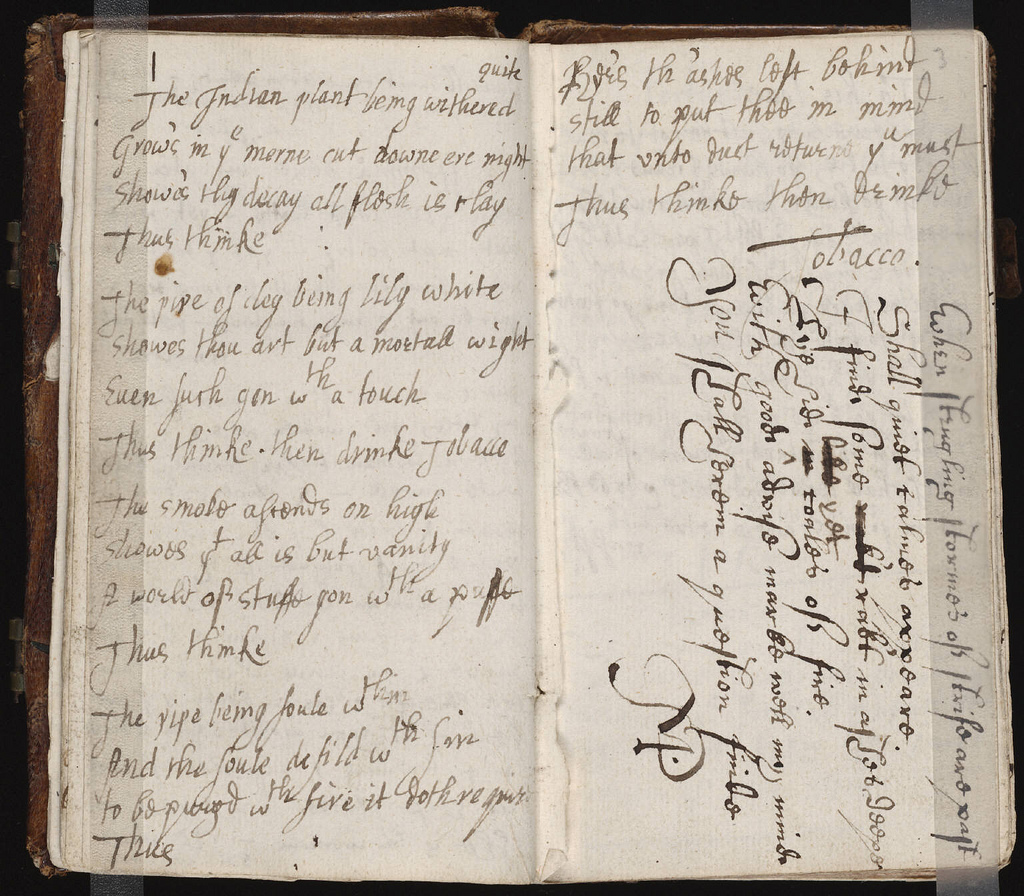
A commonplace book from the 1600s. Note the margin: it is an index. These were built to be read back, which is the one feature most vocabulary notebooks leave out — and the reason they are abandoned rather than the owner's discipline.Source: Beinecke Flickr Laboratory — CC BY 2.0, Wikimedia Commons
There is another possibility, and it is true more often: the notebook was started at the wrong stage. At some points in learning a language, recording vocabulary is close to wasted effort. At another point it is difficult to replace. And the line between them is not a matter of taste — it is arithmetic.
A notebook does two jobs, and you are only thinking about one
Research on note-taking separated these long ago. Di Vesta and Gray (1972) distinguished two functions:
Encoding — the act of writing helps you learn, because you have to select, rephrase and organise.
External storage — the notebook holds the information so you can come back to it.
Both are real. But Kiewra and colleagues (1991) showed that most of the practical benefit sits in the reviewing, not the writing. Notes never reopened retain some encoding value — considerably less than the person writing them assumes.
That is the pivot of this whole article. Most learners believe they are learning a word when they copy it into a notebook. They are storing it. And a store that is never opened is not a learning tool; it is a diary.
This does not make the writing pointless. The generation effect (Slamecka and Graf, 1978) is real: what you produce yourself is remembered better than what you merely read. Copying out a dictionary definition generates almost nothing. Writing your own example sentence generates a great deal.
The arithmetic that decides the stage
This is the part that answers the question directly.
Vocabulary in every language is distributed extremely unevenly. A small set of words accounts for most of any text, and the tail is very long and very thin. Following Nation's figures, the first 2,000 word families already account for something like 80–85% of the running words in general writing, and more in speech. But reaching 98% — the threshold for comfortable unassisted reading — takes roughly 8,000–9,000 word families.
Look closely at that gap. Going from 2,000 to 8,000 means six thousand words, and every one of them is rare. That is the entire problem.
Early on, frequency does your repetition for you. A word in the most common thousand will hit you dozens of times over the next few weeks whether you record it or not. You do not need to capture it; the language will keep reminding you. Writing these words down mostly duplicates work that frequency was already doing for free.
In the middle, frequency abandons you. A word at the 4,000–6,000 level might surface once every few weeks. Meet it once without recording it and it is almost certainly gone. This is the zone where if you do not catch it, nobody catches it.
Put simply: a vocabulary notebook is needed exactly where frequency stops doing the work for you.
Stage one — beginner: mostly no
This conclusion runs against intuition, so it needs saying plainly.
At beginner level what you need is a word list that has been chosen for you by frequency and repeated systematically — which means a decent course or a graded deck. Here, someone else has selected the words, and they have selected better than you would, because you have no basis yet for knowing which words deserve to come first.
A self-made notebook at this stage usually produces a mixed bag: a few very common words alongside random ones you happened to bump into, in no order of priority.
But there is one important exception, and it is bigger than it looks. From day one, record the words that belong to your own life: your job, the food you actually order, the things in your flat, your hobbies. No course contains them, and you need them almost every time you open your mouth. Call it the personal list — small, individual, and worth far more than its size.
Stage two — intermediate: this is the notebook's home
If this article has one answer, it is this one. A vocabulary notebook does the most work between roughly 2,000 and 6,000 word families — precisely the zone learners describe as the intermediate plateau.
That plateau is largely a statistical phenomenon rather than a psychological state. Early on, every word you learn visibly improves comprehension, because you are filling in high-frequency gaps. In the middle, each new word contributes much less — so progress feels like it has stopped even while it continues. At the same time the new words are arriving more sparsely, so without a capture mechanism you really do stall.
This is also where the research is most supportive. Schmitt and Schmitt (1995) set out the theoretical case for vocabulary notebooks as a tool for gradually expanding what you know about a word, rather than a two-column list. Walters and Bozkurt (2009) tested it and found measurable benefits for intermediate learners who kept notebooks compared with those who did not.
Stage three — advanced: the notebook survives but changes content
At an advanced level the notebook is still needed, but what belongs in it has changed completely.
Your problem is no longer what a word means. You can look that up in seconds. Your problem is now:
Collocation. You know heavy and you know rain, but is it heavy rain and not strong rain? That knowledge is not in any definition.
Register and nuance. Which word works in a work email, which only with friends, which is grammatical but nobody says.
The places you nearly got it wrong. At this level progress lives in the gap between correct and natural.
So the notebook shifts from a word book to a phrase book. The unit of capture is no longer a word but a chunk several words long.
But the real trigger is not a number
Those three stages are useful for orientation, but there is a far more precise signal, and it has nothing to do with how many words you know:
You need a notebook from the moment your input stops being curated.
Inside a course, somebody has already chosen the words, ordered them, and deliberately brought them back in later units. You are being served a review system without noticing.
The moment you step outside — reading novels, watching without subtitles, working in the language, talking to native speakers — nobody is selecting and nobody is recycling. Words arrive at random, once, and then vanish.
That is when a notebook moves from nice-to-have to load-bearing.
Why nearly every notebook dies
Four reasons, and none of them is lack of discipline.
It is write-only. This is the big one. People copy diligently and never reopen it. And as Kiewra showed, most of the benefit is in the reopening.
It has no spacing mechanism. A linear notebook has no idea which words you should see again today. Meanwhile the spacing effect (Cepeda and colleagues, 2006) is among the most secure findings in learning science. The notebook can store, but it cannot schedule.
It records too much. Capturing every unknown word turns the notebook into a bad dictionary. The real skill is selection: is this word common enough that I will meet it again? Does it belong to my life? If neither, let it go.
It copies dictionary definitions. This is the lowest-involvement act available. Laufer and Hulstijn (2001) proposed the involvement load hypothesis: the more a task demands need, search and evaluation, the better the retention. Copying a definition verbatim scores near zero on all three.
A warning that contradicts school habit
There is a striking and under-known finding here. Barcroft (2006) showed that being forced to write out a new word at first encounter can actually reduce how well it is learned, compared with simply attending to its form and meaning.
The explanation appears to be resource allocation: at first encounter, cognitive resources should go into binding form to meaning. Copying it out repeatedly pulls those resources across to processing the written form and thins out the semantic work.
This lands directly on the write-it-ten-times drill common in schools everywhere. If you were ever made to fill a page with the same word, this is evidence that the futility you felt at the time was well founded.
The practical consequence: at first encounter, understand the word — do not copy it ten times. Writing belongs to the later encounters, when you are trying to recall it, not when you are meeting it.
Paper or app?
This question matters less than people think, and the evidence is weaker than people think.
The famous study by Mueller and Oppenheimer (2014) — longhand beats typing because writing forces you to summarise — is cited everywhere. But Morehead, Dunlosky and Rawson (2019) ran a larger replication and did not reproduce the key findings. The honest position is that the handwriting advantage is smaller and shakier than folklore holds.
Two other things matter far more: whether capture is fast enough that you actually do it, and whether the notebook connects to something that schedules review.
There is one notable exception: Chinese characters. Here handwriting has a specific case — Longcamp's research found that the act of writing by hand contributes to recognising letter shapes. With characters, what distinguishes near-identical forms is stroke order and component structure, and only handwriting forces you to attend to either.
A notebook and a flashcard system are different tools
This is where most people go wrong, and fixing it solves most of the problems above.
The notebook is a capture device. Its job is to record fast, on the spot, in real context, before you forget. It is allowed to be quick and messy.
The card system is a review device. Its job is to bring the word back just as you are about to forget it, and to make you retrieve rather than reread — the testing effect of Roediger and Karpicke (2006).
Notebooks fail when asked to do both. Flashcards fail when asked to do the capturing, because nobody pauses mid-conversation to compose a well-made card.
The working arrangement is a two-step pipeline: capture into the notebook daily, transfer into cards once a week. That weekly transfer is where you are forced to select — and it is also the second look that Kiewra was talking about. It is not admin; it is the learning.
And Elgort (2011) showed that deliberate card learning does not merely produce exam knowledge: it produces genuine lexical representations that function in automatic language processing.
What actually goes in an entry
The principle: maximise involvement, minimise mechanical copying.
The sentence you actually met it in. Not the dictionary's example. A real one carries both context and an episodic hook to where you read it.
One sentence of your own. This is the most valuable component and the most commonly skipped. It forces you to evaluate where the word can be used.
One or two collocations. What this word tends to travel with.
The source. One word: the book, the film, the person. This episodic hook is cheap and surprisingly effective.
And here is what not to write: full part-of-speech tables, a phonetic transcription copied from a dictionary that you will never read back, every sense of the word. All three take space, cost time, and nobody returns to them.
In short
Beginner: no full notebook yet. Use a course or a frequency-ordered deck. Keep only a small personal list of words that belong to your own life.
Intermediate (roughly 2,000–6,000 words): this is when it matters most. Capture selectively, transfer to cards weekly, review with spacing.
Advanced: keep it, but record chunks rather than words — collocations, register, and the places you nearly got it wrong.
Every stage: if you have no plan to reopen it, do not write in it. An unreviewed notebook is just a slower, handwritten way of forgetting.
So the original question — at which stage is a notebook needed — has a compact answer: at the stage where the language stops repeating itself to you. Before that, frequency does the work. After that, only you do.
Read the simple version
The same article, told in plain words — for younger readers, or for anyone who wants the point quickly.
Almost every language learner has owned one. Bought, ruled into neat columns, filled diligently for about three weeks, then left in a drawer.
The usual reaction is self-blame: I lack discipline.
There is another possibility, and it is true more often: the notebook was started at the wrong stage. At some points in learning a language, recording vocabulary is close to wasted effort. At another point it is difficult to replace. And the line between them is not a matter of taste — it is arithmetic.
A notebook does two jobs, and you are only thinking about one
Di Vesta and Gray (1972) distinguished two functions of note-taking:
Encoding — the act of writing helps you learn, because you have to select, rephrase and organise. External storage — the notebook holds the information so you can come back to it.
Both are real. But Kiewra and colleagues (1991) showed that most of the practical benefit sits in the reviewing, not the writing. Notes never reopened retain some encoding value — considerably less than the person writing them assumes.
That is the pivot of this whole article. Most learners believe they are learning a word when they copy it into a notebook. They are storing it. And a store that is never opened is not a learning tool; it is a diary.
This does not make the writing pointless. The generation effect (Slamecka and Graf, 1978) is real: what you produce yourself is remembered better than what you merely read. Copying out a dictionary definition generates almost nothing. Writing your own example sentence generates a great deal.
The arithmetic that decides the stage
Vocabulary in every language is distributed extremely unevenly. Following Nation's figures, the first 2,000 word families already account for something like 80–85% of the running words in general writing, and more in speech. But reaching 98% — the threshold for comfortable unassisted reading — takes roughly 8,000–9,000 word families.
Look closely at that gap. Going from 2,000 to 8,000 means six thousand words, and every one of them is rare. That is the entire problem.
Early on, frequency does your repetition for you. A word in the most common thousand will hit you dozens of times over the next few weeks whether you record it or not. You do not need to capture it; the language will keep reminding you.
In the middle, frequency abandons you. A word at the 4,000–6,000 level might surface once every few weeks. Meet it once without recording it and it is almost certainly gone. This is the zone where if you do not catch it, nobody catches it.
Put simply: a vocabulary notebook is needed exactly where frequency stops doing the work for you.
Stage one — beginner: mostly no
This conclusion runs against intuition, so it needs saying plainly.
At beginner level what you need is a word list that has been chosen for you by frequency and repeated systematically — a decent course or a graded deck. Here, someone else has selected the words, and they have selected better than you would, because you have no basis yet for knowing which words deserve to come first.
A self-made notebook at this stage usually produces a mixed bag: a few very common words alongside random ones you happened to bump into, in no order of priority.
But there is one important exception, and it is bigger than it looks. From day one, record the words that belong to your own life: your job, the food you actually order, the things in your flat, your hobbies. No course contains them, and you need them almost every time you open your mouth. Call it the personal list — small, individual, and worth far more than its size.
Stage two — intermediate: this is the notebook's home
If this article has one answer, it is this one. A vocabulary notebook does the most work between roughly 2,000 and 6,000 word families — precisely the zone learners describe as the intermediate plateau.
That plateau is largely a statistical phenomenon rather than a psychological state. Early on, every word you learn visibly improves comprehension, because you are filling in high-frequency gaps. In the middle, each new word contributes much less — so progress feels like it has stopped even while it continues. At the same time the new words are arriving more sparsely, so without a capture mechanism you really do stall.
This is also where the research is most supportive. Schmitt and Schmitt (1995) set out the case for vocabulary notebooks as a tool for gradually expanding what you know about a word, rather than a two-column list. Walters and Bozkurt (2009) tested it and found measurable benefits for intermediate learners who kept notebooks compared with those who did not.
Stage three — advanced: the notebook survives but changes content
At an advanced level the notebook is still needed, but what belongs in it has changed completely.
Your problem is no longer what a word means. You can look that up in seconds. Your problem is now:
Collocation. You know heavy and you know rain, but is it heavy rain and not strong rain? That knowledge is not in any definition.
Register and nuance. Which word works in a work email, which only with friends, which is grammatical but nobody says.
The places you nearly got it wrong. At this level progress lives in the gap between correct and natural.
So the notebook shifts from a word book to a phrase book. The unit of capture is no longer a word but a chunk several words long.
But the real trigger is not a number
Those three stages are useful for orientation, but there is a far more precise signal, and it has nothing to do with how many words you know:
You need a notebook from the moment your input stops being curated.
Inside a course, somebody has already chosen the words, ordered them, and deliberately brought them back in later units. You are being served a review system without noticing.
The moment you step outside — reading novels, watching without subtitles, working in the language, talking to native speakers — nobody is selecting and nobody is recycling. Words arrive at random, once, and then vanish.
That is when a notebook moves from nice-to-have to load-bearing.
Why nearly every notebook dies
Four reasons, and none of them is lack of discipline.
It is write-only. This is the big one. People copy diligently and never reopen it. And as Kiewra showed, most of the benefit is in the reopening.
It has no spacing mechanism. A linear notebook has no idea which words you should see again today. Meanwhile the spacing effect (Cepeda and colleagues, 2006) is among the most secure findings in learning science. The notebook can store, but it cannot schedule.
It records too much. Capturing every unknown word turns the notebook into a bad dictionary. The real skill is selection: is this word common enough that I will meet it again? Does it belong to my life? If neither, let it go.
It copies dictionary definitions. This is the lowest-involvement act available. Laufer and Hulstijn (2001) proposed the involvement load hypothesis: the more a task demands need, search and evaluation, the better the retention. Copying a definition verbatim scores near zero on all three.
A warning that contradicts school habit
There is a striking and under-known finding here. Barcroft (2006) showed that being forced to write out a new word at first encounter can actually reduce how well it is learned, compared with simply attending to its form and meaning.
The explanation appears to be resource allocation: at first encounter, cognitive resources should go into binding form to meaning. Copying it out repeatedly pulls those resources across to processing the written form and thins out the semantic work.
This lands directly on the write-it-ten-times drill common in schools everywhere. If you were ever made to fill a page with the same word, this is evidence that the futility you felt at the time was well founded.
The practical consequence: at first encounter, understand the word — do not copy it ten times. Writing belongs to the later encounters, when you are trying to recall it, not when you are meeting it.
Paper or app?
This question matters less than people think, and the evidence is weaker than people think.
The famous study by Mueller and Oppenheimer (2014) — longhand beats typing because writing forces you to summarise — is cited everywhere. But Morehead, Dunlosky and Rawson (2019) ran a larger replication and did not reproduce the key findings. The honest position is that the handwriting advantage is smaller and shakier than folklore holds.
Two other things matter far more: whether capture is fast enough that you actually do it, and whether the notebook connects to something that schedules review.
There is one notable exception: Chinese characters. Here handwriting has a specific case — Longcamp's research found that the act of writing by hand contributes to recognising letter shapes. With characters, what distinguishes near-identical forms is stroke order and component structure, and only handwriting forces you to attend to either.
A notebook and a flashcard system are different tools
This is where most people go wrong, and fixing it solves most of the problems above.
The notebook is a capture device. Its job is to record fast, on the spot, in real context, before you forget. It is allowed to be quick and messy.
The card system is a review device. Its job is to bring the word back just as you are about to forget it, and to make you retrieve rather than reread — the testing effect of Roediger and Karpicke (2006).
Notebooks fail when asked to do both. Flashcards fail when asked to do the capturing, because nobody pauses mid-conversation to compose a well-made card.
The working arrangement is a two-step pipeline: capture into the notebook daily, transfer into cards once a week. That weekly transfer is where you are forced to select — and it is also the second look that Kiewra was talking about. It is not admin; it is the learning.
And Elgort (2011) showed that deliberate card learning does not merely produce exam knowledge: it produces genuine lexical representations that function in automatic language processing.
What actually goes in an entry
The principle: maximise involvement, minimise mechanical copying.
The sentence you actually met it in. Not the dictionary's example. A real one carries both context and an episodic hook to where you read it.
One sentence of your own. This is the most valuable component and the most commonly skipped. It forces you to evaluate where the word can be used.
One or two collocations. What this word tends to travel with.
The source. One word: the book, the film, the person. This episodic hook is cheap and surprisingly effective.
And here is what not to write: full part-of-speech tables, a phonetic transcription copied from a dictionary that you will never read back, every sense of the word. All three take space, cost time, and nobody returns to them.
In short
Beginner: no full notebook yet. Use a course or a frequency-ordered deck. Keep only a small personal list of words that belong to your own life.
Intermediate (roughly 2,000–6,000 words): this is when it matters most. Capture selectively, transfer to cards weekly, review with spacing.
Advanced: keep it, but record chunks rather than words — collocations, register, and the places you nearly got it wrong.
Every stage: if you have no plan to reopen it, do not write in it. An unreviewed notebook is just a slower, handwritten way of forgetting.
So the original question — at which stage is a notebook needed — has a compact answer: at the stage where the language stops repeating itself to you. Before that, frequency does the work. After that, only you do.
Sources & further reading
These articles summarize well-established research in learning science and linguistics. Key sources and further reading:
Di Vesta, F. J., & Gray, G. S. (1972). Listening and note taking. Journal of Educational Psychology, 63(1), 8–14.
Kiewra, K. A., DuBois, N. F., Christian, D., et al. (1991). Note-taking functions and techniques. Journal of Educational Psychology, 83(2), 240–245.
Slamecka, N. J., & Graf, P. (1978). The generation effect: Delineation of a phenomenon. Journal of Experimental Psychology: Human Learning and Memory, 4(6), 592–604.
Schmitt, N., & Schmitt, D. (1995). Vocabulary notebooks: theoretical underpinnings and practical suggestions. ELT Journal, 49(2), 133–143.
Walters, J., & Bozkurt, N. (2009). The effect of keeping vocabulary notebooks on vocabulary acquisition. Language Teaching Research, 13(4), 403–423.
Laufer, B., & Hulstijn, J. (2001). Incidental vocabulary acquisition in a second language: The construct of task-induced involvement. Applied Linguistics, 22(1), 1–26.
Barcroft, J. (2006). Can writing a new word detract from learning it? More negative effects of forced output during vocabulary learning. Second Language Research, 22(4), 487–497.
Nation, I. S. P. (2006). How large a vocabulary is needed for reading and listening? Canadian Modern Language Review, 63(1), 59–82.
Nation, I. S. P. (2013). Learning Vocabulary in Another Language (2nd ed.). Cambridge: Cambridge University Press.
Elgort, I. (2011). Deliberate learning and vocabulary acquisition in a second language. Language Learning, 61(2), 367–413.
Roediger, H. L., & Karpicke, J. D. (2006). Test-enhanced learning: Taking memory tests improves long-term retention. Psychological Science, 17(3), 249–255.
Cepeda, N. J., Pashler, H., Vul, E., Wixted, J. T., & Rohrer, D. (2006). Distributed practice in verbal recall tasks: A review and quantitative synthesis. Psychological Bulletin, 132(3), 354–380.
Mueller, P. A., & Oppenheimer, D. M. (2014). The pen is mightier than the keyboard: Advantages of longhand over laptop note taking. Psychological Science, 25(6), 1159–1168.
Morehead, K., Dunlosky, J., & Rawson, K. A. (2019). How much mightier is the pen than the keyboard for note-taking? A replication and extension of Mueller and Oppenheimer (2014). Educational Psychology Review, 31, 753–780.
Longcamp, M., Zerbato-Poudou, M.-T., & Velay, J.-L. (2005). The influence of writing practice on letter recognition in preschool children: A comparison between handwriting and typing. Acta Psychologica, 119(1), 67–79.