Beautiful Literary Books That Make You Want to Learn a Language
There is a familiar trap: buy a beautiful novel in the language you are learning, stall on page three, and conclude you have no gift for languages. This piece splits the shelf in two and is honest about what each half does.
AI Aggregated source·August 5, 2026·7 min read·Reading
The trap goes like this.
You have been learning Japanese for a year. You see a Murakami with a beautiful cover, buy it, open it — and stall on page three. Every sentence needs three lookups. After twenty minutes you have covered a page and a half and remember none of it.
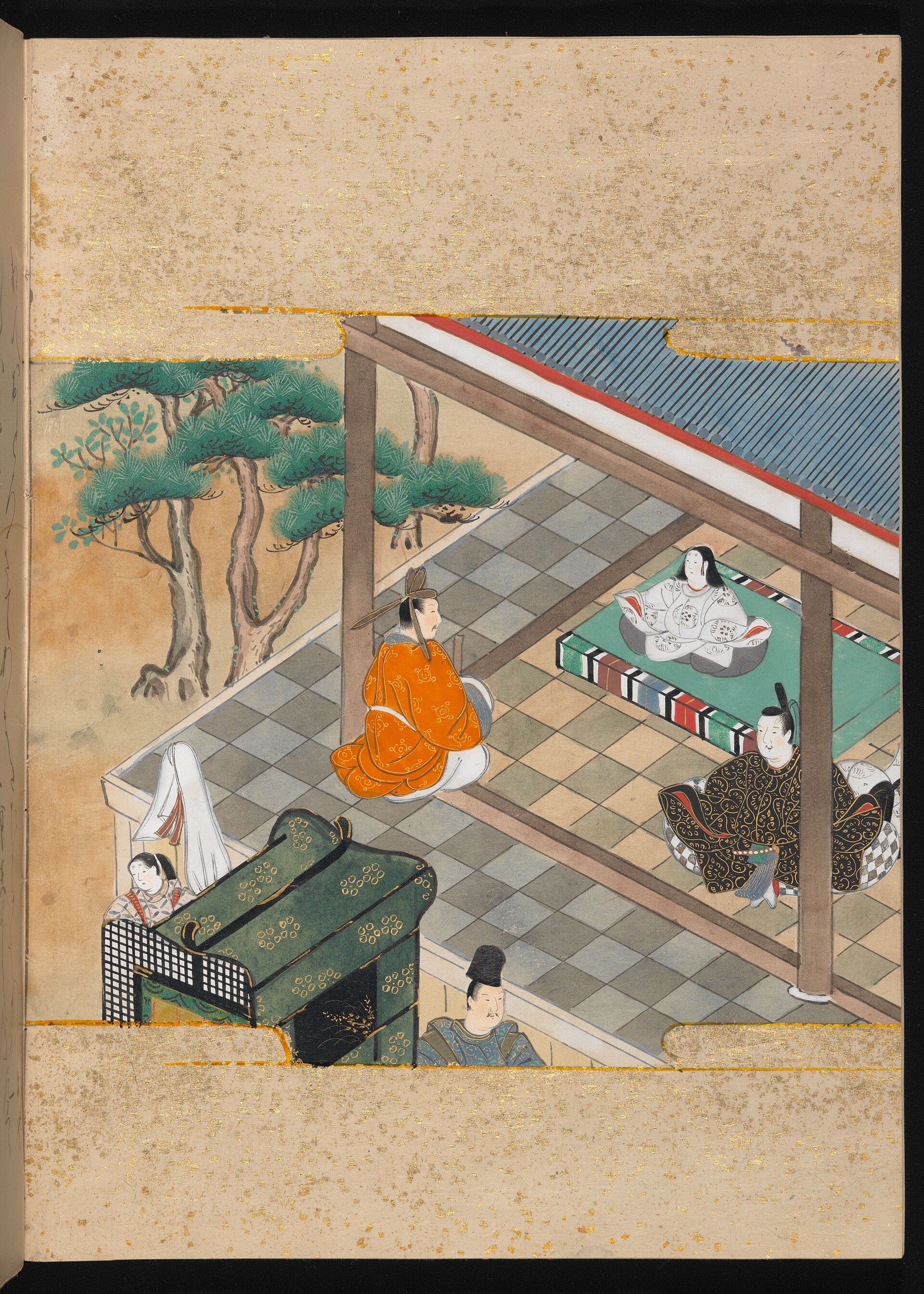
The Tale of Genji, in an Edo-period copy. The book that makes you want to learn the language is almost never the book you can read next — and knowing the difference between those two is what keeps the first one from ending the project.Source: Unknown Edo period artist — Public domain, Wikimedia Commons
And then you conclude you have no gift for languages.
That conclusion is wrong, and the numbers show why.
Hu and Nation (2000) put the threshold for comfortable reading at around 98 per cent of the words on the page already known. Nation (2006) estimates eight to nine thousand word families for reading a novel without lookups.
At intermediate level you have perhaps three or four thousand. That means roughly one word in ten is unknown — and what you are doing with that Murakami is not reading. It is decoding.
But the book is still beautiful, and the inspiration is still real.
The way out of that contradiction is a distinction most reading lists skip: inspiring you and training you are different jobs, and one book rarely does both well.
So split the shelf in two.
Shelf one: books for fuel
These you read in a language you already have. Their job is not to teach vocabulary. It is to make you want to continue on the day you are bored.
Jhumpa Lahiri — In altre parole (2015)
If you read only one book on this list, read this one.
Lahiri is a Bengali-American writer who won the Pulitzer in English. Then she moved to Rome, learned Italian, and did something almost nobody does: she abandoned English and wrote an entire book in Italian, a language she had learned as an adult.
And the sharpest detail is in the author's note: she could not bring herself to translate her own book into English. Ann Goldstein had to do it.
It is about the awkwardness of being an adult who speaks like a child, about loving a language that is not yours, about what it costs to change languages.
One further, entirely practical reason: the US edition is dual-language — Italian on the left, English on the right. It is at once the most inspiring book on this list and one of the few genuinely usable at intermediate level.
Eva Hoffman — Lost in Translation (1989)
Hoffman left Poland for Canada at thirteen. The memoir is about losing a self along with a language, and assembling a different one inside the new tongue.
There is a famous passage in which she writes that the English word river does not carry the weight of the Polish rzeka, because rzeka is attached to an actual river from childhood while river is merely a concept.
Anyone who has studied a language long enough knows that feeling: you understand the word without yet feeling it.
Xiaolu Guo — A Concise Chinese-English Dictionary for Lovers (2007)
This is the cleverest book here in terms of form.
It is a novel about a Chinese woman who comes to London to learn English, and it is written in her own broken English. As the book proceeds, the grammar straightens out and the vocabulary thickens.
The prose is the plot. You watch someone grow up inside a language, sentence by sentence.
Ngũgĩ wa Thiong'o — Decolonising the Mind (1986)
This Kenyan writer had an established career in English when he announced he would stop writing in it and work in Gikuyu instead.
The book treats language as an instrument of power. For a Vietnamese reader it echoes loudly: this site's language-history series covered Hán văn, chữ Nôm and quốc ngữ — and every time, the question of which language to write in was a political question.
Vladimir Nabokov — Speak, Memory (1966)
Nabokov switched from Russian to English and became one of the finest English prose writers of the twentieth century. He still called it a private tragedy.
Read it to understand that changing languages is not only a gain. It is also a loss.
Ted Chiang — Story of Your Life (1998)
The novella later became the film Arrival. It follows a linguist learning an alien language, and how that language changes the way she perceives time.
An honest note is needed here, because this is a site about learning science.
The premise is the strong form of the Sapir-Whorf hypothesis: that language determines thought. The strong form is not supported by the evidence. Real effects exist but are small and local — Boroditsky (2001) found differences in how Mandarin and English speakers conceive of time; Bloom and Keil (2001) push back on most of the stronger claims.
Read it as a magnificent piece of fiction. Do not read it as linguistics.
Shelf two: books to read in the target language
This shelf works differently. Here the criterion is not how good the book is but how well it fits.
The rule is simple: if a page has more than about five unknown words, that book is not for you today.
Japanese
Begin with よつばと!, a comic about a five-year-old. The dialogue is simple because the protagonist is a child, the pictures carry meaning, and furigana are supplied.
Intermediate: short stories by 村上春樹 — short sentences, heavily recycled vocabulary. Advanced: 夏目漱石.
Chinese
Begin with graded readers keyed to character counts, then children's fiction. Liu Cixin's 三体 is a worthy target but an advanced one — do not start there.
Vietnamese speakers have a particular advantage here: as this site's Chinese history article showed, the Hán-Việt layer hands you the meaning of a great many compounds before you study them.
Korean
Han Kang won the Nobel Prize in Literature in 2024 — the first South Korean writer to do so — cited for an intense poetic prose that confronts historical trauma.
채식주의자 is a major book. It is also an advanced one. Make it the target, not the first exercise.
Spanish
El principito is a translation, but a good starting point: short sentences, familiar material. García Márquez comes after.
Greek
Cavafy's poems. They are short, and that is a genuine advantage: poetry invites re-reading, and re-reading is what builds memory.
What reading actually delivers
This section is so you know what to expect.
Nakanishi (2015) meta-analysed extensive reading research and found consistent positive effects on both reading ability and vocabulary. Reading a lot does work.
But look at the rate. Waring and Takaki (2003) had learners read a graded reader and then tested them: most words met only once were not retained. Retention required repeated encounters.
Webb and Nation (2017) synthesise the mechanism: vocabulary is picked up through repeated meetings in context, not through one striking encounter.
And here is the consequence that runs against the instinct to keep buying books:
At lower levels, re-reading one book beats starting five. On the second pass you meet the same words in the same contexts, and this time they stick. Cepeda et al. (2006) show that spacing those repetitions out makes the memory more durable still.
Four things to let yourself do
Abandoning a book is not failure. It is a measurement. Either the book does not fit today's level, or you simply do not like it. Both are good reasons to put it down.
Do not look up every word. Looking up everything stops the reading and leaves you doing a vocabulary exercise. Look up the words that keep recurring — those are the ones worth having.
Re-read what you already know. The reason Harry Potter gets recommended is not that it is easy. It is that you already know what happens. A familiar plot carries the load your vocabulary cannot yet carry.
Try poetry. It is short, it rewards re-reading, and it does not require you to understand everything before it gives you something.
One more book
This list is all foreign books, so it should close with one from home.
Nguyễn Du's Truyện Kiều was written in chữ Nôm — a script that, as this site's Vietnamese history article described, Vietnamese readers today can no longer read directly.
You read it in quốc ngữ transcription. Which means that even the masterpiece of your own language reaches you through an intermediary layer.
That may be the truest reason to learn another language: not to add a skill to a CV, but to remove one layer of mediation between yourself and something you want to read.
Lahiri moved into Italian at forty-five. She wrote that she felt like a child learning to speak again.
Then she wrote a whole book in it.
Read the simple version
The same article, told in plain words — for younger readers, or for anyone who wants the point quickly.
The trap goes like this.
You have been learning Japanese for a year. You see a beautiful novel, buy it, open it — and stall on page three. Every sentence needs three lookups. After twenty minutes you have covered a page and a half and remember none of it.
And then you conclude you have no gift for languages.
That conclusion is wrong, and the numbers show why.
The number that explains the stall
Comfortable reading needs around 98% of the words on the page already known. Reading a novel without lookups needs something like eight to nine thousand word families.
At intermediate level you have perhaps three or four thousand. That means roughly one word in ten is unknown — and what you are doing with that novel is not reading. It is decoding.
But the book is still beautiful, and the inspiration is still real.
So split the shelf in two
The way out of that contradiction is a distinction most reading lists skip: inspiring you and training you are different jobs, and one book rarely does both well.
Shelf one: books for fuel. You read these in a language you already have. Their job is not to teach vocabulary. It is to make you want to continue on the day you are bored.
The best of them is Jhumpa Lahiri's In altre parole. She is a Bengali-American writer who won the Pulitzer in English. Then she moved to Rome, learned Italian, and did something almost nobody does: she abandoned English and wrote a whole book in a language she had learned as an adult.
And the sharpest detail is in the author's note — she could not bring herself to translate her own book into English. Someone else had to do it.
Shelf two: books for training. These you read in the language you are learning, and the rule is different: they should be below the level of the book that inspired you.
Start with a comic whose main character is a child, so the dialogue is simple and the pictures carry meaning. Then short stories with short sentences and heavily recycled vocabulary. The famous masterpiece is a target, not a first exercise.
What reading actually delivers
Reading a lot does work — the evidence for that is consistent. But look at the rate.
When learners read a graded reader and were tested afterwards, most words met only once were not retained. Retention required repeated encounters.
And here is the consequence, which runs against the instinct to keep buying books:
At lower levels, re-reading one book beats starting five. On the second pass you meet the same words in the same contexts, and this time they stick.
Four things to let yourself do
Abandoning a book is not failure. It is a measurement. Either the book does not fit today's level, or you simply do not like it. Both are good reasons to put it down.
Do not look up every word. Looking up everything stops the reading and leaves you doing a vocabulary exercise. Look up the words that keep recurring — those are the ones worth having.
Re-read what you already know. The reason a familiar children's series gets recommended is not that it is easy. It is that you already know what happens — and a familiar plot carries the load your vocabulary cannot yet carry.
Try poetry. It is short, it rewards re-reading, and it does not require you to understand everything before it gives you something.
One more book
This is all foreign books, so it should close with one from home.
Nguyễn Du's Truyện Kiều was written in chữ Nôm — a script Vietnamese readers today can no longer read directly. You read it in a transcription.
Which means that even the masterpiece of your own language reaches you through an intermediary layer.
That may be the truest reason to learn another language: not to add a line to a CV, but to remove one layer of mediation between yourself and something you want to read.
Lahiri moved into Italian at forty-five. She wrote that she felt like a child learning to speak again. Then she wrote a whole book in it.
Sources & further reading
These articles summarize well-established research in learning science and linguistics. Key sources and further reading:
Lahiri, J. (2015). In altre parole. Milan: Guanda. [English: In Other Words, trans. A. Goldstein, New York: Knopf, 2016, dual-language edition.]
Hoffman, E. (1989). Lost in Translation: A Life in a New Language. New York: E. P. Dutton.
Guo, X. (2007). A Concise Chinese-English Dictionary for Lovers. London: Chatto & Windus.
Tawada, Y. (2007). Exophony: Traveling Outward from Your Mother Tongue (エクソフォニー). Tokyo: Iwanami Shoten.
Ngũgĩ wa Thiong’o (1986). Decolonising the Mind: The Politics of Language in African Literature. London: James Currey.
Nabokov, V. (1966). Speak, Memory: An Autobiography Revisited. New York: G. P. Putnam’s Sons.
Canetti, E. (1977). Die gerettete Zunge: Geschichte einer Jugend. Munich: Carl Hanser Verlag.
Chiang, T. (1998). Story of Your Life. In Starlight 2. New York: Tor Books.
Carson, A. (2010). Nox. New York: New Directions.
Han, K. (2007). 채식주의자 [The Vegetarian]. Seoul: Changbi. [Nobel Prize in Literature, 2024.]
Nguyễn Du. Truyện Kiều (Đoạn trường tân thanh).
Cavafy, C. P. (1992). Collected Poems (trans. E. Keeley & P. Sherrard). Princeton, NJ: Princeton University Press.
Hu, M., & Nation, P. (2000). Unknown vocabulary density and reading comprehension. Reading in a Foreign Language, 13(1), 403–430.
Nation, I. S. P. (2006). How large a vocabulary is needed for reading and listening? Canadian Modern Language Review, 63(1), 59–82.
Nation, I. S. P. (2013). Learning Vocabulary in Another Language (2nd ed.). Cambridge: Cambridge University Press.
Nakanishi, T. (2015). A meta-analysis of extensive reading research. TESOL Quarterly, 49(1), 6–37.
Webb, S., & Nation, P. (2017). How Vocabulary is Learned. Oxford: Oxford University Press.
Waring, R., & Takaki, M. (2003). At what rate do learners learn and retain new vocabulary from reading a graded reader? Reading in a Foreign Language, 15(2), 130–163.
Day, R. R., & Bamford, J. (1998). Extensive Reading in the Second Language Classroom. Cambridge: Cambridge University Press.
Krashen, S. D. (2004). The Power of Reading: Insights from the Research (2nd ed.). Portsmouth, NH: Heinemann.
Cepeda, N. J., Pashler, H., Vul, E., Wixted, J. T., & Rohrer, D. (2006). Distributed practice in verbal recall tasks. Psychological Bulletin, 132(3), 354–380.
Boroditsky, L. (2001). Does language shape thought? Mandarin and English speakers’ conceptions of time. Cognitive Psychology, 43(1), 1–22.
Bloom, P., & Keil, F. C. (2001). Thinking through language. Mind & Language, 16(4), 351–367.
McQuillan, J. (2019). Where do we get our academic vocabulary? Comparing the efficiency of direct instruction and free voluntary reading. The Reading Matrix, 19(1), 129–138.
_from_Tale_of_Genji_(Genji_monogatari)_AR_J1038_01-054_56-f-26v.jpg)