Childhood amnesia, and what parents can actually do about it
Almost nobody remembers anything before three. The surprise is that this is not because the memories never formed — five-year-olds recall events from age three vividly, and by eight most of it is gone. This piece explains why, and sets out one intervention the research has shown to work causally.
Try something: ask any adult what their earliest memory is.
The answer will almost certainly land somewhere between three and four, and it will almost certainly be a fragment — a room, a smell, a moment with nothing before it and nothing after. Before that, nothing. Rubin (2000) pooled this distribution across studies and found one consistent shape: almost nothing before three, then a gradual rise to about seven.
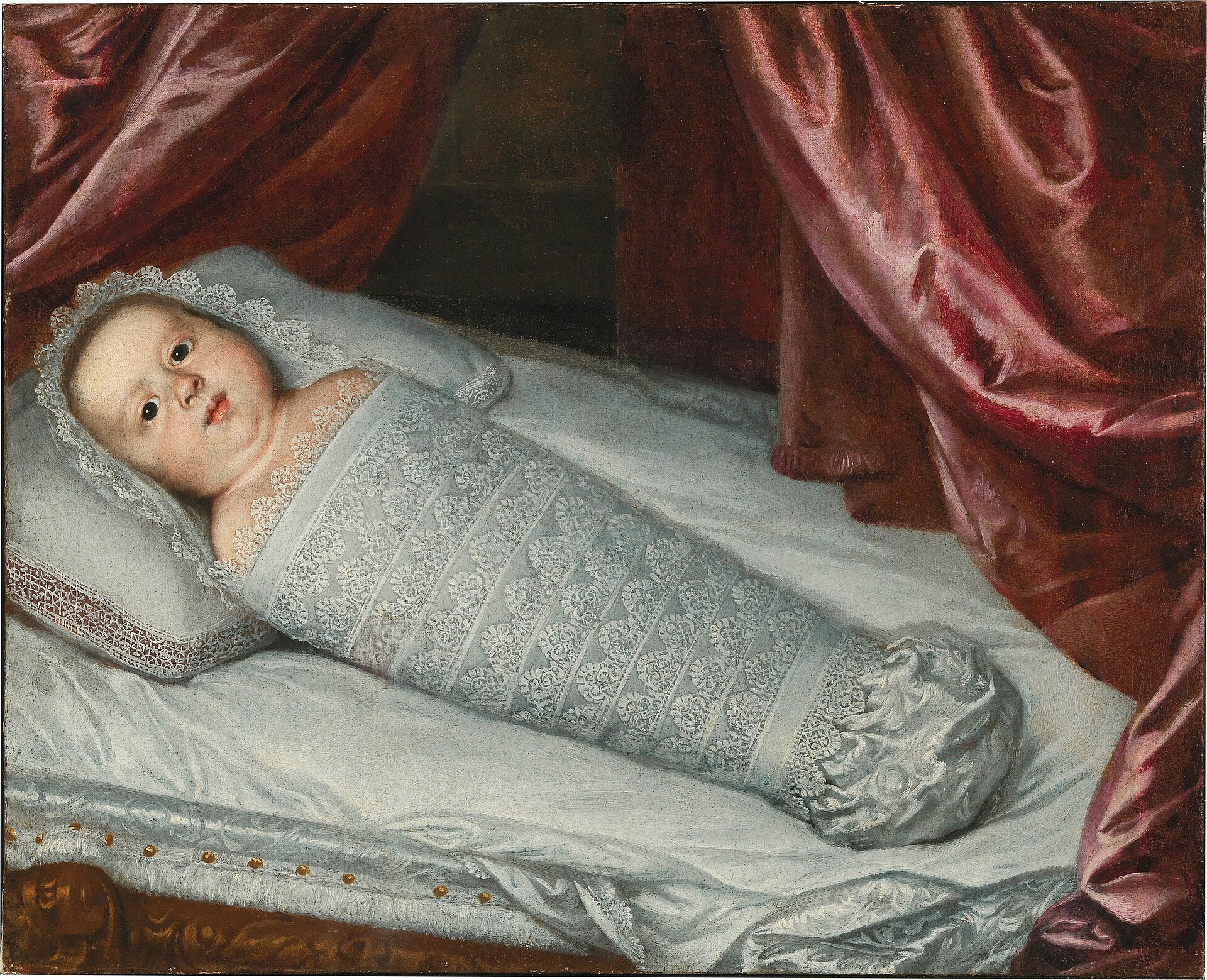
Someone thought this day worth an oil painting. The child himself would remember none of it — and that is not a defect being repaired later, it is how memory is built. What parents can affect is not whether these years are recalled but what they leave behind.Source: Justus Sustermans — Public domain, Wikimedia Commons
The phenomenon is called childhood amnesia. It is universal, it is normal, and the most surprising thing about it is not that we forget.
Freud named it, and Freud got it wrong
It was Freud who coined infantile amnesia, and he attributed it to repression: those memories were too full of conflict, so they were pushed under.
That account has been abandoned. There is no evidence that the content of a two-year-old’s memories is disturbing enough to require repression, and what has been found since points somewhere else entirely — and far more interesting.
The memories did form. They get erased afterwards
This is the finding that overturns the intuitive picture, and it comes from a carefully built design.
Patricia Bauer and Marina Larkina (2014) did not ask adults about their childhoods. They recorded events as they happened to three-year-olds, then came back to those same children at different ages.
The result:
Children aged five to seven recalled 63–72% of those events. They remembered well. The memories existed, with detail, and could be told.
Children aged eight to nine recalled about 35%.
In other words: childhood amnesia does not happen at two. It happens at eight.
Your three-year-old is holding real, rich, tellable memories right now. They simply will not survive. And that changes the question entirely: not how do I get my child to form memories, but how does any of it survive.
The mechanism: growth is what erases
Why do they vanish? The most elegant answer came in Science in 2014.
Akers and colleagues studied hippocampal neurogenesis — the brain’s production of new neurons. In infancy the rate is very high; it falls with age.
They proposed a counter-intuitive hypothesis: continually adding new neurons to a network that already holds a memory disrupts that memory. Every new cell wired in is a rewriting of the circuit.
They tested it in both directions. Increasing neurogenesis in adult mice — normally good rememberers — made them forget what they had learned. Decreasing it in infant mice — normally fast forgetters — made their memories persist. Both directions fit. Josselyn and Frankland (2012) developed this into a full theoretical framework.
It gives a rather moving way to see the phenomenon: the thing that erases your childhood is the thing that is building your brain. Nobody did anything wrong. It is the price of the rate of development.
The language trap: memories freeze in the words you had
There is a second mechanism, and for a site about language it is especially worth noting.
Simcock and Hayne (2002) ran an elegant study. They let young children play with a unique machine — something they had never seen — and returned six months and a year later.
The children remembered. They demonstrated it behaviourally: they recognised the parts, they reproduced the actions.
But when asked to describe it, they used only words they had possessed at the time of the event. Vocabulary acquired since — including words that described the machine precisely — went unused.
The authors concluded that preverbal memory is frozen in the form in which it was encoded. It does not upgrade itself when the child gets richer language.
Morrison and Conway (2010) found a matching result from another direction: the age at which a person acquires a word predicts the age of the earliest memory that word can cue. Early words cue early memories; late words cue nothing from before they were learned.
The practical consequence is sharp: a memory needs words to last — and the words must be present while it is being made, or very soon after.
What parents can do: elaborative reminiscing
This is the important part, and it is one of the rarer places in developmental science with causal rather than merely correlational evidence.
Reese, Haden and Fivush (1993) observed how mothers talked with their children about past events, and found two clear styles.
Repetitive style: the mother asks the same question repeatedly, hunting a particular answer. Where did you go today? Where did you go? Tell me where you went. The conversation is a test.
Elaborative style: the mother adds detail, asks open questions, follows the child’s lead, and offers emotional evaluations. We went to the zoo, didn’t we. Do you remember the elephant? It was enormous. How did you feel when it made that noise? The conversation is a joint reconstruction.
Fivush, Haden and Reese (2006) reviewed the whole line of work and concluded that elaborative style is associated with richer autobiographical memory, better narrative skill, better emotion understanding, and higher self-esteem in children.
But association is not enough. So:
Reese and Newcombe (2007) ran an intervention. They trained a group of mothers in elaborative reminiscing and compared them with untrained controls. The result: children in the trained group had significantly better autobiographical memory and narrative ability.
This is what makes the article more than description. Not children who remember well tend to have talkative mothers, but: teach parents how to talk and the child’s memory changes.Salmon and Reese (2016) summarise the whole line in a short review worth reading.
What the elaborative style looks like
Concretely, this is what separates the two:
Ask open questions, not quiz questions.Tell me about today rather than what was your teacher’s name.
Add, don’t only ask. When the child produces a fragment, attach one of your own. You are lending them language they do not yet have.
Follow their lead. If they care about the ant rather than the elephant, then today the story is about the ant.
Label the emotions.You were frightened then, weren’t you.You were so pleased. This is where an event becomes a memory belonging to someone rather than a sequence of things.
Anchor it in time and meaning.That was the first time you ever…Like the day Grandma came.
Return to it repeatedly. A story told five times across a year has a far better chance of surviving than one told once.
Note that the cost is zero. This is not a programme, a course or a product. It is how you talk on the way home.
It gives more than memory
If this only produced more memories it might not be worth the effort. But per Fivush and colleagues (2006), joint reminiscing builds three other things.
Coherent narrative ability. The child learns to order events with a beginning, a middle and an end. That is the underlying competence behind writing, reading comprehension, and every essay they will ever sit.
Emotion understanding. When a parent labels the feelings inside a story, the child learns that internal states have names — and as the poetry piece on this site argues, naming is the first step to regulating.
A self with length.Howe and Courage (1997) argued that autobiographical memory only emerges once a child has a concept of self — there must be a me for memories to hang on. Nelson and Fivush (2004) went further: that self is largely constructed inside these very conversations. A child learns who they are by hearing their own story told.
An uncomfortable cultural note
This is the section readers in East and Southeast Asia should read closely.
Qi Wang (2001) compared the earliest memories of American and Chinese adults. She found the American earliest memories arrived roughly six months earlier, were longer, more detailed, and more focused on the self. Chinese memories leaned towards group activity, routine, and social role.
Wang (2004) and Peterson, Wang and Hou (2009) found the same shape in children, not only adults. And the explanation offered is not genetic or neural — it is conversational style: the East Asian mothers in those studies tended towards past-talk that was more repetitive and more behaviourally instructive than elaborative and exploratory.
This is not a judgement on a culture. Talking in the mode of do you remember how you were supposed to greet your uncle teaches a child something real and necessary. But if that is the whole of how the past gets discussed, the child is being taught conduct and not being taught how to remember.
And here is where the hope sits. MacDonald, Uesiliana and Hayne (2000) surveyed earliest memories across three groups in New Zealand and found a striking result: Māori adults had the earliest memories of any group ever studied — earlier than the European-descended participants. The authors linked this to a strong oral storytelling tradition in which personal and ancestral pasts are narrated often and in detail.
Which means: culture is not destiny. Storytelling practice is the variable. And a culture with folk verse, ancestral rites and grandparents who tell the old stories already holds the tool.
Two traps
Trap one: leading. Elaborating does not mean putting words in the child’s mouth. Ceci and Bruck (1993) synthesised a large literature showing young children are highly suggestible: repeated leading questions can generate memories of events that never occurred. Loftus and Pickrell (1995) demonstrated the same in adults — with one relative’s corroboration, people can remember a wholly invented event.
The line is concrete. What do you remember about that day? is elaborating. You were terrified, weren’t you? You cried, I remember it. is leading. When a child says I don’t remember, that answer has to be accepted.
Trap two: photographing instead of looking.Henkel (2014) sent participants round a museum, some photographing objects and some only observing. The next day, the photographers remembered less — both which objects they had seen and their details. She called it the photo-taking impairment effect: the camera becomes the store, and memory outsources the job.
One nuance is worth keeping: when participants zoomed in on a specific detail, the impairment disappeared. So the problem is not the camera but the attention.
For parents the implication is plain: a thousand photographs do not replace five minutes of retelling. Photographs are good raw material for later stories — but only if someone sits down and tells them.
What to do at each age
0–2: Narrate what is happening while it happens. The child cannot speak yet, but the work on language and memory suggests your words are supplying encoding they cannot yet generate.
2–4: This is the crucial window. Start retelling daily — on the way home, at dinner, before bed. Briefly, but consistently. It is also where emotion labelling does the most work.
4–7: Shift gradually from your telling to theirs. Ask open questions, wait longer than is comfortable, and do not correct details unless it matters. This is where coherent narrative is being built.
Throughout: tell family stories, not only the child’s own. Grandparents, your own childhood, where the family came from. The Māori findings suggest it is precisely that ancestral frame that makes personal memory stick.
What is actually being built
The limits should be stated plainly. You cannot prevent childhood amnesia. It is a consequence of a brain growing very fast, and there is no way around it.
What you influence is what survives the erasure, and the evidence says that is more in your hands than one would expect.
But perhaps the number of memories is not the point. In the studies of elaborative reminiscing, what rose most clearly was not only memory but narrative ability, emotional understanding, and sense of self.
Which is to say: when you sit down with a four-year-old and ask how was today, and then actually wait to hear it, you are not only helping them remember that day.
You are teaching them that their life is a story that can be told — and that somebody wants to hear it.
Read the simple version
The same article, told in plain words — for younger readers, or for anyone who wants the point quickly.
Ask any adult what their earliest memory is. The answer nearly always lands somewhere around three or four, and it is nearly always a fragment — a room, a smell, a moment with nothing before it and nothing after.
Rubin (2000) pooled this across many studies and found one consistent shape: almost nothing before three, then a slow rise to about seven. The phenomenon is called childhood amnesia. It is universal and it is normal.
And the surprising part is not the forgetting.
Freud named it, and Freud got it wrong
Freud coined the term infantile amnesia and blamed repression: those memories were too full of conflict, so they were pushed under.
That account has been abandoned. There is no evidence that a two-year-old's memories are disturbing enough to require burying. What has replaced it is stranger, and far more interesting.
The memories do form. They are erased afterwards
Patricia Bauer and Marina Larkina (2014) did something clever. Instead of asking adults about their childhoods, they recorded events as they happened to three-year-olds, then came back to those same children at different ages.
Children aged five to seven recalled 63–72% of those events. They remembered well, with detail, and could tell you about them.
Children aged eight to nine recalled about 35%.
In other words: childhood amnesia does not happen at two. It happens at eight.
Your three-year-old is holding real, rich, tellable memories right now. They simply will not survive. And that changes the question entirely — not how do I get my child to form memories, but how does any of it survive?
What erases them is growth itself
The most elegant answer arrived in Science in 2014. Akers and colleagues studied hippocampal neurogenesis — the brain's production of new neurons. The rate is very high in infancy and falls with age.
Their hypothesis was counter-intuitive: continually adding new neurons to a network that already holds a memory disrupts that memory. Every new cell wired in is a rewriting of the circuit.
They tested it in both directions. Increase neurogenesis in adult mice — normally good rememberers — and they forget what they had learned. Decrease it in infant mice — normally fast forgetters — and their memories persist. Both directions fit. Josselyn and Frankland (2012) developed it into a full theoretical framework.
It gives a rather moving way to see the whole thing: what erases your childhood is the very thing that is building your brain. Nobody did anything wrong. It is the price of developing that fast.
The language trap: memories freeze in the words you had
There is a second mechanism, and on a site about language it is worth dwelling on.
Simcock and Hayne (2002) let young children play with a unique machine — something they had never seen before — and returned six months and a year later.
The children remembered. They showed it behaviourally: they recognised the parts, they reproduced the actions.
But when asked to describe it, they used only the words they had possessed at the time of the event. Vocabulary acquired since — including words that described the machine precisely — went unused.
The memory was frozen in the form it was encoded in. It does not upgrade itself when the child's language gets richer.
Morrison and Conway (2010) found the matching result from the other direction: the age at which a person learns a word predicts the age of the earliest memory that word can cue. Early words cue early memories; late words cue nothing from before they were learned.
The practical consequence is sharp. A memory needs words to last — and the words must be there while it is being made, or very soon after.
What parents can actually do
This is the important part, and it is one of the rarer places in developmental science with causal evidence rather than merely correlational.
Reese, Haden and Fivush (1993) observed how mothers talked with their children about past events, and found two clear styles.
Repetitive style: the same question asked over and over, hunting one particular answer. Where did you go today? Where did you go? Tell me where you went. The conversation is a test.
Elaborative style: the adult adds detail, asks open questions, follows the child's lead, and names the feelings. We went to the zoo, didn't we. Do you remember the elephant? It was enormous. How did you feel when it made that noise? The conversation is a joint reconstruction.
Fivush, Haden and Reese (2006) reviewed the whole line of work and found elaborative style associated with richer autobiographical memory, better narrative skill, better emotion understanding, and higher self-esteem.
But association is not enough. Talkative mothers might simply have talkative children. So Reese and Newcombe (2007) ran the harder study: they trained one group of mothers in elaborative reminiscing and compared them against untrained controls. The children of the trained group ended up with significantly better autobiographical memory and narrative ability.
That is what makes this more than a description. Not children who remember well tend to have talkative mothers, but: teach a parent how to talk, and the child's memory changes. Salmon and Reese (2016) summarise the whole line in a short review.
What the elaborative style looks like
Ask open questions, not quiz questions.Tell me about today rather than what was your teacher's name.
Add, don't only ask. When the child produces a fragment, attach one of your own. You are lending them language they do not yet have.
Follow their lead. If they care about the ant rather than the elephant, then today the story is about the ant.
Label the emotions.You were frightened then, weren't you.You were so pleased. This is where an event becomes a memory belonging to someone, rather than a sequence of things.
Anchor it in time and meaning.That was the first time you ever…Like the day Grandma came.
Return to it repeatedly. A story told five times across a year has a far better chance of surviving than one told once.
Note what this costs: nothing. It is not a programme, a course or a product. It is how you talk on the way home.
It gives more than memory
If it only produced more memories, it might not be worth the effort. But per Fivush and colleagues (2006), joint reminiscing builds three other things.
Coherent narrative ability. The child learns to order events with a beginning, a middle and an end. That is the underlying competence behind writing, reading comprehension, and every essay they will ever sit.
Emotion understanding. When a parent labels the feelings inside a story, the child learns that internal states have names — and naming is the first step to regulating.
A self with length. Howe and Courage (1997) argued that autobiographical memory only emerges once a child has a concept of self — there must be a me for memories to hang on. Nelson and Fivush (2004) went further: that self is largely constructed inside these very conversations. A child learns who they are by hearing their own story told.
An uncomfortable cultural note
Qi Wang (2001) compared the earliest memories of American and Chinese adults. The American ones arrived roughly six months earlier, and were longer, more detailed, and more focused on the self. The Chinese ones leaned towards group activity, routine, and social role. Wang (2004) and Peterson, Wang and Hou (2009) found the same shape in children, not only adults.
And the explanation offered is not genetic or neural. It is conversational style: the East Asian mothers in those studies tended towards past-talk that was more repetitive and more behaviourally instructive than elaborative and exploratory.
This is not a judgement on a culture. Talking in the mode of do you remember how you were supposed to greet your uncle teaches a child something real and necessary. But if that is the whole of how the past gets discussed, the child is being taught conduct and not being taught how to remember.
And here is where the hope sits. MacDonald, Uesiliana and Hayne (2000) surveyed earliest memories across three groups in New Zealand and found a striking result: Māori adults had the earliest memories of any group ever studied — earlier than the European-descended participants. The authors linked this to a strong oral storytelling tradition in which personal and ancestral pasts are narrated often and in detail.
Which means: culture is not destiny. Storytelling practice is the variable. A culture with folk verse, ancestral rites and grandparents who tell the old stories is already holding the tool.
Two traps
Trap one: leading. Elaborating does not mean putting words in the child's mouth. Ceci and Bruck (1993) synthesised a large literature showing young children are highly suggestible: repeated leading questions can generate memories of events that never occurred. Loftus and Pickrell (1995) demonstrated the same in adults — with one relative's corroboration, people can remember a wholly invented event.
The line is concrete. What do you remember about that day? is elaborating. You were terrified, weren't you? You cried, I remember it. is leading. And when a child says I don't remember, that answer has to be accepted.
Trap two: photographing instead of looking. Henkel (2014) sent participants round a museum, some photographing objects and some only observing. The next day, the photographers remembered less — both which objects they had seen and their details. She called it the photo-taking impairment effect: the camera becomes the store, and memory outsources the job.
One nuance is worth keeping: when participants zoomed in on a specific detail, the impairment disappeared. So the problem is not the camera. It is the attention. A thousand photographs do not replace five minutes of retelling — though photographs make good raw material for later stories, if someone actually sits down and tells them.
What to do at each age
0–2: Narrate what is happening while it happens. The child cannot speak yet, but the work on language and memory suggests your words are supplying encoding they cannot yet generate themselves.
2–4: The crucial window. Start retelling the day — on the way home, at dinner, before bed. Briefly, but consistently. This is also where labelling emotions does the most work.
4–7: Shift gradually from your telling to theirs. Ask open questions, wait longer than is comfortable, and do not correct details unless it matters. This is where coherent narrative gets built.
Throughout: tell family stories, not only the child's own. Grandparents, your own childhood, where the family came from. The Māori findings suggest it is precisely that ancestral frame that makes personal memory stick.
What is actually being built
The limit should be stated plainly. You cannot prevent childhood amnesia. It is a consequence of a brain growing very fast, and there is no way around it.
What you influence is what survives the erasure — and the evidence says that is more in your hands than one would expect.
But perhaps the number of memories is not the point. In the studies of elaborative reminiscing, what rose most clearly was not only memory, but narrative ability, emotional understanding, and sense of self.
Which is to say: when you sit down with a four-year-old and ask how was today, and then actually wait to hear the answer, you are not only helping them remember that day.
You are teaching them that their life is a story that can be told — and that somebody wants to hear it.
Sources & further reading
These articles summarize well-established research in learning science and linguistics. Key sources and further reading:
Bauer, P. J., & Larkina, M. (2014). The onset of childhood amnesia in childhood: A prospective investigation of the course and determinants of forgetting of early-life events. Memory, 22(8), 907–924.
Bauer, P. J., & Larkina, M. (2014). Childhood amnesia in the making: Different distributions of autobiographical memories in children and adults. Journal of Experimental Psychology: General, 143(2), 597–611.
Akers, K. G., Martinez-Canabal, A., Restivo, L., et al. (2014). Hippocampal neurogenesis regulates forgetting during adulthood and infancy. Science, 344(6184), 598–602.
Josselyn, S. A., & Frankland, P. W. (2012). Infantile amnesia: A neurogenic hypothesis. Learning & Memory, 19(9), 423–433.
Simcock, G., & Hayne, H. (2002). Breaking the barrier? Children fail to translate their preverbal memories into language. Psychological Science, 13(3), 225–231.
Morrison, C. M., & Conway, M. A. (2010). First words and first memories. Cognition, 116(1), 23–32.
Howe, M. L., & Courage, M. L. (1997). The emergence and early development of autobiographical memory. Psychological Review, 104(3), 499–523.
Nelson, K., & Fivush, R. (2004). The emergence of autobiographical memory: A social cultural developmental theory. Psychological Review, 111(2), 486–511.
Reese, E., Haden, C. A., & Fivush, R. (1993). Mother-child conversations about the past: Relationships of style and memory over time. Cognitive Development, 8(4), 403–430.
Fivush, R., Haden, C. A., & Reese, E. (2006). Elaborating on elaborations: Role of maternal reminiscing style in cognitive and socioemotional development. Child Development, 77(6), 1568–1588.
Reese, E., & Newcombe, R. (2007). Training mothers in elaborative reminiscing enhances children’s autobiographical memory and narrative. Child Development, 78(4), 1153–1170.
Salmon, K., & Reese, E. (2016). The benefits of reminiscing with young children. Current Directions in Psychological Science, 25(4), 233–238.
Wang, Q. (2001). Cultural effects on adults’ earliest childhood recollection and self-description: Growing up in a collectivist versus an individualist culture. Journal of Personality and Social Psychology, 81(2), 220–233.
Wang, Q. (2004). The emergence of cultural self-constructs: Autobiographical memory and self-description in European American and Chinese children. Developmental Psychology, 40(1), 3–15.
Peterson, C., Wang, Q., & Hou, Y. (2009). "When I was little": Childhood recollections in Chinese and European Canadian grade school children. Child Development, 80(2), 506–518.
MacDonald, S., Uesiliana, K., & Hayne, H. (2000). Cross-cultural and gender differences in childhood amnesia. Memory, 8(6), 365–376.
Ceci, S. J., & Bruck, M. (1993). Suggestibility of the child witness: A historical review and synthesis. Psychological Bulletin, 113(3), 403–439.
Loftus, E. F., & Pickrell, J. E. (1995). The formation of false memories. Psychiatric Annals, 25(12), 720–725.
Henkel, L. A. (2014). Point-and-shoot memories: The influence of taking photos on memory for a museum tour. Psychological Science, 25(2), 396–402.
Rubin, D. C. (2000). The distribution of early childhood memories. Memory, 8(4), 265–269.