When to Start a Child on a Foreign Language — and Why It Should Be Play, Not Study
When should a child begin a second language, and how? Earlier is better for accent — but the early years call for playing with a language, not studying it. The science of the sensitive period, and the crucial difference between play and study.
Parents who want to give their child a second language face two real questions: when should it begin, and how? The science of learning has clear and encouraging answers to both. And the answer to how, especially for a young child, comes down to a single distinction that changes everything — the difference between letting a child play with a language and making them study it.
When: the earlier, the richer the ceiling
For pronunciation above all, earlier is better. In the first years of life the brain is extraordinarily tuned to absorb the sounds and patterns of language — so much so that infants can hear distinctions that adults have long since lost, before their perception gradually narrows to the language around them. A child exposed early can reach a native-like accent that learners who start later rarely achieve. This is the famous sensitive period, and for accent it is real.
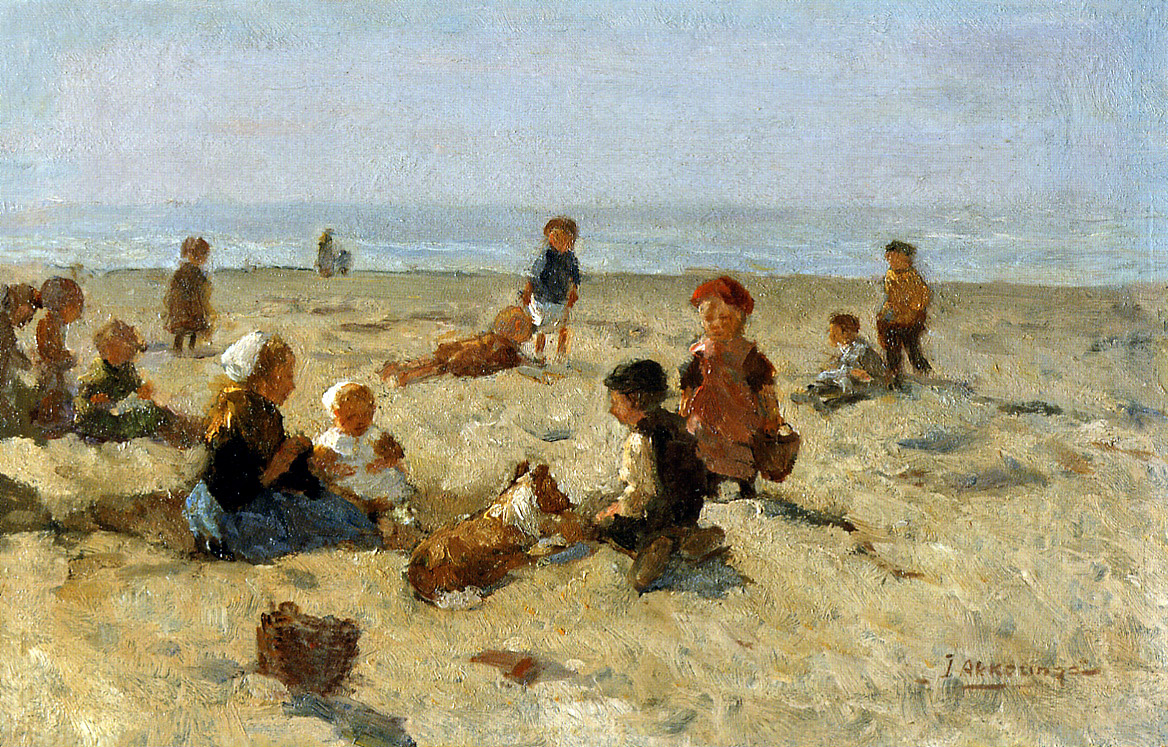
Whatever language these children are using, none of them is studying it. For pronunciation in particular the early years are the ones that count — and what fills them is this, not lessons.Source: Johannes Evert Hendrik Akkeringa — Public domain, Wikimedia Commons
But the window is a gentle slope, not a sharp cliff. Sensitivity is highest in the early years and declines gradually through childhood — so the earlier you begin, the higher the ceiling, yet it is never truly too late, and any early start is a genuine gift. There is one crucial condition, though: this early advantage only pays off if the exposure fits the way young children actually learn. Which brings us to the far more important question of how.
How: young children acquire language — they do not study it
Here is the heart of the matter. A young child's brain soaks up language implicitly, extracting patterns from rich, meaningful, repeated experience — exactly the way they mastered their first language, with never a rule explained. They are not equipped to sit and study; they are built to absorb. And this single fact settles the question of method: the right form of early exposure is play, not lessons.
Playing with language versus learning it
Playing with a language looks like songs and rhymes, stories and games, cartoons they adore, pretend play, silly sounds, movement — and, above all, a real person to interact with. The language is simply the joyful byproduct of the fun. The child is not trying to learn anything; they are playing, and the language quietly soaks in. Research even shows that a young child learns the sounds of a new language from a live, interacting human far better than from a screen alone — because for a child, language lives inside human connection and play.
Learning a language, by contrast, looks like worksheets, vocabulary lists to memorise, grammar rules, drills, tests, and the correcting of mistakes. None of this is bad — it is genuinely useful for older learners, who can think about language and use rules as a shortcut. But for a young child it is developmentally mismatched: it is boring, it is stressful, and it works against the very machinery — implicit, effortless absorption — that is doing all the real work at this age.
How to tell which one you are doing
The test is simple: ask what is in focus, and how the child feels. In play, meaning and fun are in focus, the child is engaged, and mistakes do not matter in the slightest. In study, form and correctness are in focus, the child is being tested, and mistakes get marked. If your four-year-old is laughing along to a song or begging for one more story, that is play, and it is exactly right. If they are being drilled on flashcards and corrected on their grammar, that is study — and study, this early, is simply the wrong tool for the stage.
Why the distinction matters so much
There are two reasons, and both are serious. The first is the science: play delivers precisely the conditions a young brain needs — rich input, real meaning, emotion, repetition, and low stress — while premature formal study delivers the opposite, raising the anxiety that blocks acquisition and demanding a kind of analytical thinking the child does not yet have.
The second reason is the heart, and it may matter even more. A child who plays with a language comes to love it; a child forced to study it too soon may come to resist it. The emotional association formed in these early years can shape a person's whole relationship with the language for life. Protecting the joy now is protecting the future learner — the single most valuable thing you can hand a young child is not a head start on grammar, but a warm, happy feeling about the language itself.
The balance shifts with age
None of this means never teach children. As a child grows into school age and beyond and develops the ability to reflect on language, a little structure becomes appropriate and even helpful. The rule is simply one of order: play-dominant when they are young, with structure added gently and gradually as they mature — never the reverse. You begin with the game, and let the lessons follow it, years later.
Practical guidance
Start early, but keep it play. The younger the exposure, the better the ceiling — as long as it arrives as fun, not as a class.
Prize real interaction. A living person to talk and play with — a parent, a tutor, a playmate — is the gold standard; add songs, stories, and screen content they genuinely love.
Favour consistency and joy over intensity and rigour. A little every day, delightedly, beats long drills done grudgingly.
Do not test, drill, or correct a young child's grammar. Let mistakes pass; celebrate that they communicated at all.
Follow their interest, and guard the love of the language above any accuracy.
The takeaway
The best time to give a child a second language is early — but the best way, in those early years, is to let them play with it, not study it. Fill their world with song and story and someone to talk to, keep it joyful, and their remarkable young brain will do the rest, quietly turning play into a language they may keep — and love — for the rest of their life.
Read the simple version
The same article, told in plain words — for younger readers, or for anyone who wants the point quickly.
Parents who want to give a child a second language face two questions: when, and how. The second one matters more than most people think.
When: earlier raises the ceiling
For pronunciation above all, earlier is better. In the first years of life the brain is extraordinarily tuned to absorb the sounds of language — infants can hear distinctions that adults have long since lost.
But this window is a gentle slope, not a sharp cliff. Sensitivity is highest early and declines gradually. The earlier you begin, the higher the ceiling — yet it is never truly too late.
There is one condition, though. This early advantage only pays off if the exposure fits the way young children actually learn.
How: young children absorb a language. They do not study it.
A young child's brain soaks language up by pulling patterns out of rich, meaningful, repeated experience — exactly the way they mastered their first language, with never a rule explained.
They are not equipped to sit and study. They are built to absorb. And that single fact settles the question of method.
Playing with a language, versus studying it
Play looks like songs and rhymes, stories, games, cartoons they adore, silly noises, movement — and above all a real person to interact with. The language is simply the joyful by-product of the fun. The child is not trying to learn anything; they are playing, and it soaks in.
A young child even learns the sounds of a new language far better from a live, responding human than from a screen alone — because for a child, language lives inside human connection.
Study looks like worksheets, word lists to memorise, grammar rules, and being corrected.
The test is simple. Ask what is in focus, and how the child feels:
In play, meaning and fun are in focus, the child is engaged, and mistakes do not matter in the slightest.
In study, form and correctness are in focus, the child is being tested, and mistakes get marked.
Why the difference matters so much
The science: play delivers exactly what a young brain needs — rich input, real meaning, emotion, repetition and low stress. Formal study too early delivers the opposite: it raises the anxiety that blocks learning, and demands a kind of analytical thinking the child does not yet have.
And the heart, which may matter more: a child who plays with a language comes to love it. A child forced to study it too soon may come to resist it. The feeling formed in these years can shape a person's whole relationship with that language for life.
The most valuable thing you can hand a small child is not a head start on grammar. It is a warm, happy feeling about the language itself.
The balance shifts as they grow
This does not mean never teach children. As a child grows and becomes able to think about language, a little structure becomes useful.
The rule is simply one of order: play-dominant when they are young, with structure added gently as they mature — never the reverse. You begin with the game, and let the lessons follow it, years later.
In practice
Start early, but keep it play.
Prize real interaction. A living person to talk and play with is the gold standard.
Choose consistency and joy over intensity. A little every day, delightedly, beats long drills done grudgingly.
Do not test, drill or correct a young child's grammar. Let mistakes pass. Celebrate that they communicated at all.
Sources & further reading
These articles summarize well-established research in learning science and linguistics. Key sources and further reading:
Kuhl, P. K. (2004). Early language acquisition: Cracking the speech code. Nature Reviews Neuroscience.
Kuhl, P. K., Tsao, F.-M., & Liu, H.-M. (2003). Foreign-language experience in infancy: Effects of short-term exposure and social interaction on phonetic learning. Proceedings of the National Academy of Sciences.
Johnson, J. S., & Newport, E. L. (1989). Critical period effects in second language learning. Cognitive Psychology.
Krashen, S. D. (1982). Principles and Practice in Second Language Acquisition. Pergamon.
Pinter, A. (2011). Children Learning Second Languages. Palgrave Macmillan.