Deep encoding: why one study hour leaves a trace and another does not
The idea that deeper processing means better memory has a hole in it that its own authors later conceded. What survived is not the ladder — it is three specific operations, and a better rule that replaced "go deeper".
Two people learn the same fifty words in the same hour. A month later one remembers most of them and the other is almost blank. That gap is not about time spent, and it is not about intelligence. It is about what they did with the words during that hour.
Shallow and deep: the original idea
In 1972 Fergus Craik and Robert Lockhart proposed a different way of thinking about memory. On their account you do not put information into storage; memory is a by-product of how deeply you process the thing. Shallow processing attends to form — how the word looks, how it sounds. Deep processing attends to meaning.
The classic experiment gives the same word with three different questions: is it in capitals, does it rhyme with table, does it fit into this sentence. None of the groups is told there will be a memory test. When the test comes, the group that had to consider meaning remembers far more than the other two.
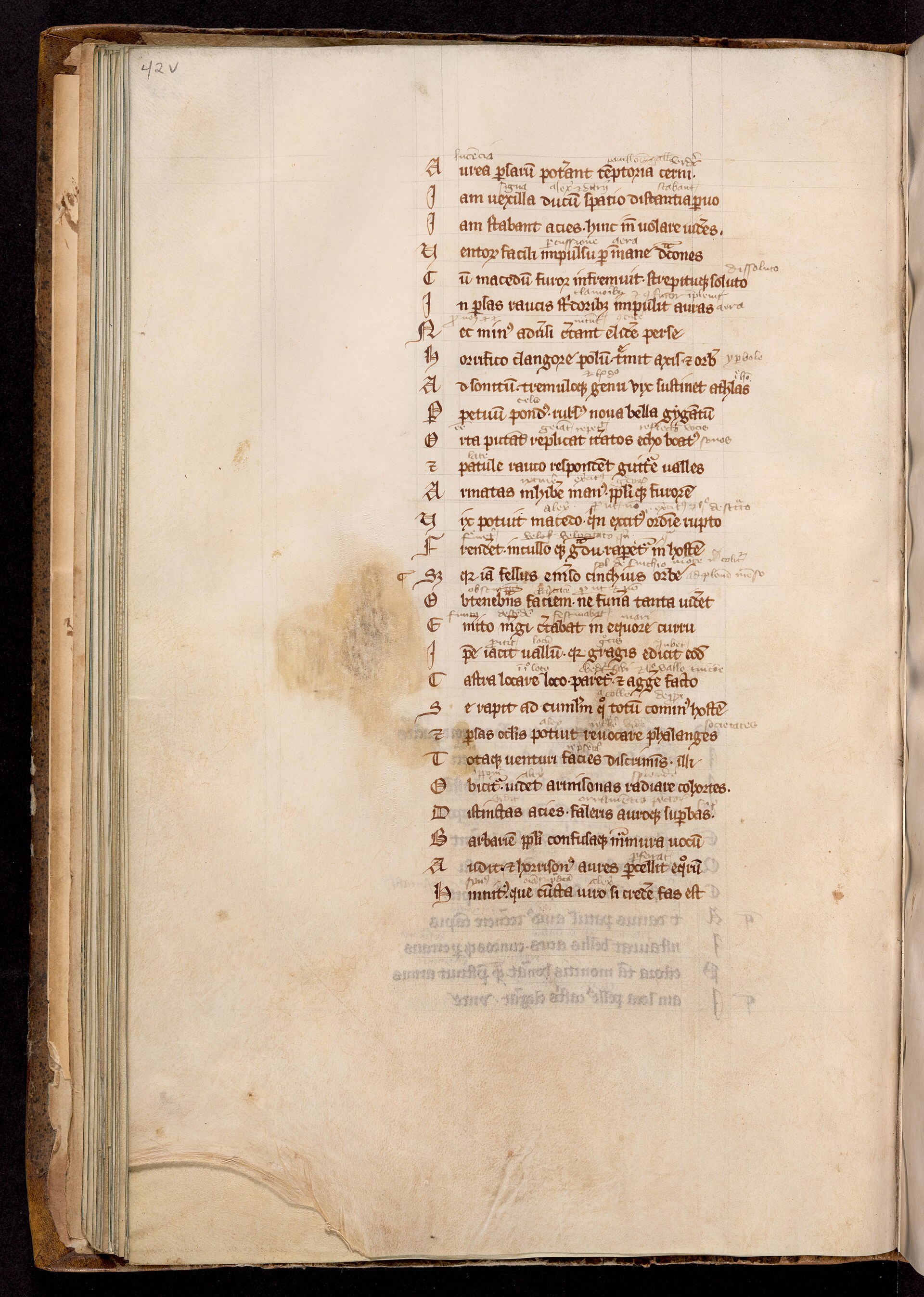
A glossed copy of the Alexandreis, France, about 1250. Two kinds of processing sit on one page: the small words squeezed between the lines are equivalents, while the dense margins are a reader working out why the text says what it says.Source: Walter, of Châtillon, active 1170-1180; Louis II, Count of Flanders, 1330-1384; Barrois, Joseph, approximately 1785-1855; Eustace, F. H; Ashburnham, Bertram Ashburnham, Earl of, 1797-1878; Cockerell, Sydney Carlyle, Sir, 1867-1962; Sotheby's (Firm) — Public domain, Wikimedia Commons
For language learners that is an uncomfortable finding. Copying a word twenty times is shallow. Reading down a vocabulary list until it feels familiar is shallow. Both take real time and both leave very little behind.
The hole in the theory, and why it matters
The framework has a weakness that researchers pointed out early: nobody could measure "depth" independently. You infer depth from how much was remembered, then explain how much was remembered by depth. That is a circle.
What matters is that the authors answered it themselves. In 1990 Craik and Lockhart looked back at their framework and conceded that deeper processing is not universally better, that they had under-theorised the relationship between encoding and retrieval, and that the original model was too simple.
So what survived? Not the picture of a ladder with shallow and deep rungs. What survived is a list of specific operations — things you can actually do, and test — and one better rule that took the place of the advice to "process more deeply".
Three operations with evidence behind them
One: generate rather than re-read. This is the best-evidenced of the three. A meta-analysis pooling 445 effect sizes from 86 studies puts the advantage of generating over reading at roughly 0.40 of a standard deviation. In practice: cover the translation and produce it, instead of reading the pair.
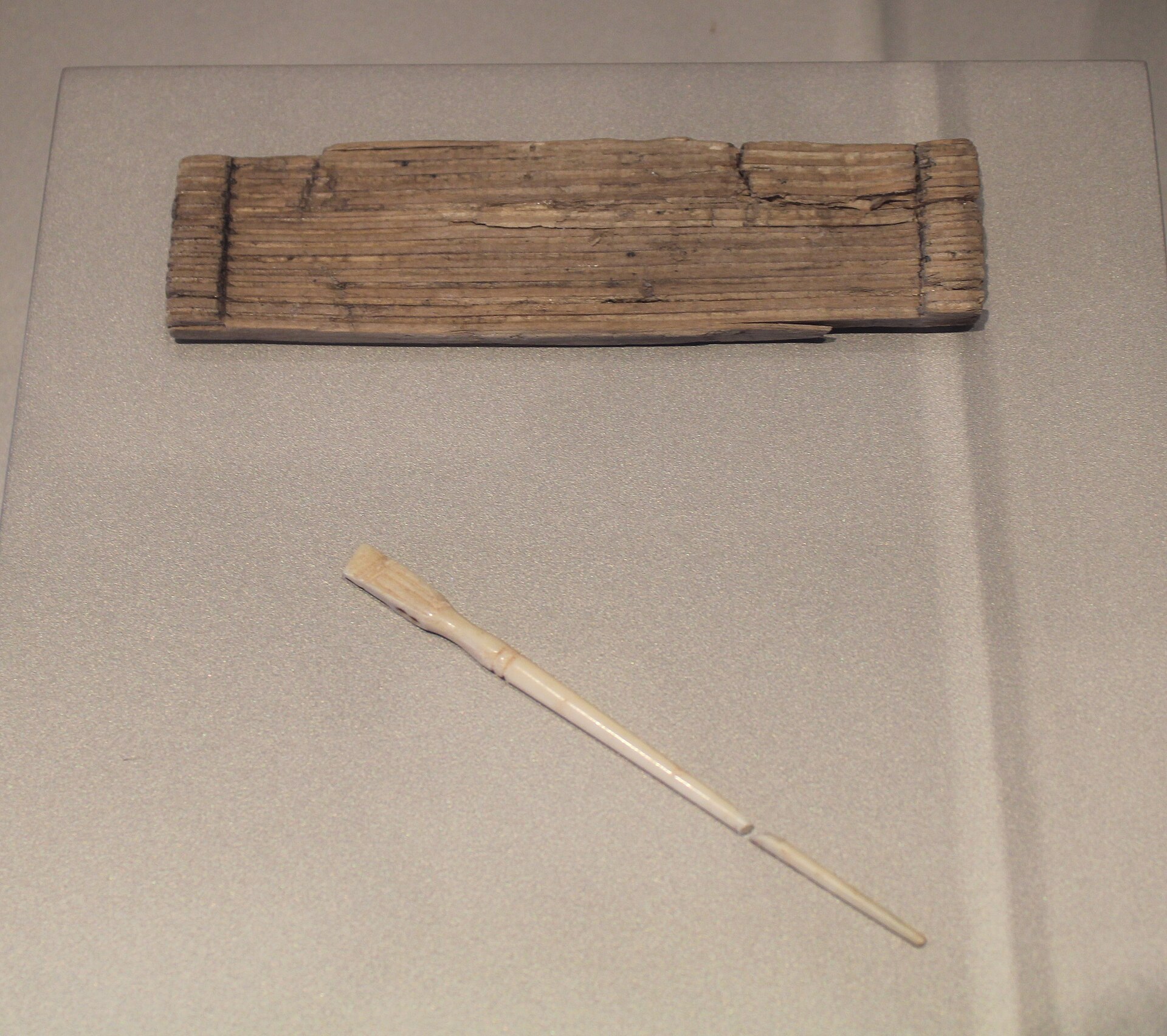
A writing tablet and stylus from Narbonne, around the turn of the first century. The wax surface could be smoothed and used again, which is precisely what made it a learning tool: you produced the answer yourself, then wiped it and produced it again.Source: Zunkir — CC BY-SA 4.0, Wikimedia Commons
Two: ask why. Instead of noting a fact, ask why it is so. Why does German push the verb to the end of a subordinate clause? The question forces you to tie the new thing to what you already hold. The research is specific about when this pays: the explanation has to be precise, and the learner has to produce it — handing them the answer works markedly less well.
Three: make it about you. An example sentence about your own life is remembered better than a neutral one. Put the new word into something true — the route you take to work, the food you refuse to eat — and it costs no extra minutes while changing the quality entirely.
Notice what the three have in common: each one makes you produce something. That is the honest way to say "depth" — not thinking harder, but making something.
The rule that replaced "go deeper"
In 1977 Morris, Bransford and Franks offered something more useful: what decides the outcome is not depth but the match between how you encoded and how you will have to retrieve.
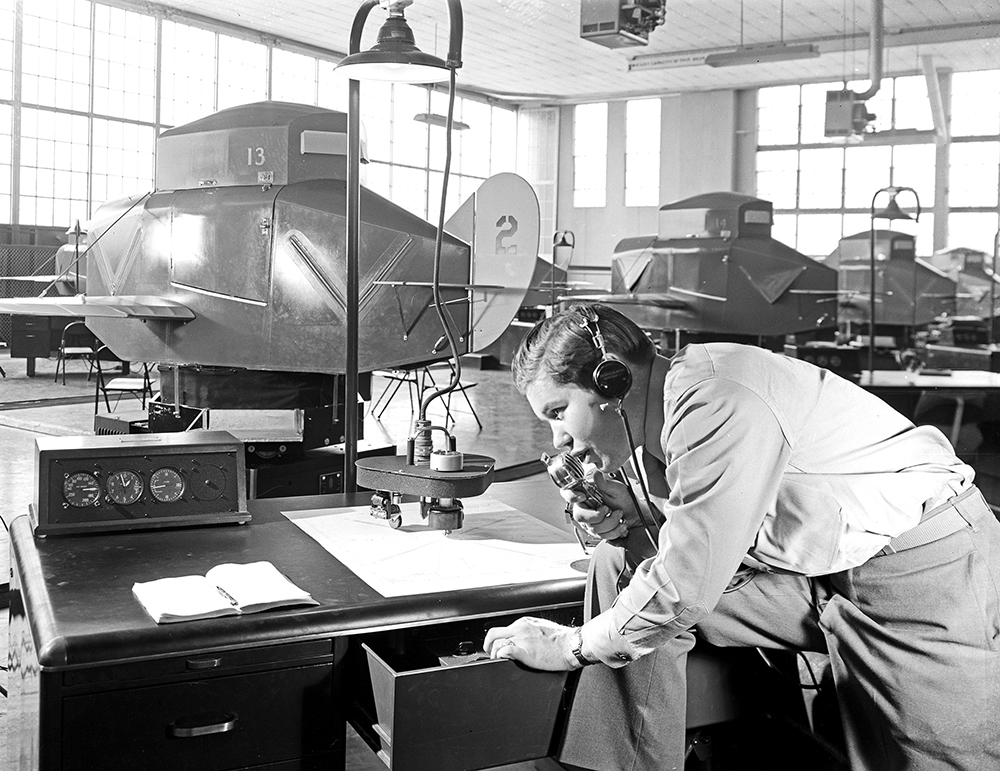
A Link Trainer in February 1943. It never left the ground, and that was never the point: under the hood the pilot had to fly on instruments alone, which is exactly the condition the training was for.Source: Robert Yarnall Richie — No restrictions, Wikimedia Commons
Their result annoyed a lot of people. When the test asked about rhyme, the group that had only processed rhyme — the shallow group — beat the group that had processed meaning. Deeper lost, simply because the other group's practice matched the test.
For languages this explains something every learner discovers the hard way: a reading vocabulary does not turn into a speaking vocabulary. That is not because you failed to go deep enough. It is because you practised recognising and then sat an exam in producing.
Putting it to work
So for each thing you are learning, ask first: when I need this, what shape will it have to come out in? If you need it for reading, drill recognition. If you need it in speech, you have to practise saying it aloud, under time pressure, with no prompt in view.
Four things follow. Cover the answer and produce it rather than re-reading. For every rule that surprises you, answer why it is that way yourself. Write example sentences about your own life instead of copying the book's. And practise the skill you actually need, not the one that is easiest to practise.
"Study deeply" sounds good but does not tell you what to do. "Produce it, and practise it in the shape you will need it" does — and that is the part of the evidence still standing.
Read the simple version
The same article, told in plain words — for younger readers, or for anyone who wants the point quickly.
Two friends sit down to learn fifty new words. Both give it one hour. A month later, one of them still knows most of the words. The other has almost nothing left.
They spent the same hour. So what was different? What they did with the words while the hour was passing.
Looking at a word, and thinking about a word
Back in 1972 two researchers said something simple. You do not put words into your memory like putting socks in a drawer. What stays is a side effect of how hard you worked on the meaning.
They tested it. Same word, three different jobs. Is it written in capitals? Does it rhyme with table? Does it make sense in this sentence? Nobody was told there would be a test later.
There was a test later. The people who had to think about the meaning remembered far more.
That is bad news for two habits. Writing a word out twenty times is the easy kind. Reading down a list until it looks familiar is the easy kind too. Both eat real time. Both leave very little.
Where the idea goes wrong
Here is the honest part. Nobody could ever measure "deep". You look at who remembered more, decide they went deeper, then say they remembered more because they went deeper. That goes in a circle.
The two researchers said so themselves. In 1990 they came back to their own idea and admitted it: deeper is not always better, and they had got something important wrong.
Three things that do work
Make it yourself. This one has the most evidence behind it. Cover the answer and say it out loud before you look. Do not read the word and its meaning side by side.
Ask why. Do not just write down that German puts the verb at the end. Ask yourself why. And answer it yourself — being handed the answer does much less for you.
Make it about you. Write your example sentence about your own street, your own job, the food you cannot stand. It takes no extra minutes and it sticks much better.
Notice what all three share. Every one of them makes you produce something.
The better rule
In 1977 three researchers found something more useful. What matters is not how deep you went. It is whether your practice looks like the moment you will need it.
They proved it in an uncomfortable way. When the test was about rhyme, the people who had only thought about rhyme won. The deep thinkers lost. The shallow group had practised the right thing.
Every learner meets this sooner or later: words you can read do not become words you can say. You did not fail to go deep enough. You practised recognising, then got tested on speaking.
So
Before you study something, ask what it will have to look like when you need it. Then practise it in that shape — out loud if you will speak it, with no hint in front of you, and with the clock running.
"Study deeply" sounds wise but tells you nothing. "Make it yourself, and practise the shape you will need" tells you what to do tonight.
Sources & further reading
These articles summarize well-established research in learning science and linguistics. Key sources and further reading:
Craik, F. I. M., & Lockhart, R. S. (1972). Levels of processing: A framework for memory research. Journal of Verbal Learning and Verbal Behavior, 11(6), 671–684.
Lockhart, R. S., & Craik, F. I. M. (1990). Levels of processing: A retrospective commentary on a framework for memory research. Canadian Journal of Psychology, 44(1), 87–112.
Morris, C. D., Bransford, J. D., & Franks, J. J. (1977). Levels of processing versus transfer appropriate processing. Journal of Verbal Learning and Verbal Behavior, 16(5), 519–533.
Bertsch, S., Pesta, B. J., Wiscott, R., & McDaniel, M. A. (2007). The generation effect: A meta-analytic review. Memory & Cognition, 35(2), 201–210.
Dunlosky, J., Rawson, K. A., Marsh, E. J., Nathan, M. J., & Willingham, D. T. (2013). Improving students' learning with effective learning techniques. Psychological Science in the Public Interest, 14(1), 4–58.
.jpg)

.jpg)