The Hardest Parts of Chinese for Vietnamese Learners
Vietnamese speakers start Chinese with deep advantages — but not a free pass. The genuine hard points: the characters, retuning the tones, the retroflex sounds, the limits of the Hán-Việt shortcut, and a few stubborn grammar patterns.
Vietnamese speakers begin Chinese with real, deep advantages — a shared vocabulary, an ear already tuned to tones, a familiar grammar. But an advantage is not a free pass, and Chinese still holds a specific set of hard points for Vietnamese learners. Like the advantages, most of them sit exactly where the two languages diverge. Facing them squarely is the fastest way through.
The characters: the great task
This is the biggest hurdle by far. Modern Vietnamese is written in the Latin alphabet; the country gave up Chinese characters generations ago. So learning to read and — harder still — write thousands of Hanzi is done from scratch: the sheer number, the look-alikes that differ by a single stroke, the fixed stroke order, the labour of handwriting. Knowing the meanings already, through your Hán-Việt vocabulary, lightens the load enormously — but the shapes themselves are still real, patient work that no shortcut removes.
The tones: familiar idea, unfamiliar shapes
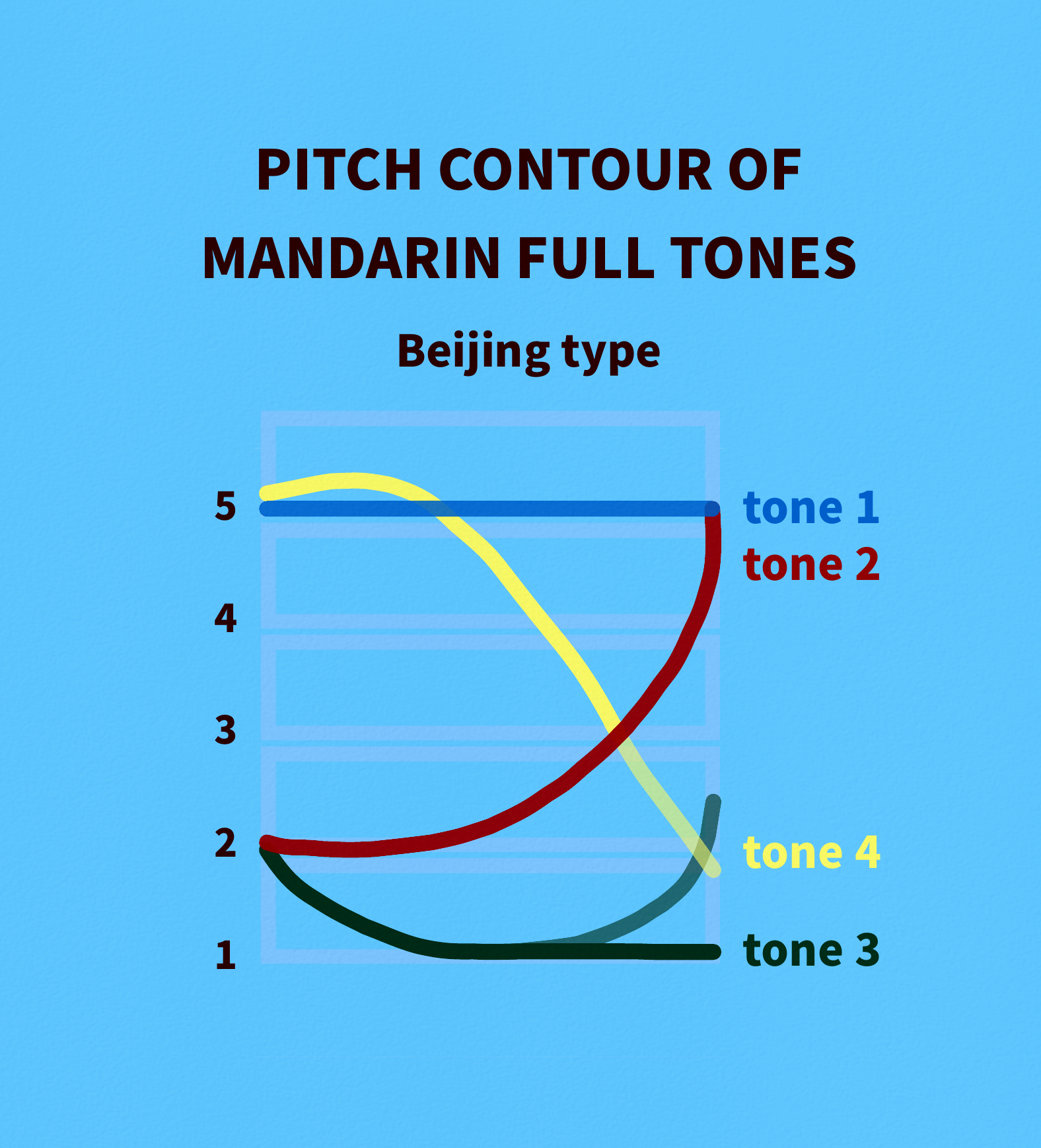
Here the advantage and the difficulty are two sides of one coin. You already use tones to change meaning, which spares you the leap that torments other learners — but Mandarin's tones are not Vietnamese tones. Mandarin has four where Vietnamese has six, and their contours are different, so your instincts can actively mislead you: a Vietnamese tonal habit slipped onto a Mandarin syllable produces the wrong word. The dipping third tone is awkward, and tone sandhi — tones that change depending on their neighbours — is a specific trap that catches even confident learners.
Four shapes over the same syllable. A Vietnamese speaker already knows that pitch carries meaning, which removes the hardest step — and then has to unlearn six shapes to fit four, which is a different difficulty from the one English speakers meet.Source: Hmm1HmmHmm — CC BY-SA 4.0, Wikimedia Commons
Sounds that do not exist in Vietnamese
Several Mandarin sounds have no Vietnamese equivalent. The retroflex series — zh, ch, sh, r, made with the tongue curled back — is the hardest, both to produce and to tell apart from the flatter z, c, s. Mandarin also leans heavily on a distinction between aspirated and unaspirated consonants (b/p, d/t, g/k, j/q, zh/ch) that Vietnamese marks differently, so pairs that sound identical to a beginner are, to a native, entirely different. The ü sound, the palatals x, q, j, and pinyin's non-intuitive spellings add their own confusion.
The vocabulary trap hidden inside the advantage
The Hán-Việt head start is powerful but partial, and mistaking it for more than it is causes trouble. It hands you the meaning of countless words — but not their Mandarin sound. 学 means học, yes, but a Vietnamese speaker cannot simply read it as học; its Mandarin pronunciation, xué, must be learned separately, and the Hán-Việt reading can even interfere. Worse, much of everyday spoken Chinese uses common words that are not Hán-Việt at all, so the advantage is strongest in formal and written vocabulary and thinner in casual speech. And a handful of Hán-Việt words have drifted in meaning over the centuries, leaving the occasional false friend.
Grammar: similar, with its own puzzles
Because both languages are isolating, much of Chinese grammar feels natural to a Vietnamese speaker — but not all of it. A few constructions are genuinely different and reliably cause errors: the particle 了 (le), which marks completion and change of state in ways that do not map neatly onto Vietnamese; the 把 (bǎ) construction, which moves the object before the verb; the result and direction complements that attach to verbs; and choosing the right measure word, since Chinese classifiers do not line up one-to-one with Vietnamese ones. These are small in number but stubborn in practice.
How to tackle them
Attack the characters with method, not willpower. Break them into radicals and components, tie each to a vivid mnemonic, and drill them with spaced repetition and a little handwriting — and lean on the Hán-Việt meanings you already own to make each one half-familiar from the start.
Retrain your tones and new sounds deliberately. Do not assume Mandarin's tones match Vietnamese; practise the four contours and the sandhi by close listening and imitation, and drill the retroflex sounds until zh/ch/sh and z/c/s come apart cleanly.
Treat pronunciation as a separate layer from meaning. Use Hán-Việt for meaning, but learn each character's Mandarin sound in its own right, and harvest everyday spoken vocabulary from real listening rather than relying on cognates.
Notice the tricky grammar. Give conscious attention to 了, 把, complements, and measure words, and collect them in context as set patterns rather than rules.
The takeaway
The hard points of Chinese are real, but they are few and well-mapped — the characters, the retuning of tones, a handful of new sounds, the limits of the Hán-Việt shortcut, and a few stubborn grammar patterns. Set against the deep advantages a Vietnamese speaker already carries, they are entirely surmountable. Respect the characters, retune your ear, drill the new sounds, and notice the grammar that differs, and you turn a strong head start into genuine mastery.
Read the simple version
The same article, told in plain words — for younger readers, or for anyone who wants the point quickly.
A Vietnamese speaker starts Chinese with real advantages. The hard parts are few, and every one of them is well mapped. Here they are.
Tones: the advantage and the trap are the same thing
You already use tone to change meaning, which spares you the leap that torments other learners.
But Mandarin's tones are not Vietnamese tones. Mandarin has four where Vietnamese has six, and the shapes are different — so your instinct can actively mislead you. A Vietnamese tonal habit dropped onto a Mandarin syllable produces the wrong word.
The dipping third tone is awkward. And tone sandhi — tones that change depending on their neighbours — catches even confident learners.
Sounds that simply are not there
The retroflex series — zh, ch, sh, r, made with the tongue curled back — is the hardest, both to say and to tell apart from the flatter z, c, s.
Mandarin also leans heavily on a puff-of-air distinction (b/p, d/t, g/k, j/q, zh/ch) that Vietnamese marks differently. Pairs that sound identical to a beginner are, to a native ear, entirely different words.
The trap hidden inside your biggest advantage
The Hán-Việt head start is powerful but partial, and mistaking it for more than it is causes trouble.
It hands you the meaning of countless words — but not their sound. 学 does mean học. But you cannot read it as học; its Mandarin pronunciation, xué, has to be learned separately, and the Hán-Việt reading can even get in the way.
Worse: much of everyday spoken Chinese uses common words that are not Hán-Việt at all. So the advantage is strongest in formal and written vocabulary, and thinner in casual speech. And a handful of Hán-Việt words have drifted in meaning over the centuries, leaving the occasional false friend.
Grammar: familiar, with a short stubborn list
Because both languages work the same way, most of Chinese grammar feels natural. A few things genuinely do not:
了 — marks completion and change, but does not map neatly onto Vietnamese.
把 — moves the object in front of the verb.
Complements that attach to verbs.
Which measure word — Chinese classifiers do not line up one-to-one with Vietnamese ones.
Few in number, stubborn in practice.
How to attack them
Take the characters apart, do not out-stubborn them. Break them into components, tie each to a picture, drill with spaced repetition and a little handwriting — and lean on the Hán-Việt meanings you already own so each one starts half-familiar.
Retrain your tones on purpose. Do not assume Mandarin's match yours. Practise the four shapes and the sandhi by close listening and imitation.
Keep meaning and sound in separate drawers. Use Hán-Việt for meaning; learn each character's Mandarin sound in its own right. And harvest everyday spoken words from real listening rather than from cognates.
Notice the four grammar points. Collect 了, 把, complements and measure words in real sentences, as patterns, not as rules.
Set against the advantages you already carry, none of this is out of reach. Respect the characters, retune your ear, and a strong head start turns into real mastery.
Sources & further reading
These articles summarize well-established research in learning science and linguistics. Key sources and further reading:
Li, C. N., & Thompson, S. A. (1981). Mandarin Chinese: A Functional Reference Grammar. University of California Press.
Duanmu, S. (2007). The Phonology of Standard Chinese (2nd ed.). Oxford University Press.
DeFrancis, J. (1984). The Chinese Language: Fact and Fantasy. University of Hawai'i Press.
Alves, M. J. (2009). Loanwords in Vietnamese. In M. Haspelmath & U. Tadmor (Eds.), Loanwords in the World's Languages. De Gruyter Mouton.
Odlin, T. (1989). Language Transfer: Cross-linguistic Influence in Language Learning. Cambridge University Press.
.png)