How Greek shaped English — and why that makes you a faster learner
Telephone, democracy, psychology — you read Greek every day without noticing. The surprise is that most of those Greek words never existed in Greece. Here are the three routes Greek took into English, why recognising word parts speeds up learning (the same way Sino-Vietnamese does for Vietnamese speakers), and the traps that make decoding go wrong.
Read this list slowly: telephone, democracy, psychology, biology, atmosphere, drama, chaos, enthusiasm, criterion, panic. Not one of them is a native English word. All of them come from Greek — and if you are learning English, you have been reading Greek every day without knowing it.
The actual numbers may surprise you. A classic survey of the Shorter Oxford English Dictionary put the origins of English roughly like this: French about 28%, Latin about 28%, Germanic (that is, Old English) about 25%, and Greek only about 5%. Five per cent. So why does its influence feel so much larger?
Because that five per cent is not scattered at random. It clusters in exactly the hardest places: science, medicine, technology, philosophy, politics — precisely the academic vocabulary that learners of English struggle with most. Everyday words like eat, house, water, good are Germanic and you learn them early. Photosynthesis, epidemiology, haemorrhage arrive much later and look far more frightening. That is Greek territory.
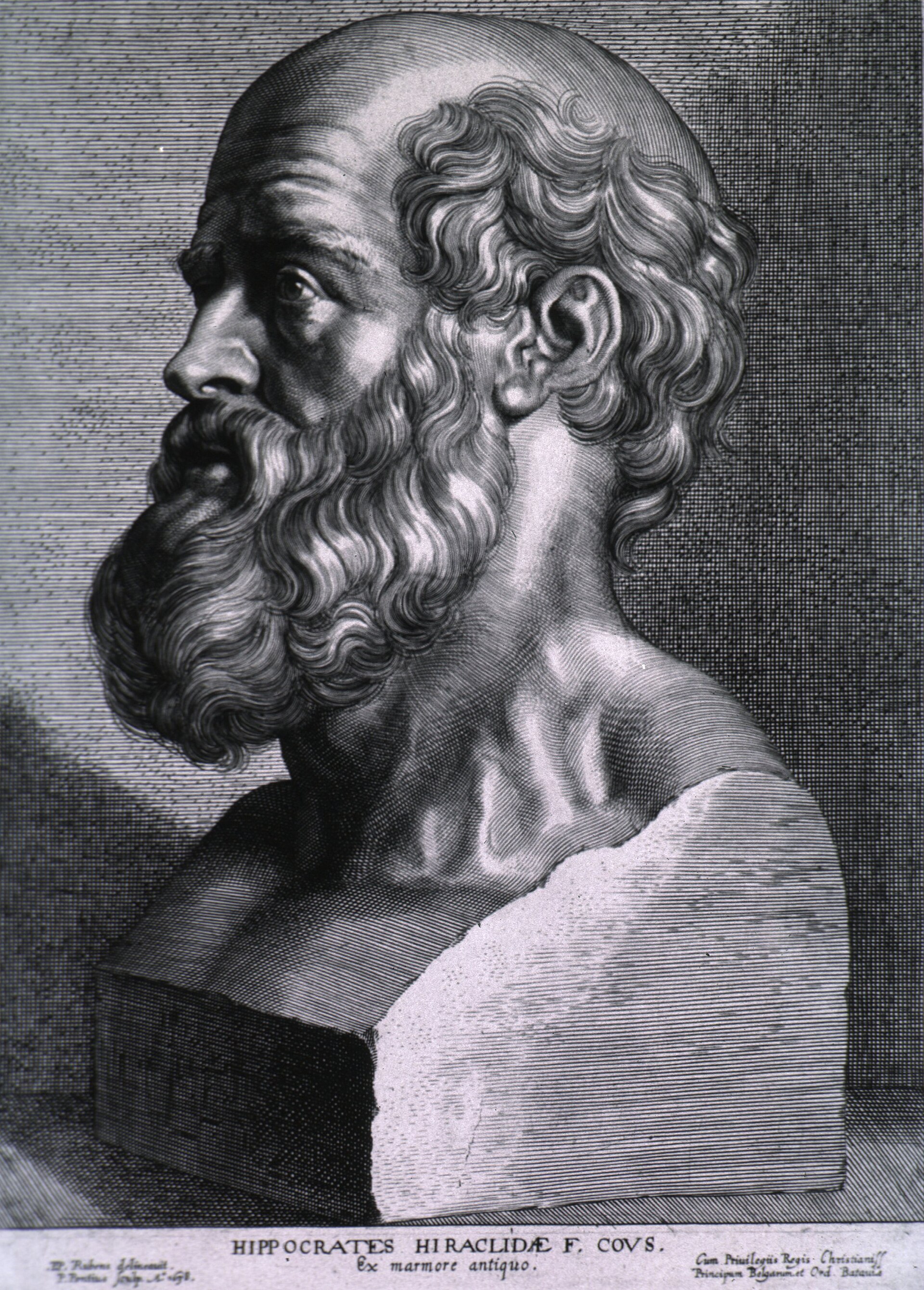
Hippocrates. Greek did not spread through English evenly — it settled in the vocabularies of medicine, science and philosophy, which is exactly where a learner meets the longest words.Source: Paulus Pontius / After Peter Paul Rubens — Public domain, Wikimedia Commons
Three routes Greek took into English
The first route was quiet, through the church and through Latin. The earliest Greek words in English do not look Greek at all, because they travelled via Latin and stayed long enough to become ordinary. Church comes from κυριακόν (belonging to the Lord). Bishop is ἐπίσκοπος, an overseer. Angel is ἄγγελος, which meant nothing more mystical than messenger. So are devil, priest, monk and alms. Nobody experiences them as loanwords now.
The second route was the Renaissance, deliberate and in bulk. From the sixteenth century, European scholars read the ancient Greek texts again and carried the vocabulary straight into English — this time without hiding where it came from. Drama, theory, chaos, enthusiasm, atmosphere, catastrophe, dogma, crisis all belong to this layer, and many of them stubbornly kept their Greek shape, spelling and plurals included.
The third route is the interesting one: people simply started manufacturing new words. When the modern world needed names for things that had never existed, it stopped borrowing Greek words. It took Greek pieces and assembled them.
Most Greek words in English were never Greek
This is the part few learners are ever told, and it changes how academic vocabulary looks.
No ancient Greek ever said telephone. It was assembled in the nineteenth century from τῆλε (far) and φωνή (sound, voice). Photograph was coined around 1839 from φῶς (light) and γράφειν (to write) — literally writing with light. Dinosaur was minted by the palaeontologist Richard Owen in 1841 from δεινός (terrible) and σαῦρος (lizard). Aristotle would have understood none of the three.
The technique has a name: neoclassical compounding. Greek stopped being used as a language and started being used as a kit — a stock of pieces with clear meanings, available for naming whatever came next. The kit is still in service: biotechnology, cryptocurrency, technophobia all come off the same shelf.
Sometimes the pieces are mixed across languages. Television welds Greek τῆλε to Latin visio; automobile joins αὐτός (self) to mobilis. Purists of the day objected loudly to these hybrids. They lost, and we have TV.
Why this makes you faster
If academic English is largely assembled from a limited kit of parts, then learning the kit beats learning the words one at a time.
This is not a study hack; it is one of the sturdier findings in vocabulary research. When Nagy and Anderson counted the words in printed school English, they estimated around 88,500 word families — a number that makes memorising word by word hopeless. But most of those families are morphologically related: know one word and understand how words are built, and you can work out its relatives. That capacity is called morphological awareness, and Carlisle's work along with the systematic review by Bowers, Kirby and Deacon links it to both vocabulary size and reading comprehension, with the largest gains for weaker readers.
Now try a word you may never have met: chronobiology. Chrono (time) + bio (life) + logy (study) → the study of how living things run on time. Correct. Or hypothermia: hypo (under) + therm (heat) → body temperature below normal. Also correct. You did not look those up; you decoded them.
Vietnamese speakers already know this trick
If you speak Vietnamese, you need no convincing that this works, because you have done it your whole life.
Meeting học sinh, học tập, đại học and học phí, you do not learn four unrelated words — you recognise học (study) and combine it. You know thủy means water, so thủy sản, thủy triều and thủy lợi open together. That is exactly what Greek roots do in English: a formal, systematic vocabulary layer sitting above the everyday one.
Even the stratification matches. In Vietnamese, nước is the everyday native word and thủy the Sino-Vietnamese technical element. In English, water is the everyday Germanic word and hydro- the Greek technical element: hydration, dehydrated, hydroelectric. Same architecture, two different cultures.
So Greek roots are not foreign knowledge to be acquired from scratch. They are a skill you already have, transferred to a new language — a genuine advantage that many native English speakers never developed.
Three traps to know about first
Trap one: meanings drift, sometimes enormously. A root gives you history, not a current definition. School comes from σχολή, which meant leisure. Gymnasium comes from γυμνός — naked, which is how the Greeks trained. An idiot was an ἰδιώτης, a private citizen who took no part in public affairs. A cemetery is a κοιμητήριον, a sleeping place. Etymology makes a good story, but when it disagrees with current usage, usage wins every time.
Trap two: the spelling and sound follow their own rules. Greek-derived words carry letter combinations that English handles by convention: ph as /f/ (photograph), ch as /k/ (chaos, character, chorus), initial rh (rhythm, rhetoric), and the silent initial consonants that catch learners out — psychology, pneumonia, mnemonic. Spotting a Greek origin is also a clue to pronunciation.
Trap three: irregular plurals. Many Greek words kept their own plural, and this is a classic error in academic writing: phenomenon → phenomena, criterion → criteria, crisis → crises, analysis → analyses, thesis → theses. Writing a criteria or this phenomena marks a text as unedited.
Turning this into a habit
Learn parts in clusters, never as a list.tele- on its own will not stick. Learn it with three words you already know (telephone, television, telescope) and one you do not (telemetry), and the piece has something to hold on to.
Guess first, look up second. When a long unfamiliar word appears, break it apart and guess before reaching for the dictionary. Producing an answer yourself — even a wrong one — is remembered far better than reading a definition. That is the retrieval principle the whole learning system on this site is built around.
Treat a decoding as a hypothesis, not a conclusion. Analysing the parts gives you a good guess, and a good guess is an excellent hook for the real definition. But check it — trap one exists for a reason.
Prioritise the right pieces. If you are learning English for work or study, start with the parts that are dense in your field. Medical learners get the most from cardi-, derm-, gastro-, neuro-, -itis, -ectomy; people in technology from crypt-, cyber-, -morph, meta-, proto-.
And the other direction
There is an unexpected reward at the end of this. If you have ever considered learning Greek, you are starting further along than you think, because hundreds of those roots are already in your head by way of English.
To be clear: modern Greek is not ancient Greek. The pronunciation has moved on (β is now /v/; η, ι and υ all say /i/), the grammar has simplified considerably, and the everyday vocabulary will be entirely new to you. But the alphabet becomes familiar within hours, and reading signs in Athens you keep meeting words you already know: βιβλιοθήκη (library — the root behind bibliography), φαρμακείο (pharmacy), αστυνομία (police — sharing -nomia, law, with astronomy).
Five per cent of the dictionary sounds small. But it is five per cent sitting in the hardest places, assembled from pieces that can be learned, in exactly the way you already handle Sino-Vietnamese. Once you see the mechanism, a long intimidating word stops being something to memorise and becomes something to solve.
Read the simple version
The same article, told in plain words — for younger readers, or for anyone who wants the point quickly.
Read this list slowly: telephone, democracy, psychology, biology, atmosphere, drama, chaos, enthusiasm, panic.
Not one of them is a native English word. All of them come from Greek — and if you are learning English, you have been reading Greek every day without knowing it.
Only five per cent — and yet
The numbers may surprise you. Of the words in a large English dictionary, French accounts for about 28%, Latin about 28%, Germanic (that is, Old English) about 25%, and Greek only about 5%.
Five per cent. So why does its influence feel so much larger?
Because that five per cent is not scattered at random. It clusters in exactly the hardest places — science, medicine, technology, philosophy, politics. Everyday words like eat, house, water, good are Germanic and you learn them early. Photosynthesis, epidemiology, haemorrhage arrive much later and look far more frightening. That is Greek territory.
Most Greek words in English were never Greek
This is the part few learners are ever told, and it changes how academic vocabulary looks.
No ancient Greek ever said telephone. It was assembled in the nineteenth century from tēle (far) and phōnē (sound). Photograph was coined around 1839 from phōs (light) and graphein (to write) — literally writing with light. Dinosaur was minted in 1841 from deinos (terrible) and sauros (lizard).
Aristotle would have understood none of the three.
Greek stopped being used as a language and started being used as a kit — a stock of pieces with clear meanings, available for naming whatever came next. The kit is still in service: biotechnology, cryptocurrency, technophobia all come off the same shelf.
Why this makes you faster
If academic English is largely assembled from a limited kit of parts, then learning the kit beats learning the words one at a time.
Printed school English contains something like 88,500 word families — a number that makes memorising word by word hopeless. But most of those families are related by their parts. Know one word and understand how words are built, and you can work out its relatives.
Consider the reach of about twenty pieces:
tele- far · auto- self · bio- life · geo- earth · chrono- time · psycho- mind · demo- people · micro-/macro- small/large · mono-/poly- one/many · hyper-/hypo- over/under · anti- against · thermo- heat · -logy study of · -graph writing · -phone sound · -scope seeing · -meter measure · -phobia fear
Now try a word you may never have met: chronobiology. Chrono (time) + bio (life) + logy (study) → the study of how living things run on time. Correct.
Or hypothermia: hypo (under) + therm (heat) → body temperature below normal. Also correct.
You did not look those up. You decoded them.
And Vietnamese speakers already know this trick
You need no convincing that it works, because you have done it your whole life.
Meeting học sinh, học tập, đại học and học phí, you do not learn four unrelated words — you recognise học and combine it. You know thuỷ means water, so thuỷ sản, thuỷ triều and thuỷ lợi open together.
That is exactly what Greek roots do in English.
Two practical notes
Guess, then check. A first guess from the parts is an excellent hook for the real definition. But check it — the parts do not always add up neatly.
Prioritise the pieces dense in your own field. Medicine: cardi-, derm-, gastro-, neuro-, -itis, -ectomy. Technology: crypt-, cyber-, meta-, proto-.
And a reward at the far end
If you have ever considered learning Greek, you are starting further along than you think, because hundreds of those roots are already in your head by way of English.
To be clear: modern Greek is not ancient Greek. The pronunciation has moved on, the grammar has simplified, and the everyday vocabulary will be entirely new. But the alphabet becomes familiar within hours, and reading signs in Athens you keep meeting words you already know: βιβλιοθήκη (library — the root behind bibliography), φαρμακείο (pharmacy), αστυνομία (police — sharing -nomia, law, with astronomy).
Five per cent of the dictionary sounds small. But it sits in the hardest places, assembled from pieces that can be learned — exactly the way you already handle Hán-Việt.
Once you see the mechanism, a long intimidating word stops being something to memorise and becomes something to solve.
Sources & further reading
These articles summarize well-established research in learning science and linguistics. Key sources and further reading:
Finkenstaedt, T., & Wolff, D. (1973). Ordered Profusion: Studies in Dictionaries and the English Lexicon. Heidelberg: Carl Winter.
Durkin, P. (2014). Borrowed Words: A History of Loanwords in English. Oxford University Press.
Nagy, W. E., & Anderson, R. C. (1984). How many words are there in printed school English? Reading Research Quarterly, 19(3), 304–330.
Carlisle, J. F. (2000). Awareness of the structure and meaning of morphologically complex words: Impact on reading. Reading and Writing, 12, 169–190.
Bowers, P. N., Kirby, J. R., & Deacon, S. H. (2010). The effects of morphological instruction on literacy skills: A systematic review of the literature. Review of Educational Research, 80(2), 144–179.
Nation, I. S. P. (2013). Learning Vocabulary in Another Language (2nd ed.). Cambridge University Press.
Ayers, D. M. (1986). English Words from Latin and Greek Elements (2nd ed.). University of Arizona Press.