In person, online, or blended: what the evidence actually says
The largest meta-analysis says blended wins. The natural experiment of 2020 says one kind of blended was the worst of the three. Those findings do not contradict each other — and where they meet is the answer worth using.
AI Aggregated source·August 19, 2026·5 min read·Habits & method
The question sounds reasonable: is it better to learn in a room, online, or with a mix of both? But read the research closely and the answer is not where we expect it. The format of a class explains far less than what happens inside it. That is not a dodge — the numbers point at something more specific.
Teaching at a distance is not a 2020 invention
Correspondence schools have been posting lessons since the nineteenth century. From the 1920s, school radio carried teaching to classrooms hundreds of kilometres from any teacher. Children in the Australian outback learned over the airwaves for decades before the internet existed.
And it is still running. Interactive radio instruction — where pupils listen, then answer, sing and work on the spot — still reaches millions of children in places short of teachers. So the question of whether teaching at a distance can work was settled long ago: it can, and at scale.
Interactive radio instruction in Southern Sudan, 2007. The pupils answer, sing and work along with the broadcast — teaching at a distance, decades before video calls, and still running where teachers are scarce.Source: Karl Grobl/Education Development Center Inc. — Public domain, Wikimedia Commons
What the largest meta-analysis found
In 2010 the US Department of Education pooled more than fifty studies comparing the three formats. The result: blended classes outperformed purely face-to-face ones, while purely online classes came out roughly level. At first glance the matter looks closed.
But the authors themselves flagged something that has to be read alongside it. In most of those studies the blended groups received more learning time and extra material that the control groups did not get. So the difference may come from the hours, not from the medium. A class given six extra hours does better whatever it is taught through.
Then the world ran an enormous experiment
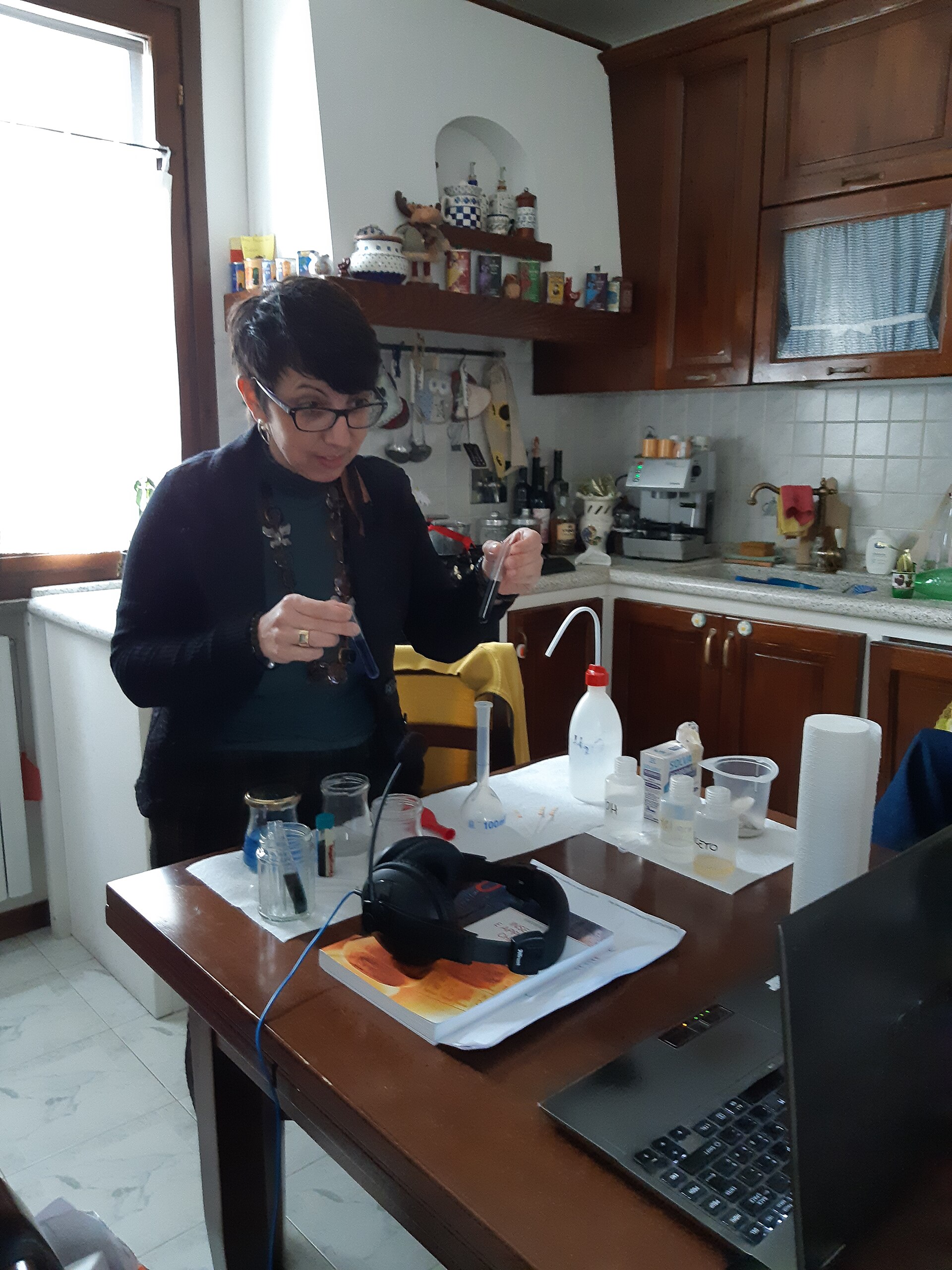
In 2020 hundreds of millions of pupils moved to learning at a distance at the same time. It was the largest natural experiment in the history of education, and it produced data no researcher would have dared to design.
A chemistry lesson at the University of Pisa, April 2020. Within weeks, hundreds of millions of pupils were learning like this at once — the largest natural experiment education has ever run.Source: Valentina Domenici 77 — CC BY-SA 4.0, Wikimedia Commons
The results were uncomfortable. In the United States, pass rates fell by roughly 12.8 percentage points in mathematics and 6.8 points in reading between 2019 and 2021. The losses were not shared evenly: they fell hardest on disadvantaged pupils and on those already behind. By the 2023–24 school year scores had still not returned to pre-pandemic levels.
But the most striking number lies elsewhere. Of the three formats, the one that fared worst was not pure online but synchronous blended — a teacher running the room and the remote group at the same moment.
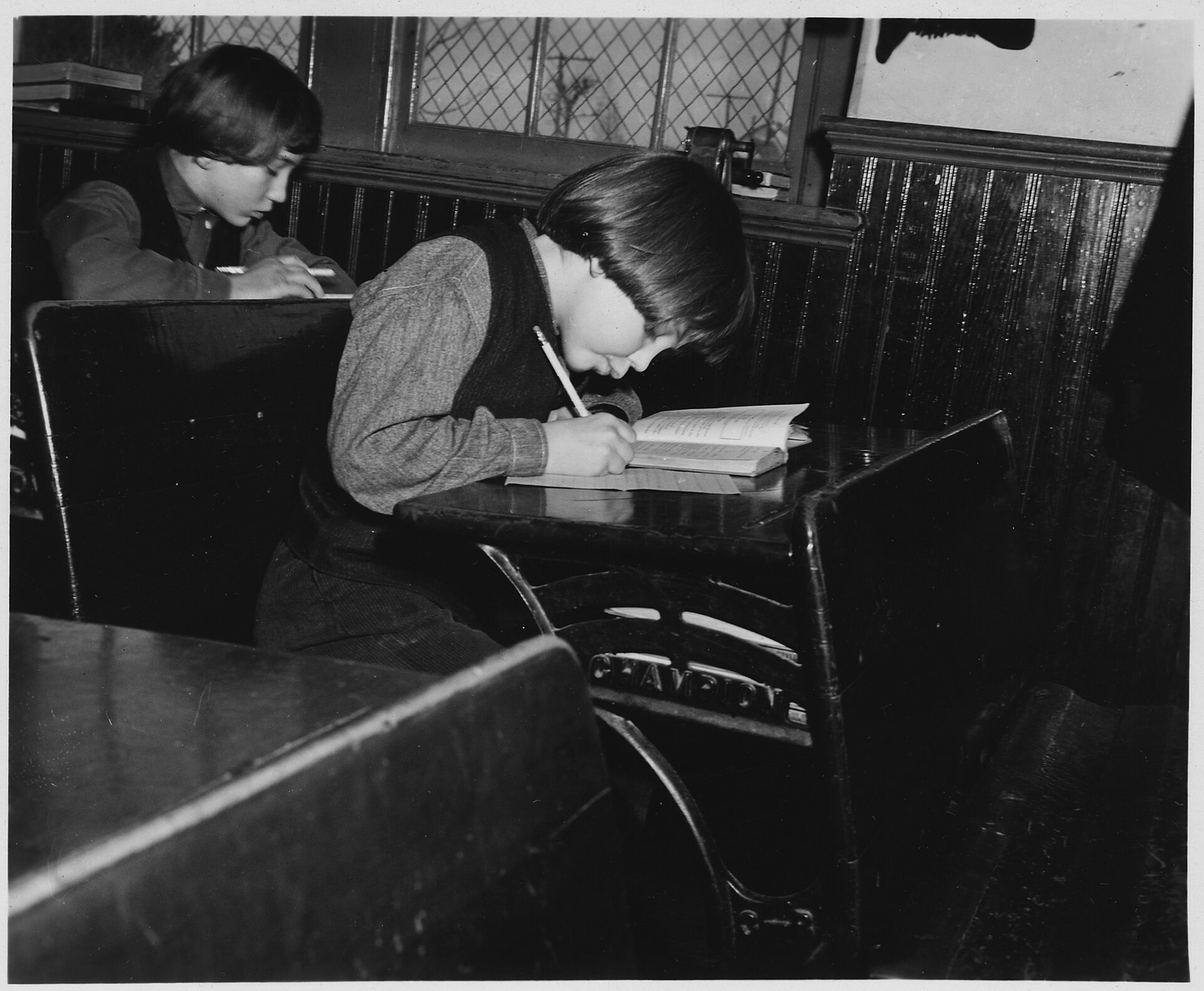
A one-room school in Lancaster County, Pennsylvania, 1941. Several grades in one room — but the teacher took them in turn. Synchronous blended teaching asks for two groups at the same moment, which is the part that does not work.Source: Irving Rusinow — Public domain, Wikimedia Commons
The reason is no mystery: the teacher's attention is split, and neither group gets a whole teacher. The old one-room schoolhouse also held several levels together, but it solved that by rotating between groups rather than serving two at once. Synchronous blended throws away exactly that piece of craft.
There is a further finding that gets less attention. A 2024 study in PNAS followed pupils in Connecticut and found that when schools opened for in-person days, pupils attended only about half the days on offer — and attendance was lowest in the most disadvantaged schools. Offering a format is not the same as it being used.
So what does decide the outcome?
Pull the studies together and three things recur, all of which cut across the three formats: how many hours of real teaching there are, whether the learner actually takes part, and whether the tools suit the thing being taught. Format does not settle these; it only makes some of them easier to reach.
What this means for language learners
Here the conclusion sharpens, because learning a language needs two quite different kinds of hours, and the two do not thrive in the same format.
The first is input time — listening to and reading things you can follow. Online does this better than a classroom, and not by a little. A two-hour lesson gives you two hours of exposure; a podcast feed gives you more than that every week, at your level, whenever you are free.
The second is output time — opening your mouth and being corrected. That needs a person, needs enough minutes per head, and needs to feel safe enough to get things wrong. A forty-person online class gives you almost none of it; an hour one to one, even online, gives you a great deal.
So for languages the natural split is not by room but by kind of hour: get your input yourself, find a person for your output. That is blended learning run in sequence — precisely the shape the evidence favours.
Which gives a more practical way to choose than asking which is best: choose by what a format protects. A room protects attention and attendance. Online protects access and the hours in your week. Blended pays off when the two halves are sequenced — theory at home, speaking in class — rather than run in parallel.
And whichever you pick, the number that decides it is still hours of practice you genuinely understand, not the room they happen in.
Read the simple version
The same article, told in plain words — for younger readers, or for anyone who wants the point quickly.
Imagine a teacher standing in a classroom. Half the class is in front of her. The other half is at home, on a screen. She has to teach both at the same second.
Try to picture doing that well. It is very hard — and that is not a guess. When schools tried it, this way of teaching went worst of all.
The question people ask
Is it better to learn in a room, on a computer, or a bit of both? Lots of studies have tried to answer it. The honest answer is a little disappointing: the room matters much less than what happens in it.
One big study found mixed classes did best. But look closer and those classes had extra hours the others did not get. More time helps, whatever room you are in.
What 2020 showed
Then schools everywhere closed at once, and the world found out for real. Marks fell. They fell hardest on children who already had the least help, and years later they still had not come all the way back.
And the teacher split between two rooms? That went worst. Nobody got a whole teacher.
What actually helps
Three things, and none of them is the room:
How many hours you are really taught.
Whether you actually join in.
Whether the tools fit what you are learning.
If you are learning a language
You need two kinds of hours, and they like different places.
Listening and reading work brilliantly on your own, online. You can get far more of it than any class gives you.
Speaking needs a person who answers you and fixes your mistakes. Forty people on a call gives you almost none. One person for an hour gives you plenty.
So do your listening yourself, and find a human for your talking. What counts in the end is hours you understood — not the room they happened in.
Sources & further reading
These articles summarize well-established research in learning science and linguistics. Key sources and further reading:
Means, B., Toyama, Y., Murphy, R., Bakia, M., & Jones, K. (2010). Evaluation of Evidence-Based Practices in Online Learning: A Meta-Analysis and Review of Online Learning Studies. U.S. Department of Education, Office of Planning, Evaluation, and Policy Development.
Means, B., Toyama, Y., Murphy, R., & Baki, M. (2013). The effectiveness of online and blended learning: A meta-analysis of the empirical literature. Teachers College Record, 115(3), 1–47.
Jiang, S., Ross, S. L., Young, M. F., Meyer, J. L., & Strambler, M. J. (2024). In-person learning during the pandemic: Student take-up and school-level effects of remote and hybrid instruction on student outcomes. Proceedings of the National Academy of Sciences, 121(33).
Fahle, E. M., Kane, T. J., Patterson, T., Reardon, S. F., Staiger, D. O., & Stuart, E. A. (2023). The Educational Consequences of Remote and Hybrid Instruction During the Pandemic. Center for Education Policy Research, Harvard University.
World Bank (2021). Remote Learning During COVID-19: Lessons from Today, Principles for Tomorrow. Washington, DC: World Bank.