Does Your Brain Store Each Language in a Separate Region?
Does a polyglot keep each language in its own corner of the brain? Mostly no. How languages share one network, how age and proficiency shape the overlap, and why the real marvel is control, not separate storage.
Picture someone who speaks five languages. It is tempting to imagine their brain as a set of filing cabinets — English in one drawer, Chinese in another, each language tucked away in its own corner. It is a natural image, and it is mostly wrong. The truth is stranger and more elegant: your languages largely live together, in the same networks, and the brain has an ingenious way of keeping them straight without ever putting them in separate rooms.
One shared language network
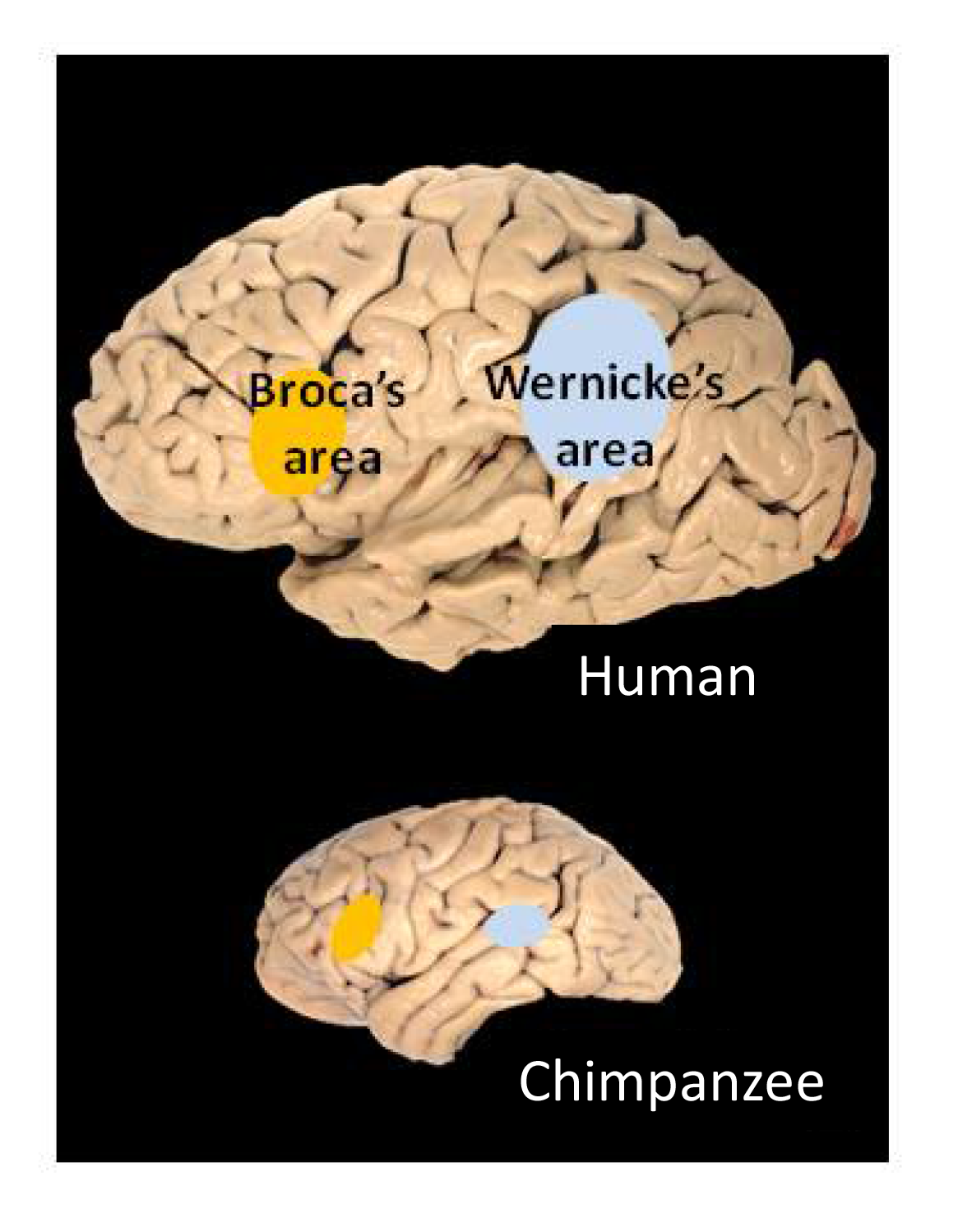
The brain has a core language system, mostly in the left hemisphere — classically the regions known as Broca's area, involved in producing speech, and Wernicke's area, involved in understanding it, along with the pathways that connect them. Here is the key finding of decades of brain imaging: this same network handles all of a person's languages. There is no dedicated English area sitting beside a separate Chinese area. When a bilingual speaks either language, largely the same regions light up. The languages are superimposed on shared machinery, not parcelled out to different territories.
Broca's area and Wernicke's area on the left hemisphere. Every language a person speaks draws on the same two regions — which is why the interesting question is not where they sit but how the brain keeps them apart.Source: Michael C. Corballis — CC BY 2.5, Wikimedia Commons
But when and how well you learned matters
The picture has a fascinating wrinkle. A landmark study scanned bilinguals and found that people who learned both languages early in life used almost perfectly overlapping tissue for the two. But people who learned their second language later showed slightly separated patches of activity within Broca's area for each language — near neighbours, not distant regions, but not quite the same spot. So the age at which you learned a language subtly shapes how tightly it overlaps with the others.
Proficiency matters too. The more fluent you are, the more your second language settles into the same efficient, native-like network as your first. A weak, newly acquired language is more effortful, leaning harder on the brain's general-purpose control and attention areas until practice lets it join the core network. In other words, languages do not start fully merged — repeated use gradually weaves a new one into the shared fabric.
What is actually special: control, not storage
If the languages share the same regions, how does a multilingual speaker not blurt out Chinese in the middle of an English sentence? The answer is the real headline of bilingual neuroscience. It is not separate storage that keeps languages apart — it is a dedicated system of control. Both languages are always, quietly, switched on, and a network involving the prefrontal cortex, the anterior cingulate, and the basal ganglia continuously selects the language you need and suppresses the one you do not. Keeping your languages straight is not a filing problem solved by separate drawers; it is a traffic-control problem solved, moment by moment, by the brain's executive system.
Are there any differences at all?
Yes — just not the tidy, separate-region kind. With fine-grained analysis, researchers can actually read out which language a bilingual is using from the subtle pattern of activity, so each language does leave a faint distinctive signature within the shared network. And languages that look and sound very different can lean on some extra, sense-specific areas: reading Chinese characters, for instance, draws a little more on visual and spatial processing than reading an alphabet does. So the languages are not neurally identical. But these are shades and textures woven through the same regions — not separate compartments in different parts of the brain.
The bigger truth
Part of why the filing-cabinet image fails is that a single language is not stored in one place to begin with. Any language is spread across networks — one region weighting toward sound, others toward meaning, others toward grammar. Your languages share these distributed networks, layered and interwoven rather than boxed off. It is less like books on separate shelves and more like several melodies played by the same orchestra, on the same instruments, with the conductor choosing which to bring forward.
Why this matters for a learner
This shared architecture is quietly good news. It is why you will never run out of room for another language; why your languages can lend each other strength, as knowledge and strategies transfer between them; and why growing up with — or working hard at — more than one builds that powerful control network, the very thing thought to keep the multilingual mind nimble as it ages. Your languages are not rivals in separate rooms competing for space. They are housemates in one connected home.
The takeaway
Does the brain keep each language in its own region? No — not in the way we picture it. Your languages share the same core network, overlapping ever more tightly the earlier and the better you learn them, distinguished not by where they are stored but by a control system that always seems to know which one you need. The multilingual brain's real marvel is not a set of separate drawers. It is one shared home, and a conductor who never loses the thread.
Read the simple version
The same article, told in plain words — for younger readers, or for anyone who wants the point quickly.
Picture someone who speaks five languages. It is tempting to imagine their brain as a set of filing cabinets — English in one drawer, Chinese in another.
It is a natural picture, and it is mostly wrong. The truth is stranger and more elegant.
One shared network
The brain has a core language system, mostly on the left side. Decades of brain scans point to the same finding: that one network handles all of a person's languages.
There is no English area sitting beside a separate Chinese area. When a bilingual speaks either one, largely the same regions light up. The languages are laid on top of shared machinery, not given separate territory.
But when and how well you learned it shows
There is a lovely wrinkle. People who learned both languages early in life use almost perfectly overlapping tissue for the two. People who learned the second one later show slightly separated patches of activity — near neighbours, not distant regions, but not quite the same spot.
How well you speak it matters too. The more fluent you become, the more the second language settles into the same efficient network as the first. A weak, new language is effortful, and leans harder on the brain's general-purpose attention areas until practice lets it join the core.
So languages do not begin fully merged. Use gradually weaves a new one into the shared fabric.
The real headline: control, not storage
If they share the same regions, why does a multilingual not blurt out Chinese in the middle of an English sentence?
Because both languages are always quietly switched on, and a separate control system is constantly choosing the one you need and holding the other back.
Keeping your languages straight is not a filing problem solved by separate drawers. It is a traffic problem, solved moment by moment.
Are there any differences at all?
Yes — just not the tidy separate-room kind.
With careful analysis, researchers can actually tell which language a bilingual is using from the fine pattern of activity, so each language does leave a faint signature. And very different writing systems lean on a little extra: reading Chinese characters draws more on visual and spatial processing than reading an alphabet does.
But these are shades woven through the same regions, not compartments in different parts of the brain.
The bigger truth
The filing-cabinet picture fails for a deeper reason: a single language is not stored in one place to begin with. Any language is spread across networks — one area leaning toward sound, others toward meaning, others toward grammar.
It is less like books on separate shelves and more like several melodies played by the same orchestra, on the same instruments, with a conductor choosing which to bring forward.
Why this is good news for you
You will never run out of room for another language.
Your languages can lend each other strength, because what you learn in one transfers.
Working at more than one builds that control network — the very thing thought to keep a multilingual mind nimble as it ages.
Your languages are not rivals in separate rooms competing for space. They are housemates in one connected home.
Sources & further reading
These articles summarize well-established research in learning science and linguistics. Key sources and further reading:
Kim, K. H. S., Relkin, N. R., Lee, K.-M., & Hirsch, J. (1997). Distinct cortical areas associated with native and second languages. Nature.
Perani, D., & Abutalebi, J. (2005). The neural basis of first and second language processing. Current Opinion in Neurobiology.
Abutalebi, J., & Green, D. W. (2007). Bilingual language production: The neurocognition of language representation and control. Journal of Neurolinguistics.
Green, D. W., & Abutalebi, J. (2013). Language control in bilinguals: The adaptive control hypothesis. Journal of Cognitive Psychology.
Xu, M., Baldauf, D., Chang, C. Q., Desimone, R., & Tan, L. H. (2017). Distinct distributed patterns of neural activity are associated with two languages in the bilingual brain. Science Advances.