Every normal child learns to speak without instruction. No child learns to read without it. The gap between those two facts — what the psychologist David Geary called biologically primary and secondary knowledge — explains why discovery learning works for one and fails for the other, why learning takes effort at all, and why your memory forgetting things is a feature rather than a fault.
Here is something so familiar we have stopped finding it strange.
Every normal child, in every culture, learns to speak their mother tongue without being taught. No syllabus, no exercises, no one explaining the grammar. By five they are handling structures that an adult learning the same language as a foreign one will struggle with for years.
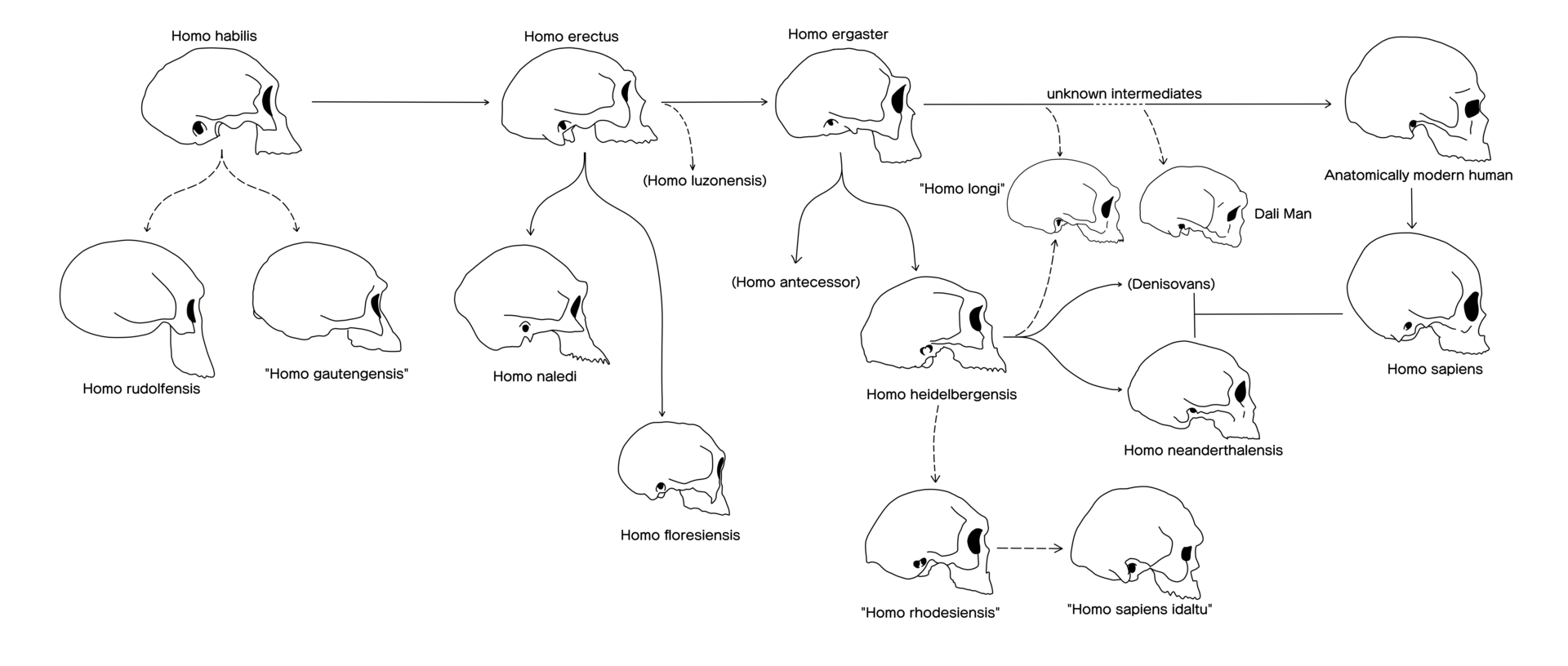
Speech had hundreds of thousands of years to become something a child picks up without being taught. Reading has had about five thousand, and has to be installed in every child one at a time — which is why one of them looks effortless and the other needs schools.Source: SimplisticReps — CC BY-SA 4.0, Wikimedia Commons
And yet no child learns to read on their own. Writing has to be taught, systematically, over years, and a substantial share of learners still find it hard for life.
Same brain, same language. Why the difference?
Two kinds of knowledge
The most useful answer comes from the psychologist David Geary, who drew a line between two sorts of cognitive competence.
Biologically primary knowledge is what our species evolved to acquire. Speaking and understanding a first language. Recognising faces. Judging small quantities at a glance. Finding your way through space. Reading other people's intentions. These appear in every culture, develop on a broadly similar schedule, and are acquired without instruction — a child needs only to be among other people, and to play.
Biologically secondary knowledge is the set of cultural inventions too recent for evolution to have equipped us for. Writing is about five thousand years old; algebra, chemical notation, musical scores and programming are far younger. There is no reading instinct the way there is a speaking instinct. These have to be actively transmitted, and the learner has to spend conscious effort.
The neuroscientist Stanislas Dehaene showed the mechanism. When we learn to read, the brain does not switch on a region built for writing, because there is no such region. It repurposes a patch of visual cortex that evolved to recognise shapes and objects, and retrains it on letterforms. Dehaene calls this neuronal recycling. Learning to read is, quite literally, borrowing a machine built for something else.
Why this matters for teaching
The distinction sounds academic, and it settles one of education's longest arguments.
The argument runs plausibly enough: children learn to speak by immersion, without teaching — so let them learn mathematics, reading and science the same way. Let them discover. Do not lecture.
This confuses the two kinds of knowledge. Natural discovery works for primary knowledge because the brain arrives prepared for it. For secondary knowledge, which the brain is not prepared for at all, nothing guarantees the same thing happens.
That is the foundation of the well-known 2006 paper by Kirschner, Sweller and Clark, arguing that minimal guidance fails novices. Not because discovery is bad, but because with secondary content a novice lacks the background knowledge to discover anything worth having. They grope about, working memory floods, and little is retained.
Working memory is narrow, and there is a reason
John Sweller went further and built the whole of cognitive load theory on evolutionary foundations, describing human cognition in parallel with natural selection: both are information-processing systems that build complex structures over time.
Two of his principles are worth pulling out.
The borrowing and reorganising principle. Almost everything you know, you did not discover. You took it from other people, through speech, writing and watching. That, not personal discovery, is the human species' main mechanism of learning. Original discovery is rare and expensive.
The narrow limits of change principle. Working memory holds only a handful of elements at once. That sounds like a defect, and it has an evolutionary logic: any large, fast change to a store of knowledge that already works is more likely to damage it than improve it — much as large mutations are usually lethal. A narrow channel forces change to happen slowly, a piece at a time.
Put differently: the feeling that your head is full when you meet a hard concept is not a sign that you are slow. It is a safety mechanism doing its job.
Forgetting is a feature
The evolutionary view also inverts how we think about memory.
Memory did not evolve for storage. It evolved for prediction — to make the right information available for the situation in front of you. Seen that way, letting go of what has stopped being used is not a malfunction; it is how the system keeps what is useful within reach.
Robert and Elizabeth Bjork formalised this: a memory has a storage strength and a retrieval strength, and the two come apart. What is easy to recall right now is often what is least securely stored. This is why desirable difficulties work: retrieving instead of rereading, spacing instead of massing, interleaving instead of blocking. All of them make studying feel worse and make the outcome better.
One finding is especially telling. James Nairne and colleagues had people process word lists in various ways, including one instruction: imagine you are stranded in the grasslands, and rate how useful each item would be for survival. That survival framing produced better recall than the deep-encoding methods previously thought strongest. Our memories still, quite literally, favour what mattered to a stone-age brain.
What it says about learning a language
For language learners the evolutionary frame resolves several things that otherwise look contradictory.
Why immersion works — but not for everything. Listening and speaking recruit the primary machinery: sound, rhythm, social interaction, reading the other person's intent. That is why living among native speakers does so much for comprehension and fluency.
Why writing is a different problem entirely. The Greek alphabet, Chinese characters, English spelling — all pure secondary knowledge. No instinct helps you here. They have to be taught systematically, broken into parts, and reviewed on a schedule.
For a Vietnamese speaker learning Chinese characters this has a concrete consequence. Three thousand characters will not seep in the way a mother tongue does. But they can be decomposed into repeating parts — radicals and phonetic components — and learned as a system. That is precisely how you turn an enormous secondary load into something a narrow working memory can handle: small regular pieces, revisited at spaced intervals.
And why motivation is a real problem. No child needs encouragement to learn to talk. Everyone needs a reason to sit down with thirty characters. With primary knowledge motivation comes built in; with secondary knowledge it has to be supplied. That is not a character flaw in the learner — it is the shape of the problem.
Where to be careful
A strong framework invites overreach, so a few honest limits.
The primary–secondary line is not sharp. It is a useful classification, not a cleanly defined biological boundary. Critics point out that it is hard to test which category a given ability falls into, and that weakens its explanatory force.
Evolutionary explanations slide easily into just-so stories. Any trait can be given a plausible-sounding evolutionary account after the fact. The parts of this framework worth trusting are the ones that make testable predictions — Nairne's survival-processing effect, or the cognitive load experiments.
And most importantly: we did not evolve for this does not mean it cannot be learned. It means it has to be taught, worked at, and well designed. Humans read, do mathematics and write software extremely well. Just not naturally.
What to actually do
Classify what you are learning. Is this something the brain arrives ready for, or a cultural invention? The answer sets the method: immersion and practice for the first, explicit instruction for the second.
With secondary knowledge, do not wait for it to arrive. Go and find the clear explanation, the worked example, the system. Working the rule out for yourself is appealing and, for a novice, many times slower.
Borrow the primary machinery as scaffolding. Story, spatial imagery, voice, interaction with another person — these are channels the brain processes almost for free. A character attached to an image and a story stays put better than a bare one.
Treat forgetting as part of the plan. Do not measure progress by how fluent studying feels. Measure it by what survives a week — and build the review schedule around that.
The brain you bring to a Chinese lesson was shaped by a few hundred thousand years of talking, watching, and remembering what mattered for staying alive. It was never prepared for writing. Knowing that does not make learning easier — but it does explain why some things must be taught, repeated and systematised, and why the feeling of effort is not a sign that you are doing it wrong.
Read the simple version
The same article, told in plain words — for younger readers, or for anyone who wants the point quickly.
Every child learns to speak without being taught. No child learns to read on their own.
Same brain, same language. Why the difference?
Two kinds of knowledge
The useful answer draws a line between two sorts of thing.
The first is what our species evolved to acquire. Speaking and understanding a first language. Recognising faces. Judging small quantities at a glance. Finding your way through space. Reading other people's intentions.
These appear in every culture, arrive on a broadly similar schedule, and are acquired without instruction. A child needs only to be among other people, and to play.
The second is the set of cultural inventions too recent for evolution to have equipped us for. Writing is about five thousand years old; algebra, chemical notation, musical scores and programming are far younger.
There is no reading instinct the way there is a speaking instinct. These have to be actively transmitted, and the learner has to spend conscious effort.
What the brain actually does when you learn to read
It does not switch on a region built for writing, because there is no such region. It repurposes a patch of visual cortex that evolved to recognise shapes and objects, and retrains it on letterforms.
Learning to read is, quite literally, borrowing a machine built for something else.
Why this settles an old argument
The argument runs plausibly enough: children learn to speak by immersion, without teaching — so let them learn mathematics, reading and science the same way. Let them discover. Do not lecture.
This confuses the two kinds of knowledge. Natural discovery works for the first kind because the brain arrives prepared for it. For the second kind, which the brain is not prepared for at all, nothing guarantees the same thing happens.
Minimal guidance fails beginners — not because discovering things is bad, but because with this kind of content a beginner lacks the background knowledge to discover anything worth having. They grope about, working memory floods, and little is retained.
What to do with this
Classify what you are learning. Is this something the brain arrives ready for, or a cultural invention? The answer sets the method: immersion and practice for the first, explicit instruction for the second.
With the second kind, do not wait for it to arrive. Go and find the clear explanation, the worked example, the system. Working the rule out for yourself is appealing and, for a beginner, many times slower.
Borrow the first kind as scaffolding. Story, spatial imagery, voice, interaction with another person — these are channels the brain processes almost for free. A character attached to an image and a story stays put better than a bare one.
Treat forgetting as part of the plan. Do not measure progress by how fluent studying feels. Measure it by what survives a week — and build the review schedule around that.
The point
The brain you bring to a Chinese lesson was shaped by a few hundred thousand years of talking, watching, and remembering what mattered for staying alive. It was never prepared for writing.
Knowing that does not make learning easier. But it explains why some things must be taught, repeated and systematised — and why the feeling of effort is not a sign that you are doing it wrong.
Sources & further reading
These articles summarize well-established research in learning science and linguistics. Key sources and further reading:
Geary, D. C. (1995). Reflections of evolution and culture in children's cognition: Implications for mathematical development and instruction. American Psychologist, 50(1), 24–37.
Geary, D. C. (2008). An evolutionarily informed education science. Educational Psychologist, 43(4), 179–195.
Sweller, J. (2008). Instructional implications of David C. Geary's evolutionary educational psychology. Educational Psychologist, 43(4), 214–216.
Sweller, J., Ayres, P., & Kalyuga, S. (2011). Cognitive Load Theory. New York: Springer.
Kirschner, P. A., Sweller, J., & Clark, R. E. (2006). Why minimal guidance during instruction does not work. Educational Psychologist, 41(2), 75–86.
Dehaene, S. (2009). Reading in the Brain: The New Science of How We Read. New York: Viking.
Nairne, J. S., & Pandeirada, J. N. S. (2008). Adaptive memory: Remembering with a stone-age brain. Current Directions in Psychological Science, 17(4), 239–243.
Bjork, R. A., & Bjork, E. L. (1992). A new theory of disuse and an old theory of stimulus fluctuation. In A. Healy et al. (eds.), From Learning Processes to Cognitive Processes. Erlbaum.
Pinker, S. (1994). The Language Instinct: How the Mind Creates Language. New York: William Morrow.