The Hidden Head Start: Why Vietnamese Speakers Have an Edge in Learning Chinese
Vietnamese speakers may be among the best-positioned learners of Chinese in the world. The built-in advantages — shared Hán-Việt vocabulary, a tonal ear, similar grammar, and known character meanings — and how to make the most of them.
If you are Vietnamese and thinking of learning Chinese, here is some genuinely good news, and it is grounded in linguistics rather than encouragement: you may be one of the best-positioned learners in the world. Where an English speaker starts Mandarin almost from zero — strange sounds, alien grammar, a wall of characters — a Vietnamese speaker begins with a set of deep, built-in advantages. Some are obvious; others are hidden in the very words you speak every day. Two thousand years of shared history have quietly loaded the dice in your favour.
You already know thousands of Chinese words
This is the biggest head start of all. A large share of the Vietnamese vocabulary — by many estimates well over half, and higher still in formal and academic language — comes from Chinese. These are the Hán-Việt (Sino-Vietnamese) words, borrowed over centuries, and they shadow modern Chinese with startling closeness. Consider: 大学 (dàxué) is đại học, university. 国家 (guójiā) is quốc gia, nation. 自由 (zìyóu) is tự do, freedom. 文化 (wénhuà) is văn hóa; 历史 (lìshǐ) is lịch sử; 注意 (zhùyì) is chú ý; 电话 (diànhuà) is điện thoại; 银行 (yínháng) is ngân hàng. The list runs to thousands. Once you learn the systematic sound correspondences between Hán-Việt and Mandarin, an enormous store of Chinese vocabulary is not new at all — it is already half yours, waiting to be recognised.
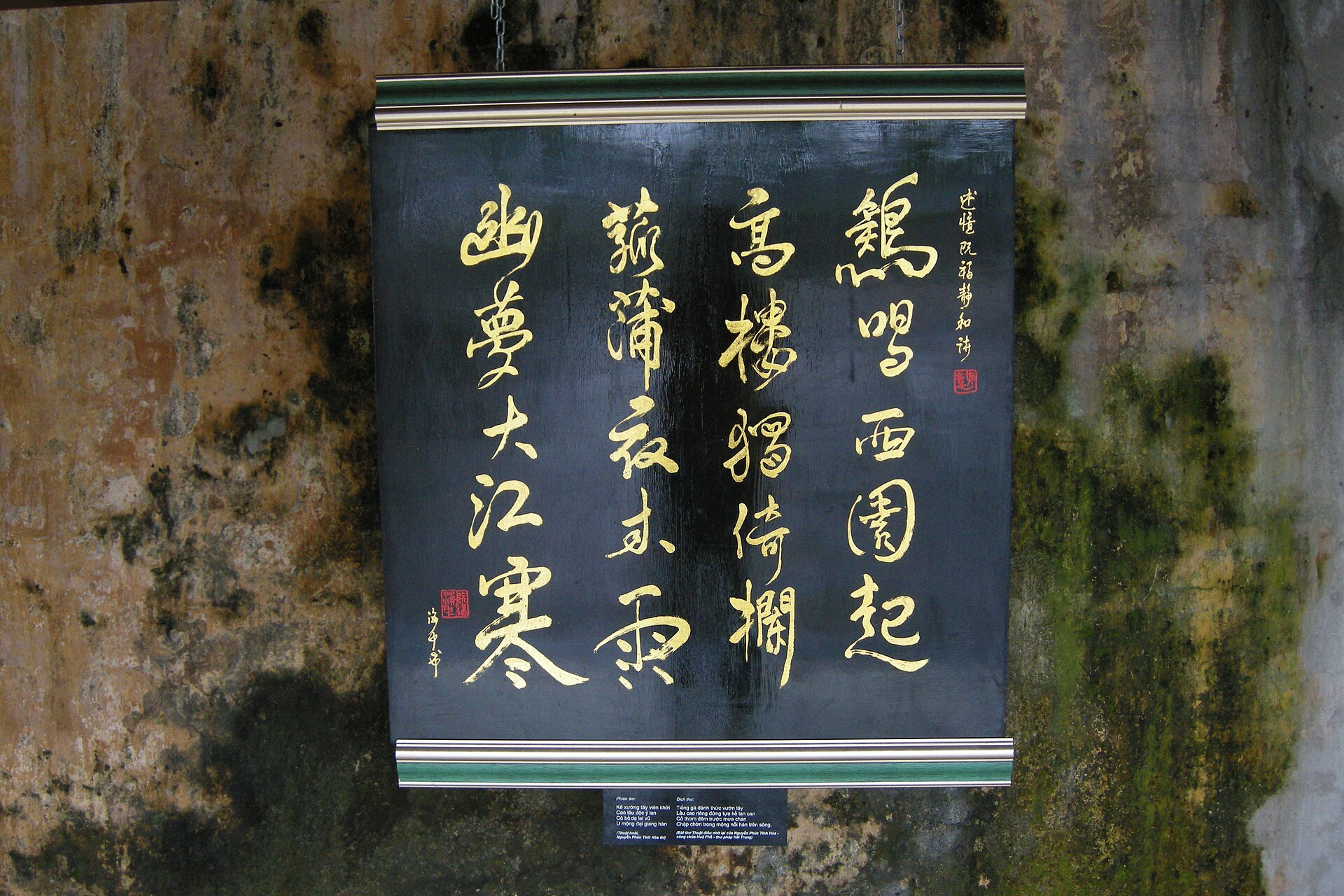
Chinese characters in Hue, on Vietnamese ground. The head start is not sentiment about shared history — it is that a large share of Vietnamese vocabulary came through this door, and a Vietnamese learner meets those words already half known.Source: Vyacheslav Argenberg — CC BY 4.0, Wikimedia Commons
You already think in tones
The single thing that most terrifies English speakers about Chinese — that a change in pitch changes the meaning of a word — is completely natural to you. Vietnamese is a tonal language with six tones; Mandarin has only four. You have spent your whole life using pitch to distinguish meaning, and your ear is already trained to hear it. You will still need to retune to Mandarin's particular tones, but the great conceptual leap that costs other learners months of struggle, you made as a baby.
The grammar will feel familiar
Vietnamese and Chinese are built the same way. Both are isolating languages: words do not change their form. There are no verb conjugations to memorise, no plurals, no genders, no tenses stitched onto the ends of words — time is shown with small helper words, exactly as in Vietnamese. Both follow subject-verb-object order, and both use measure words — the classifiers that baffle Europeans feel obvious to you, because Vietnamese has them too (một quyển sách maps neatly onto 一本书). Chinese grammar, which other learners find genuinely strange, will often simply feel like sense.
You already know what the characters mean
Modern Vietnamese is written in the Latin alphabet, so you will still have to learn to read and write the characters — that part is real work. But you are not learning their meaning from scratch, and that changes everything. See 学 and you already know it is học, to study. 国 is quốc, country; 心 is tâm, heart; 水 is thủy, water. Each character arrives with a meaning and a sound-anchor you already carry in your Hán-Việt vocabulary. Where an English learner must attach both a new shape and a new meaning to every character, you only have to fasten the shape onto a meaning you have known your whole life.
The culture is close, too
Beyond words and grammar lies a shared world. Centuries in the same cultural sphere mean shared four-character idioms (the Chinese chengyu often have direct Vietnamese cousins in thành ngữ), shared festivals, shared values and concepts. Much of the cultural context that mystifies other learners of Chinese is already familiar to you — which makes texts easier to understand and, just as importantly, makes the language feel less foreign and more worth the effort.
An honest word about the challenges
None of this makes Chinese effortless, and it is worth being clear-eyed. The characters themselves are still a genuine task — Vietnamese gave them up generations ago, so learning to read and write Hanzi takes real, sustained work, even if knowing the meanings lightens the load. The tones do not map one-to-one: your six Vietnamese tones and Mandarin's four have different shapes, so your instincts can mislead you, and you will need to retrain rather than transfer them wholesale. And a handful of Hán-Việt words have drifted in meaning over the centuries, creating the occasional false friend. These are real advantages, not a free pass.
How to make the most of your head start
Lean hard on Hán-Việt. For every new Chinese word, consciously find its Hán-Việt cousin, and learn the regular sound correspondences between the two. This one habit unlocks thousands of words at a stroke.
Trust your ear — but retune it. Believe in your natural feel for tones, then deliberately practise Mandarin's four so your Vietnamese habits do not leak in.
Attack characters with the science. Since you already own the meanings, pour your early effort into the shape and the Mandarin sound — using radicals, mnemonic stories, and spaced repetition to make the forms stick.
Use the cultural bridge. Reach for shared idioms, proverbs, and history; they deepen understanding and keep the language feeling like home rather than a foreign country.
The takeaway
A Vietnamese learner of Chinese is not setting off on a foreign expedition so much as returning to a familiar neighbourhood. The two languages have been entwined for two millennia, and that long history has quietly stocked your vocabulary, tuned your ear, and shaped your grammar with advantages most learners can only envy. Put in the honest work the characters demand, retune your tones, and lean on the Hán-Việt already living in your everyday speech — and Chinese may prove far closer to home than you ever imagined.
Read the simple version
The same article, told in plain words — for younger readers, or for anyone who wants the point quickly.
If you are Vietnamese and thinking of learning Chinese, here is genuinely good news — and it comes from linguistics, not from encouragement. You may be one of the best-positioned learners in the world.
Two thousand years of shared history have quietly loaded the dice in your favour.
You already know thousands of Chinese words
This is the biggest head start of all. A large share of Vietnamese vocabulary — by many estimates well over half, and higher still in formal language — comes from Chinese. These are the Hán-Việt words, and they shadow modern Chinese with startling closeness:
大学 dàxué = đại học
国家 guójiā = quốc gia
自由 zìyóu = tự do
历史 lìshǐ = lịch sử
电话 diànhuà = điện thoại
银行 yínháng = ngân hàng
The list runs to thousands. Learn the regular sound correspondences between Hán-Việt and Mandarin and an enormous store of Chinese vocabulary is not new at all — it is already half yours, waiting to be recognised.
You already think in tones
The single thing that most terrifies English speakers about Chinese — that a change in pitch changes the word — is completely natural to you. Vietnamese has six tones; Mandarin has four.
You will still have to retune to Mandarin's particular tones. But the great conceptual leap that costs other learners months of struggle, you made as a baby.
The grammar will feel familiar
Both languages are built the same way: words do not change their shape. No conjugations, no plurals, no genders, no tense endings — time is shown with small helper words, exactly as in Vietnamese.
Characters: real work, but half done
Modern Vietnamese uses the Latin alphabet, so you still have to learn to read and write the characters. That part is genuine work.
But you are not learning their meaning from scratch, and that changes everything. See 学 and you already know it is học. 国 is quốc. 心 is tâm. 水 is thuỷ.
Where an English learner must attach both a new shape and a new meaning to every character, you only have to fasten the shape onto a meaning you have known your whole life.
And the culture is close too
Centuries in the same cultural sphere mean shared four-character idioms, shared festivals, shared concepts. Much of what mystifies other learners is already familiar — which makes texts easier and, just as importantly, makes the language feel less foreign and more worth the effort.
An honest word
None of this makes Chinese effortless.
The characters are still a real task — Vietnamese gave them up generations ago. The tones do not map one to one: six against four, with different shapes, so your instincts can mislead you and must be retrained rather than transferred. And a handful of Hán-Việt words have drifted in meaning over the centuries, leaving the occasional false friend.
These are real advantages, not a free pass.
A Vietnamese learner of Chinese is not setting off on a foreign expedition so much as returning to a familiar neighbourhood.
Sources & further reading
These articles summarize well-established research in learning science and linguistics. Key sources and further reading:
Alves, M. J. (2009). Loanwords in Vietnamese. In M. Haspelmath & U. Tadmor (Eds.), Loanwords in the World's Languages. De Gruyter Mouton.
Nguyễn, Đình-Hoà. (1997). Vietnamese. John Benjamins.
DeFrancis, J. (1977). Colonialism and Language Policy in Viet Nam. Mouton.
Ringbom, H. (2007). Cross-linguistic Similarity in Foreign Language Learning. Multilingual Matters.
Odlin, T. (1989). Language Transfer: Cross-linguistic Influence in Language Learning. Cambridge University Press.