This piece belongs to a series of 100 posts written in memory of Thom's grandmother, published on her Facebook.
Once I understood a little more about attention and about living awake, I wished I had come to it sooner. I imagine that if my grandfather were still alive I would know how to love him and care for him better — that after squeezing his orange juice I would also know how to talk with him about other things I have learnt, buy him cauliflower to eat, let him see how much I treasure every book of poems and every diary he ever kept, and so turn every moment beside him into something worth remembering.
These past few years I have been thinking about how children can learn “mindfulness” and “impermanence” while they are still small, and here are the three simplest ways:
Watching the breath come and go naturally, watching the triangle of skin around the nose and mouth; whenever attention is lost or calm is out of reach, come back to the breathing. (From Vipassana meditation)
Watching the sensations in the body come and go (Vipassana meditation)
Eating a fruit the child REALLY LIKES, and showing them how to compare: when we truly attend to the smell and the taste, and when we do not — because without that attention we cannot see the beauty in it at all.
Ah, let me think and add more if there is more.
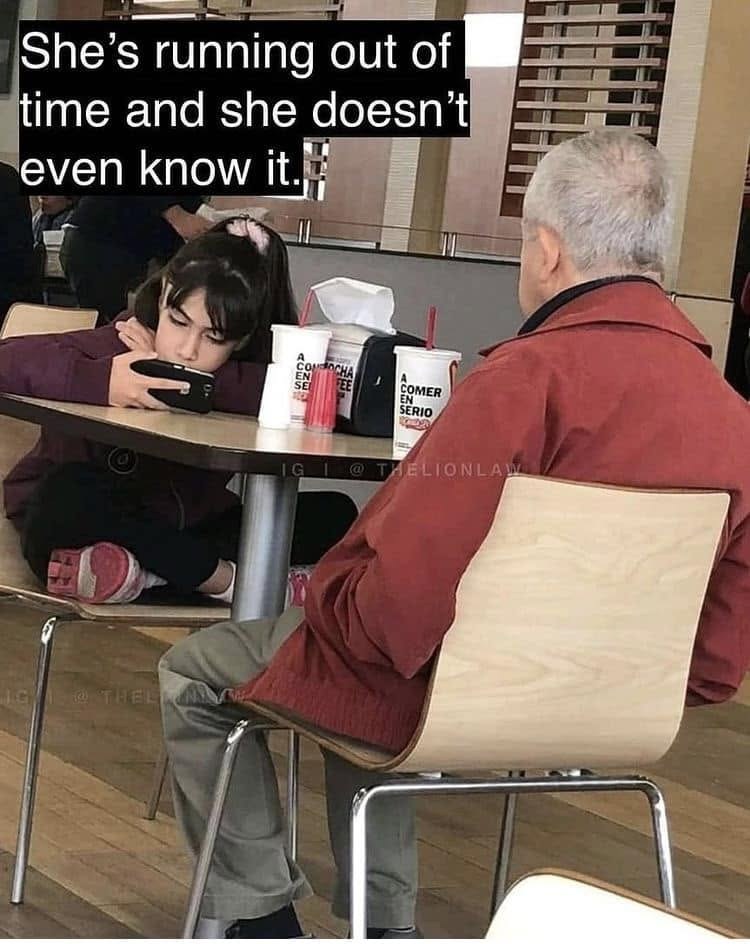
“She does not know she is running out of time.”
A picture I saw on Instagram (watermarked @thelionlaw).