You are reading this in letters the Greeks completed. This piece covers three thousand four hundred years of a small language with the largest vocabulary footprint on earth — and a fight over language that killed people, which Vietnam fought its own version of.
The letters you are reading are Greek, four steps removed: Phoenician to Greek, Greek to Etruscan, Etruscan to Latin, and Latin to the quốc ngữ that missionaries built for Vietnamese.
But the Greek step was the decisive one, and it bears directly on whether Vietnamese could be written alphabetically at all.
The real gift: vowels
The Phoenician script wrote consonants only. Readers inferred the vowels from context — workable for Semitic languages, where the root of a word lives in its consonants.
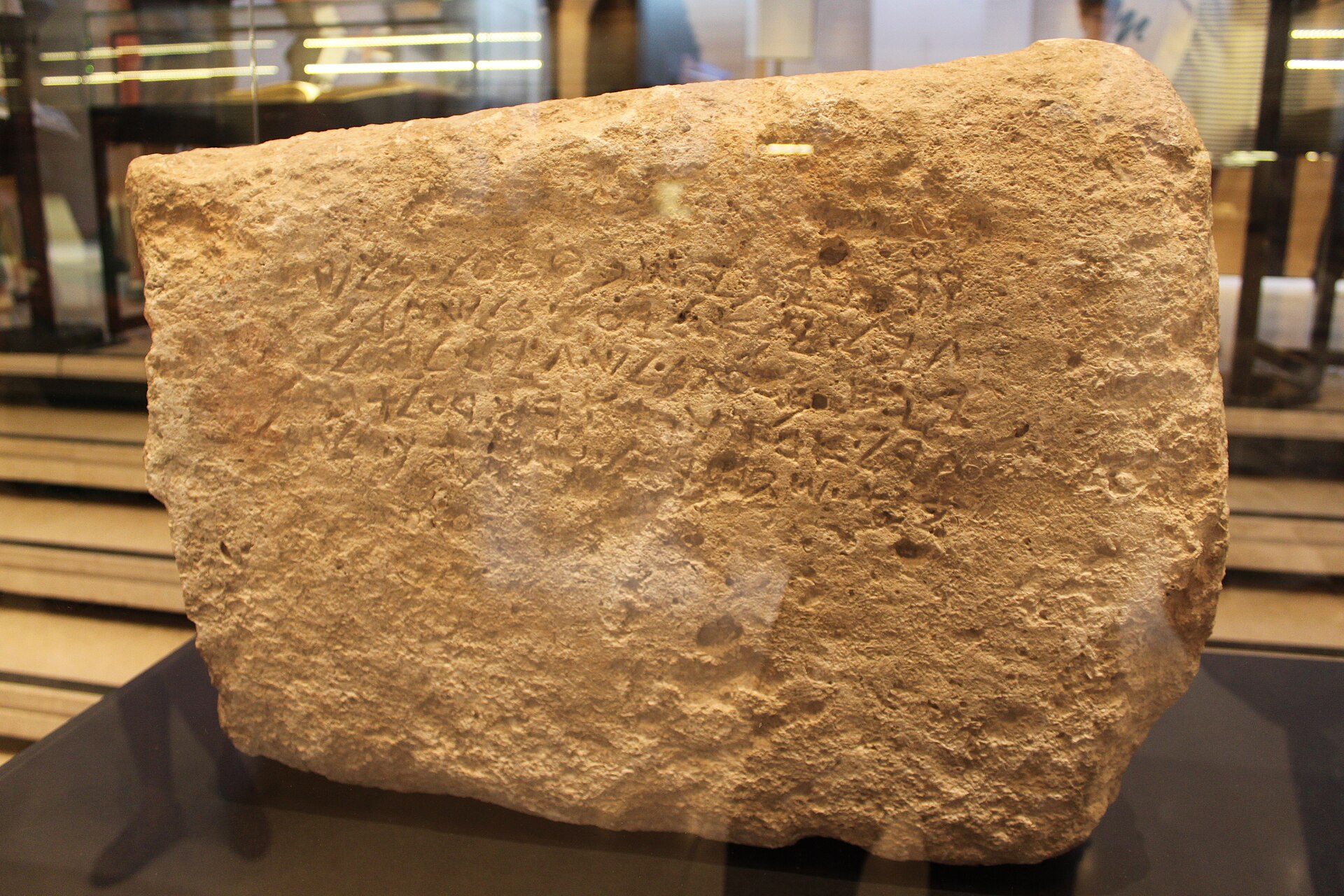
The Shipitbaal inscription from Byblos, 9th century BC. Consonants only — the reader supplied the vowels, which is the gap Greek later filled.Source: Faqscl — CC BY-SA 4.0, Wikimedia Commons
When the Greeks took that script over, around the eighth century BCE, they hit a problem. Greek had sounds Phoenician lacked, and the reverse too: several Phoenician signs stood for consonants Greek had no use for.
Rather than discard them, they spent the spare signs on vowels. Aleph became alpha, he became epsilon, ayin became omicron.
It was the first time in history a script recorded consonants and vowels alike. Coulmas (2003), Daniels and Bright (1996) and Woodard (1997) all treat it as the hinge of writing's history.
And here is where it reaches you. Vietnamese is a language in which vowel quality and tone carry almost all the information. Ma, mà, má, mả, mã, mạ — same consonants, six different words. A consonant-only script would be useless for Vietnamese.
Quốc ngữ is possible because of a decision somebody made on the Aegean coast nearly three thousand years ago.
Three thousand four hundred years of paperwork
Greek has the longest continuously documented history of any European language still spoken today.
The oldest attested form is Mycenaean Greek, written in the syllabic script Linear B on clay tablets from Knossos, Pylos, Mycenae, Thebes and Tiryns, dating from roughly 1450 to 1200 BCE.
For decades nobody could read them. Then in 1952, Michael Ventris — an architect with no formal training in linguistics — proved that Linear B recorded an early form of Greek. The finding pushed the language's documented history back by half a millennium. Chadwick (1958) tells the story of the decipherment.
But one detail deserves stating, because it cuts against the usual romance.
The Linear B tablets are almost entirely accounts. Inventories of olive oil, lists of workers, counts of chariot wheels, records of tribute. No poetry, no epic, no philosophy.
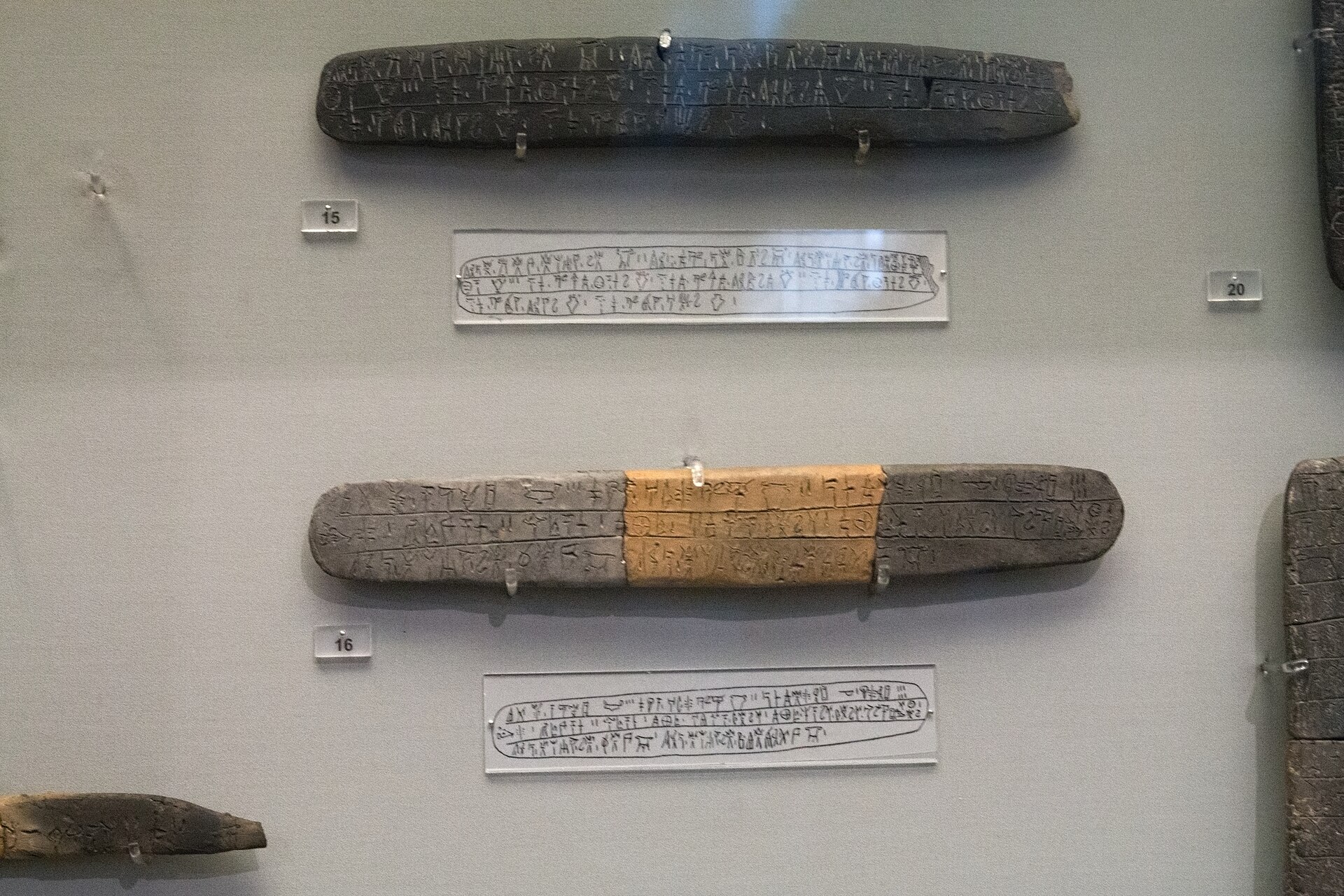
A Linear B tablet from Pylos, 13th century BC. Almost every surviving tablet is an inventory — the script was kept for accounts, not for poetry.Source: Zde — CC BY-SA 4.0, Wikimedia Commons
The oldest Greek humanity possesses is warehouse bookkeeping. Writing is like this everywhere: it is invented to count things, and only much later put to literature.
There was never one Ancient Greek
Learners tend to imagine Ancient Greek as a single block. It was not.
The classical period had distinct dialects: Ionic, Attic, Doric, Aeolic, different enough that you can place an author immediately. Homer's language was not even a real dialect — it is a literary amalgam, mixing dialect layers from different eras.
And the Greek that spread across the world was not the literary Attic of Athens. It was Koine — literally the common tongue, the simplified Greek that emerged after Alexander's conquests.
Koine became the lingua franca of the whole eastern Mediterranean for centuries, and it is the language the New Testament was written in. Bubenik (1989) and Colvin (2007) describe the period.
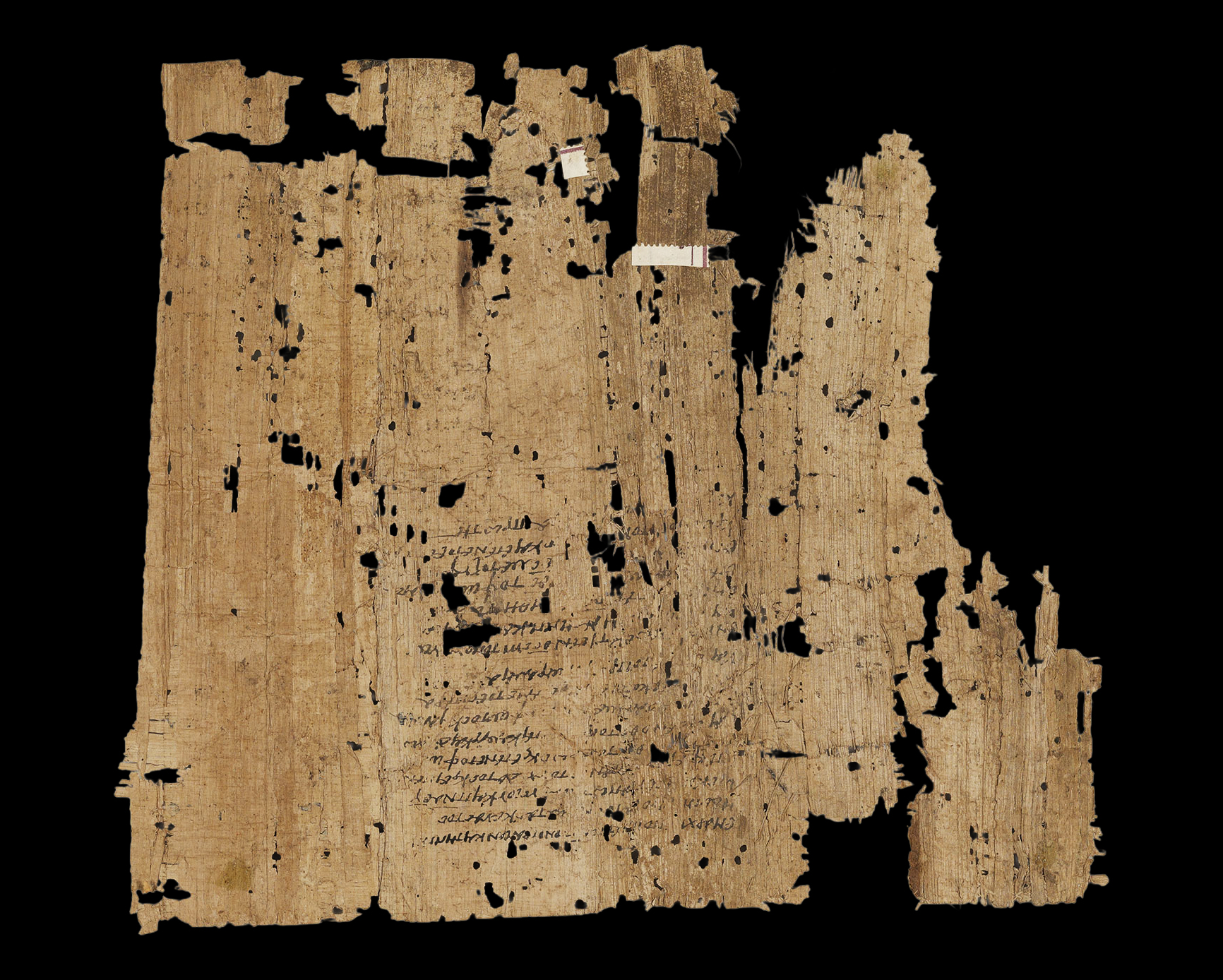
A Greek papyrus of Genesis, written in Koine. Note that nothing separates the words — the reader was expected to hear the text, not scan it.Source: Unknown authorUnknown author — Public domain, Wikimedia Commons
It is a pattern that recurs across this whole series: the variety that travels is not the most beautiful one, it is the simplest and most useful one.
Why you can read Greek but not hear it
This is the thing that most disorients learners, and it is the mirror image of what happened to English.
In Ancient Greek, the letters and digraphs η, ι, υ, ει, οι were clearly distinct in sound. Over the centuries they merged, one after another, into a single vowel: /i/. The phenomenon is called itacism.
Which means Modern Greek has five spellings for one vowel. The orthography preserved every distinction; the pronunciation erased them all.
Compare this site's article on English. There, the spelling froze while the sounds moved on. In Greek, the sounds collapsed while the spelling held. Opposite routes, same destination: writing and speech out of step.
The practical consequence is concrete, and it favours you in one direction.
Reading Greek aloud is almost perfectly predictable: see it, say it, because all those spellings produce /i/. But spelling is genuinely hard: you hear /i/ and must pick one of five spellings, with no rule to guide you beyond knowing the word's origin.
So read aloud early and without fear. And expect spelling to take longer than you think.
The trap: ancient is not modern
This needs saying plainly, because it sends people into Greek with the wrong expectations.
The reasoning goes: I already know biology, telephone, psychology, so Greek should be easy.
That vocabulary comes from Ancient Greek, and it does give you an advantage — but only in recognition on the page, and mostly for learned words.
Modern Greek has travelled a long way. It has lost the infinitive entirely — where English says to do, Modern Greek must use a subordinate clause. Joseph (1983) studies this across the Balkans, where several unrelated languages lost the infinitive together through long contact.
It has also lost the dative case, changed its entire sound system, and — most importantly — its everyday vocabulary is not its learned vocabulary. Knowing φιλοσοφία will not buy you a bus ticket.
Holton, Mackridge and Philippaki-Warburton (2012) is the full descriptive grammar of the modern language, and even its contents page shows a language in its own right rather than a late edition of the ancient one.
The language war that killed people
This is the part worth remembering, and the part that echoes in Vietnam.
When the modern Greek state came into being in the nineteenth century, it had to choose a language to write in. That question split the country for over a hundred years.
On one side stood katharevousa — the purified tongue. An artificial written form that restored vocabulary and morphology from Ancient Greek which the spoken language had long since shed. It stood for reconnection with the ancient glory.
On the other stood dimotiki — the people's language, what Greeks actually spoke in the market.
This was no grammarians' quarrel. In 1901, publication of a translation of the Gospel of Matthew into everyday Greek touched off riots in the streets of Athens — the Evangelika. The climax came on 8 November, remembered as Black Thursday, when eight demonstrators were killed.
People died over which written form of their own language a book should be translated into.
The dispute was only settled officially in 1976, when the Karamanlis government made demotic the official language. Katharevousa survives in some ceremonial contexts, particularly in the Greek Orthodox Church.
Ferguson (1959) used the Greek case as his classic example when he coined the term diglossia. Mackridge (2009) and Frangoudaki (1992) tell the full story.
Vietnam fought its own version
A Vietnamese reader should find this familiar.
For centuries the prestige written language in Vietnam was Hán văn — literary Chinese, the language of the examinations and of official documents, spoken by nobody in daily life. Alongside it sat chữ Nôm, which wrote Vietnamese and was considered lower. Then in the early twentieth century, quốc ngữ and a written Vietnamese modelled on speech displaced both.
Marr (1981) describes that transition, and DeFrancis (1977) examines colonial language policy.
The structure is strikingly similar: a formal, archaic written form tied to prestige and learning, displaced by everyday speech — and the displacement was a political decision, not a natural evolution.
But it is worth marking where the comparison breaks, lest it seem too tidy. In Greece the fight was within one language, between two written forms of the same tongue. In Vietnam it was simultaneously a change of script, and it unfolded under French colonial pressure. The political settings were very different.
What they share is not a cause but a lesson: what gets called the standard language is always the outcome of a fight, never a pre-existing fact.
Why you meet the originals, not translations
This site's Spanish article showed that the Greco-Latin academic layer and the Sino-Vietnamese one are translations of each other. With Greek that relationship reverses, and that is the difference.
Here you are not meeting another translation. You are meeting the original.
When Meiji Japanese scholars built new compounds out of Chinese characters to render European concepts, what they were mostly rendering were Greek compounds. Liu (1995) and Howland (2002) examine the process.
So the actual chain of transmission runs like this:
φιλοσοφία (love + wisdom) → translated as 哲學 → into Vietnamese as triết học.
δημοκρατία (people + rule) → 民主 → dân chủ.
ψυχολογία (soul + discourse) → 心理學 → tâm lý học.
When you learn λόγος, ψυχή, δῆμος, βίος, γράφω, μέτρον, φῶς, you are not loading a third layer. You are walking upstream to the source of Hán-Việt words you have used since school.
And the effort pays broadly: those same roots sit inside English, French and Spanish. Coxhead's (2000) Academic Word List is largely that Greco-Latin layer. Thirty roots open hundreds of words, across several languages at once.
A small language with an enormous footprint
Greek today is the language of one small country and Cyprus, plus a diaspora. By speaker numbers it is nowhere near the front rank.
Now open any scientific paper, in any language, anywhere on the planet. Greek morphemes will be in it.
Greek stopped being the language of an empire two thousand years ago. It never stopped being the language of science.
That is an unusual split: political power long gone, lexical power entirely intact.
And you read all of this in letters the Greeks completed — by deciding that vowels deserved writing down too.
Read the simple version
The same article, told in plain words — for younger readers, or for anyone who wants the point quickly.
Look down at this line of text.
The letters you are reading are Greek, four steps removed: Phoenician to Greek, Greek to Etruscan, Etruscan to Latin, and Latin to the quốc ngữ that missionaries built for Vietnamese.
But the Greek step was the decisive one, and it bears directly on whether Vietnamese could be written alphabetically at all.
The real gift: vowels
The Phoenician script wrote consonants only. Readers inferred the vowels from context — workable for Semitic languages, where the root of a word lives in its consonants.
When the Greeks took that script over, around the eighth century BCE, they hit a problem. Greek had sounds Phoenician lacked, and the reverse too: several Phoenician signs stood for consonants Greek had no use for.
Rather than discard them, they spent the spare signs on vowels. Aleph became alpha, he became epsilon, ayin became omicron.
It was the first time in history a script recorded consonants and vowels alike. Coulmas (2003), Daniels and Bright (1996) and Woodard (1997) all treat it as the hinge of writing's history.
And here is where it reaches you. Vietnamese is a language in which vowel quality and tone carry almost all the information. Ma, mà, má, mả, mã, mạ — same consonants, six different words. A consonant-only script would be useless for Vietnamese.
Quốc ngữ is possible because of a decision somebody made on the Aegean coast nearly three thousand years ago.
Three thousand four hundred years of paperwork
Greek has the longest continuously documented history of any European language still spoken today.
The oldest attested form is Mycenaean Greek, written in the syllabic script Linear B on clay tablets dating from roughly 1450 to 1200 BCE.
For decades nobody could read them. Then in 1952, Michael Ventris — an architect with no formal training in linguistics — proved that Linear B recorded an early form of Greek. The finding pushed the language's documented history back by half a millennium. Chadwick (1958) tells the story.
But one detail deserves stating, because it cuts against the usual romance.
The Linear B tablets are almost entirely accounts. Inventories of olive oil, lists of workers, counts of chariot wheels, records of tribute. No poetry, no epic, no philosophy.
The oldest Greek humanity possesses is warehouse bookkeeping. Writing is like this everywhere: it is invented to count things, and only much later put to literature.
There was never one Ancient Greek
Learners tend to imagine Ancient Greek as a single block. It was not.
The classical period had distinct dialects: Ionic, Attic, Doric, Aeolic, different enough that you can place an author immediately. Homer's language was not even a real dialect — it is a literary amalgam, mixing dialect layers from different eras.
And the Greek that spread across the world was not the literary Attic of Athens. It was Koine — literally the common tongue, the simplified Greek that emerged after Alexander's conquests. Koine became the lingua franca of the whole eastern Mediterranean for centuries, and it is the language the New Testament was written in.
It is a pattern that recurs across this whole series: the variety that travels is not the most beautiful one, it is the simplest and most useful one.
Why you can read Greek but not hear it
This is the thing that most disorients learners, and it is the mirror image of what happened to English.
In Ancient Greek, the letters and digraphs η, ι, υ, ει, οι were clearly distinct in sound. Over the centuries they merged, one after another, into a single vowel: /i/. The phenomenon is called itacism.
Which means Modern Greek has five spellings for one vowel. The orthography preserved every distinction; the pronunciation erased them all.
Compare English. There, the spelling froze while the sounds moved on. In Greek, the sounds collapsed while the spelling held. Opposite routes, same destination: writing and speech out of step.
The practical consequence favours you in one direction. Reading Greek aloud is almost perfectly predictable: see it, say it, because all those spellings produce /i/. But spelling is genuinely hard: you hear /i/ and must pick one of five spellings, with no rule to guide you beyond knowing the word's origin.
So read aloud early and without fear. And expect spelling to take longer than you think.
The trap: ancient is not modern
This needs saying plainly, because it sends people into Greek with the wrong expectations.
The reasoning goes: I already know biology, telephone, psychology, so Greek should be easy.
That vocabulary comes from Ancient Greek, and it does give you an advantage — but only in recognition on the page, and mostly for learned words.
Modern Greek has travelled a long way. It has lost the infinitive entirely — where English says to do, Modern Greek must use a subordinate clause. Joseph (1983) studies this across the Balkans, where several unrelated languages lost the infinitive together through long contact.
It has also lost the dative case, changed its entire sound system, and — most importantly — its everyday vocabulary is not its learned vocabulary. Knowing φιλοσοφία will not buy you a bus ticket.
The language war that killed people
This is the part worth remembering, and the part that echoes in Vietnam.
When the modern Greek state came into being in the nineteenth century, it had to choose a language to write in. That question split the country for over a hundred years.
On one side stood katharevousa — the purified tongue. An artificial written form that restored vocabulary and morphology from Ancient Greek which the spoken language had long since shed. It stood for reconnection with the ancient glory.
On the other stood dimotiki — the people's language, what Greeks actually spoke in the market.
This was no grammarians' quarrel. In 1901, publication of a translation of the Gospel of Matthew into everyday Greek touched off riots in the streets of Athens — the Evangelika. The climax came on 8 November, remembered as Black Thursday, when eight demonstrators were killed.
People died over which written form of their own language a book should be translated into.
The dispute was only settled officially in 1976, when demotic became the official language. Ferguson (1959) used the Greek case as his classic example when he coined the term diglossia. Mackridge (2009) and Frangoudaki (1992) tell the full story.
Vietnam fought its own version
For centuries the prestige written language in Vietnam was Hán văn — literary Chinese, the language of the examinations and of official documents, spoken by nobody in daily life. Alongside it sat chữ Nôm, which wrote Vietnamese and was considered lower. Then in the early twentieth century, quốc ngữ and a written Vietnamese modelled on speech displaced both.
The structure is strikingly similar: a formal, archaic written form tied to prestige and learning, displaced by everyday speech — and the displacement was a political decision, not a natural evolution.
But it is worth marking where the comparison breaks, lest it seem too tidy. In Greece the fight was within one language, between two written forms of the same tongue. In Vietnam it was simultaneously a change of script, and it unfolded under French colonial pressure. The political settings were very different.
What they share is not a cause but a lesson: what gets called the standard language is always the outcome of a fight, never a pre-existing fact.
Why you meet the originals, not translations
The Greco-Latin academic layer and the Sino-Vietnamese one are translations of each other. With Greek that relationship reverses, and that is the difference.
Here you are not meeting another translation. You are meeting the original.
When Meiji Japanese scholars built new compounds out of Chinese characters to render European concepts, what they were mostly rendering were Greek compounds.
So the actual chain of transmission runs like this:
φιλοσοφία (love + wisdom) → 哲學 → triết học δημοκρατία (people + rule) → 民主 → dân chủ ψυχολογία (soul + discourse) → 心理學 → tâm lý học
When you learn λόγος, ψυχή, δῆμος, βίος, γράφω, μέτρον, φῶς, you are not loading a third layer. You are walking upstream to the source of Hán-Việt words you have used since school.
And the effort pays broadly: those same roots sit inside English, French and Spanish. Coxhead's (2000) Academic Word List is largely that Greco-Latin layer. Thirty roots open hundreds of words, across several languages at once.
A small language with an enormous footprint
Greek today is the language of one small country and Cyprus, plus a diaspora. By speaker numbers it is nowhere near the front rank.
Now open any scientific paper, in any language, anywhere on the planet. Greek morphemes will be in it.
Greek stopped being the language of an empire two thousand years ago. It never stopped being the language of science.
That is an unusual split: political power long gone, lexical power entirely intact.
And you read all of this in letters the Greeks completed — by deciding that vowels deserved writing down too.
Sources & further reading
These articles summarize well-established research in learning science and linguistics. Key sources and further reading:
Horrocks, G. (2010). Greek: A History of the Language and its Speakers (2nd ed.). Oxford: Wiley-Blackwell.
Browning, R. (1983). Medieval and Modern Greek (2nd ed.). Cambridge: Cambridge University Press.
Palmer, L. R. (1980). The Greek Language. London: Faber & Faber.
Colvin, S. (2007). A Historical Greek Reader: Mycenaean to the Koiné. Oxford: Oxford University Press.
Ventris, M., & Chadwick, J. (1973). Documents in Mycenaean Greek (2nd ed.). Cambridge: Cambridge University Press.
Chadwick, J. (1958). The Decipherment of Linear B. Cambridge: Cambridge University Press.
Ventris, M. (1953). Evidence for Greek dialect in the Mycenaean archives. Journal of Hellenic Studies, 73, 84–103.
Woodard, R. D. (1997). Greek Writing from Knossos to Homer. Oxford: Oxford University Press.
Powell, B. B. (1991). Homer and the Origin of the Greek Alphabet. Cambridge: Cambridge University Press.
Jeffery, L. H. (1990). The Local Scripts of Archaic Greece (rev. ed.). Oxford: Clarendon Press.
Coulmas, F. (2003). Writing Systems: An Introduction to their Linguistic Analysis. Cambridge: Cambridge University Press.
Daniels, P. T., & Bright, W. (Eds.) (1996). The World’s Writing Systems. New York: Oxford University Press.
Sampson, G. (1985). Writing Systems: A Linguistic Introduction. Stanford, CA: Stanford University Press.
Allen, W. S. (1987). Vox Graeca: The Pronunciation of Classical Greek (3rd ed.). Cambridge: Cambridge University Press.
Bubenik, V. (1989). Hellenistic and Roman Greece as a Sociolinguistic Area. Amsterdam: John Benjamins.
Mackridge, P. (1985). The Modern Greek Language. Oxford: Oxford University Press.
Mackridge, P. (2009). Language and National Identity in Greece, 1766–1976. Oxford: Oxford University Press.
Holton, D., Mackridge, P., & Philippaki-Warburton, I. (2012). Greek: A Comprehensive Grammar (2nd ed.). London: Routledge.
Ferguson, C. A. (1959). Diglossia. Word, 15(2), 325–340.
Frangoudaki, A. (1992). Diglossia and the present language situation in Greece. Language in Society, 21(3), 365–381.
Joseph, B. D. (1983). The Synchrony and Diachrony of the Balkan Infinitive. Cambridge: Cambridge University Press.
Marr, D. G. (1981). Vietnamese Tradition on Trial, 1920–1945. Berkeley: University of California Press.
DeFrancis, J. (1977). Colonialism and Language Policy in Viet Nam. The Hague: Mouton.
Liu, L. H. (1995). Translingual Practice: Literature, National Culture, and Translated Modernity — China, 1900–1937. Stanford, CA: Stanford University Press.
Howland, D. (2002). Translating the West: Language and Political Reason in Nineteenth-Century Japan. Honolulu: University of Hawaii Press.
Coxhead, A. (2000). A new academic word list. TESOL Quarterly, 34(2), 213–238.
_-_Mus%C3%A9e_national_du_Liban.jpg)

_verso_Genesis_1,_1%E2%80%935_LXX_Greek.jpg)