A History of Korean: Two Answers to the Same Problem
In the fifteenth century Korea and Vietnam faced the same problem: how to write a language the available script was never built for. They answered in opposite ways — and history then reversed both results.
In the fifteenth century, Korea and Vietnam faced an identical problem.
Both were states that used Chinese characters as their official writing. Both spoke a language entirely unrelated to Chinese which that script fitted badly. Both had an educated class writing in literary Chinese, and a large population that could read nothing at all.
The two chose opposite solutions.
Korea invented an alphabet from nothing. Vietnam made more Chinese characters.
And history then inverted both outcomes in a way nobody could have predicted. This is that story.
An alphabet that was designed, not evolved
Almost every writing system on earth evolved. Nobody knows who devised Chinese characters, or the Phoenician script, or the Latin alphabet; they accreted over centuries with no blueprint.
Hangul is different, and that is why it occupies a category of its own in the history of writing.
It is the only major writing system whose inventor we know, whose date we know, and whose design document survives to explain why each letter looks as it does.
King Sejong and a team of scholars created it in 1443 and promulgated it in 1446 as the Hunminjeongeum (訓民正音) — the correct sounds for the instruction of the people.
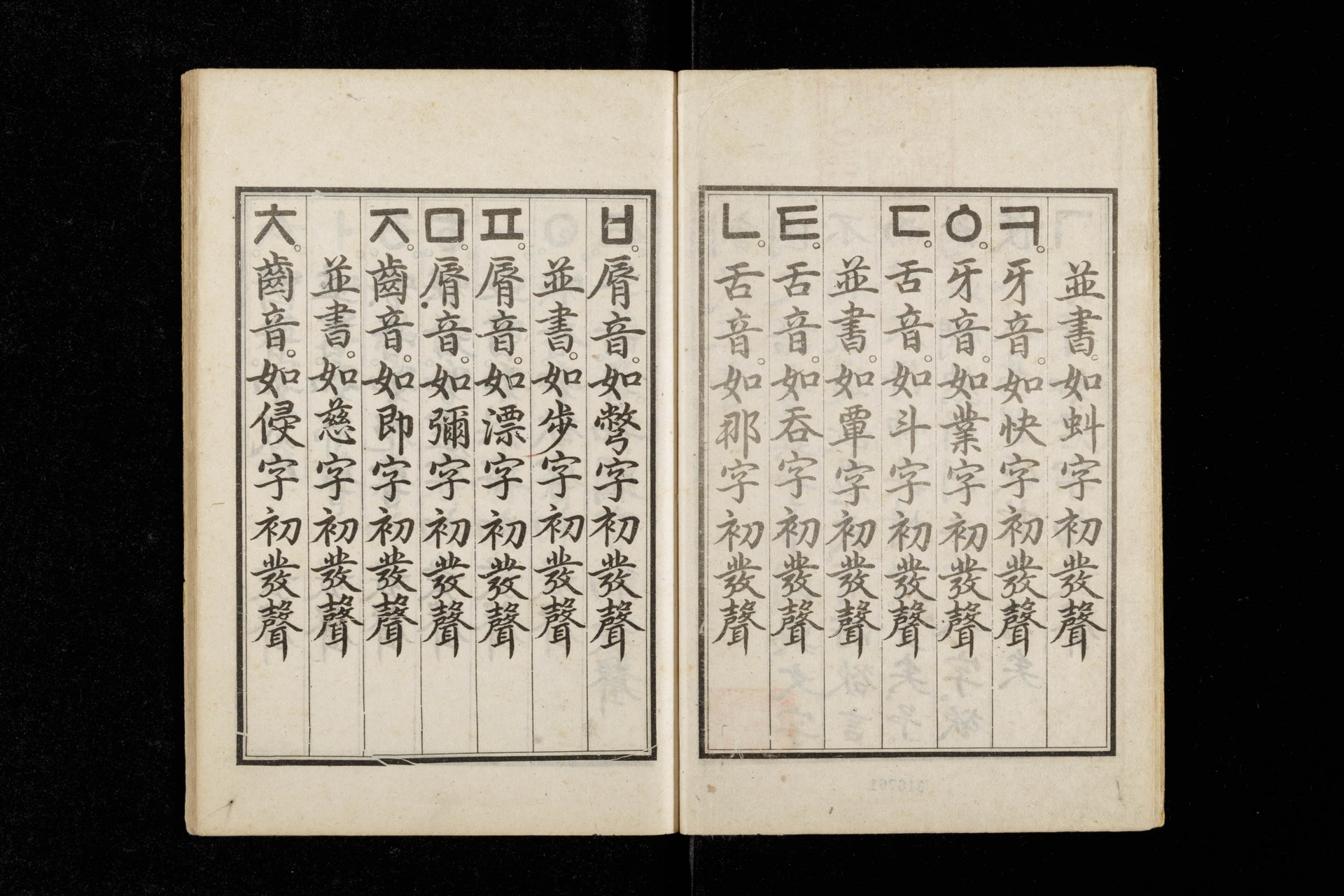
The Hunminjeongeum Haerye, 1446 — the document that explains the new alphabet. Almost no other writing system on earth arrives with its designer's reasoning attached.Source: Government of Joseon — Public domain, Wikimedia Commons
The remarkable part is the design principle, recorded in the accompanying Hunminjeongeum Haerye.
The consonants are diagrams of the speech organs. Five basic letters imitate the shape the tongue, lips, teeth and throat take when producing the corresponding sound, across five articulatory categories. The remaining consonants are derived by adding strokes — and the added strokes encode aspiration.
So ㄱ, ㅋ and ㄲ are not three unrelated symbols to be memorised separately. They are one sound at two degrees of modification, and the shapes say so.
The vowels are built from three elements drawn from Confucian cosmology: Heaven (ㆍ), Earth (ㅡ) and Human (ㅣ). Every other vowel combines those three, and Korean's vowel harmony is written directly into the shapes.
Sampson (1985) places Hangul in a class of its own as a featural script, because the letter shapes mirror the structure of the sounds themselves. Kim-Renaud (1997) and Ledyard (1998) examine the system in full.
In his preface, Sejong wrote that ordinary people had things they wished to say but no way to express them, and that he had made these letters so that anyone could learn them easily and use them daily.
That is not decoration. It is a design brief, and the script meets it.
And it was banned
Here is the part the tourist accounts leave out.
For most of the Joseon period, Hangul was dismissed as eonmun (諺文) — vulgar script. It was associated with women, merchants and the lower classes. Educated men went on writing in literary Chinese.
In 1504, King Yeonsangun banned its use. In 1506, King Jungjong abolished the office for its study.
The reason is worth stating directly, because it is not Korea's alone.
For the yangban class, the difficulty of Classical Chinese was not a flaw but the point. It maintained the boundary between those who governed and those who were governed. A script anyone could learn in a few days threatened that boundary directly.
Hangul only truly prevailed in the twentieth century.
Readers following this series will see the pattern. The Greek article told of katharevousa and dimotiki, and eight dead in 1901. Vietnam had its shift from Hán văn to quốc ngữ. Korea had literary Chinese and eonmun.
Three countries, three different centuries, one dispute: who is permitted to read, and who benefits from reading remaining difficult. Ferguson (1959) called the phenomenon diglossia, but its substance is power, not grammar.
Chữ Nôm: the other answer
Now look at Vietnam.
Vietnam faced the same problem and produced a wholly different answer: chữ Nôm. Rather than start fresh, Vietnamese writers extended the existing script, combining Chinese character components to build new characters for Vietnamese sounds and meanings.
It was a real achievement, and it produced the greatest literature of classical Vietnamese. Truyện Kiều was written in chữ Nôm.
But compare the two solutions on cost of learning, because that is where they differ fundamentally.
Hangul has twenty-eight letters and a set of combination rules. An adult can learn to read it in days.
Chữ Nôm required you to know Chinese characters first — and then to learn several thousand more. It did not replace the old difficulty; it stacked a new one on top.
Handel (2019) surveys how Chinese characters were borrowed and adapted across East Asia, and places chữ Nôm alongside the other derived scripts in one comparative frame.
To be fair: this is not a story about Korea being cleverer. Chữ Nôm emerged gradually from the practical needs of writers, with no king commissioning a new system. Hangul was the product of centralised state power aimed at a specific project. That is a difference of circumstance, not of intelligence.
And then history reversed both
Here is where the story turns.
The script Koreans built for themselves was despised in its own country for four hundred years — and then won. Korea today writes with exactly what Sejong designed.
The script the Vietnamese built for themselves did not win. Chữ Nôm fell out of use, and Vietnamese is written today in a European alphabet devised by missionaries. Marr (1981) and DeFrancis (1977) describe that transition under colonial rule.
Both countries wanted out from under Chinese characters. One got out using its own invention. The other got out using someone else's.
This should not be read as a moral. It is an observation that which script survives depends far more on politics than on design quality. Hangul is a superb alphabet and it was still banned. Quốc ngữ won largely because colonial administration and nationalist movement pushed it at the same time.
The gift: more than half the vocabulary is already yours
Now the practical part, and this is the strongest bridge between Vietnamese and any language this site teaches.
According to the Standard Korean Language Dictionary of the National Institute of Korean Language, Sino-Korean accounts for roughly 57% of Korean vocabulary.
A caveat on that figure: estimates range from about 30% to 70%, depending on whether you count dictionary entries or words in running text. The 57% is one source's count, not an absolute fact.
But take either end of that range and the conclusion holds: a very large share of Korean is Sino-Korean, and you already have it as Hán-Việt.
學生 — haksaeng — học sinh
圖書館 — doseogwan — đồ thư quán (library)
注意 — juui — chú ý
準備 — junbi — chuẩn bị
約束 — yaksok — ước thúc (a promise)
家族 — gajok — gia tộc
無理 — muri — vô lý
And as this site's Chinese article showed, the relationship runs deeper than meaning. Both Sino-Vietnamese and Sino-Korean were borrowed from Middle Chinese, so the final consonants line up too: Korean kept -k and -p, and turned -t into -l.
So 十 is thập and sip. 國 is quốc and guk. 一 is nhất and il.
Once you see that pattern you stop memorising Korean vocabulary by rote. You start cross-referencing it against what you already know.
The wall: grammar
This has to be said, because the vocabulary makes people overconfident.
The vocabulary is a gift. The grammar is a wall. And that wall is higher for a Vietnamese speaker than for an English one.
Vietnamese is isolating, subject-verb-object, with almost no morphology. Korean is close to the opposite on every count:
Word order is subject-object-verb. The verb comes last. Which means that in listening, you must hold the whole sentence in mind before you learn what the action is.
It is agglutinative. A Korean verb can carry a stack of suffixes, each doing one job. Vietnamese expresses those things with separate words.
Particles mark semantic roles. 은/는, 이/가, 을/를 — Vietnamese leaves that work to word order.
And there is the honorific system. Vietnamese has a rich set of address terms keyed to age and relationship, so you do have an intuition for hierarchy. But Korean encodes hierarchy in verb endings, not only in pronouns. Brown (2011) studies learner difficulty in precisely this area.
In short: use the Hán-Việt advantage to move fast through vocabulary, then spend the time you saved on grammar. That is where the real work is.
One misconception to correct
Because Sino-Korean vocabulary exceeds half the lexicon, people conclude Korean is related to Chinese.
It is not.
Borrowed vocabulary, however much of it there is, does not create a genealogical relationship. The same holds for Vietnamese — an Austroasiatic language, not Sino-Tibetan, despite the depth of its Hán-Việt layer.
So what family does Korean belong to? The honest answer is that it is unsettled.
Through the twentieth century, many placed Korean in a family called Altaic alongside Japanese, Mongolic and Turkic. That hypothesis has largely been abandoned.Georg et al. (1999) set out the objections systematically; Vovin (2010) — once a supporter of a Korean-Japanese relationship — later concluded the similarities came from prolonged contact rather than common origin. Janhunen (2010) reconstructs the region's language map on different grounds.
The careful formulation today is that Korean constitutes a small family consisting of itself and its varieties, including Jeju.
What to take away
Back to the opening question.
Two countries, one problem, two answers. One designed an alphabet shaped like the speech organs. One extended the script it had, and produced Truyện Kiều.
Then the carefully engineered script was banned, and the organically grown one faded away.
What remains for a learner today is a tidy and very practical fact: two languages that history sent down separate roads still share more than half their vocabulary.
You are not starting Korean from zero. You are starting from 學生.
Read the simple version
The same article, told in plain words — for younger readers, or for anyone who wants the point quickly.
In the fifteenth century, Korea and Vietnam faced an identical problem.
Both were states that used Chinese characters as their official writing. Both spoke a language entirely unrelated to Chinese, which that script fitted badly. Both had an educated class writing in literary Chinese, and a large population that could read nothing at all.
The two chose opposite solutions.
Korea invented an alphabet from nothing. Vietnam made more Chinese characters.
And then history inverted both outcomes in a way nobody could have predicted.
An alphabet that was designed, not evolved
Almost every writing system on earth evolved. Nobody knows who devised Chinese characters, or the Phoenician script, or the Latin alphabet. They accreted over centuries with no blueprint.
Hangul is different, and that is why it sits in a category of its own in the history of writing. It is the only major writing system whose inventor we know, whose date we know, and whose design document survives to explain why each letter looks as it does.
King Sejong and a team of scholars created it in 1443 and promulgated it in 1446 as the Hunminjeongeum (訓民正音) — the correct sounds for the instruction of the people.
The remarkable part is the design principle. The consonants are diagrams of the speech organs. Five basic letters imitate the shape the tongue, lips, teeth and throat take when producing the corresponding sound. The rest are derived by adding strokes — and the added strokes encode aspiration.
So ㄱ, ㅋ and ㄲ are not three unrelated symbols to be memorised separately. They are one sound at two degrees of modification, and the shapes say so.
The vowels are built from three elements taken from Confucian cosmology: Heaven (ㆍ), Earth (ㅡ) and Human (ㅣ). Every other vowel combines those three, and Korean's vowel harmony is written directly into the shapes.
Sampson (1985) places Hangul in a class of its own as a featural script, because the letter shapes mirror the structure of the sounds themselves. Kim-Renaud (1997) and Ledyard (1998) examine the system in full.
In his preface, Sejong wrote that ordinary people had things they wished to say but no way to express them, and that he had made these letters so that anyone could learn them easily and use them daily. That is not decoration. It is a design brief, and the script meets it.
And it was banned
Here is the part the tourist accounts leave out.
For most of the Joseon period, Hangul was dismissed as eonmun (諺文) — vulgar script. It was associated with women, merchants and the lower classes. Educated men went on writing in literary Chinese.
In 1504, King Yeonsangun banned its use. In 1506, King Jungjong abolished the office for its study.
The reason is worth stating directly, because it is not Korea's alone. For the yangban class, the difficulty of Classical Chinese was not a flaw but the point. It maintained the boundary between those who governed and those who were governed. A script anyone could learn in a few days threatened that boundary directly.
Hangul only truly prevailed in the twentieth century.
Readers following this series will see the pattern. The Greek article told of katharevousa and dimotiki, and eight dead in 1901. Vietnam had its shift from Hán văn to quốc ngữ. Korea had literary Chinese and eonmun.
Three countries, three different centuries, one dispute: who is permitted to read, and who benefits from reading remaining difficult. Ferguson (1959) called the phenomenon diglossia, but its substance is power, not grammar.
Chữ Nôm: the other answer
Vietnam faced the same problem and produced a wholly different answer: chữ Nôm. Rather than start fresh, Vietnamese writers extended the existing script, combining Chinese character components to build new characters for Vietnamese sounds and meanings.
It was a real achievement, and it produced the greatest literature of classical Vietnamese. Truyện Kiều was written in chữ Nôm.
But compare the two solutions on the cost of learning, because that is where they differ fundamentally.
Hangul has twenty-eight letters and a set of combination rules. An adult can learn to read it in days.
Chữ Nôm required you to know Chinese characters first — and then to learn several thousand more. It did not replace the old difficulty; it stacked a new one on top.
Handel (2019) surveys how Chinese characters were borrowed and adapted across East Asia, and places chữ Nôm alongside the other derived scripts in one comparative frame.
To be fair: this is not a story about Korea being cleverer. Chữ Nôm emerged gradually from the practical needs of writers, with no king commissioning a new system. Hangul was the product of centralised state power aimed at a specific project. That is a difference of circumstance, not of intelligence.
And then history reversed both
The script Koreans built for themselves was despised in its own country for four hundred years — and then won. Korea today writes with exactly what Sejong designed.
The script the Vietnamese built for themselves did not win. Chữ Nôm fell out of use, and Vietnamese is written today in a European alphabet devised by missionaries. Marr (1981) and DeFrancis (1977) describe that transition under colonial rule.
Both countries wanted out from under Chinese characters. One got out using its own invention. The other got out using someone else's.
This should not be read as a moral. It is an observation that which script survives depends far more on politics than on design quality. Hangul is a superb alphabet and it was still banned. Quốc ngữ won largely because colonial administration and nationalist movement pushed it at the same time.
The gift: more than half the vocabulary is already yours
According to the Standard Korean Language Dictionary of the National Institute of Korean Language, Sino-Korean accounts for roughly 57% of Korean vocabulary.
A caveat on that figure: estimates range from about 30% to 70%, depending on whether you count dictionary entries or words in running text. The 57% is one source's count, not an absolute fact.
But take either end of that range and the conclusion holds: a very large share of Korean is Sino-Korean, and a Vietnamese speaker already has it as Hán-Việt.
學生 — haksaeng — học sinh 圖書館 — doseogwan — đồ thư quán (library) 注意 — juui — chú ý 準備 — junbi — chuẩn bị 約束 — yaksok — ước thúc (a promise) 家族 — gajok — gia tộc 無理 — muri — vô lý
And the relationship runs deeper than meaning. Both Sino-Vietnamese and Sino-Korean were borrowed from Middle Chinese, so the final consonants line up too: Korean kept -k and -p, and turned -t into -l.
So 十 is thập and sip. 國 is quốc and guk. 一 is nhất and il.
Once you see that pattern you stop memorising Korean vocabulary by rote. You start cross-referencing it against what you already know.
The wall: grammar
This has to be said, because the vocabulary makes people overconfident.
The vocabulary is a gift. The grammar is a wall. And that wall is higher for a Vietnamese speaker than for an English one.
Vietnamese is isolating, subject-verb-object, with almost no morphology. Korean is close to the opposite on every count.
Word order is subject-object-verb. The verb comes last — which means that in listening, you must hold the whole sentence in mind before you learn what the action is.
It is agglutinative. A Korean verb can carry a stack of suffixes, each doing one job. Vietnamese expresses those things with separate words.
Particles mark semantic roles. 은/는, 이/가, 을/를 — Vietnamese leaves that work to word order.
And there is the honorific system. Vietnamese has a rich set of address terms keyed to age and relationship, so you do have an intuition for hierarchy. But Korean encodes hierarchy in verb endings, not only in pronouns. Brown (2011) studies learner difficulty in precisely this area.
In short: use the Hán-Việt advantage to move fast through vocabulary, then spend the time you saved on grammar. That is where the real work is.
One misconception to correct
Because Sino-Korean vocabulary exceeds half the lexicon, people conclude Korean is related to Chinese. It is not.
Borrowed vocabulary, however much of it there is, does not create a genealogical relationship. The same holds for Vietnamese — an Austroasiatic language, not Sino-Tibetan, despite the depth of its Hán-Việt layer.
So what family does Korean belong to? The honest answer is that it is unsettled.
Through the twentieth century, many placed Korean in a family called Altaic alongside Japanese, Mongolic and Turkic. That hypothesis has largely been abandoned. Georg et al. (1999) set out the objections systematically; Vovin (2010) — once a supporter of a Korean-Japanese relationship — later concluded the similarities came from prolonged contact rather than common origin. Janhunen (2010) reconstructs the region's language map on different grounds.
The careful formulation today is that Korean constitutes a small family consisting of itself and its varieties, including Jeju.
What to take away
Two countries, one problem, two answers. One designed an alphabet shaped like the speech organs. One extended the script it had, and produced Truyện Kiều.
Then the carefully engineered script was banned, and the organically grown one faded away.
What remains for a learner today is a tidy and very practical fact: two languages that history sent down separate roads still share more than half their vocabulary.
You are not starting Korean from zero. You are starting from 學生.
Sources & further reading
These articles summarize well-established research in learning science and linguistics. Key sources and further reading:
Lee, K.-M., & Ramsey, S. R. (2011). A History of the Korean Language. Cambridge: Cambridge University Press.
Sohn, H.-M. (1999). The Korean Language. Cambridge: Cambridge University Press.
Sohn, H.-M. (2006). Korean Language in Culture and Society. Honolulu: University of Hawaii Press.
Song, J. J. (2005). The Korean Language: Structure, Use and Context. London: Routledge.
Ledyard, G. K. (1998). The Korean Language Reform of 1446. Seoul: Singu munhwasa.
Kim-Renaud, Y.-K. (Ed.) (1997). The Korean Alphabet: Its History and Structure. Honolulu: University of Hawaii Press.
King, R. (1996). Korean writing. In P. T. Daniels & W. Bright (Eds.), The World’s Writing Systems. New York: Oxford University Press.
Daniels, P. T., & Bright, W. (Eds.) (1996). The World’s Writing Systems. New York: Oxford University Press.
Coulmas, F. (2003). Writing Systems: An Introduction to their Linguistic Analysis. Cambridge: Cambridge University Press.
Sampson, G. (1985). Writing Systems: A Linguistic Introduction. Stanford, CA: Stanford University Press.
Taylor, I., & Taylor, M. M. (2014). Writing and Literacy in Chinese, Korean and Japanese (rev. ed.). Amsterdam: John Benjamins.
Handel, Z. (2019). Sinography: The Borrowing and Adaptation of the Chinese Script. Leiden: Brill.
Yeon, J., & Brown, L. (2011). Korean: A Comprehensive Grammar. London: Routledge.
Brown, L. (2011). Korean Honorifics and Politeness in Second Language Learning. Amsterdam: John Benjamins.
Martin, S. E. (1992). A Reference Grammar of Korean. Rutland, VT: Charles E. Tuttle.
Vovin, A. (2010). Koreo-Japonica: A Re-evaluation of a Common Genetic Origin. Honolulu: University of Hawaii Press.
Georg, S., Michalove, P. A., Ramer, A. M., & Sidwell, P. J. (1999). Telling general linguists about Altaic. Journal of Linguistics, 35(1), 65–98.
Janhunen, J. (2010). Reconstructing the language map of prehistorical Northeast Asia. Studia Orientalia, 108, 281–304.
Robbeets, M. (2005). Is Japanese Related to Korean, Tungusic, Mongolic and Turkic? Wiesbaden: Harrassowitz.
National Institute of Korean Language. Standard Korean Language Dictionary (표준국어대사전). Seoul: NIKL.
Ferguson, C. A. (1959). Diglossia. Word, 15(2), 325–340.
Nguyễn, Đ. H. (1997). Vietnamese. Amsterdam: John Benjamins.
DeFrancis, J. (1977). Colonialism and Language Policy in Viet Nam. The Hague: Mouton.
Marr, D. G. (1981). Vietnamese Tradition on Trial, 1920–1945. Berkeley: University of California Press.
Alves, M. J. (2009). Loanwords in Vietnamese. In M. Haspelmath & U. Tadmor (Eds.), Loanwords in the World’s Languages. Berlin: De Gruyter Mouton.
Nation, I. S. P. (2013). Learning Vocabulary in Another Language (2nd ed.). Cambridge: Cambridge University Press.