This piece belongs to a series of 100 posts written in memory of Thom's grandmother, published on her Facebook.
Contrary to what you may be thinking, this piece is not about the age at which to start learning a foreign language.
It tells you something you rarely think about: that being exposed to a wide — or a narrow — range of different sounds (which may come from different people or different objects), or to different languages, can help or can limit how sensitive and how open a child will later be to a world full of difference (the author uses a very serious term: linguistic prejudice).
Infants are extremely sensitive to the features of many kinds of language. (Including telling which language is being spoken from the movement of the lips — no easy challenge, even for adults.)
But without continued exposure, a child’s sensitivity soon narrows to the range that best fits their mother tongue.
One study found that even five-month-old infants prefer native speakers and the accent of their own language, showing an early preference for their mother tongue — specifically, in working out their mother tongue from the movement of the lips.
And children gradually lose this ability by the EIGHTH MONTH.
Conclusion: (purely in terms of being more open and more at ease with languages and with other peoples later on) let children be exposed to a diversity of sounds — and of languages in particular.
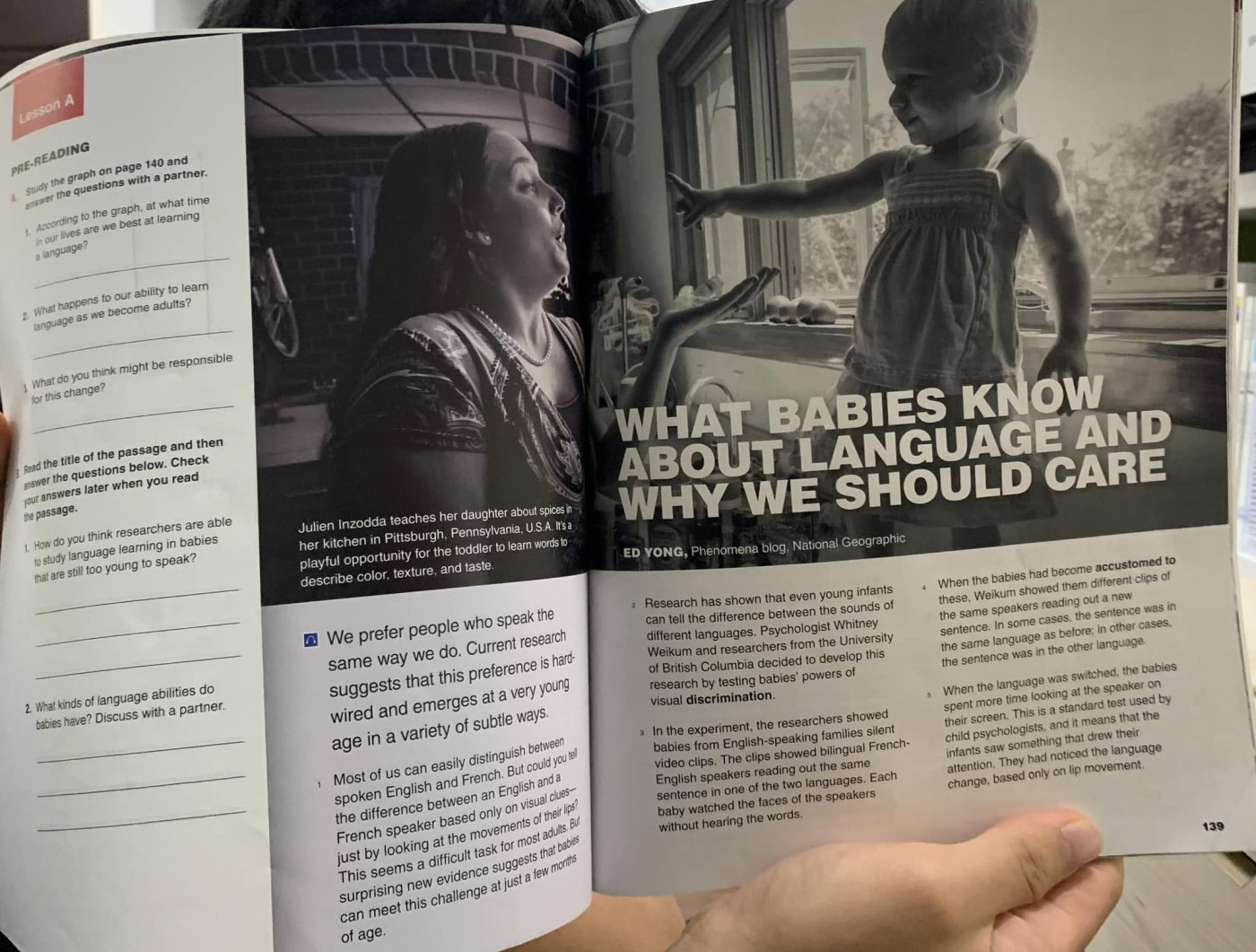
Page 139 of “21st Century Reading: Creative Thinking and Reading with TED Talks”. The reading is “What Babies Know About Language and Why We Should Care” by Ed Yong (Phenomena blog, National Geographic).