This piece belongs to a series of 100 posts written in memory of Thom's grandmother, published on her Facebook.
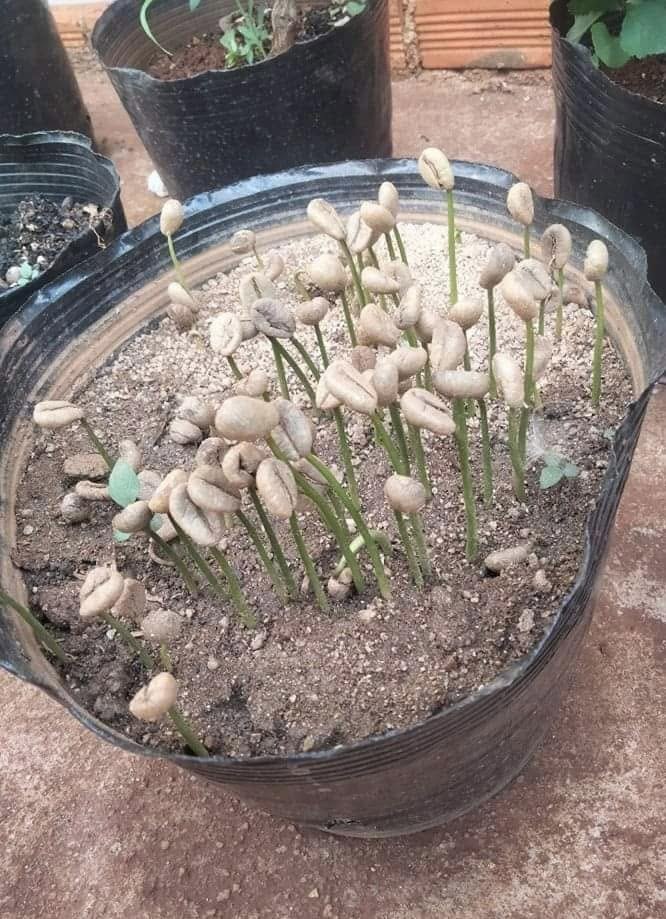
These coffee seedlings also go by the name “little soldiers”.
That is a lovely thing to learn from James Hoffmann’s The World Atlas of Coffee.
Before drinking at Oriberry I had no idea that coffee could be grown under the forest canopy (shade-grown coffee — which is how human beings first grew it) as distinct from the far more common monoculture method (sun-grown coffee). Reading the information and the figures Oriberry gives, and reading further about coffee farming in Brazil, I came to understand that it is not the smoke from factories: the food on our own table is the greater cause of the greenhouse effect.
And here is what is especially interesting about beans grown under the canopy.
“The forest canopy narrows the swing of temperature across the day and across the year. The coffee plant needs longer to ripen, and so it also has longer to develop its flavour. The cherries are picked ripe and the wet process is used. The characteristic flavour is floral and grassy, soft on the palate, with a sweet finish.” (Oriberry)
When we come to know a little better, our reasons for buying — and even for PRODUCING — may get a little better too. A little better.
From Oriberry:
“Coffee is one of the products we use every day, and yet we rarely ask whether the way it is produced meets our responsibility towards the generations to come.
“World coffee consumption rose from 90 million bags (60 kg a bag) in 1990 to 166 million bags in 2020 (ICO). This has driven both an expansion of the planted area and a change in farming methods in the coffee-exporting countries, and those changes are having more than a little negative effect on the living environment.
“In 1990 Vietnam had about 6,000 ha of coffee; three decades on, the country’s total planted area is now close to 600,000 ha. Thousands of hectares that were once forest have been turned over to coffee, which has made us the second largest coffee exporter in the world. The demand for the volumes needed for export has pushed coffee farmers to change the way they farm. In a great many places, the coffee areas that once had shade trees — which provided at least a minimum habitat for animals and for birds — have been replaced by coffee monoculture, tended entirely with chemical fertiliser and with no need for shade trees at all.”
Robusta coffee seedlings, photographed by chị Quỳnh in her own garden at Cư M’gar, Đắk Lắk