The Beautiful Things About Languages That Nobody Mentions
The beauty of language usually gets advertised with lists of untranslatable words and the story about fifty Eskimo words for snow — most of which is invented. The real beauty sits somewhere else, and it is far stranger: languages that make you declare how you know a thing, languages with no left or right, a language that puts the past in front of you, a language whistled across valleys, and a language that came into existence, complete, in under two decades.
When people want to say that language is beautiful, they usually reach for two things: a list of untranslatable words, and the story that Eskimos have fifty words for snow.
The second is not true. In 1986 the anthropologist Laura Martin traced the claim to its source and showed the number inflating with each retelling — from a modest remark by Franz Boas into a myth that reproduced itself. Geoffrey Pullum later named it outright: the great Eskimo vocabulary hoax. The first is mostly marketing. Nearly every untranslatable word translates fine; it just costs you a sentence instead of a word.
The pity is that these two have crowded out the real thing. Because the beauty of language rarely lives in its vocabulary. It lives in the grammar — in what a language obliges you to say.
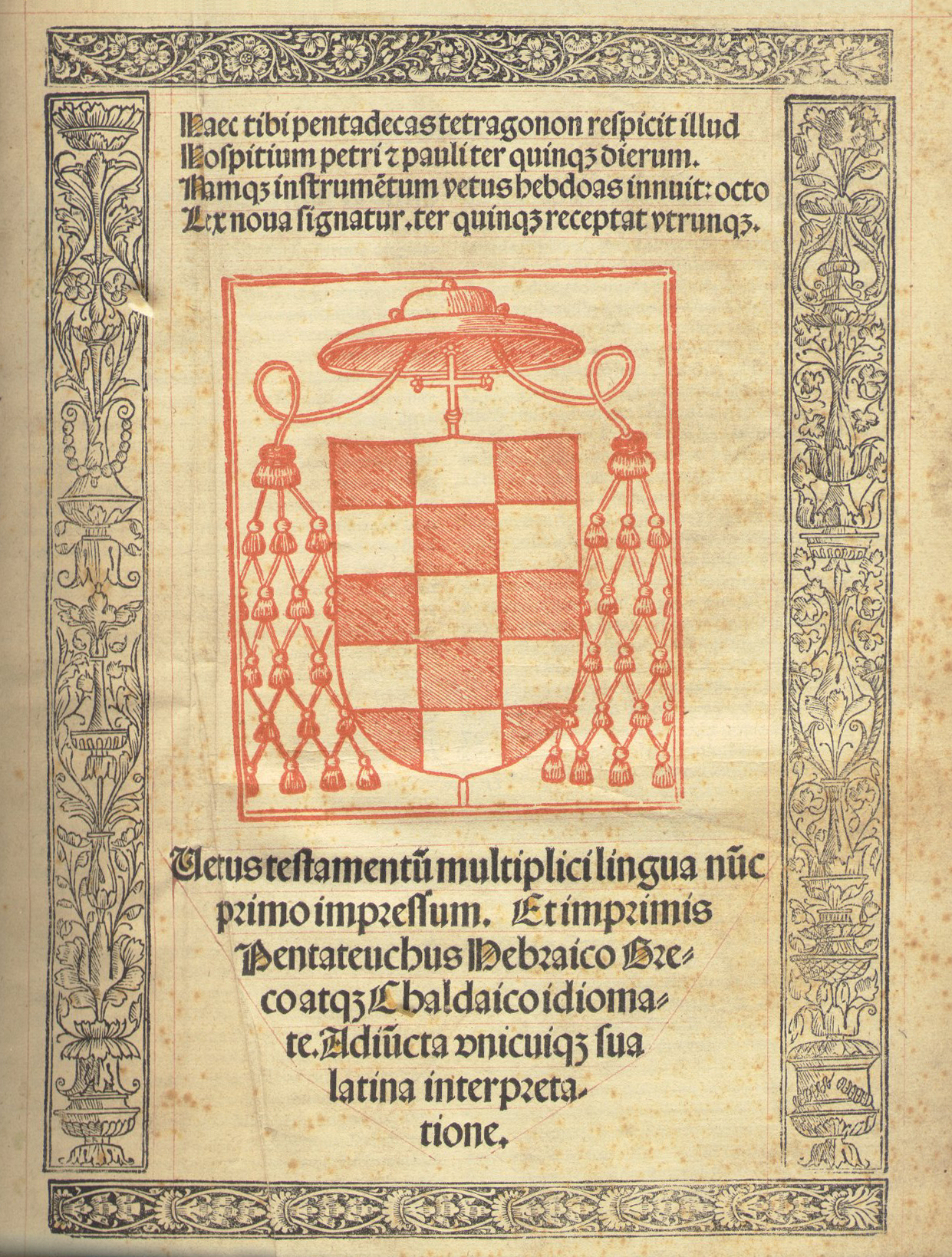
The Complutensian Polyglot, printed 1514–17: three languages on one page so a reader could see where they refuse to line up. That refusal is the interesting thing about languages, and it is what both of the usual compliments manage to miss.Source: Francisco Jiménez de Cisneros (Uploaded by MaiDireLollo) — Public domain, Wikimedia Commons
Languages that make you declare how you know
In English you can say it's raining and nobody asks how you came by that. Did you see it? Hear it? Did someone text you? The sentence does not distinguish, and you are under no obligation to.
Tuyuca does not permit that vagueness. It is an Eastern Tucanoan language of the Vaupés region of Colombia and the Brazilian state of Amazonas, with perhaps five hundred to a thousand speakers. In Tuyuca every finite clause carries an obligatory suffix marking how you know: you saw it, you perceived it by some other sense, you inferred it from evidence left behind, someone told you, or you are assuming.
Which means that in Tuyuca you cannot repeat a rumour in a way that lets your listener think you witnessed it. The grammar will not let you. Janet Barnes described the system in 1984, and it remains the most-cited example of what linguists call evidentiality.
Sit with that for a moment. There are communities where distinguishing I saw it from I was told is not a matter of professional ethics or journalistic discipline. It is a matter of verb conjugation.
A language with no left and no right
Guugu Yimithirr is an Aboriginal language of north Queensland, Australia. It makes almost no use of the relative frame of reference that English leans on — no left of the tree, no right in front of me. Spatial description uses absolute direction instead. You do not say George is standing in front of the tree; you say the equivalent of George is just north of the tree.
And this holds at tiny scales. There is an ant east of your foot. Move a little to the west.
Stephen Levinson spelled out what that costs: to speak Guugu Yimithirr at all, you must know which way you are facing — indoors, in the dark, on waking, in unfamiliar forest, continuously. Native speakers do it with remarkable accuracy. Levinson argued that they are not merely speaking this way but holding a running compass bearing in mind even when they are saying nothing at all.
A language that puts the past in front of you
Nearly every language we know well puts the future ahead: the days ahead, looking forward, putting it behind us. The metaphor is so familiar it is hard to imagine an alternative arrangement.
Aymara, of the Andes, runs the other way. The word for front is also the word for the past; the word for behind is also the word for the future. Rafael Núñez and Eve Sweetser published evidence in 2006 that this is not confined to vocabulary: when older Aymara speakers talk about the past, they gesture forward; talking about the future, they throw a hand back over the shoulder. Speech and gesture agree.
And the arrangement has a logic that is hard to argue with: the past is what you have seen, so it lies before you. The future is what you have not seen, so it is at your back.
Words that do not describe but depict
English is thin here, but not empty: zigzag, splash, flicker. Words that do not define a thing so much as imitate it. Linguists call them ideophones, and they are not a curiosity of one or two languages.
Japanese has thousands, drawn so finely that English usually needs a whole phrase to render one. Many African and Asian languages give them a word class of their own, with their own grammatical behaviour. Mark Dingemanse, who surveys this field, makes a point worth keeping: an ideophone does not describe a sensation, it enacts one. That is a categorically different use of speech — closer to drawing than to telling.
Learners of Japanese and Vietnamese routinely skip this layer because textbooks under-serve it. It is precisely the most alive part of the language.
A language whistled across a valley
La Gomera, in the Canary Islands, is cut by ravines so deep that two people can see each other clearly and still need hours on foot to meet. Its inhabitants developed Silbo Gomero: a whistled register that reproduces Spanish and carries enormous distances across the valleys.
This is not a signal code of a few agreed phrases. It maps the spoken language onto whistling, so in principle anything sayable is whistleable. UNESCO added Silbo Gomero to the Representative List of the Intangible Cultural Heritage of Humanity in 2009, and it is now taught in the island's schools — after coming close to disappearing altogether.
A language that appeared while researchers watched
This is perhaps the most beautiful item on the list, because it is rare to the point of almost not being allowed to happen.
Before the late 1970s, deaf children in Nicaragua were mostly scattered, each managing with a few gestures inside their own family. Then schools brought them together. Nobody taught them a sign language — there was no existing language to teach. But once hundreds of children were in one place, the scattered gestures began to converge, and then to acquire grammar.
Ann Senghas and Marie Coppola studied the process and found a detail worth remembering: the systematising — the actual grammar — came chiefly from the youngest cohort. Children arriving later, learning from the unfinished language of those before them, produced something more regular than the input they had received.
Which is to say: the language was not designed by adults. Children made it, in under two decades, and researchers were present to record it happening.
So does language shape thought?
This is where the subject usually slides, so it is worth being plain. The strong version — that language imprisons thought, that you cannot think what your mother tongue has no word for — does not hold up. It is also the soil in which the snow myth grew.
But the modest version has real evidence, and it is far more interesting. Russian has no single basic term for blue: it has goluboy (light blue) and siniy (dark blue) as separate basic colours. Jonathan Winawer's group reported in 2007 that Russian speakers discriminate two shades of blue faster when the shades fall into different linguistic categories — and that the advantage disappears when they simultaneously perform a verbal interference task.
That is the true shape of the effect: small, measurable, sitting at the edge of perception, and dependent on whether language happens to be running in the mind at that moment. Not a prison. A finger resting lightly on the scale.
Why this matters to a learner
Not so that you go and learn Tuyuca.
Rather because the hardest part of learning a language is seldom the vocabulary. It is accepting that the new language forces you to attend to things your mother tongue let you ignore: aspect in English, tone in Chinese, honorifics in Korean, gender in Spanish, classifiers in Vietnamese. Learners tend to treat these as arbitrary obstacles erected to make life difficult.
They are not arbitrary. They are the places where a language has already decided what is worth saying out loud. And when you stop treating them as a penalty and start treating them as a point of view, the work gets considerably lighter — because you are no longer memorising a list, you are learning to see the world a different way.
Read the simple version
The same article, told in plain words — for younger readers, or for anyone who wants the point quickly.
The beauty of a language rarely lives in its vocabulary. It lives in the grammar — in what a language obliges you to say.
A language that makes you declare how you know
In English you can say it's raining and nobody asks how you came by that. Did you see it? Hear it? Did someone text you? The sentence does not distinguish, and you are under no obligation to.
Tuyuca does not permit that vagueness. It is a language of the Vaupés region, on the border of Colombia and Brazil, with perhaps five hundred to a thousand speakers. In Tuyuca every finite clause carries a compulsory ending marking how you know: you saw it, you perceived it by some other sense, you inferred it from evidence left behind, someone told you, or you are assuming.
Which means that in Tuyuca you cannot repeat a rumour in a way that lets your listener think you witnessed it. The grammar will not let you.
Sit with that for a moment. There are communities where distinguishing I saw it from I was told is not a matter of professional ethics or journalistic discipline. It is a matter of verb conjugation.
A language with no left and no right
Guugu Yimithirr, an Aboriginal language of north Queensland, makes almost no use of the frame English leans on — no left of the tree, no right in front of me. It uses absolute direction instead. Not George is standing in front of the tree but the equivalent of George is just north of the tree.
And this holds at tiny scales. There is an ant east of your foot. Move a little to the west.
Consider what that costs: to speak the language at all, you must know which way you are facing — indoors, in the dark, on waking, in unfamiliar forest, continuously.
The famous claim, in its honest size
You have probably heard that the language you speak shapes how you think. The strong version — that language imprisons thought — does not hold up.
But the modest version has real evidence, and it is far more interesting.
Russian has no single basic word for blue: it has goluboy (light blue) and siniy (dark blue) as separate basic colours. Russian speakers tell two shades of blue apart faster when the shades fall into those two different words — and the advantage disappears when they are simultaneously doing a task that occupies their language.
That is the true shape of the effect: small, measurable, sitting at the edge of perception, and dependent on whether language happens to be running in the mind at that moment.
Not a prison. A finger resting lightly on the scale.
Why this matters to you as a learner
Not so that you go and learn Tuyuca.
Rather because the hardest part of learning a language is seldom the vocabulary. It is accepting that the new language forces you to attend to things your mother tongue let you ignore — aspect in English, tone in Chinese, honorifics in Korean, gender in Spanish, classifiers in Vietnamese.
Learners tend to treat these as arbitrary obstacles erected to make life difficult. They are not arbitrary. They are the places where a language has already decided what is worth saying out loud.
And when you stop treating them as a penalty and start treating them as a point of view, the work gets considerably lighter — because you are no longer memorising a list. You are learning to see the world a different way.
Sources & further reading
These articles summarize well-established research in learning science and linguistics. Key sources and further reading:
Barnes, J. (1984). Evidentials in the Tuyuca verb. International Journal of American Linguistics, 50(3), 255–271.
Levinson, S. C. (1997). Language and cognition: the cognitive consequences of spatial description in Guugu Yimithirr. Journal of Linguistic Anthropology, 7(1), 98–131.
Haviland, J. B. (1998). Guugu Yimithirr cardinal directions. Ethos, 26(1), 25–47.
Núñez, R. E., & Sweetser, E. (2006). With the future behind them: convergent evidence from Aymara language and gesture in the crosslinguistic comparison of spatial construals of time. Cognitive Science, 30(3), 401–450.
Senghas, A., & Coppola, M. (2001). Children creating language: how Nicaraguan Sign Language acquired a spatial grammar. Psychological Science, 12(4), 323–328.
Dingemanse, M. (2012). Advances in the cross-linguistic study of ideophones. Language and Linguistics Compass, 6(10), 654–672.
Martin, L. (1986). "Eskimo words for snow": a case study in the genesis and decay of an anthropological example. American Anthropologist, 88(2), 418–423.
Pullum, G. K. (1991). The Great Eskimo Vocabulary Hoax and Other Irreverent Essays on the Study of Language. Chicago: University of Chicago Press.
Winawer, J., Witthoft, N., Frank, M. C., Wu, L., Wade, A. R., & Boroditsky, L. (2007). Russian blues reveal effects of language on color discrimination. Proceedings of the National Academy of Sciences, 104(19), 7780–7785.
UNESCO (2009). Whistled language of the island of La Gomera (Canary Islands), the Silbo Gomero. Representative List of the Intangible Cultural Heritage of Humanity.