A History of English, and Why It Explains What Frustrates You
You are not learning one language. You are learning four layers of sediment plus an accident of printing. This piece tells the history backwards, starting from the things that frustrate learners — and points out one advantage Vietnamese speakers have that others do not.
Every learner of English keeps a list of absurdities.
Why is the past of go not goed? Why are there three words for almost everything — ask, question, interrogate — that are not interchangeable? Why is the animal a cow and the meat beef? And why does the spelling bear so little relation to the sound?
Here is the thing: every one of those questions has a date attached.
You are not learning one language. You are learning four layers of sediment stacked on top of one another, plus one accident of printing. This piece tells that history backwards, starting from the parts that annoy you.
Layer one: the Germanic core (c. 450–1150)
English began as the speech of Germanic tribes who crossed the North Sea to Britain from the fifth century. Old English looked nothing like the modern language: it was heavily inflected, much like modern German, with grammatical gender on nouns and endings on verbs.
That layer has all but vanished from the surface. But it survives where it matters most: almost every one of the commonest words in English is Germanic.The, be, of, and, to, in, have, it, I, you, man, woman, house, water, eat, drink, sleep, good, bad — not one of them comes from French or Latin.
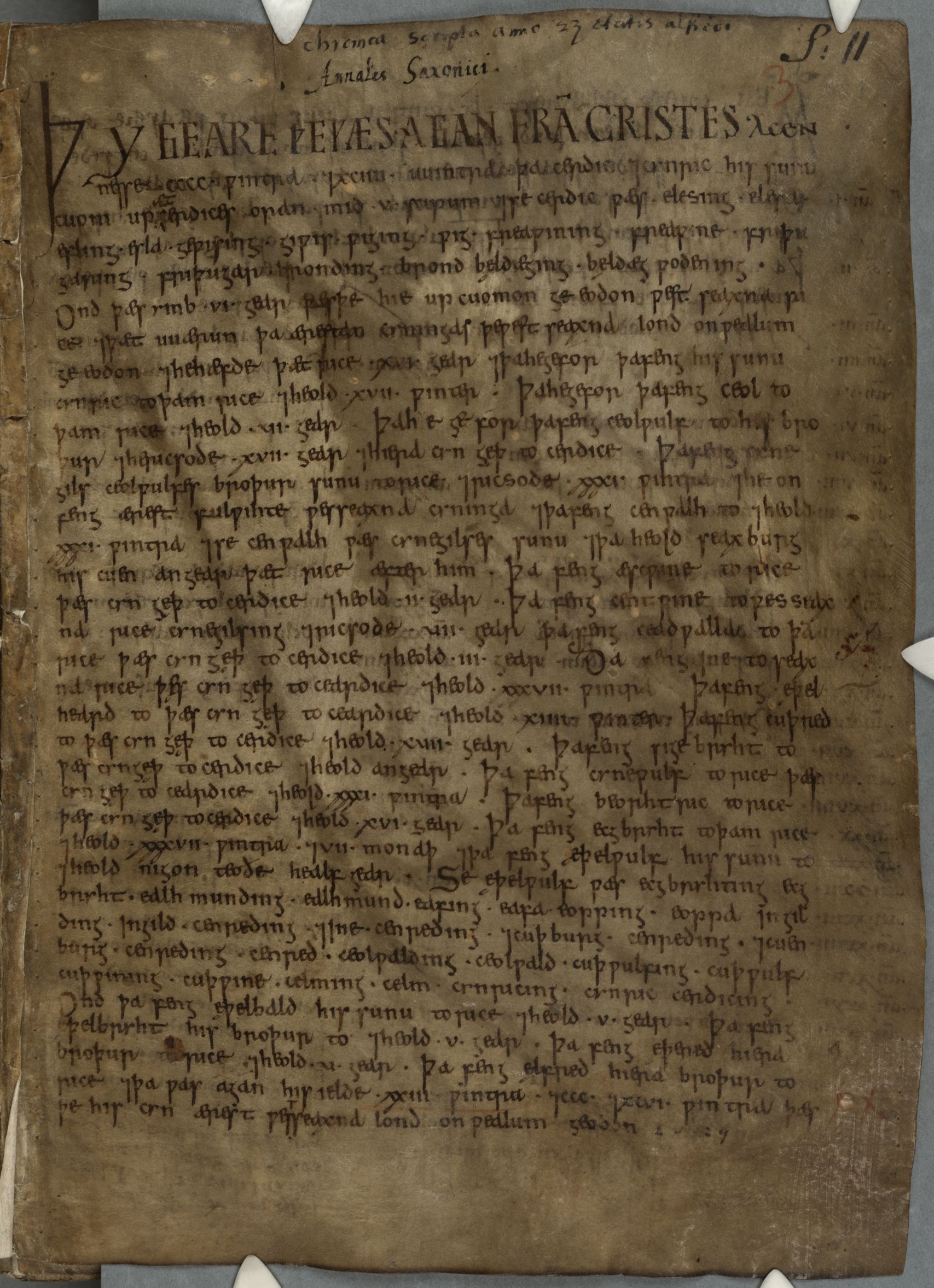
The Anglo-Saxon Chronicle, Parker manuscript. This is English before 1066 — and almost every word in it that survives today is one of the short, blunt ones you reach for first.Source: Unknown authorUnknown author — Public domain, Wikimedia Commons
And here the history answers the irregular-verb question directly.
Lieberman et al. (2007) published a quantitative study in Nature tracking 177 Old English irregular verbs across more than twelve hundred years. Of those, 145 were still irregular in Middle English, and only 98 remain irregular today.
The interesting part is the pattern they found. Irregular verbs are regularised over time, and the rate of that regularisation goes with the square root of how often the verb is used. The more common a verb, the longer it resists.
In other words, go/went survives precisely because it is so common. Rarer irregulars quietly turned regular long ago — the past of help was once holp.
This has a clear practical consequence. The irregular verb list you must memorise is not an arbitrary list invented to torment you. It is a list of the most frequent words in the language. Which means you will meet them constantly, and repeated encounters will do much of the memorising for you. Conversely, verbs you rarely meet are almost certainly regular — you can derive them.
Layer two: the Norse (793–1066)
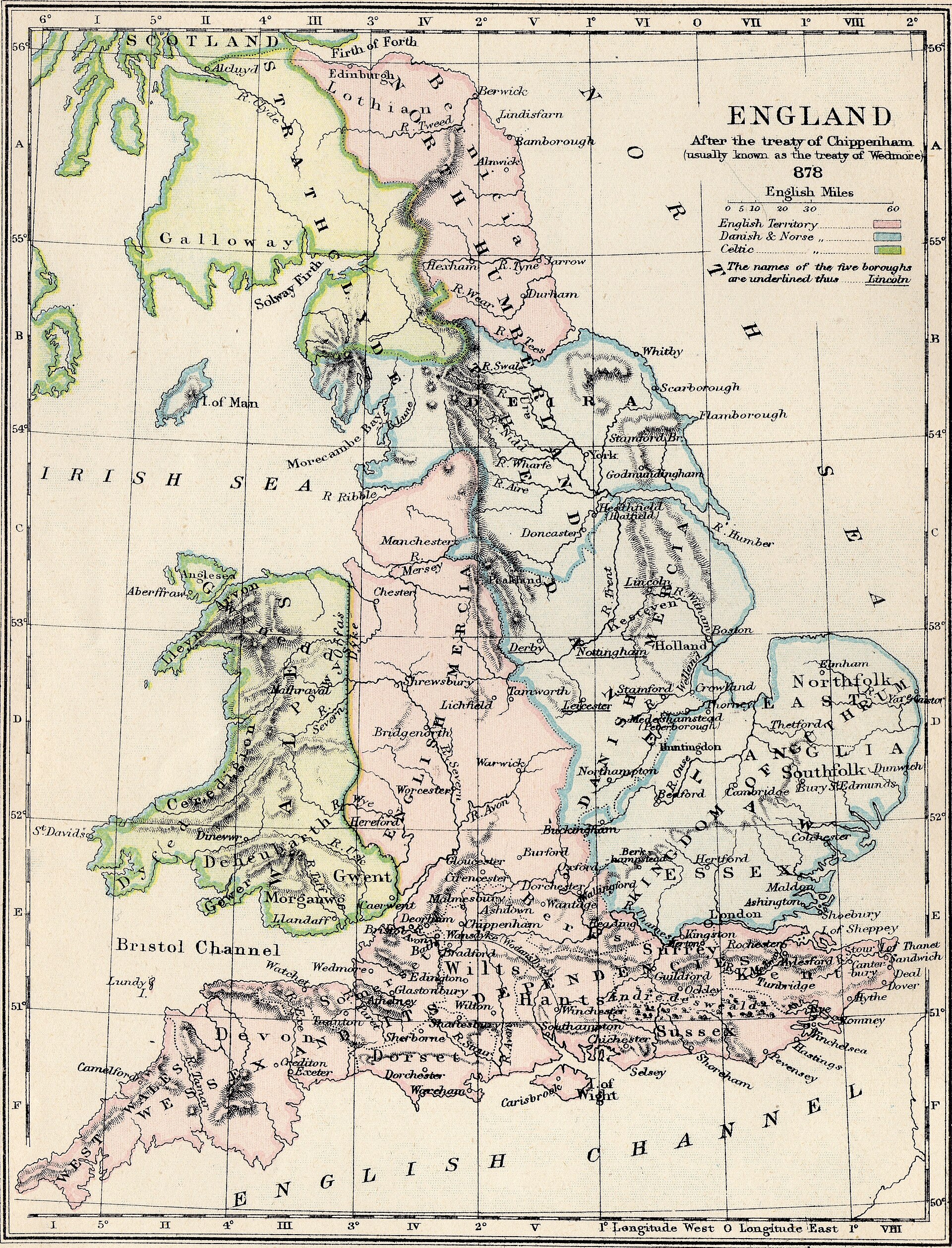
From the late eighth century, Vikings raided and then settled the north and east of England, in the territory known as the Danelaw.
The Danelaw. Old Norse and Old English were close enough to argue in — and languages that close tend to shed the endings that get in the way.Source: S. R. Gardiner — Public domain, Wikimedia Commons
Old Norse and Old English were close enough for rough mutual comprehension, and Townend (2002) argues that this very closeness produced an unusual kind of contact: people could communicate without properly learning each other's language.
The result is that English borrowed things languages rarely borrow. It borrowed pronouns: they, them, their are all Norse, displacing the native Old English forms. That is a marker of very deep contact — pronouns are usually a language's most durable layer.
The rest are among the most ordinary words there are: sky, skin, egg, knife, law, window, husband, take, give, get.
And one beautiful trace a learner can spot: the sk- and sh- pairs. Same root, two languages, and now split in meaning — shirt and skirt, shatter and scatter, ship and skipper.
The lesson generalises: pairs of similar-looking words are rarely synonyms. If a language has kept both for a thousand years, they have almost certainly divided the labour between them.
Layer three: 1066 and three centuries of French
This is the largest event, and the layer that explains most of a learner's difficulty.
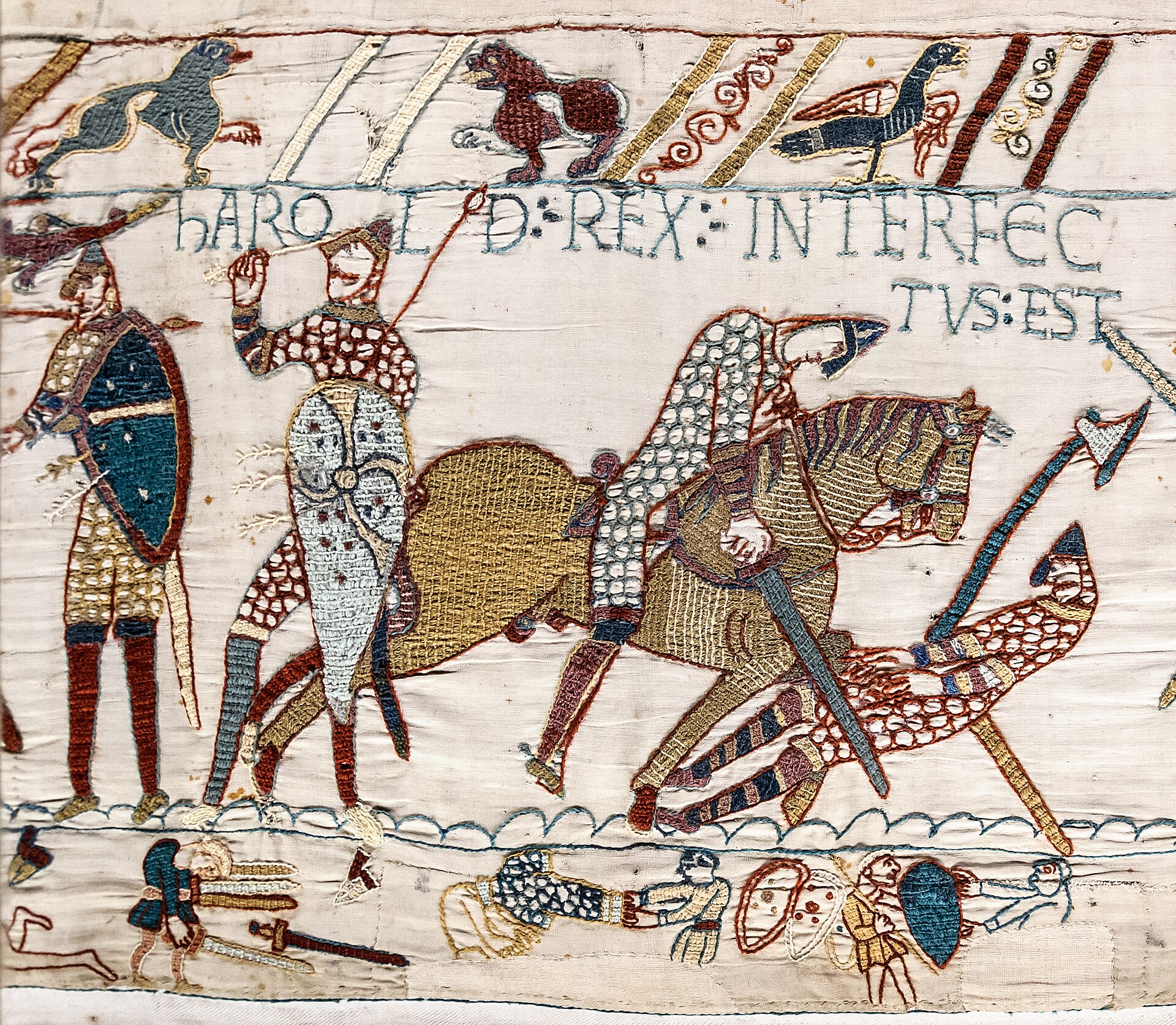
In 1066 the Normans conquered England. For roughly three centuries afterwards, French was the language of the court, the law, the administration and the nobility. English survived, but lower down — the language of farmers, servants, and everyday life.
The Bayeux Tapestry, scene 57: the death of Harold at Hastings, 1066. Three centuries of French administration begin on this square of cloth.Source: Myrabella — Public domain, Wikimedia Commons
When the two levels met again, English did not discard the old word. It kept both. That is why English has a three-tier vocabulary to a degree almost no other European language matches.
The famous example is on the dinner table. The animal in the field, tended by English speakers: cow, pig, sheep, calf. The meat served to French-speaking nobility: beef, pork, mutton, veal. One animal, two languages, depending on who is looking at it.
But the structure runs right through the vocabulary, and this is the usable part:
The rule barely fails: Germanic words are short, concrete and intimate; French words are neutral and moderately formal; Latin words are long, learned and distant.
For a learner this is not idle history. It is a word-choice tool. When you hesitate between end, finish and terminate, you do not need a dictionary — you need to know who you are writing for.
Layer four: Renaissance Latin and Greek
From the sixteenth century, English scholars borrowed heavily from Latin and Greek to express new concepts. Contemporaries mocked these as inkhorn terms, and plenty died young. But most stayed.
This is the layer that supplies English's entire academic vocabulary, and it has a concrete consequence for anyone sitting IELTS or reading in their field.
Coxhead (2000) built the Academic Word List from a corpus of university texts: 570 word families that recur across academic writing in every discipline. The overwhelming majority are Latin or French in origin.
Which means: the vocabulary that costs you marks in academic reading sits almost entirely in layers three and four. It is also why learning roots — -spect- to look, -dict- to say, -duc- to lead — has such an unusually high return past intermediate level. One root opens dozens of words.
Why the spelling does not match the sound
Every learner asks this, and the answer is a coincidence of timing.
Between roughly the fifteenth and eighteenth centuries, English long vowels shifted as a system. The phenomenon is called the Great Vowel Shift. Long vowels raised in turn, and those already at the top broke into diphthongs.
Bite once sounded close to beet-uh. House sounded close to hoose. Name sounded close to nah-muh.
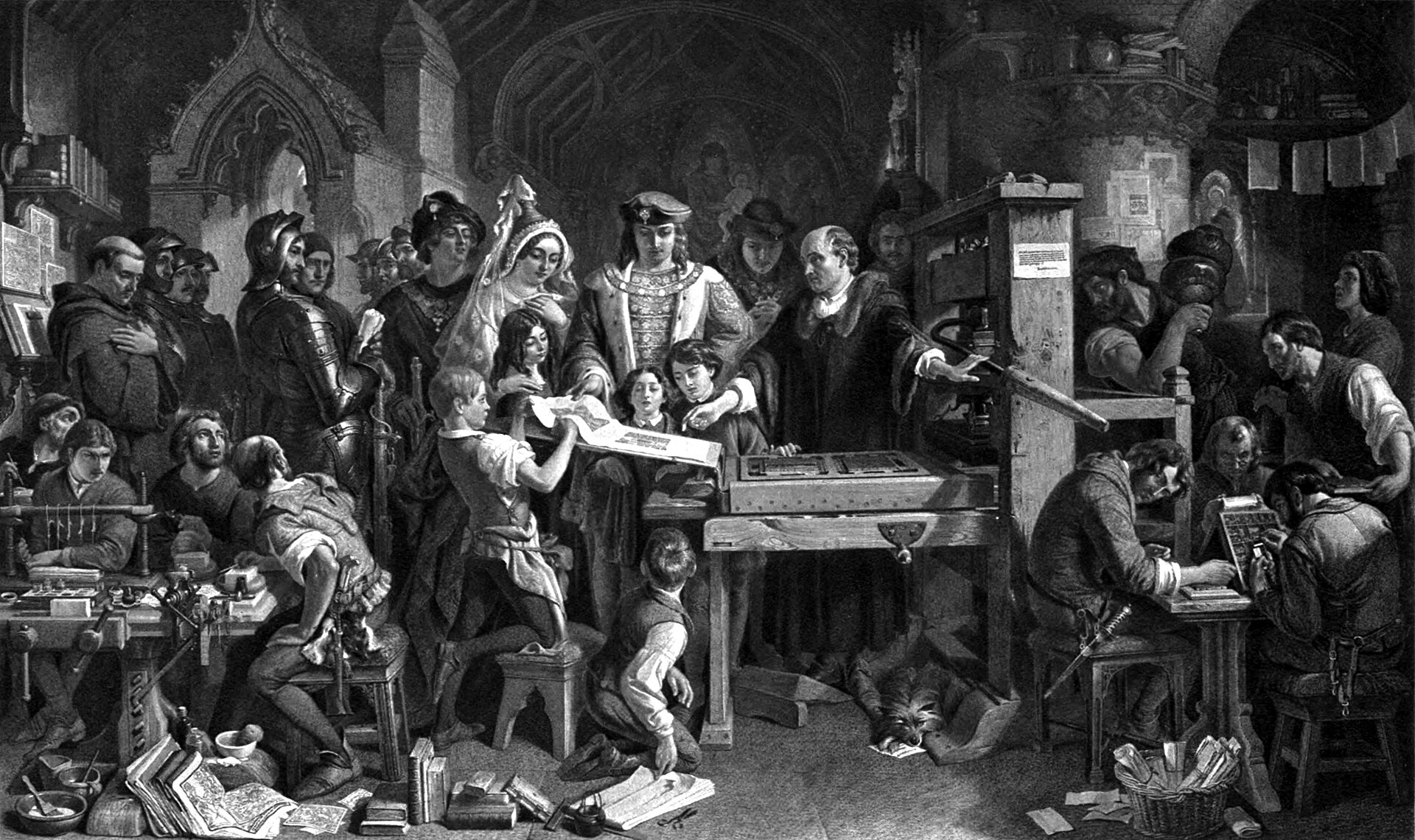
And here is where the accident happened. William Caxton brought printing to England in 1476 — in the middle of the shift. Printing demands stable spelling. Orthography froze around the pronunciation of that moment, and then the vowels went on moving for two more centuries while the spelling stayed put.
Caxton shows his printing to Edward IV. The press fixed English spelling in 1476, in the middle of the vowel shift — which is why the spelling records a pronunciation nobody uses.Source: Daniel Maclise — Public domain, Wikimedia Commons
Briefly: English spelling is a photograph of fifteenth-century pronunciation, and the pronunciation walked on.
Be honest about what is unsettled. The causes of the shift remain debated. Stockwell and Minkova (1988) reviewed the explanations and showed that none accounts for all the data; Minkova (2014) presents it as a set of related changes rather than a single event with a single cause. That it happened is certain. Why is not.
Where Vietnamese speakers already have the instinct
This is where Vietnamese learners hold an advantage, and almost no English-language account mentions it, because they are not writing for you.
The history of Vietnamese is structurally parallel to the history of English.
Vietnamese has a native Austroasiatic core. Then, across roughly a thousand years under Chinese administration, it took on an enormous Sino-Vietnamese layer laid over the top. Alves (2009), writing in Haspelmath and Tadmor's survey of loanwords, records the proportion of Chinese-derived vocabulary in Vietnamese as among the highest of the languages surveyed.
And the result is the same phenomenon 1066 produced in English:
ăn (native) — thực (Sino-Vietnamese)
chết — tử, tử vong
nước — quốc
người — nhân
trước — tiền
sống — sinh
You would not write thực cơm, and you would not write ăn đơn for a menu. You know tử vong belongs to the news bulletin and chết to ordinary speech. You never learned that rule. You absorbed it.
That is precisely the instinct English asks of you.
Spanish and French speakers learning English do not have this advantage in the same form — for them the Latin layer is native, so they reach for the academic word where the everyday one belongs, and sound stilted. A Vietnamese speaker is already used to a language with two registers and the obligation to pick the right one.
The concrete use: when you meet an English pair that looks synonymous, ask which word is shorter and more concrete. The short one is almost always Germanic, and it plays the part of chết. The long one plays tử vong.
Three things commonly got wrong
English has the largest vocabulary in the world
This is close to meaningless, however often it is repeated.
Vocabulary counts depend entirely on what you count. Bauer and Nation (1993) showed that even a word needs defining: are nation, national, nationality, nationalise one word family or four? And languages that compound freely, like German, can generate new words without limit, so counting dictionary entries compares two things measured in different units.
English has large, well-funded dictionaries compiled over centuries. That is a fact about lexicography, not about the language.
English is easy because it has no inflections or genders
Half true, and false in the part that matters.
English did lose almost all of Old English's inflectional system. But languages give nothing away free: what goes in morphology must be paid for elsewhere. English pays in rigid word order and in its system of prepositions and phrasal verbs.
Put up with, get over, look after, run into — underivable from their parts, numbering in the thousands, and this is where learners genuinely suffer. The difficulty moved; it did not disappear.
English is special because it is a mixture
No. All languages borrow heavily, and Haspelmath and Tadmor's (2009) survey of forty-one languages shows large-scale borrowing to be ordinary rather than exceptional.
Vietnamese is the example directly in front of you. So is Korean. So is Japanese.
English is not different in kind — it is merely unusually well documented, so its history is easy to tell as a good story.
The last chapter: you are the majority
There is one fact about English today that learners should know, because it changes how you should see yourself.
By Ethnologue's 2025 figures, English has roughly 1.53 billion speakers. Of those, about 390 million are native speakers, and around 1.14 billion speak it as a second language.
Which means roughly three quarters of the world's English speakers learned it the way you are learning it.
Seidlhofer (2011) and Jenkins (2015) argue that this has consequences: most English exchanges in the world today take place between two people for whom it is a second language. A Vietnamese speaker with a Korean. A German with a Brazilian.
Say the caveat clearly, to avoid being misread: this does not mean standards stop mattering, and it does not mean errors are fine. In examinations and professional writing, the standard applies.
But it does mean that sounding native is an optional goal, not a condition of using the language. The language you are learning has been borrowed from, lent to, mixed and remade by wave after wave of new speakers for fifteen hundred years.
You are the next wave.
Read the simple version
The same article, told in plain words — for younger readers, or for anyone who wants the point quickly.
Every learner of English keeps a list of absurdities.
Why is the past of go not goed? Why are there three words for almost everything — ask, question, interrogate — that are not interchangeable? Why is the animal a cow and the meat beef? And why does the spelling bear so little relation to the sound?
Here is the thing: every one of those questions has a date attached.
You are not learning one language. You are learning four layers of sediment stacked on top of one another, plus one accident of printing. This tells that history backwards, starting from the parts that annoy you.
Layer one: the Germanic core (c. 450–1150)
English began as the speech of Germanic tribes who crossed the North Sea to Britain from the fifth century. Old English looked nothing like the modern language: heavily inflected, much like modern German, with grammatical gender on nouns and endings on verbs.
That layer has all but vanished from the surface. But it survives where it matters most: almost every one of the commonest words in English is Germanic.The, be, of, and, to, in, have, it, I, you, man, woman, house, water, eat, drink, sleep, good, bad — not one of them comes from French or Latin.
And here the history answers the irregular-verb question directly.
Lieberman and colleagues (2007) published a quantitative study in Nature tracking 177 Old English irregular verbs across more than twelve hundred years. Of those, 145 were still irregular in Middle English, and only 98 remain irregular today.
The interesting part is the pattern. Irregular verbs get regularised over time, and the rate of that regularisation goes with the square root of how often the verb is used. The more common a verb, the longer it resists.
So go/went survives precisely because it is so common. Rarer irregulars quietly turned regular long ago — the past of help was once holp.
This has a clear practical consequence. The irregular verb list you must memorise is not an arbitrary list invented to torment you. It is a list of the most frequent words in the language. Which means you will meet them constantly, and repeated encounters will do much of the memorising for you. Conversely, verbs you rarely meet are almost certainly regular — you can derive them.
Layer two: the Norse (793–1066)
From the late eighth century, Vikings raided and then settled the north and east of England, in the territory known as the Danelaw.
Old Norse and Old English were close enough for rough mutual comprehension, and Townend (2002) argues that this very closeness produced an unusual kind of contact: people could communicate without properly learning each other's language.
The result is that English borrowed things languages rarely borrow. It borrowed pronouns: they, them, their are all Norse, displacing the native Old English forms. That is a marker of very deep contact — pronouns are usually a language's most durable layer.
The rest are among the most ordinary words there are: sky, skin, egg, knife, law, window, husband, take, give, get.
And one beautiful trace a learner can spot: the sk- and sh- pairs. Same root, two languages, now split in meaning — shirt and skirt, shatter and scatter, ship and skipper.
The lesson generalises: pairs of similar-looking words are rarely synonyms. If a language has kept both for a thousand years, they have almost certainly divided the labour between them.
Layer three: 1066 and three centuries of French
This is the largest event, and the layer that explains most of a learner's difficulty.
In 1066 the Normans conquered England. For roughly three centuries afterwards, French was the language of the court, the law, the administration and the nobility. English survived, but lower down — the language of farmers, servants, and everyday life.
When the two levels met again, English did not discard the old word. It kept both. That is why English has a three-tier vocabulary to a degree almost no other European language matches.
The famous example is on the dinner table. The animal in the field, tended by English speakers: cow, pig, sheep, calf. The meat served to French-speaking nobility: beef, pork, mutton, veal. One animal, two languages, depending on who is looking at it.
But the structure runs right through the vocabulary, and this is the usable part:
The rule barely fails: Germanic words are short, concrete and intimate; French words are neutral and moderately formal; Latin words are long, learned and distant.
For a learner this is not idle history. It is a word-choice tool. When you hesitate between end, finish and terminate, you do not need a dictionary — you need to know who you are writing for.
Layer four: Renaissance Latin and Greek
From the sixteenth century, English scholars borrowed heavily from Latin and Greek to express new concepts. Contemporaries mocked these as inkhorn terms, and plenty died young. But most stayed.
This is the layer that supplies English's entire academic vocabulary, and it has a concrete consequence for anyone sitting an exam or reading in their field.
Coxhead (2000) built the Academic Word List from a corpus of university texts: 570 word families that recur across academic writing in every discipline. The overwhelming majority are Latin or French in origin.
Which means: the vocabulary that costs you marks in academic reading sits almost entirely in layers three and four. It is also why learning roots — -spect- to look, -dict- to say, -duc- to lead — has such an unusually high return past intermediate level. One root opens dozens of words.
Why the spelling does not match the sound
Every learner asks this, and the answer is a coincidence of timing.
Between roughly the fifteenth and eighteenth centuries, English long vowels shifted as a system. The phenomenon is called the Great Vowel Shift. Long vowels raised in turn, and those already at the top broke into diphthongs.
Bite once sounded close to beet-uh. House sounded close to hoose. Name sounded close to nah-muh.
And here is where the accident happened. William Caxton brought printing to England in 1476 — in the middle of the shift. Printing demands stable spelling. Orthography froze around the pronunciation of that moment, and then the vowels went on moving for two more centuries while the spelling stayed put.
Briefly: English spelling is a photograph of fifteenth-century pronunciation, and the pronunciation walked on.
But be honest about what is unsettled. The causes of the shift remain debated. Stockwell and Minkova (1988) reviewed the explanations and showed that none accounts for all the data; Minkova (2014) presents it as a set of related changes rather than a single event with a single cause. That it happened is certain. Why is not.
Where Vietnamese speakers already have the instinct
This is where Vietnamese learners hold an advantage, and almost no English-language account mentions it, because they are not writing for you.
The history of Vietnamese is structurally parallel to the history of English.
Vietnamese has a native Austroasiatic core. Then, across roughly a thousand years under Chinese administration, it took on an enormous Sino-Vietnamese layer laid over the top. Alves (2009), writing in Haspelmath and Tadmor's survey of loanwords, records the proportion of Chinese-derived vocabulary in Vietnamese as among the highest of the languages surveyed.
And the result is the same phenomenon 1066 produced in English:
ăn (native) — thực (Sino-Vietnamese)
chết — tử, tử vong
nước — quốc
người — nhân
trước — tiền
sống — sinh
You would not write thực cơm, and you would not write ăn đơn for a menu. You know tử vong belongs to the news bulletin and chết to ordinary speech. You never learned that rule. You absorbed it.
That is precisely the instinct English asks of you.
Spanish and French speakers learning English do not have this advantage in the same form — for them the Latin layer is native, so they reach for the academic word where the everyday one belongs, and sound stilted. A Vietnamese speaker is already used to a language with two registers and the obligation to pick the right one.
The concrete use: when you meet an English pair that looks synonymous, ask which word is shorter and more concrete. The short one is almost always Germanic, and it plays the part of chết. The long one plays tử vong.
Three things commonly got wrong
English has the largest vocabulary in the world. This is close to meaningless, however often it is repeated. Vocabulary counts depend entirely on what you count. Bauer and Nation (1993) showed that even a word needs defining: are nation, national, nationality, nationalise one word family or four? And languages that compound freely, like German, can generate new words without limit, so counting dictionary entries compares two things measured in different units. English has large, well-funded dictionaries compiled over centuries. That is a fact about lexicography, not about the language.
English is easy because it has no inflections or genders. Half true, and false in the part that matters. English did lose almost all of Old English's inflectional system. But languages give nothing away free: what goes in morphology must be paid for elsewhere. English pays in rigid word order and in its system of prepositions and phrasal verbs. Put up with, get over, look after, run into — underivable from their parts, numbering in the thousands, and this is where learners genuinely suffer. The difficulty moved; it did not disappear.
English is special because it is a mixture. No. All languages borrow heavily, and Haspelmath and Tadmor's (2009) survey of forty-one languages shows large-scale borrowing to be ordinary rather than exceptional. Vietnamese is the example directly in front of you. So is Korean. So is Japanese. English is not different in kind — it is merely unusually well documented, so its history is easy to tell as a good story.
The last chapter: you are the majority
There is one fact about English today that learners should know, because it changes how you should see yourself.
By Ethnologue's 2025 figures, English has roughly 1.53 billion speakers. Of those, about 390 million are native speakers, and around 1.14 billion speak it as a second language.
Which means roughly three quarters of the world's English speakers learned it the way you are learning it.
Seidlhofer (2011) and Jenkins (2015) argue that this has consequences: most English exchanges in the world today take place between two people for whom it is a second language. A Vietnamese speaker with a Korean. A German with a Brazilian.
Say the caveat clearly, to avoid being misread: this does not mean standards stop mattering, and it does not mean errors are fine. In examinations and professional writing, the standard applies.
But it does mean that sounding native is an optional goal, not a condition of using the language. The language you are learning has been borrowed from, lent to, mixed and remade by wave after wave of new speakers for fifteen hundred years.
You are the next wave.
Sources & further reading
These articles summarize well-established research in learning science and linguistics. Key sources and further reading:
Lieberman, E., Michel, J.-B., Jackson, J., Tang, T., & Nowak, M. A. (2007). Quantifying the evolutionary dynamics of language. Nature, 449(7163), 713–716.
Crystal, D. (2003). The Cambridge Encyclopedia of the English Language (2nd ed.). Cambridge: Cambridge University Press.
Crystal, D. (2004). The Stories of English. London: Penguin.
Crystal, D. (2003). English as a Global Language (2nd ed.). Cambridge: Cambridge University Press.
Baugh, A. C., & Cable, T. (2012). A History of the English Language (6th ed.). London: Routledge.
Hogg, R. M., & Denison, D. (Eds.) (2006). A History of the English Language. Cambridge: Cambridge University Press.
Mugglestone, L. (Ed.) (2012). The Oxford History of English (updated ed.). Oxford: Oxford University Press.
Barber, C., Beal, J. C., & Shaw, P. A. (2009). The English Language: A Historical Introduction (2nd ed.). Cambridge: Cambridge University Press.
Townend, M. (2002). Language and History in Viking Age England: Linguistic Relations between Speakers of Old Norse and Old English. Turnhout: Brepols.
Miller, D. G. (2012). External Influences on English: From its Beginnings to the Renaissance. Oxford: Oxford University Press.
Durkin, P. (2014). Borrowed Words: A History of Loanwords in English. Oxford: Oxford University Press.
Kastovsky, D. (2006). Vocabulary. In R. M. Hogg & D. Denison (Eds.), A History of the English Language. Cambridge: Cambridge University Press.
Lass, R. (1999). Phonology and morphology. In R. Lass (Ed.), The Cambridge History of the English Language, Volume III: 1476–1776. Cambridge: Cambridge University Press.
Stockwell, R., & Minkova, D. (1988). The English vowel shift: Problems of coherence and explanation. In D. Kastovsky & G. Bauer (Eds.), Luick Revisited. Tübingen: Gunter Narr.
Minkova, D. (2014). A Historical Phonology of English. Edinburgh: Edinburgh University Press.
Nevalainen, T. (2006). An Introduction to Early Modern English. Edinburgh: Edinburgh University Press.
Görlach, M. (1991). Introduction to Early Modern English. Cambridge: Cambridge University Press.
Simons, G. F., & Fennig, C. D. (Eds.). Ethnologue: Languages of the World. Dallas, TX: SIL International.
Jenkins, J. (2015). Global Englishes: A Resource Book for Students (3rd ed.). London: Routledge.
Seidlhofer, B. (2011). Understanding English as a Lingua Franca. Oxford: Oxford University Press.
Alves, M. J. (2009). Loanwords in Vietnamese. In M. Haspelmath & U. Tadmor (Eds.), Loanwords in the World’s Languages: A Comparative Handbook. Berlin: De Gruyter Mouton.
Haspelmath, M., & Tadmor, U. (Eds.) (2009). Loanwords in the World’s Languages: A Comparative Handbook. Berlin: De Gruyter Mouton.
Coxhead, A. (2000). A new academic word list. TESOL Quarterly, 34(2), 213–238.
Nation, I. S. P. (2006). How large a vocabulary is needed for reading and listening? Canadian Modern Language Review, 63(1), 59–82.
Nation, I. S. P. (2013). Learning Vocabulary in Another Language (2nd ed.). Cambridge: Cambridge University Press.
Bauer, L., & Nation, P. (1993). Word families. International Journal of Lexicography, 6(4), 253–279.