A History of Japanese: Where Your Modern Vocabulary Was Made
When you say cách mạng, tư bản, thời gian or dân chủ, you are using words manufactured in Japan. This piece closes a loop the previous five articles in the series kept opening.
When you say cách mạng, tư bản, thời gian or dân chủ, you are using words manufactured in Japan. This piece closes a loop the previous five articles in the series kept opening.
Read these four words: cách mạng, tư bản, thời gian, dân chủ.
You use them every day. They are Sino-Vietnamese, written with Chinese characters, and they sound entirely classical.
Not one of the four came from China.
All four were manufactured in Japan in the late nineteenth century, by Meiji scholars struggling to translate Western concepts that had no name in any East Asian language. China then borrowed them, and only afterwards did they reach Vietnam.
The previous five articles in this series each brushed against that fact and moved on. This one puts it at the centre.
Japanese uses Chinese characters, has borrowed tens of thousands of Chinese words, and sits next to China. So people conclude the two languages are related.
They are not. Exactly as with Korean in the previous article: borrowed vocabulary, however deep, does not create kinship.
Japanese belongs to the Japonic family, comprising Japanese and the Ryukyuan languages. Through the twentieth century many placed it in an Altaic family alongside Korean, Mongolic and Turkic; that hypothesis has largely been abandoned — Georg et al. (1999) set out the objections systematically.
The Japanese-Korean question deserves its own note, because it shows a field correcting itself. Vovin (2010) had been a leading advocate of a common origin — and then re-examined the evidence and concluded the similarities came from prolonged contact rather than shared descent.
This is what sets Japanese apart from Vietnamese and Korean, and it explains the single greatest frustration of learning Japanese characters.
As the Chinese article showed, Sino-Vietnamese is one photograph of Middle Chinese. Sino-Korean is another — one layer, borrowed once.
Japan borrowed three times, in three different periods, from three different regions. And kept all three.
Each time a new pronunciation arrived, Japan did not discard the old one. It filed the new one alongside.
Then add one more layer: kun-yomi (訓読み), the practice of assigning a character to a native Japanese word that already existed.
That is why a single character in Japanese can have five or six readings. 行 is ぎょう in go-on, こう in kan-on, あん in tō-on, and い or おこな in kun readings.
For a Vietnamese learner this is both consolation and warning. Consolation: you are not slow, the system genuinely is a tangle, and it is tangled for historical reasons rather than because of you. Warning: do not learn readings in isolation. Learn compounds, because the reading depends on the word, not on the character.
Chinese characters record Japanese badly, because Japanese is agglutinative with inflectional endings and characters have nowhere to put an ending. Japan solved that problem twice, in two ways.
Hiragana emerged in the Heian period from cursive forms of characters, simplified progressively until they became syllabic signs.
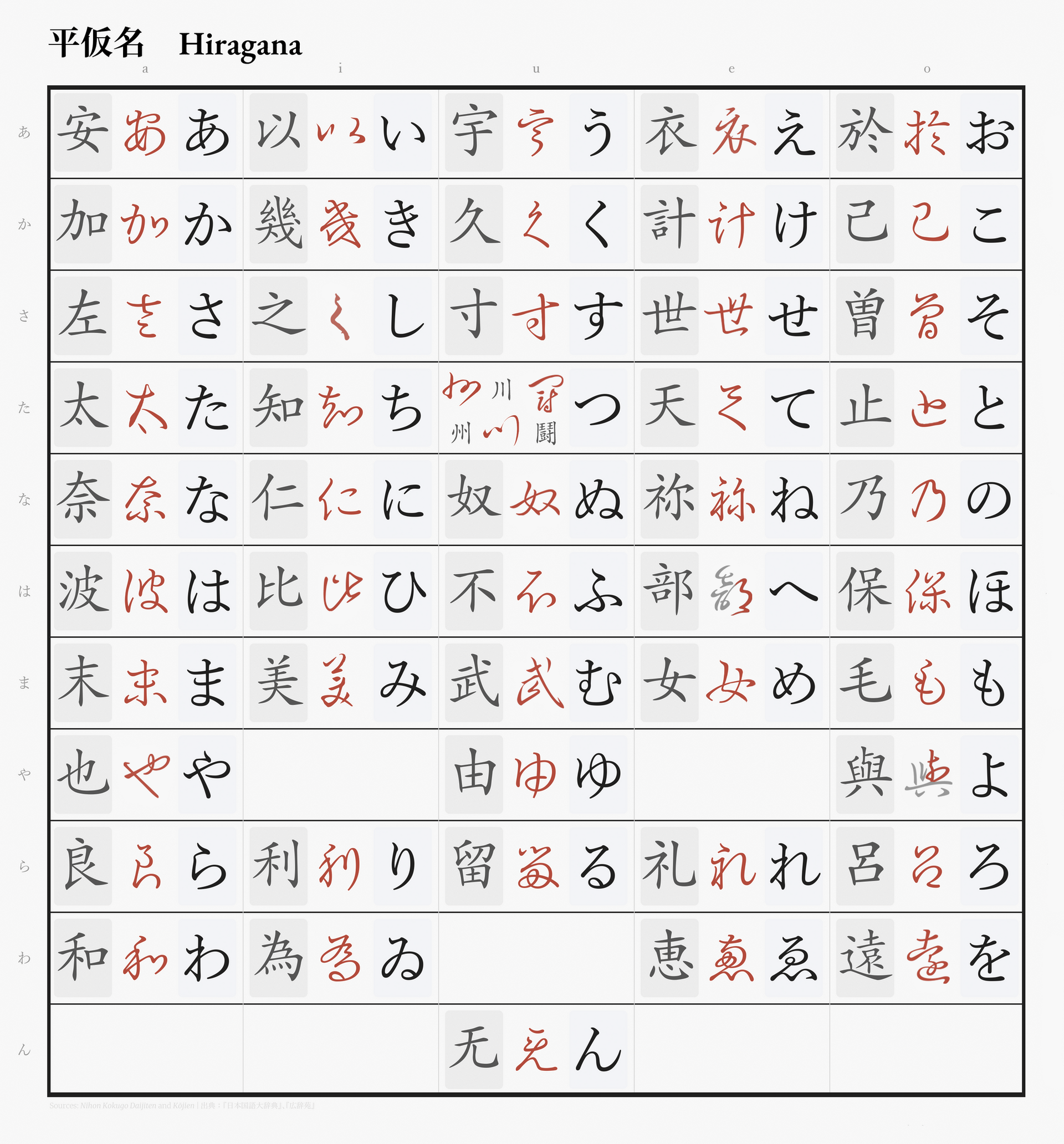
And here is the detail worth remembering: it was called onnade (女手) — women's hand. Women at court were not given a formal education in Chinese characters, so they wrote in the simplified forms.
Readers following this series will recognise that. The previous article described Hangul dismissed as eonmun, vulgar script, associated with women and merchants. Two countries, two scripts, the same disparagement — and both won in the end.
Katakana came the other way: ninth-century monks took fragments of characters as phonetic signs, to annotate the pronunciation of Chinese scripture.
One script used by court women for literature. One used by monks for glossing sutras. Both survive today, sharing the work.
Now set the three countries side by side, because the comparison only appears when you see all three.
Korea invented a new script and eventually used almost only that.
Vietnam invented chữ Nôm, abandoned it, and adopted a foreign alphabet.
Japan invented, and discarded nothing.
An ordinary modern Japanese sentence can use four sign systems at once: characters for word roots, hiragana for grammatical endings, katakana for foreign words, and Latin letters for acronyms.
From outside this looks like disorder. It is in fact the direct consequence of never having cleared anything away. Three layers of readings, two syllabaries, and at no point did anyone stand up and say: from today, the old one goes.
Seeley (1991) and Habein (1984) trace the whole accretion. Handel (2019) places it beside chữ Nôm and Korean hanja in one comparative frame.
This series has told the story three times already. Greece had katharevousa and dimotiki, and eight dead in 1901. Korea had literary Chinese and eonmun, and a ban in 1504. Vietnam had Hán văn, chữ Nôm and quốc ngữ.
Japan had genbun itchi (言文一致) — the unification of speech and writing.
Until the late nineteenth century, written Japanese followed classical forms far removed from speech. The genbun itchi movement set out to abolish that and write as people spoke. Twine (1978, 1991) narrates the whole process, and it succeeded around the turn of the twentieth century.
Four countries, four disputes, one question: should writing follow the speech of the living, or the models of the dead? Ferguson (1959) named the general phenomenon diglossia, but in all four places the outcome was decided by politics rather than by linguistics.
This is the centre of the piece, and the reason it exists.
After 1868 Japan opened and had to digest the entire intellectual output of the West within a few decades. The problem was concrete: Japanese had no words for those concepts. No word for society, economy, philosophy, revolution, capital, right.
Their solution was to treat Chinese characters as building material, compounding Chinese morphemes to cast new words. These are called wasei-kango (和製漢語) — Japanese-made Chinese words.
They are written in characters, read with Sino-Japanese pronunciations, and look entirely classical. They were brand new.
Then the surprising thing happened: China borrowed them back. Chinese students in Japan carried them home, and they flooded into modern Chinese. Masini (1993) surveys the formation of the modern Chinese lexicon; Liu (1995) and Howland (2002) analyse the translation and the politics.
And from Chinese they reached Vietnam — through the Tân thư, the new books in Chinese carrying reformist thought that circulated among Vietnamese scholars in the early twentieth century, and through the intellectual traffic of the Đông Du years, when Phan Bội Châu sent young Vietnamese to study in Japan. Marr (1971) describes that period.
The result is a layer of vocabulary nobody now recognises as imported:
Pause on that.
The language Vietnamese speakers use to discuss modern politics, economics and science was assembled in Tokyo in the 1870s and 1880s, out of Chinese material, to hold European ideas, and reached Hanoi by way of Beijing.
And the most striking part: those words fused into Vietnamese so completely that they left no seam. Nobody hears kinh tế and thinks of Japan.
For a Vietnamese learner of Japanese the advantage is real and large.
The Sino-Japanese layer accounts for a very substantial share of abstract vocabulary, and you already hold most of it as Hán-Việt. 経験 is kinh nghiệm. 環境 is hoàn cảnh. 準備 is chuẩn bị. 注意 is chú ý.
But three things must be said so the advantage does not become a trap.
First, the grammar is a wall — as with Korean. Japanese is agglutinative, subject-object-verb, verb-final, with particles marking roles and an honorific system encoded in verb endings. Vietnamese is isolating, subject-verb-object, with almost no morphology. Wetzel (2004) treats the honorific system specifically, which is where learners spend the most time.
Second, the readings cannot be predicted from Hán-Việt. You can guess the meaning; you cannot guess the sound. That is why the three reading layers matter: the sound systems have diverged too far.
Third, some shared characters have drifted, and they drift exactly where it hurts:
The working rule: use the characters to guess meaning, then verify; never use them to guess sound.
This series began with English and passed through Chinese, Spanish, Greek and Korean. Each stop held a piece of this story.
The Greek article showed that triết học is a translation of philosophia. The Spanish article showed that dân chủ and democracia are one word translated twice. The Chinese article showed that the Hán-Việt layer in your head is a recording of seventh-century Chinese.
This article closes the circuit: the missing link is Japan.
A Greek concept, recast in Chinese characters by Meiji scholars, borrowed back by China, and carried into Vietnamese by the Tân thư and by students walking to Japan — where it became a word you now use without a second thought.
When you learn Japanese, you are not travelling somewhere foreign.
You are visiting the workshop where half your abstract vocabulary was cast.
The same article, told in plain words — for younger readers, or for anyone who wants the point quickly.
Read these four words: cách mạng, tư bản, thời gian, dân chủ.
A Vietnamese speaker uses them every day. They are Sino-Vietnamese, written with Chinese characters, and they sound entirely classical.
Not one of the four came from China.
All four were manufactured in Japan in the late nineteenth century, by Meiji scholars struggling to translate Western concepts that had no name in any East Asian language. China then borrowed them, and only afterwards did they reach Vietnam.
Japanese uses Chinese characters, has borrowed tens of thousands of Chinese words, and sits next to China. So people conclude the two languages are related. They are not — exactly as with Korean: borrowed vocabulary, however deep, does not create kinship.
Japanese belongs to the Japonic family, made up of Japanese and the Ryukyuan languages. Through the twentieth century many placed it in an Altaic family alongside Korean, Mongolic and Turkic; that hypothesis has largely been abandoned, and Georg et al. (1999) set out the objections systematically.
The Japanese–Korean question deserves its own note, because it shows a field correcting itself. Vovin (2010) had been a leading advocate of a common origin — and then re-examined the evidence and concluded the similarities came from prolonged contact rather than shared descent.
This is what sets Japanese apart from Vietnamese and Korean, and it explains the single greatest frustration of learning Japanese characters.
Sino-Vietnamese is one photograph of Middle Chinese. Sino-Korean is another — one layer, borrowed once.
Japan borrowed three times, in three different periods, from three different regions. And kept all three.
Go-on (呉音) — fourth to sixth centuries, from the Wu region of southern China. Now used mainly in Buddhism and the classics.
Kan-on (漢音) — seventh to ninth centuries, from Chang'an, the Tang capital. Used in institutions and scholarship.
Tō-on (唐音) — twelfth to sixteenth centuries, from later dynasties. Used in trade and craft.
Each time a new pronunciation arrived, Japan did not discard the old one. It filed the new one alongside.
Then add one more layer: kun-yomi (訓読み), the practice of assigning a character to a native Japanese word that already existed.
That is why a single character can have five or six readings. 行 is ぎょう in go-on, こう in kan-on, あん in tō-on, and い or おこな in kun readings.
For a learner this is both consolation and warning. Consolation: you are not slow. The system genuinely is a tangle, and it is tangled for historical reasons rather than because of you. Warning: do not learn readings in isolation. Learn compounds, because the reading depends on the word, not on the character.
Chinese characters record Japanese badly, because Japanese is agglutinative with inflectional endings and characters have nowhere to put an ending. Japan solved that problem twice, in two ways.
Hiragana emerged in the Heian period from cursive forms of characters, simplified progressively until they became syllabic signs. And here is the detail worth remembering: it was called onnade (女手) — women's hand. Women at court were not given a formal education in Chinese characters, so they wrote in the simplified forms.
Readers of the previous article will recognise that. Hangul was dismissed as eonmun, vulgar script, associated with women and merchants. Two countries, two scripts, the same disparagement — and both won in the end.
Katakana came the other way: ninth-century monks took fragments of characters as phonetic signs, to annotate the pronunciation of Chinese scripture.
One script used by court women for literature. One used by monks for glossing sutras. Both survive today, sharing the work.
Set the three countries side by side, because the comparison only appears when you see all three.
Korea invented a new script and eventually used almost only that. Vietnam invented chữ Nôm, abandoned it, and adopted a foreign alphabet. Japan invented, and discarded nothing.
An ordinary modern Japanese sentence can use four sign systems at once: characters for word roots, hiragana for grammatical endings, katakana for foreign words, and Latin letters for acronyms.
From outside this looks like disorder. It is in fact the direct consequence of never having cleared anything away. Three layers of readings, two syllabaries, and at no point did anyone stand up and say: from today, the old one goes.
Seeley (1991) and Habein (1984) trace the whole accretion. Handel (2019) places it beside chữ Nôm and Korean hanja in one comparative frame.
Greece had katharevousa and dimotiki, and eight dead in 1901. Korea had literary Chinese and eonmun, and a ban in 1504. Vietnam had Hán văn, chữ Nôm and quốc ngữ.
Japan had genbun itchi (言文一致) — the unification of speech and writing.
Until the late nineteenth century, written Japanese followed classical forms far removed from speech. The genbun itchi movement set out to abolish that and write as people spoke. Twine (1978, 1991) narrates the whole process, and it succeeded around the turn of the twentieth century.
Four countries, four disputes, one question: should writing follow the speech of the living, or the models of the dead? Ferguson (1959) named the general phenomenon diglossia, but in all four places the outcome was decided by politics rather than by linguistics.
This is the centre of the piece, and the reason it exists.
After 1868 Japan opened and had to digest the entire intellectual output of the West within a few decades. The problem was concrete: Japanese had no words for those concepts. No word for society, economy, philosophy, revolution, capital, right.
The solution was to treat Chinese characters as building material, compounding Chinese morphemes to cast new words. These are called wasei-kango (和製漢語) — Japanese-made Chinese words.
They are written in characters, read with Sino-Japanese pronunciations, and look entirely classical. They were brand new.
Then the surprising thing happened: China borrowed them back. Chinese students in Japan carried them home, and they flooded into modern Chinese. Masini (1993) surveys the formation of the modern Chinese lexicon; Liu (1995) and Howland (2002) analyse the translation and the politics.
And from Chinese they reached Vietnam — through the Tân thư, the new books in Chinese carrying reformist thought that circulated among Vietnamese scholars in the early twentieth century, and through the intellectual traffic of the Đông Du years, when Phan Bội Châu sent young Vietnamese to study in Japan. Marr (1971) describes that period.
The result is a layer of vocabulary nobody now recognises as imported:
革命 — kakumei — cách mạng (revolution)
資本 — shihon — tư bản (capital)
時間 — jikan — thời gian (time)
民主 — minshu — dân chủ (democracy)
社会 — shakai — xã hội (society)
経済 — keizai — kinh tế (economy)
科学 — kagaku — khoa học (science)
哲学 — tetsugaku — triết học (philosophy)
Pause on that. The language Vietnamese speakers use to discuss modern politics, economics and science was assembled in Tokyo in the 1870s and 1880s, out of Chinese material, to hold European ideas, and reached Hanoi by way of Beijing.
And the most striking part: those words fused into Vietnamese so completely that they left no seam. Nobody hears kinh tế and thinks of Japan.
For a Vietnamese learner of Japanese the advantage is real and large. The Sino-Japanese layer accounts for a very substantial share of abstract vocabulary, and you already hold most of it as Hán-Việt. 経験 is kinh nghiệm. 環境 is hoàn cảnh. 準備 is chuẩn bị. 注意 is chú ý.
But three things must be said so the advantage does not become a trap.
First, the grammar is a wall — as with Korean. Japanese is agglutinative, subject-object-verb, verb-final, with particles marking roles and an honorific system encoded in verb endings. Vietnamese is isolating, subject-verb-object, with almost no morphology. Wetzel (2004) treats the honorific system specifically, which is where learners spend the most time.
Second, the readings cannot be predicted from Hán-Việt. You can guess the meaning; you cannot guess the sound. That is why the three reading layers matter: the sound systems have diverged too far.
Third, some shared characters have drifted, and they drift exactly where it hurts:
勉強 — Sino-Vietnamese miễn cưỡng, reluctant; Japanese benkyō means study.
大丈夫 — Sino-Vietnamese đại trượng phu, a great man; Japanese daijōbu means it's all right.
無理 — Sino-Vietnamese vô lý, illogical; Japanese muri means impossible.
手紙 — Japanese tegami is a letter; the same two characters in Chinese mean toilet paper.
The working rule: use the characters to guess meaning, then verify; never use them to guess sound.
This series began with English and passed through Chinese, Spanish, Greek and Korean. Each stop held a piece of this story.
The Greek article showed that triết học is a translation of philosophia. The Spanish article showed that dân chủ and democracia are one word translated twice. The Chinese article showed that the Hán-Việt layer in your head is a recording of seventh-century Chinese.
This article closes the circuit: the missing link is Japan.
A Greek concept, recast in Chinese characters by Meiji scholars, borrowed back by China, and carried into Vietnamese by the Tân thư and by students walking to Japan — where it became a word you now use without a second thought.
When you learn Japanese, you are not travelling somewhere foreign.
You are visiting the workshop where half your abstract vocabulary was cast.
These articles summarize well-established research in learning science and linguistics. Key sources and further reading:
The question assumes focus is a muscle you train. The strongest evidence says the training barely carries over, and the...
No time, no talent, too old — those are explanations, not causes. What can be measured is duller: one sentence with a ti...
Not one event but four, running on clocks a billion-fold apart: a wave at 400 milliseconds, a word locked in overnight,...
