A History of Spanish, and the Two Bridges Vietnamese Speakers Have
With English a Vietnamese reader has an analogy. With Chinese, descent. With Spanish, neither — the two languages are unrelated. But two real bridges exist, and the second is far stronger than it looks.
Set these two words side by side: dân chủ and democracia.
They look nothing alike. But they are the same word, translated twice.
Democracia joins dēmos (people) to krátos (rule). 民主 joins 民 (people) to 主 (master). That is no coincidence: the Chinese compound was coined in Meiji Japan precisely to render the European concept, and passed from there into Chinese and Vietnamese.
This is the third piece in this site's series on language history. With English, a Vietnamese reader has an analogy. With Chinese, descent. With Spanish, neither — Vietnamese and Spanish are not related in any way.
But two real bridges exist, and this piece will point at them once the story is told.
The Latin of soldiers, not of Cicero
Spanish is Latin, changed over two thousand years. But not the Latin of the textbooks.
It descends from Vulgar Latin — the speech of the soldiers, traders and settlers who arrived in Iberia from 218 BCE. That difference is still stamped on the vocabulary, and you can read it.
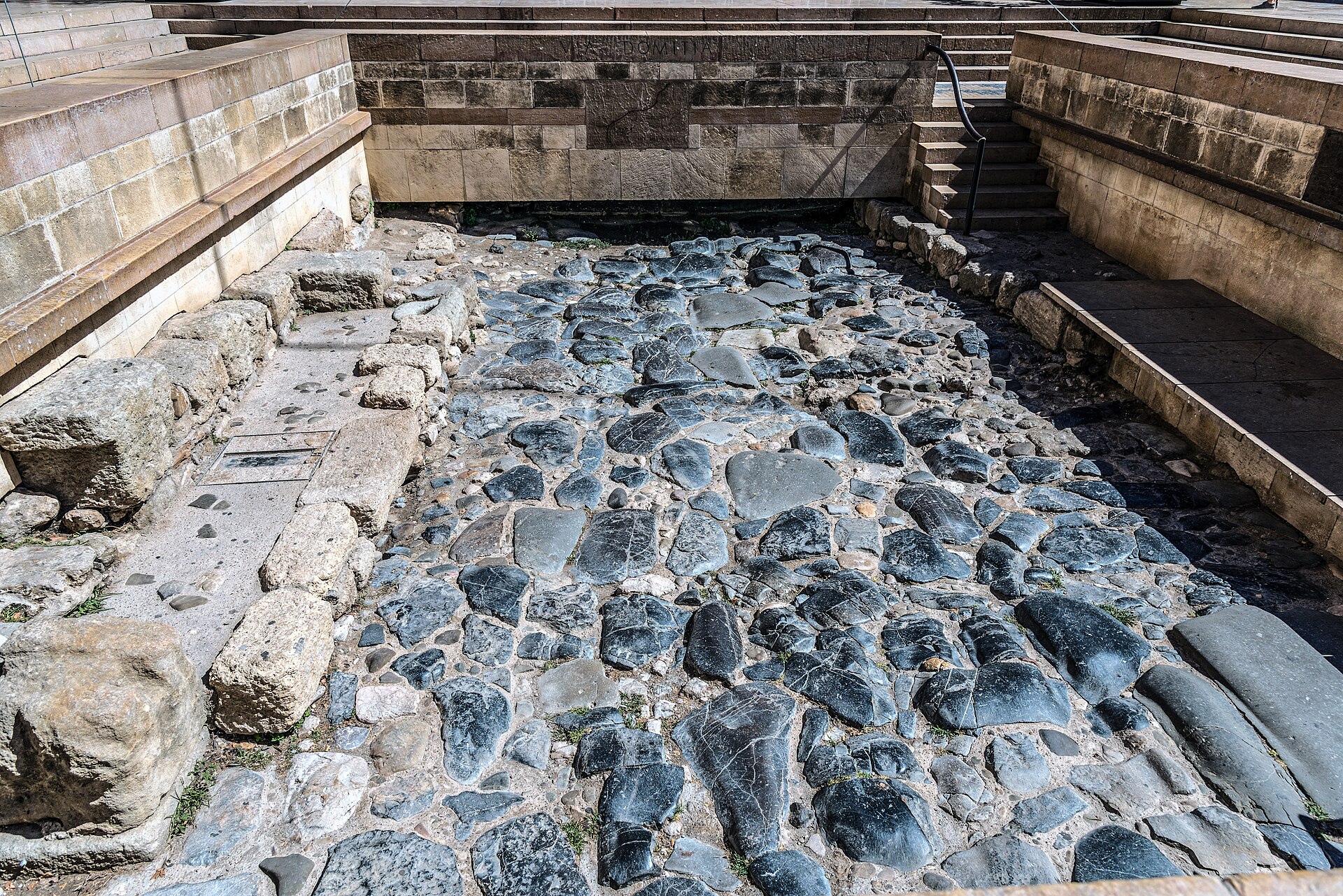
A Roman road. Spanish descends not from the Latin of Cicero but from what was spoken by the people who arrived on roads like this one — soldiers, traders, settlers.Source: Didier Descouens — CC BY-SA 4.0, Wikimedia Commons
Classical Latin used loqui for to speak. Spanish took hablar, from fabulari — to chat, to tell tales. Classical used equus for horse; Spanish took caballo, from caballus, a nag or workhorse. Classical used edere for to eat; Spanish took comer, from comedere.
In every case the everyday word beat the dignified one.Penny (2002) and Lloyd (1987) trace hundreds of such pairs.
It is a useful reminder in itself: the language that survives is not descended from the literature. It is descended from ordinary talk.
The Visigoths: a thin layer
As the Roman empire came apart, the Visigoths ruled the peninsula from the fifth century. But they adopted Latin rather than imposing their Germanic speech, so the traces are light.
Mostly words of war and organisation: guerra (war), guardia (guard), rico (rich), blanco (white), ganso (goose). And a great many names — Rodrigo, Fernando, Álvaro and Elvira are all Germanic.
Seven centuries of Arabic (711–1492)
In 711 a Muslim army crossed the Strait of Gibraltar. Most of the peninsula lay under Muslim rule for nearly eight hundred years, until Granada fell in 1492.
This is the largest borrowing Spanish took from outside the Latin family. The commonly cited estimate is more than four thousand words, around eight per cent of the vocabulary.
A word about the reliability of that number: estimates vary considerably, with some sources reaching nearly eight thousand. The difference lies in what gets counted — living words only, or archaisms and place names too. Corriente (2008) is the fullest lexicographical treatment.
The clearest marker is the Arabic article al- fused to the word: alcohol, álgebra, almohada (pillow), alcalde (mayor), algodón (cotton). Also aceite (oil), azúcar (sugar), arroz (rice), naranja (orange), limón.
The Nasrid motto carved at the Alhambra, Granada. Eight centuries of Arabic in Iberia left roughly four thousand words in Spanish — and the fused article al- marks most of them.Source: Jebulon — CC0, Wikimedia Commons
And one word worth pausing on: ojalá, meaning I hope — from wa-shā' Allāh, if God wills. Spaniards say it daily, mostly unaware they are invoking Allah.
Place names too: Guadalquivir is wādī al-kabīr, the great river.
1492: three events in one year
1492 is the hinge year, and it deserves to be looked at directly.
In January, Granada fell, ending Muslim rule on the peninsula. In August, Columbus sailed.
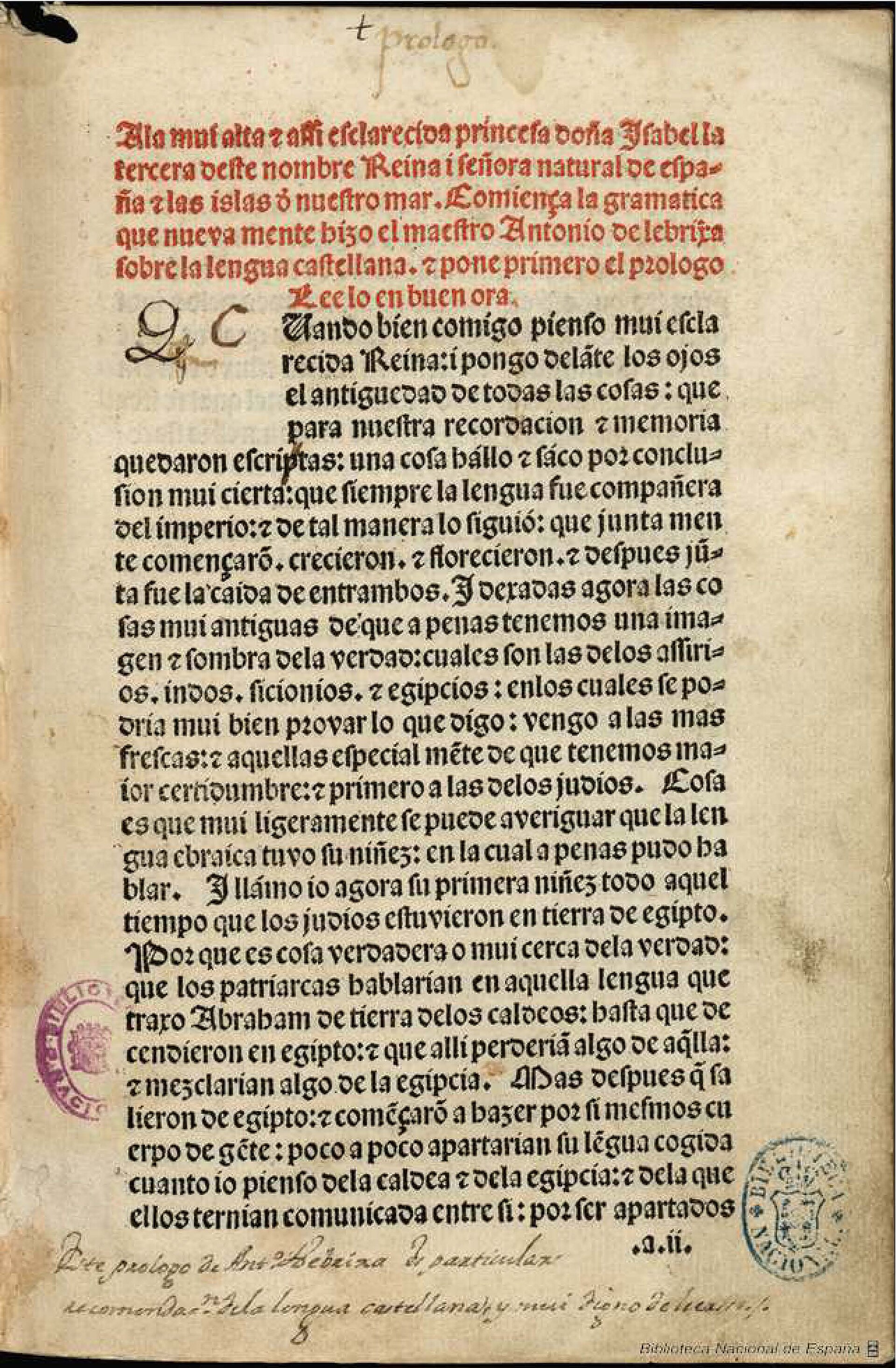
And also in August 1492, at Salamanca, Antonio de Nebrija printed his Gramática de la lengua castellana — the first grammar of any modern European language ever printed.
Nebrija's Gramática de la lengua castellana, Salamanca 1492 — the first grammar of any modern European language, printed the same year the ships sailed.Source: Nebrija, Antonio de (1444-1522) — Public domain, Wikimedia Commons
In his dedication to Queen Isabella, Nebrija wrote that language was the instrument of empire, and that his grammar would prove useful as the monarchs conquered peoples speaking other tongues.
That line deserves to be named for what it is. It is not a harmless metaphor. Nebrija stated outright what histories of language usually narrate around: Spanish travelled the world alongside guns and ships.Mar-Molinero (2000) and Elliott (1963) place the language story in its political setting.
The return journey: words from the Americas
But language does not move only outward. Spanish brought a new layer back from the Americas, and you use several of those words daily.
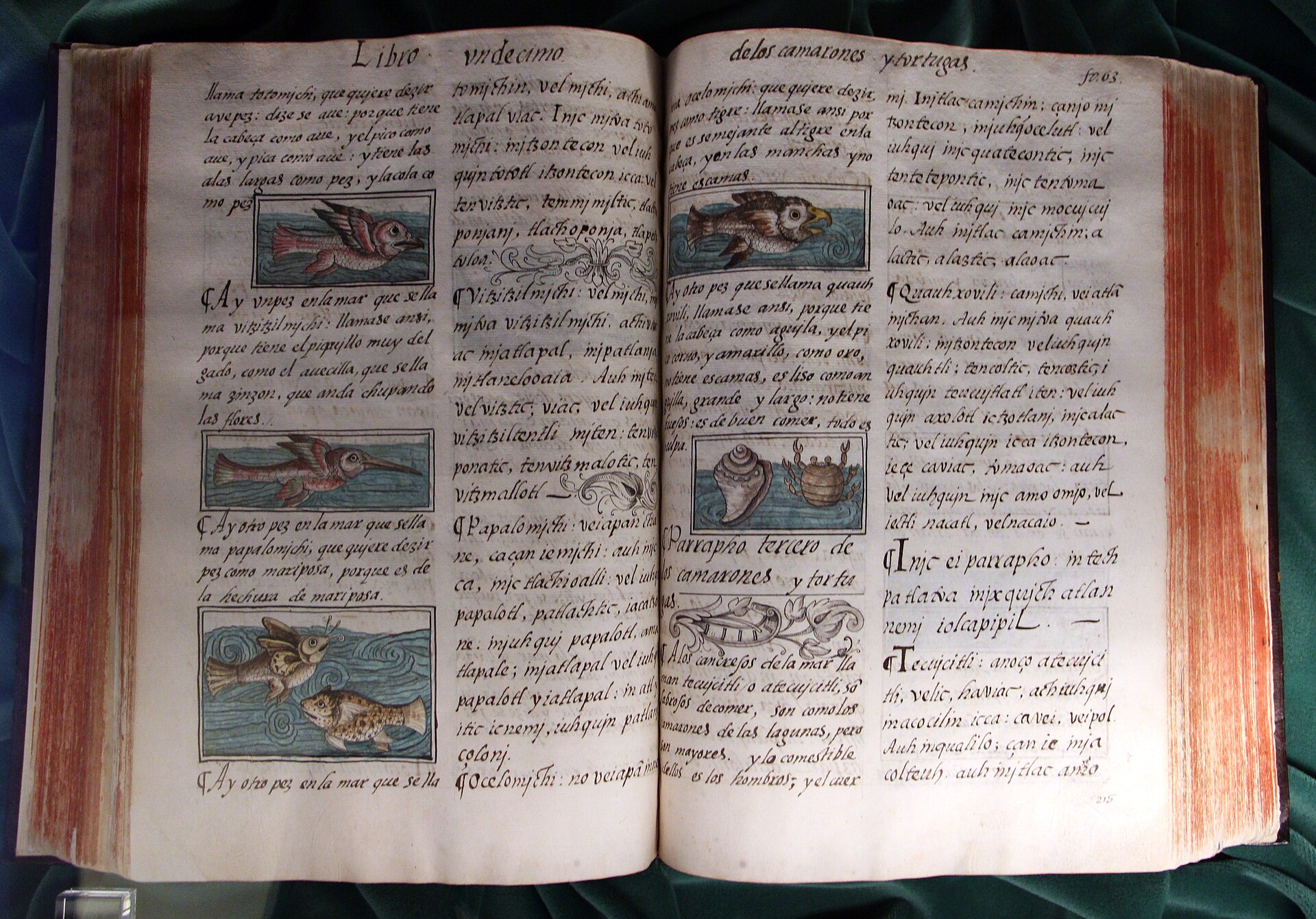
Sahagún's history of New Spain, 1576–77. The traffic ran both ways: chocolate, tomato, hurricane and canoe entered Spanish here, and reached everyone else's language through it.Source: Sailko — CC BY 3.0, Wikimedia Commons
From Nahuatl, the language of the Aztecs: tomate, chocolate, aguacate (avocado), cacao, chile.
From Quechua in the Andes: papa (potato), cóndor, pampa, llama.
From Taíno in the Caribbean: huracán (hurricane), canoa, hamaca (hammock), barbacoa.
Pause on chocolate, because it concerns you directly. The word set out from Nahuatl in Mexico, entered Spanish, passed into French as chocolat, and arrived with the French in Vietnamese as sô cô la.
An Aztec word that reached Hanoi by way of Madrid and Paris.
Three sound changes that explain three learner complaints
Why h is silent
Latin farina became harina (flour). Facere became hacer (to do). Filius became hijo (son).
Initial f- weakened to a breathy sound, then fell silent entirely. The spelling kept the h as a headstone for a sound that died.
Honesty is required here: the commonest explanation credits the influence of Basque — the non-Indo-European language still spoken in northern Spain, which lacked an f. Menéndez Pidal (1926) proposed that account and it is still widely repeated. But it remains contested, and Penny (2002) sets out the objections. The change is certain; the cause is not.
Why c and z sound different across the Atlantic
In most of Spain, casa and caza sound different: the z is pronounced like English th. This is called distinción.
Across all of Latin America, plus Andalusia and the Canaries, the two words sound identical — seseo.
Learners often ask which is correct. The answer is that both are standard. American Spanish spread largely from the southern Spanish ports, so it carried the southern sound system with it. Lipski (1994) and Zamora Vicente (1967) map the result.
Why some places say vos instead of tú
In Argentina, Uruguay, Paraguay and much of Central America, the familiar second person is not tú but vos, with its own conjugation: vos hablás, not tú hablas.
This is not incorrect speech. It is an older form of Spanish surviving in regions far from the centres of standardisation.
1713, and a standard that changed hands
The Royal Spanish Academy was founded in 1713, modelled on Italy's Accademia della Crusca (1582) and the Académie Française (1635), with the aim of fixing the words of Spanish with propriety, elegance and purity.
But one change is worth a learner knowing.
The standard is no longer set by Madrid alone. The current reference grammar was produced by the Royal Academy together with the Association of Academies of the Spanish Language, comprising twenty-three national academies, and it describes regional variants as parallel standards rather than as errors.
The practical consequence: you do not have to find correct Spanish. You have to pick a region and be consistent.
Bridge one: the alphabet you write with
Now the part that is specifically yours.
The quốc ngữ script you are reading was built by Iberian Jesuit missionaries. Jacques (2002) restores the credit due to the Portuguese who came first, above all Francisco de Pina, who laid the foundations Alexandre de Rhodes later inherited.
De Rhodes's printed dictionary of 1651 is titled Dictionarium Annamiticum Lusitanum et Latinum — Vietnamese–Portuguese–Latin. The Portuguese is right there in the title.
And the marks you write every day come from that same orthographic tradition. The acute and grave are the Latin accents; the tilde is the Portuguese and Spanish til; the circumflex on â, ê, ô is Portuguese. Only the horn on ơ and ư was invented for Vietnamese.
Which means that when you look at a page of Spanish, you are looking at a spelling system related to the one Vietnamese borrowed. That is why Vietnamese learners pick up Spanish reading unusually fast: the letter-to-sound rules are regular, and your eye already knows this kind of notation.
The French left a further layer, and much of it has Spanish cousins: cà phê and café, ban công and balcón, xi măng and cemento, ô tô and auto, va li and valija.
Bridge two, which is the important one
The first bridge helps you read. The second helps you understand, and it is far stronger than it looks.
Spanish academic vocabulary is Greek and Latin, assembled from meaningful parts. Vietnamese academic vocabulary is Sino-Vietnamese, also assembled from meaningful parts.
And in a great many cases the two layers are translations of each other.
In the nineteenth century, scholars in Meiji Japan had to render a flood of European concepts, and they did it by compounding Chinese characters. Chinese and then Vietnamese took most of those coinages back. Liu (1995) and Howland (2002) examine that process.
The result is two academic vocabularies that align at the level of construction:
demo-cracia (people + rule) — dân chủ (民主)
filo-sofía (love + wisdom) — triết học (哲學)
geo-grafía (earth + writing) — địa lý (地理)
bio-logía (life + discourse) — sinh vật học (生物學)
socie-dad — xã hội (社會)
eco-nomía (household + law) — kinh tế (經濟)
The practical consequence is concrete. When you meet hidrología, you need no dictionary. You break it apart: hidro- water, -logía the study of. That is thủy văn học. You have just performed the operation you have been performing on Sino-Vietnamese compounds since childhood.
This is not a new skill. It is an old skill carried somewhere new. English speakers have the advantage too, but usually without noticing the structure — to them biology is one solid block. To you, sinh vật học has always been three pieces.
Coxhead's (2000) Academic Word List for English is largely that same Greco-Latin layer, so effort spent here pays into both languages.
Where Spanish is harder for you than for an English speaker
This part has to be said, because promotional writing about Spanish leaves it out, and leaving it out is not honest with you.
Spanish is often called easy. There is one sense in which that is true: the relationship between spelling and pronunciation is highly regular. See it, say it — unlike English. That is a genuine advantage.
But the difficulty has moved, and it has landed exactly where a Vietnamese speaker is least prepared.
Vietnamese does not conjugate. At all.Ăn is ăn, whoever eats, whenever they eat, whether or not the eating is real.
Spanish gives every verb dozens of forms, varying by person, number, tense and mood. The subjunctive alone — el subjuntivo — is a system Vietnamese has no counterpart for, and Vietnamese learners typically spend a long time there.
Add grammatical gender, which Vietnamese also lacks. And the pair ser and estar, two verbs meaning to be where Vietnamese has one.
An English speaker walks in with at least some conjugation experience and a vague notion of a subjunctive. You walk in from zero.
Saying so is not discouragement but budgeting: pour your effort into the verb system, and do not worry much about academic vocabulary. The academic vocabulary you can already take apart. The verbs you cannot.
Today
According to the Instituto Cervantes annual report published in November 2025, Spanish has 636 million users worldwide, of whom 519 million are native speakers. It is the world's second most-spoken native language, after Chinese.
And its centre of gravity is not in Spain. Mexico alone has several times more Spanish speakers than Spain does.
That is worth remembering when you choose an accent to learn. This language left the Iberian peninsula in 1492 and never came back.
Much like the word sô cô la — which left Mexico, passed through Madrid and Paris, and stayed on your kitchen table.
Read the simple version
The same article, told in plain words — for younger readers, or for anyone who wants the point quickly.
Set these two words side by side: dân chủ and democracia.
They look nothing alike. But they are the same word, translated twice.
Democracia joins dēmos (people) to krátos (rule). 民主 joins 民 (people) to 主 (master). That is no coincidence: the Chinese compound was coined in Meiji Japan precisely to render the European concept, and passed from there into Chinese and Vietnamese.
With English, a Vietnamese reader has an analogy. With Chinese, descent. With Spanish, neither — Vietnamese and Spanish are not related in any way.
But two real bridges exist, and this will point at them once the story is told.
The Latin of soldiers, not of Cicero
Spanish is Latin, changed over two thousand years. But not the Latin of the textbooks.
It descends from Vulgar Latin — the speech of the soldiers, traders and settlers who arrived in Iberia from 218 BCE. That difference is still stamped on the vocabulary, and you can read it.
Classical Latin used loqui for to speak. Spanish took hablar, from fabulari — to chat, to tell tales. Classical used equus for horse; Spanish took caballo, from caballus, a nag or workhorse. Classical used edere for to eat; Spanish took comer, from comedere.
In every case the everyday word beat the dignified one. Penny (2002) and Lloyd (1987) trace hundreds of such pairs.
It is a useful reminder in itself: the language that survives is not descended from the literature. It is descended from ordinary talk.
The Visigoths: a thin layer
As the Roman empire came apart, the Visigoths ruled the peninsula from the fifth century. But they adopted Latin rather than imposing their Germanic speech, so the traces are light.
Mostly words of war and organisation: guerra (war), guardia (guard), rico (rich), blanco (white), ganso (goose). And a great many names — Rodrigo, Fernando, Álvaro and Elvira are all Germanic.
Seven centuries of Arabic (711–1492)
In 711 a Muslim army crossed the Strait of Gibraltar. Most of the peninsula lay under Muslim rule for nearly eight hundred years, until Granada fell in 1492.
This is the largest borrowing Spanish took from outside the Latin family. The commonly cited estimate is more than four thousand words, around eight per cent of the vocabulary.
A word about the reliability of that number: estimates vary considerably, with some sources reaching nearly eight thousand. The difference lies in what gets counted — living words only, or archaisms and place names too. Corriente (2008) is the fullest lexicographical treatment.
The clearest marker is the Arabic article al- fused to the word: alcohol, álgebra, almohada (pillow), alcalde (mayor), algodón (cotton). Also aceite (oil), azúcar (sugar), arroz (rice), naranja (orange), limón.
And one word worth pausing on: ojalá, meaning I hope — from wa-shā' Allāh, if God wills. Spaniards say it daily, mostly unaware they are invoking Allah.
Place names too: Guadalquivir is wādī al-kabīr, the great river.
1492: three events in one year
1492 is the hinge year, and it deserves to be looked at directly.
In January, Granada fell, ending Muslim rule on the peninsula. In August, Columbus sailed.
And also in August 1492, at Salamanca, Antonio de Nebrija printed his Gramática de la lengua castellana — the first grammar of any modern European language ever printed.
In his dedication to Queen Isabella, Nebrija wrote that language was the instrument of empire, and that his grammar would prove useful as the monarchs conquered peoples speaking other tongues.
That line deserves to be named for what it is. It is not a harmless metaphor. Nebrija stated outright what histories of language usually narrate around: Spanish travelled the world alongside guns and ships. Mar-Molinero (2000) and Elliott (1963) place the language story in its political setting.
The return journey: words from the Americas
But language does not move only outward. Spanish brought a new layer back from the Americas, and you use several of those words daily.
From Nahuatl, the language of the Aztecs: tomate, chocolate, aguacate (avocado), cacao, chile.
From Quechua in the Andes: papa (potato), cóndor, pampa, llama.
From Taíno in the Caribbean: huracán (hurricane), canoa, hamaca (hammock), barbacoa.
Pause on chocolate, because it concerns you directly. The word set out from Nahuatl in Mexico, entered Spanish, passed into French as chocolat, and arrived with the French in Vietnamese as sô cô la.
An Aztec word that reached Hanoi by way of Madrid and Paris.
Three sound changes that explain three learner complaints
Why h is silent. Latin farina became harina (flour). Facere became hacer (to do). Filius became hijo (son). Initial f- weakened to a breathy sound, then fell silent entirely. The spelling kept the h as a headstone for a sound that died.
Honesty is required here: the commonest explanation credits the influence of Basque — the non-Indo-European language still spoken in northern Spain, which lacked an f. Menéndez Pidal (1926) proposed that account and it is still widely repeated. But it remains contested, and Penny (2002) sets out the objections. The change is certain; the cause is not.
Why c and z sound different across the Atlantic. In most of Spain, casa and caza sound different: the z is pronounced like English th. This is called distinción. Across all of Latin America, plus Andalusia and the Canaries, the two words sound identical — seseo.
Learners often ask which is correct. The answer is that both are standard. American Spanish spread largely from the southern Spanish ports, so it carried the southern sound system with it. Lipski (1994) and Zamora Vicente (1967) map the result.
Why some places say vos instead of tú. In Argentina, Uruguay, Paraguay and much of Central America, the familiar second person is not tú but vos, with its own conjugation: vos hablás, not tú hablas. This is not incorrect speech. It is an older form of Spanish surviving in regions far from the centres of standardisation.
1713, and a standard that changed hands
The Royal Spanish Academy was founded in 1713, modelled on Italy's Accademia della Crusca (1582) and the Académie Française (1635), with the aim of fixing the words of Spanish with propriety, elegance and purity.
But one change is worth a learner knowing. The standard is no longer set by Madrid alone. The current reference grammar was produced by the Royal Academy together with the Association of Academies of the Spanish Language, comprising twenty-three national academies, and it describes regional variants as parallel standards rather than as errors.
The practical consequence: you do not have to find correct Spanish. You have to pick a region and be consistent.
Bridge one: the alphabet you write with
Now the part that is specifically yours.
The quốc ngữ script you are reading was built by Iberian Jesuit missionaries. Jacques (2002) restores the credit due to the Portuguese who came first, above all Francisco de Pina, who laid the foundations Alexandre de Rhodes later inherited.
De Rhodes's printed dictionary of 1651 is titled Dictionarium Annamiticum Lusitanum et Latinum — Vietnamese–Portuguese–Latin. The Portuguese is right there in the title.
And the marks you write every day come from that same orthographic tradition. The acute and grave are the Latin accents; the tilde is the Portuguese and Spanish til; the circumflex on â, ê, ô is Portuguese. Only the horn on ơ and ư was invented for Vietnamese.
Which means that when you look at a page of Spanish, you are looking at a spelling system related to the one Vietnamese borrowed. That is why Vietnamese learners pick up Spanish reading unusually fast: the letter-to-sound rules are regular, and your eye already knows this kind of notation.
The French left a further layer, and much of it has Spanish cousins: cà phê and café, ban công and balcón, xi măng and cemento, ô tô and auto, va li and valija.
Bridge two, which is the important one
The first bridge helps you read. The second helps you understand, and it is far stronger than it looks.
Spanish academic vocabulary is Greek and Latin, assembled from meaningful parts. Vietnamese academic vocabulary is Sino-Vietnamese, also assembled from meaningful parts.
And in a great many cases the two layers are translations of each other.
In the nineteenth century, scholars in Meiji Japan had to render a flood of European concepts, and they did it by compounding Chinese characters. Chinese and then Vietnamese took most of those coinages back. Liu (1995) and Howland (2002) examine that process.
The result is two academic vocabularies that align at the level of construction:
demo-cracia (people + rule) — dân chủ (民主)
filo-sofía (love + wisdom) — triết học (哲學)
geo-grafía (earth + writing) — địa lý (地理)
bio-logía (life + discourse) — sinh vật học (生物學)
socie-dad — xã hội (社會)
eco-nomía (household + law) — kinh tế (經濟)
The practical consequence is concrete. When you meet hidrología, you need no dictionary. You break it apart: hidro- water, -logía the study of. That is thủy văn học. You have just performed the operation you have been performing on Sino-Vietnamese compounds since childhood.
This is not a new skill. It is an old skill carried somewhere new. English speakers have the advantage too, but usually without noticing the structure — to them biology is one solid block. To you, sinh vật học has always been three pieces.
Coxhead's (2000) Academic Word List for English is largely that same Greco-Latin layer, so effort spent here pays into both languages.
Where Spanish is harder for you than for an English speaker
This part has to be said, because promotional writing about Spanish leaves it out, and leaving it out is not honest with you.
Spanish is often called easy. There is one sense in which that is true: the relationship between spelling and pronunciation is highly regular. See it, say it — unlike English. That is a genuine advantage.
But the difficulty has moved, and it has landed exactly where a Vietnamese speaker is least prepared.
Vietnamese does not conjugate. At all.Ăn is ăn, whoever eats, whenever they eat, whether or not the eating is real.
Spanish gives every verb dozens of forms, varying by person, number, tense and mood. The subjunctive alone — el subjuntivo — is a system Vietnamese has no counterpart for, and Vietnamese learners typically spend a long time there.
Add grammatical gender, which Vietnamese also lacks. And the pair ser and estar, two verbs meaning to be where Vietnamese has one.
An English speaker walks in with at least some conjugation experience and a vague notion of a subjunctive. You walk in from zero.
Saying so is not discouragement but budgeting: pour your effort into the verb system, and do not worry much about academic vocabulary. The academic vocabulary you can already take apart. The verbs you cannot.
Today
According to the Instituto Cervantes annual report published in November 2025, Spanish has 636 million users worldwide, of whom 519 million are native speakers. It is the world's second most-spoken native language, after Chinese.
And its centre of gravity is not in Spain. Mexico alone has several times more Spanish speakers than Spain does.
That is worth remembering when you choose an accent to learn. This language left the Iberian peninsula in 1492 and never came back.
Much like the word sô cô la — which left Mexico, passed through Madrid and Paris, and stayed on your kitchen table.
Sources & further reading
These articles summarize well-established research in learning science and linguistics. Key sources and further reading:
Penny, R. (2002). A History of the Spanish Language (2nd ed.). Cambridge: Cambridge University Press.
Lapesa, R. (1981). Historia de la lengua española (9th ed.). Madrid: Gredos.
Lloyd, P. M. (1987). From Latin to Spanish. Philadelphia: American Philosophical Society.
Pharies, D. A. (2007). A Brief History of the Spanish Language. Chicago: University of Chicago Press.
Pountain, C. J. (2001). A History of the Spanish Language through Texts. London: Routledge.
Menéndez Pidal, R. (1926). Orígenes del español. Madrid: Hernando.
Wright, R. (1982). Late Latin and Early Romance in Spain and Carolingian France. Liverpool: Francis Cairns.
Corominas, J., & Pascual, J. A. (1980–1991). Diccionario crítico etimológico castellano e hispánico. Madrid: Gredos.
Corriente, F. (2008). Dictionary of Arabic and Allied Loanwords: Spanish, Portuguese, Catalan, Galician and Kindred Dialects. Leiden: Brill.
Nebrija, A. de (1492). Gramática de la lengua castellana. Salamanca: Juan de Porras.
Real Academia Española & Asociación de Academias de la Lengua Española (2009). Nueva gramática de la lengua española. Madrid: Espasa.
Instituto Cervantes (2025). El español en el mundo: Anuario del Instituto Cervantes. Madrid: Instituto Cervantes.
Hualde, J. I. (2005). The Sounds of Spanish. Cambridge: Cambridge University Press.
Hualde, J. I., Olarrea, A., Escobar, A. M., & Travis, C. E. (2010). Introducción a la lingüística hispánica (2nd ed.). Cambridge: Cambridge University Press.
Lipski, J. M. (1994). Latin American Spanish. London: Longman.
Zamora Vicente, A. (1967). Dialectología española (2nd ed.). Madrid: Gredos.
Elliott, J. H. (1963). Imperial Spain 1469–1716. London: Edward Arnold.
Mar-Molinero, C. (2000). The Politics of Language in the Spanish-Speaking World. London: Routledge.
Jacques, R. (2002). Portuguese Pioneers of Vietnamese Linguistics Prior to 1650. Bangkok: Orchid Press.
Rhodes, A. de (1651). Dictionarium Annamiticum Lusitanum et Latinum. Rome: Sacra Congregatio de Propaganda Fide.
DeFrancis, J. (1977). Colonialism and Language Policy in Viet Nam. The Hague: Mouton.
Liu, L. H. (1995). Translingual Practice: Literature, National Culture, and Translated Modernity — China, 1900–1937. Stanford, CA: Stanford University Press.
Howland, D. (2002). Translating the West: Language and Political Reason in Nineteenth-Century Japan. Honolulu: University of Hawaii Press.
Alves, M. J. (2009). Loanwords in Vietnamese. In M. Haspelmath & U. Tadmor (Eds.), Loanwords in the World’s Languages: A Comparative Handbook. Berlin: De Gruyter Mouton.
Coxhead, A. (2000). A new academic word list. TESOL Quarterly, 34(2), 213–238.
Nation, I. S. P. (2013). Learning Vocabulary in Another Language (2nd ed.). Cambridge: Cambridge University Press.

.jpg)


