How Do Children Learn Grammar Without Being Taught the Rules?
No one explains the past tense to a toddler, yet by five they command a grammar of staggering complexity. How children extract grammar from pure input — the pattern-detecting brain, the wug test, goed, and what it means for adult learners.
No one sits a three-year-old down to explain the past tense. Nobody diagrams a sentence for a toddler or drills them on subject-verb agreement. And yet, by the age of five or six, children command a grammar of breathtaking complexity — forming questions, marking time, nesting clauses inside clauses — and they mostly get it right. They do all this without a single rule being explained to them. How? It is one of the most remarkable feats the human brain performs, and understanding it changes how we think about grammar itself.
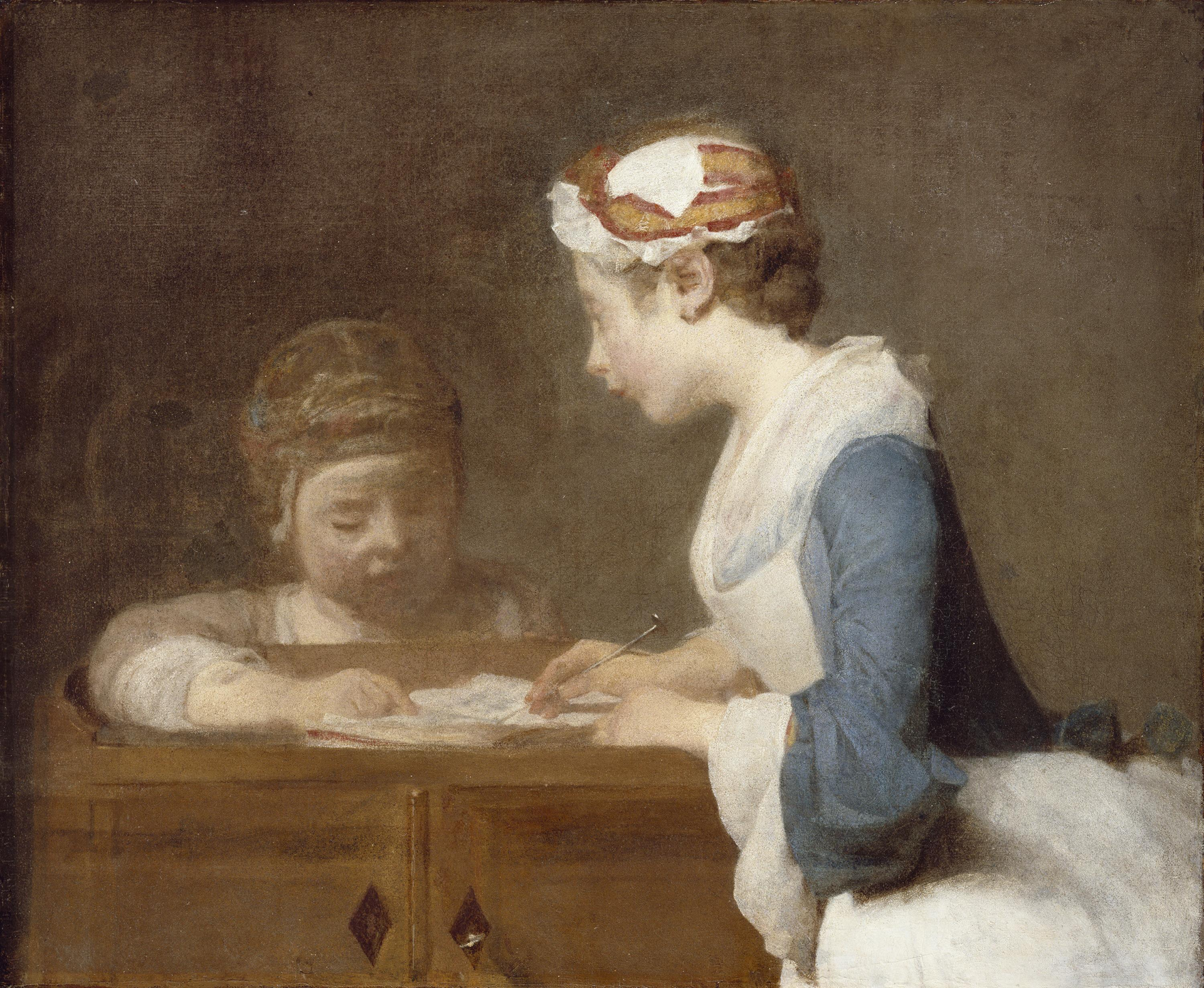
Chardin's schoolmistress, around 1735. Whatever is being taught on that page, it is not grammar — and by the age of the smaller child the hardest grammar has already been worked out, without a lesson and without anybody able to say how.Source: Jean-Baptiste-Siméon Chardin — Public domain, Wikimedia Commons
The brain as a pattern detector
The short answer is that children do not learn rules at all — they extract patterns. The human brain, from infancy, is a relentless statistical learner: bathed in a flood of speech, it quietly tracks which sounds follow which, which words cluster together, and in what order. Experiments show that babies only a few months old already use these statistical regularities to find the boundaries between words in a stream of talk. Long before they can speak, they are analysing the structure of their language, unconsciously, from nothing but examples.
The proof: children build rules they were never given
How do we know they are abstracting rules rather than just copying what they hear? The evidence is delightful, and it comes from their mistakes. A young child who has said went perfectly for months will suddenly start saying goed. They say foots,mans,runned — forms no adult ever modelled for them. These errors are a gift, because they prove the child has unconsciously extracted a rule — add -ed for the past, add -s for more than one — and is now over-applying it, even to words that break it. You cannot over-apply a rule you were only ever imitating.
A classic experiment made this unmistakable. Show a child a made-up creature and say, This is a wug. Then show two and ask, Now there are two…? Children who have never heard the word before answer, without hesitation, wugs. They are not recalling; they are generating, applying a rule to a word that does not exist. That is grammar being built from the inside.
Knowledge they cannot see
Here is the strange part: this grammar is invisible to the very child who owns it. A native speaker of any language obeys hundreds of intricate rules flawlessly and yet cannot state most of them. Ask an adult whythe big red ball sounds right and the red big ball sounds wrong, and most will only shrug — it just feels right. Grammar of this kind is implicit: it lives in the same silent, procedural memory as riding a bicycle, known in the doing rather than the explaining. Children build exactly this kind of knowledge, which is why it never needed words to teach it.
Why teaching barely enters into it
Not only do children not need grammar explained — they barely respond to correction when it is offered. Parents mostly correct what a child means, not how they say it, and studies of the rare cases where adults do correct grammar find children largely impervious to it. They do not fix goed because someone tells them to; they fix it because they keep hearing went, again and again, until the exception overwrites the rule. The engine of grammar is input, not instruction.
Two explanations — and what they share
Why the brain is so good at this is where linguists genuinely disagree. One camp, following Noam Chomsky, argues from the poverty of the stimulus: children end up knowing more about grammar than the messy, limited speech they hear could strictly teach them, which points to an innate predisposition — a language faculty the human brain is born with. The other camp, the usage-based view associated with Michael Tomasello, holds that no special grammar organ is needed: powerful general pattern-learning, combined with a uniquely human drive to share attention and meaning with others, is enough to build grammar from ordinary usage. The debate is real and unresolved. But both sides agree on the essentials that matter here: give a young brain a flood of meaningful language and time, and it will extract the system on its own.
What this means for language learners
This implicit, pattern-hungry machinery does not vanish in adulthood — it only quiets. Adults can still tap it the same way children do: through large amounts of comprehensible input, reading and listening until the patterns of the new language start to feel right rather than be recalled. Adults have a shortcut children lack — they can be handed a rule to speed up noticing — but the deep, automatic grammar that lets you speak without stopping to think is still built the ancient way: by meeting the language, again and again, in meaning.
The takeaway
Children learning grammar without rules reveal a truth we easily forget: grammar was never fundamentally a set of rules to be taught. It is a set of patterns to be absorbed. No one explained the system to you as a child, and you learned it perfectly all the same — because a human brain, given enough meaningful language and time, will quietly, unconsciously, work the whole thing out for itself.
Read the simple version
The same article, told in plain words — for younger readers, or for anyone who wants the point quickly.
Nobody sat you down as a child and explained grammar to you. You learned it perfectly anyway.
How?
Children do not learn rules. They catch patterns.
From the very beginning, a human brain is counting. Bathed in a flood of speech, it quietly tracks which sounds follow which, which words travel together, and in what order.
Babies only a few months old already use this to find where one word ends and the next begins in a stream of talk. Long before they can say anything, they are taking their language apart — unconsciously, from nothing but examples.
The proof is in their mistakes
How do we know they are building rules rather than just copying?
Because of the errors. A child who has said went correctly for months will suddenly start saying goed. They say foots, mans, runned — forms no adult ever said to them.
Those mistakes are a gift. They prove the child has worked out a rule — add -ed for the past — and is now applying it even to words that break it. You cannot over-apply a rule you were only ever imitating.
One classic experiment made this unmistakable. Show a child a made-up creature: This is a wug. Then show two and ask, Now there are two…? Children who have never heard the word answer without hesitating: wugs.
They are not remembering. They are generating — applying a rule to a word that does not exist.
Knowledge they cannot see
Here is the strange part. This grammar is invisible to the child who owns it.
A native speaker of any language follows hundreds of intricate rules flawlessly and cannot state most of them. Ask an adult why the big red ball sounds right and the red big ball sounds wrong, and most will just shrug. It feels right.
This kind of grammar lives in the same silent memory as riding a bicycle: known in the doing, not in the explaining. That is why it never needed words to teach it.
Why teaching barely comes into it
Children not only do not need grammar explained — they barely respond to correction when it is offered. Parents mostly correct what a child means, not how they said it.
A child does not fix goed because someone told them to. They fix it because they keep hearing went, again and again, until the exception overwrites the rule.
The engine of grammar is input, not instruction.
Two explanations, and what they share
Why the brain is this good at it is where linguists genuinely disagree. One side argues that children end up knowing more than the messy speech around them could strictly have taught, which points to something the brain is born with. The other side says no special grammar organ is needed — powerful general pattern-learning, plus a very human urge to share meaning with other people, is enough.
The argument is real and unsettled. But both sides agree on the part that matters here: give a young brain a flood of meaningful language and time, and it will work out the system by itself.
What this means if you are learning a language now
That pattern-hungry machinery does not vanish when you grow up. It only goes quiet.
You can still reach it the way a child does: through large amounts of language you mostly understand, read and heard until the patterns start to feel right rather than be recalled.
Adults do have one shortcut children lack — someone can hand you a rule, and that speeds up your noticing. But the deep, automatic grammar that lets you speak without stopping to think is still built the ancient way: by meeting the language, again and again, in meaning.
Sources & further reading
These articles summarize well-established research in learning science and linguistics. Key sources and further reading:
Chomsky, N. (1965). Aspects of the Theory of Syntax. MIT Press.
Berko, J. (1958). The child's learning of English morphology. Word.
Saffran, J. R., Aslin, R. N., & Newport, E. L. (1996). Statistical learning by 8-month-old infants. Science.
Tomasello, M. (2003). Constructing a Language: A Usage-Based Theory of Language Acquisition. Harvard University Press.
Marcus, G. F., Pinker, S., Ullman, M., Hollander, M., Rosen, T. J., & Xu, F. (1992). Overregularization in language acquisition. Monographs of the Society for Research in Child Development.