Four thousand years before the first app, somebody was sitting down to learn a language that was not their own — with no recordings, no instant dictionary, and for most of that span no printing press. The interesting question is not how they coped, but what the scarcity forced them to do that we no longer have to.
Four thousand years before the first language app, somebody was sitting down to learn a language that was not their own. No recordings, no dictionary you could search in a second, and for most of that stretch no printing press either. The question worth asking is not how they coped. It is what the scarcity forced them to do that we no longer have to.
The oldest homework we still have
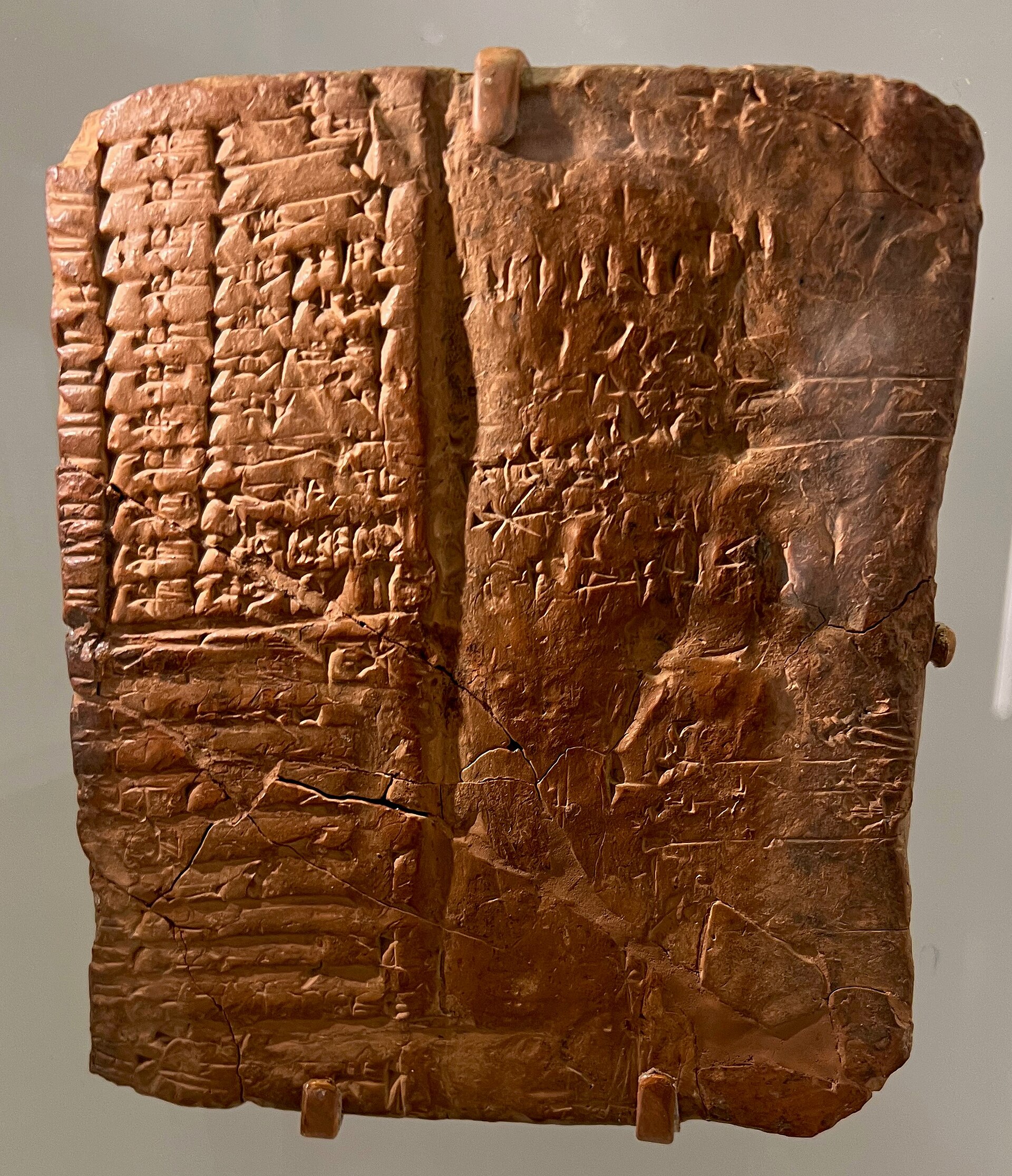
At Nippur, in what is now southern Iraq, excavators have pulled up thousands of clay tablets dating to roughly 1900–1600 BC. A great many of them are schoolwork: pupils copying out word lists grouped by theme — kinds of wood, wooden objects, metals, animals, foodstuffs.
A pupil’s exercise from Nippur, 1900–1600 BC: a lexical list of woods. Not a monument and not literature — somebody’s vocabulary homework, in a language that was already dead when they copied it. This particular list is well enough studied to have a doctoral thesis of its own.Source: Onceinawhile — CC BY-SA 4.0, Wikimedia Commons
The striking part is elsewhere. What they were learning was Sumerian, and by then nobody spoke Sumerian in the street. The pupils spoke Akkadian at home and went to school to learn a dead language, in order to read and write it. That is exactly the position Latin held in Europe a thousand years later, and Classical Chinese in Vietnam, Korea and Japan.
Which makes the themed vocabulary list the oldest language-teaching technology still in service. Four thousand years, and it is still sitting at the end of every textbook chapter. It has lasted for a reason: copying a list by hand and then reciting it forces you to pull the word out of your head, rather than look at it and nod.
The 1,800-year-old phrasebook
Jump to Rome, around the third century AD. The Hermeneumata were manuals for Greek speakers learning Latin and Latin speakers learning Greek, laid out in two parallel columns. The content is not Virgil. It is: waking up, greeting the neighbours, going to the baths, going to market, borrowing money, arguing about a debt, having people over.
One thing jumps out. The template — each lesson is one everyday situation, plus exactly the words needed to survive it — is eighteen centuries old. It survives intact in every course book on sale today, not because nobody thought of an alternative, but because the situation is the hook that pulls the word back out of memory.
The textbook that stayed in print for four hundred years
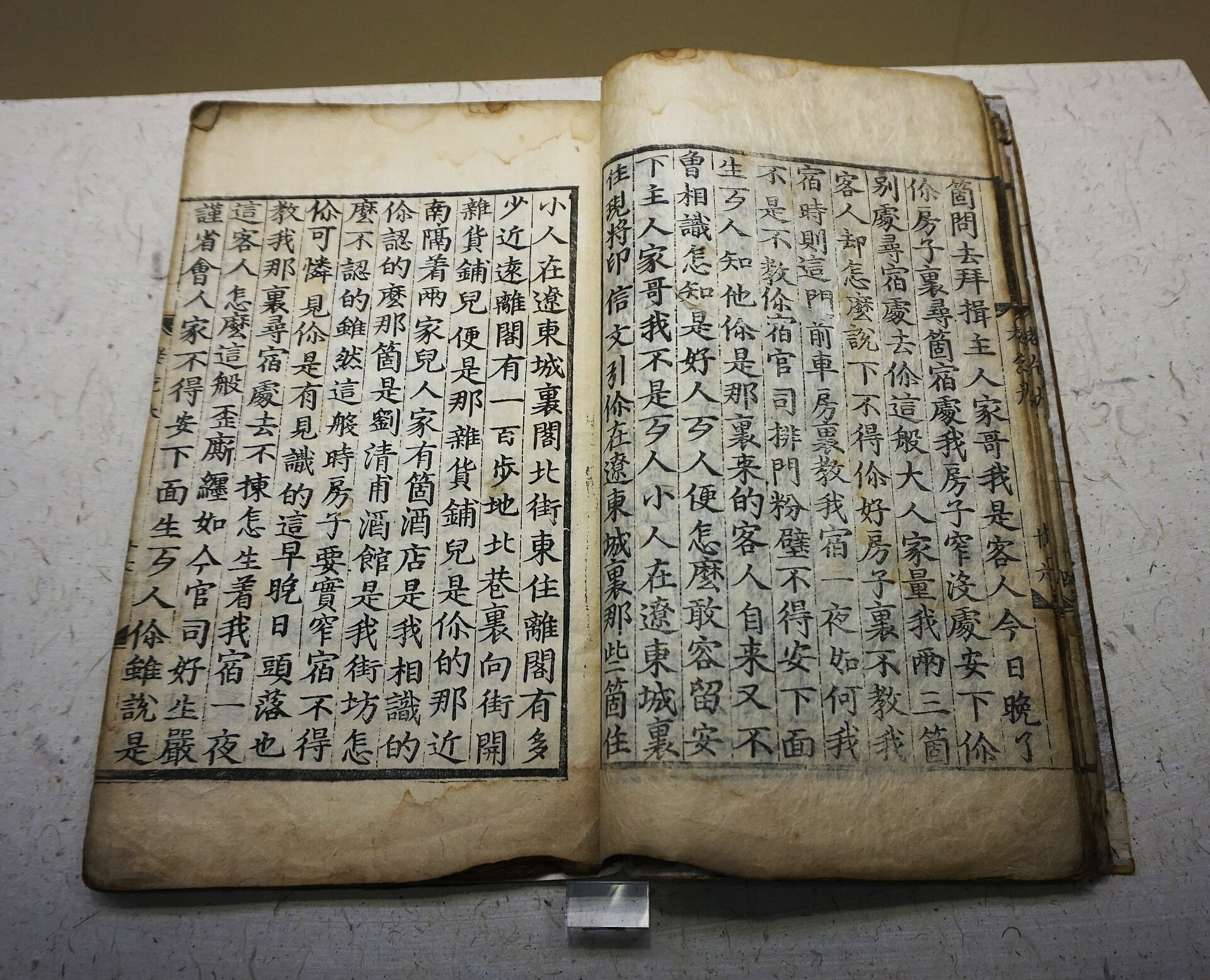
Fourteenth-century Korea produced the 老乞大, the Nogeoldae or Old Cathayan. The whole book is a journey: a Korean merchant travels to Beijing, introduces himself, asks directions, takes a room, haggles over horses, sells his goods and goes home. You learn Chinese through the exact sentences you are going to have to say.
And this was no amateur self-study guide. Korean records from 1426 list it as required reading for government interpreters. It was reprinted and revised from the fourteenth century into the eighteenth, then translated onward into Manchu and Mongolian. Four hundred years of service for one conversation textbook.
The Nogeoldae, in a 1670 printing. The text begins with a Korean merchant meeting a stranger on the road to Beijing and being asked where he is from — the same opening move as lesson one of any course book you have ever bought.Source: 三猎 — CC BY-SA 4.0, Wikimedia Commons
Three things the scarcity handed them free
There was nowhere to look it up. Books were distant, expensive, and often there was one copy for the whole school. If you wanted the word, you had to dig for it. Every act of digging was a real self-test — the thing Jeffrey Karpicke and Henry Roediger would later measure as the learning event itself, rather than the re-reading.
Speaking practice required another human. There was no such thing as practising speech alone. So every session came with misunderstanding, stalling, and having to say it again so the other person got it — what Merrill Swain calls pushed output: you find the hole in what you know at the moment you are forced to produce it.
The need was real. Merchants, interpreters, clergy, physicians. Nobody copied clay tablets for fun or to protect a streak. The motivation already existed out in the world; it did not have to be designed in.
The other half, which is much less charming
Do not romanticise it. Before roughly 1900 there was no recorded sound at all. Most people who learned Latin never once heard a native speaker say it, because there were none left. Pronunciation passed from teacher to pupil; where a teacher drifted, a whole region drifted with them, for centuries.
Nineteenth-century grammar-translation then produced a peculiar product: readers fluent in Cicero who could not order dinner. On top of which, the whole enterprise was available to a very small number of people with money and access to a teacher. And we only ever hear about the ones who succeeded.
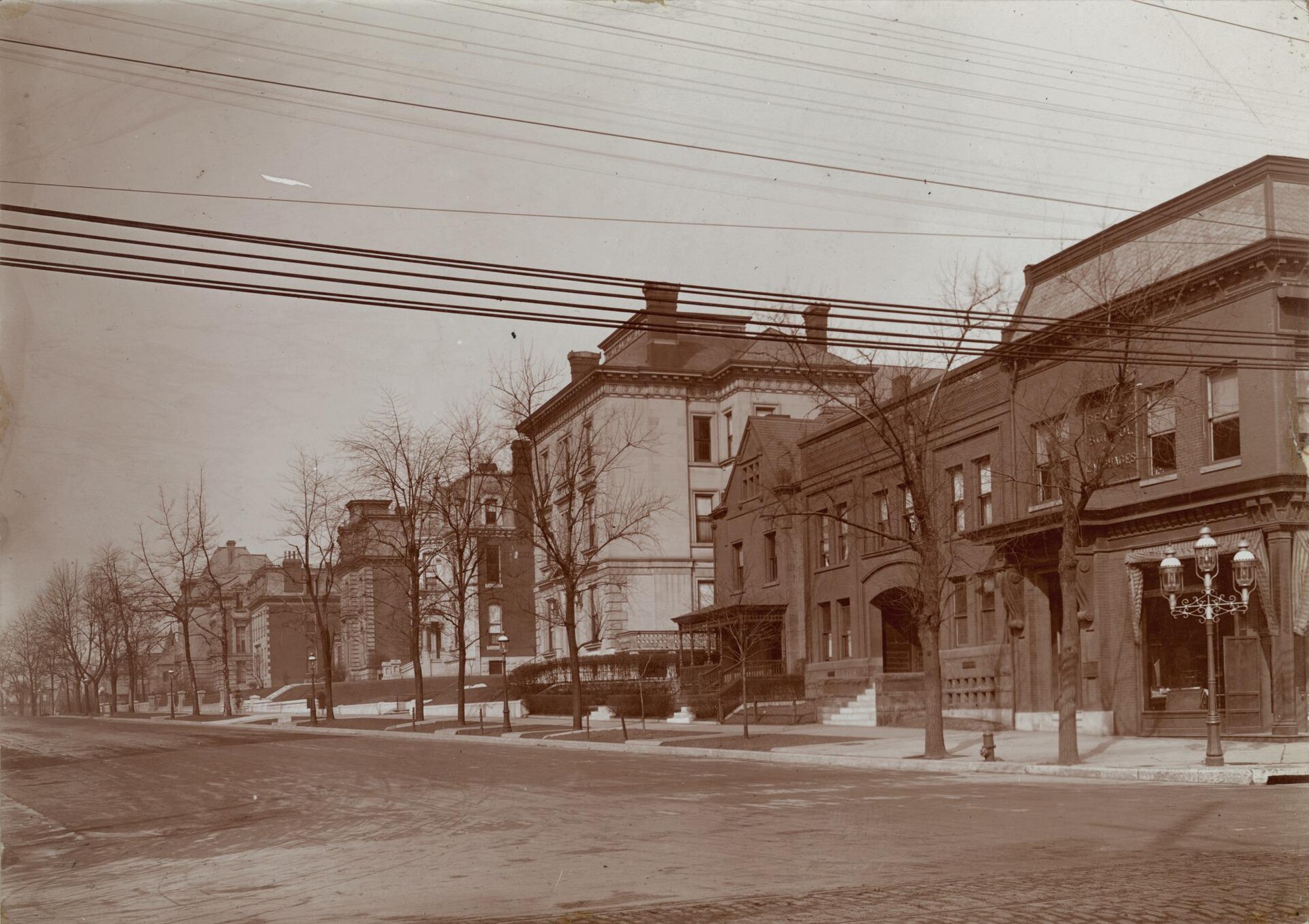
A Berlitz school on a street corner in St Louis, Missouri, in the 1910s. This is what happened next: within a generation of the accident described below, learning to speak a language stopped being a privilege arranged through tutors and became something with a shopfront and an evening timetable.Source: Oscar C. Kuehn — Public domain, Wikimedia Commons
The revolt that began with a hiring accident
In May 1878, in Providence, Rhode Island, Maximilian Berlitz opened a language school and hired a French assistant named Nicolas Joly. The two had corresponded entirely in French, so Berlitz had no idea that Joly spoke almost no English.
Then Berlitz fell ill and had to hand over his classes. Unable to translate anything for anyone, Joly was reduced to pointing at objects, acting verbs out, and simply talking in French. Six weeks later Berlitz came back braced to apologise to his students, and found people who had been grinding through conjugation drills holding a conversation with their teacher.
That accident got named the direct method, and it is still the frame underneath every app that advertises speaking from lesson one. One of the most durable ideas in language teaching exists because somebody misread a letter.
Three things worth taking back
Not to return there — we have what they wanted and lacked: real audio, native speakers one tap away, books that cost almost nothing. But those three constraints can be reclaimed at no cost. Try to recall before you look it up, even when looking it up takes one second. Memorise a few whole passages you can actually use, not loose word lists. And speak to someone who can misunderstand you, because the misunderstanding is what shows you the gap.
How confident we should be
One limit is worth stating plainly: what gets excavated is the teaching material, not the results. We know what Roman schoolboys used to learn Greek; we have almost no idea how many of them actually learned it. There were no tests, no data, and the people who gave up left nothing behind. So read this for what it is — a history of method, not evidence that the old way was better. The part that holds up is the three constraints above, and that part has modern research behind it.
Read the simple version
The same article, told in plain words — for younger readers, or for anyone who wants the point quickly.
Four thousand years ago, someone was already sitting down to learn a language that was not their own.
No recordings. No dictionary you could search in one second. For most of that time, no printed books either.
So how did they do it? And did they have anything we have lost?
The oldest homework in the world
In southern Iraq, diggers found thousands of clay tablets from about 4,000 years ago. Many of them are just schoolwork. Children copying out word lists: kinds of wood, metals, animals, food.
Here is the odd part. The language they were learning was already dead. Nobody spoke it any more. They learned it to read and write, the way Europe later learned Latin.
So the vocabulary list is the oldest teaching tool we still use. Four thousand years old, and still sitting at the end of every chapter.
The Romans had phrasebooks too
About 1,800 years ago, Greek and Roman students used books with two columns side by side. One language in each column.
The topics were not poetry. They were: getting up, saying hello to the neighbours, going to the baths, going to market, borrowing money, arguing about money.
That is exactly what a modern textbook chapter looks like. One everyday situation, plus the words you need to get through it. The idea is 1,800 years old.
A book that lasted 400 years
In Korea, in the 1300s, someone wrote a book called the Nogeoldae. The whole book is one trip. A merchant travels to Beijing. He introduces himself, asks the way, finds a room, argues about the price of a horse, sells his goods, goes home.
It worked so well that the government made it required reading for official interpreters. People kept printing it for 400 years.
Three things they had that we do not
Nowhere to look things up. If you wanted a word, you had to dig it out of your own head. That digging is what makes memory stronger.
No way to practise alone. Speaking meant speaking to a person. So you got misunderstood, and had to say it again better.
A real reason. Traders, interpreters, priests, doctors. Nobody studied to keep a streak alive.
But it was also worse — much worse
Before about 1900 there were no recordings at all. Most people who learned Latin never once heard anyone speak it. If your teacher said it wrong, your whole region said it wrong for hundreds of years.
And the old school method produced people who could read famous books but could not order a meal.
Also, almost nobody got to do it. You needed money and a teacher.
The accident that changed everything
In 1878 a man named Berlitz opened a language school in America. He hired a French teacher, Nicolas Joly. The two had only ever written letters, in French. So Berlitz never found out that Joly could barely speak English.
Then Berlitz got sick, and Joly had to teach the classes alone.
He could not translate anything for anyone. So he pointed at objects, acted out verbs, and just kept talking in French.
Six weeks later Berlitz came back, ready to apologise. Instead he found his students having a conversation with the teacher.
That accident is why apps today promise you will speak from day one.
What to take from all this
Try to remember before you look it up. Even when looking it up takes one second.
Learn a few whole passages by heart — real ones you can use, not lists of separate words.
Talk to someone who might misunderstand you. That is how you find out what is missing.
One honest warning
We dug up their books. We did not dig up their results.
We know what Roman students used to study Greek. We have almost no idea how many of them actually learned it. There were no tests, and the people who gave up left nothing behind.
So this is a story about methods. It is not proof that the old way was better. The three things above are the part with real research behind them.
Sources & further reading
These articles summarize well-established research in learning science and linguistics. Key sources and further reading:
Veldhuis, N. C. (1997). Elementary Education at Nippur: The Lists of Trees and Wooden Objects. Doctoral dissertation, University of Groningen.
Robson, E. (2001). The tablet house: a scribal school in Old Babylonian Nippur. Revue d’Assyriologie et d’archéologie orientale, 95(1), 39–66.
Dickey, E. (2012–2015). The Colloquia of the Hermeneumata Pseudodositheana (Vols. 1–2). Cambridge: Cambridge University Press.
Dickey, E. (2016). Learning Latin the Ancient Way: Latin Textbooks from the Ancient World. Cambridge: Cambridge University Press.
Rimsky-Korsakoff Dyer, S. (1983). Grammatical Analysis of the Lao Ch’i-ta, with an English Translation of the Chinese Text. Canberra: Faculty of Asian Studies, Australian National University.
Kelly, L. G. (1969). 25 Centuries of Language Teaching. Rowley, MA: Newbury House.
Howatt, A. P. R., & Widdowson, H. G. (2004). A History of English Language Teaching (2nd ed.). Oxford: Oxford University Press.
Titone, R. (1968). Teaching Foreign Languages: An Historical Sketch. Washington, DC: Georgetown University Press.
Karpicke, J. D., & Roediger, H. L. (2008). The critical importance of retrieval for learning. Science, 319(5865), 966–968.
Swain, M. (1995). Three functions of output in second language learning. In G. Cook & B. Seidlhofer (Eds.), Principle and Practice in Applied Linguistics (pp. 125–144). Oxford: Oxford University Press.
Bjork, E. L., & Bjork, R. A. (2011). Making things hard on yourself, but in a good way: creating desirable difficulties to enhance learning. In M. A. Gernsbacher et al. (Eds.), Psychology and the Real World (pp. 56–64). New York: Worth.


.jpg)