How the polyglots of earlier generations actually learned
Before apps, before cassettes, before decent dictionaries existed for most languages, people still learned ten or fifteen of them. How? This piece takes each method in turn — Schliemann, Kató Lomb, Richard Burton, Trương Vĩnh Ký — and checks it against the modern research to see which survive.
Before apps, before cassettes, before decent dictionaries existed for most of the world’s languages, people still learned ten and fifteen of them.
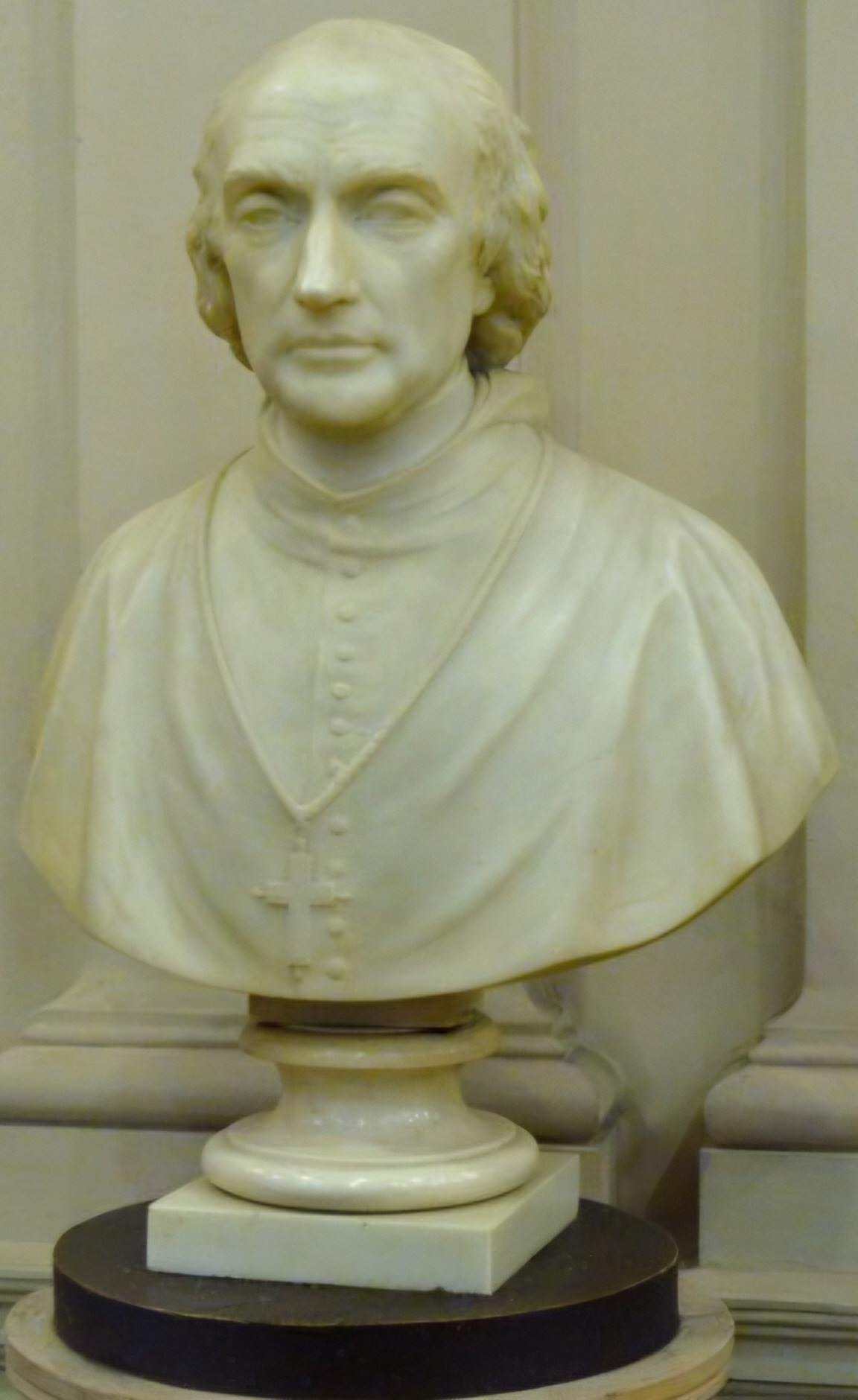
Cardinal Mezzofanti, in the library at Bologna. He is said to have used dozens of languages, with no recordings, no dictionaries worth the name for most of them, and no method beyond talking to whoever came through the city.Source: Unknown authorUnknown author — Public domain, Wikimedia Commons
The interesting question is not how good they were. It is how they did it, and which of the things they did survive contact with modern evidence.
This piece takes each method in turn, and checks it.
Schliemann and the method that fits on one page
Heinrich Schliemann (1822–1890), who excavated Troy, left in his memoirs a procedure so short it is almost startling. He summarised it as:
Read aloud a great deal. Never translate. One hour daily. Write essays on subjects of interest. Have them corrected by a teacher. Learn the corrected version by heart, and recite it at the next lesson.
He claimed that by this route he learned English in six months, memorising in the process the whole of Goldsmith’s The Vicar of Wakefield and Walter Scott’s Ivanhoe.
An honest note belongs immediately: Schliemann was a famous self-mythologiser. Historians have identified numerous points where his autobiography does not match the record, including matters concerning Troy. The six-month figure should be read as a claim by an interested party, not a datum.
The procedure itself, though, deserves examining piece by piece — because its two core components, reading aloud and memorising, both have modern support, in ways Schliemann could not have known.
Reading aloud: an old habit, new evidence
Reading aloud was near-universal among earlier polyglots. It was also the first thing modern methods discarded, because it looks naive.
It turns out not to be naive.
MacLeod and colleagues (2010) describe what they call the production effect: words read aloud are remembered substantially better than words read silently, even when both appear in the same list in the same session.
Ozubko and MacLeod (2010) traced the mechanism to distinctiveness. A spoken word acquires an extra memory trace — of the act of saying it and of hearing oneself say it — and that trace makes it stand out among the others.
So earlier learners were not reading aloud for want of better ideas. They were unknowingly exploiting a memory effect that would not be named for another century.
Kadota’s work (2019) on shadowing is the modern descendant of the same intuition: put the articulators to work rather than letting the eye skim.
Memorising whole texts: why it is less absurd than it sounds
Learning a whole novel by heart sounds like a monumental waste. If the goal is retaining the content, it is. But that is not what it does.
Alison Wray (2002) argued that a very large proportion of natural language is not assembled word by word from grammatical rules but retrieved whole from a store of formulaic sequences — strings that habitually travel together. Native speakers do not build every sentence from scratch; they fit prefabricated pieces together.
This is exactly what a foreign learner lacks, and it is why a grammatically correct sentence can still sound wrong.
Boers and colleagues (2006) tested this directly: learners taught to notice and retain formulaic sequences in their material were rated by judges as more fluent and more proficient speakers than learners working through the same material word by word.
Memorising a long text, in this frame, loads thousands of formulaic sequences at once — along with rhythm, word order and collocations that no dictionary lists.
So it is not absurd. But it is expensive: dozens of hours per text. The real question is not whether it works but whether it beats spending those hours reading widely.
Kató Lomb and her formula
Kató Lomb (1909–2003) was among the world’s first simultaneous interpreters, working in some sixteen languages. Her book Polyglot: How I Learn Languages is valuable because she set the method down plainly and self-critically.
How she began a new language runs almost opposite to every textbook:
She bought a dictionary and a novel — not a coursebook. She read the novel from the start, looking up almost nothing, accepting that she understood very little of the early chapters, and inferring from context. She wrote in the margins, and she wrote in the language early, mistakes included.
She also left a formula she offered half in jest:
Result = invested time × motivation ÷ inhibition.
The important term is the denominator. She held that what most obstructs adults is not poor memory but fear of error — and that most progress comes from shrinking the denominator rather than enlarging the numerator.
Her read-first-understand-later approach now has a name: extensive reading. Nakanishi’s meta-analysis (2015) found consistent positive effects on reading ability and vocabulary, and Elley’s book-flood work (1991) showed it outperforming conventional instruction at scale.
But there is one thing Lomb did that modern research would adjust. Nation (2006) puts the threshold for comfortable reading at about 98% known words. Lomb began far below that — and coped, because she had unusual motivation and an unusual tolerance for ambiguity. For most learners, starting at sixty per cent is a recipe for quitting. Graded readers exist precisely for that reason.
Richard Burton and the fifteen-minute rule
Richard Francis Burton (1821–1890), explorer and translator, described a fairly specific procedure: take a grammar and a word list, learn some three hundred words a week, read aloud, and — the most striking detail — never study for more than fifteen minutes at a stretch without a break.
He explained that after fifteen minutes the mind loses its edge and further study is wasted.
He could not have known that he had just approximately described one of the firmest conclusions in memory science.
The meta-analysis by Cepeda and colleagues (2006), across hundreds of experiments, confirms that the same total time split into short spaced sessions retains better than the same time massed.
And the most remarkable evidence for language learning comes from Bahrick and his family (1993). It is a rare study: four members of one family served as their own subjects, learning Spanish vocabulary at different review intervals — and tracked for nine years.
The finding: the longer the interval, the harder each review session felt, but the more vocabulary survived across years. Reviewing at 56-day intervals beat 14-day intervals substantially in the long run, despite feeling worse at the time.
Burton was right about chunking. He simply did not know why.
Mezzofanti and the problem of the numbers
Cardinal Giuseppe Mezzofanti (1774–1849) was credited by contemporaries with thirty-eight languages, some sources claiming more than sixty. Russell’s biography (1858) is the main source, and it is full of anecdotes of the kind where he converses fluently overnight in a language just begun.
This is where a serious honest note is needed.
Michael Erard, in Babel No More (2012), went back to the primary records on Mezzofanti and figures like him. Several parts of his conclusion are worth remembering.
First, the counts are almost always inflated — by contemporaries, by the press, and sometimes by the subject. Second, knowing a language is an elastic notion: reading a familiar religious text and arguing about politics are very different achievements, both counted as one. Third, when Erard located genuinely extraordinary multilinguals, he found they typically had a small core of genuinely strong languages and a long tail at reading level.
This applies equally close to home. Trương Vĩnh Ký (1837–1898) was a documented polyglot — he worked as an interpreter and compiled dictionaries, and sources put his languages at anywhere from fifteen to twenty-six. What is notable about him is not the number but the mechanism: he studied at the Penang seminary, where teaching happened in several languages at once among students from across South-East Asia. That is organised immersion, not pure genius.
The claim that he was ranked among the world’s eighteen great scholars is a modern legend that has never been traced to a verifiable source. It is not needed. What he actually did — the dictionaries, the translations, the popularising of the quốc ngữ script — is sufficient.
Michael West: the only one who did research
Of everyone here, the least famous left the most behind.
Michael West (1888–1973) was a British educator working in Bengal in the 1920s. He faced a practical problem: millions of pupils needing English, very few teaching hours, very few good teachers.
Rather than proposing a method, he measured. He surveyed what was actually achievable under those conditions and published in Bilingualism (1926) a conclusion that ran against policy: with limited resources, teach reading first and teach it thoroughly, because reading has the highest return per hour and is the skill pupils can actually use.
Then he did what nobody had done at that scale: he built graded readers on frequency principles, tightly controlling new words per page, so pupils could read continuously without stopping.
That work led to the General Service List (1953), some two thousand of the commonest English word families — the foundation of nearly every graded scheme since.
In other words: the graded reader in your child’s hands is a direct descendant of research done in Bengal a century ago. And it holds up — the coverage thresholds Nation (2006) established are the precise version of the intuition West already had.
The Army Method, and a lesson from a failure
Not every tradition survived, and one deserves mention for the opposite reason.
During the Second World War the US Army needed interpreters urgently and set up intensive language programmes. What emerged, through Charles Fries at Michigan, became the audiolingual method, dominant in language teaching through the 1950s and 1960s.
Its principles: drill sentence patterns to the point of reflex, correct errors instantly, never explain grammar. It rested on behaviourist psychology and the belief that language is a set of habits.
It declined for two reasons. Theoretically, the habit account of language collapsed. Practically, students became excellent at repeating patterns and still could not speak outside the classroom.
But something here surprises people. The meta-analysis by Norris and Ortega (2000), across the literature on instructional effectiveness, found that explicit grammar instruction outperformed implicit.
Which means the pendulum swung from grammar-translation to audiolingual to purely communicative teaching, and at each swing something valuable was thrown out. Explaining grammar — which audiolingualism forbade and which earlier polyglots did constantly — has evidence behind it.
An honest note: aptitude is real
It would be dishonest to present all this as though method were the only thing that mattered.
Language aptitude exists, is measurable, and predicts outcomes. Li’s meta-analysis (2015) across five decades found consistent associations between aptitude measures and second-language grammar acquisition. Doughty (2019) summarises its cognitive components: working memory, phonetic coding ability, and sensitivity to morphological patterning.
Skehan (1998) adds a useful point: aptitude is not one thing. Someone strong at sound processing and someone strong at pattern analysis learn differently, and the same method does not serve both equally.
So: the people in this article were probably biologically different, not merely more disciplined. That does not make their methods useless. It means their results should not be used as your yardstick.
Six things that still hold
One: read aloud. The production effect is real, free, and entirely neglected in modern self-study.
Two: chunk it, space it. Burton said fifteen minutes; Bahrick demonstrated that wider intervals produce more durable memory, however much worse they feel.
Three: memorise a little, not a lot. No need for a whole novel. But a few dozen dialogues or poems load formulaic sequences no dictionary teaches.
Four: write, get it corrected, then learn the corrected version. This is the central loop of Schliemann’s procedure, and it is retrieval with feedback — exactly what Roediger and Karpicke (2006) showed beats review.
Five: read widely, read early, tolerate ambiguity. This is Lomb’s contribution and the best-supported item here — with West’s and Nation’s correction about appropriate difficulty.
Six: allow grammar explanations. Norris and Ortega say they help. Keep them brief, and let them explain a sentence you just met.
Three things to leave behind
Drop sentence-by-sentence translation. Schliemann himself forbade it in his own procedure, and he was right — parallel translating keeps the learner inside the mother tongue.
Drop meaningless pattern drilling. This is where audiolingualism failed. Repetition earns its keep only when you understand and mean what you are repeating.
Drop counting languages. Erard showed the number is the least reliable part of any polyglot story. Three usable languages beat ten listable ones.
What they had that we do not
Once everything inflated has been subtracted, one real difference between them and us remains, and it is not method.
They had necessity. Burton learned languages to survive where he went. Trương Vĩnh Ký learned because the work demanded it. Lomb learned Russian during the war because she needed it. None of them studied because one ought to have another language.
They had uninterrupted time. A nineteenth-century evening was a continuous evening. Nothing in the pocket vibrated every four minutes.
Of the two, the first cannot be manufactured — though it can be approximated by attaching the language to something you genuinely want to do. The second is entirely within our control, and most of us choose otherwise.
That is probably the largest lesson from the earlier generation. Their methods, once checked, hold no mystery: read aloud, chunk it, read widely, write and be corrected, memorise a little, and let yourself understand the grammar.
What they had and we lack is not a secret technique. It is two uninterrupted hours and a reason.
Read the simple version
The same article, told in plain words — for younger readers, or for anyone who wants the point quickly.
Before apps, before cassettes, before decent dictionaries existed for most of the world's languages, people still learned ten and fifteen of them.
The interesting question is not how good they were. It is how they did it, and which of the things they did survive contact with modern evidence.
So let us take each method in turn, and check it.
Schliemann and the method that fits on one page
Heinrich Schliemann (1822–1890), who excavated Troy, left in his memoirs a procedure so short it is almost startling:
Read aloud a great deal. Never translate. One hour daily. Write essays on subjects of interest. Have them corrected by a teacher. Learn the corrected version by heart, and recite it at the next lesson.
He claimed that by this route he learned English in six months, memorising in the process the whole of Goldsmith's The Vicar of Wakefield and Walter Scott's Ivanhoe.
An honest note belongs immediately. Schliemann was a famous self-mythologiser. Historians have identified numerous points where his autobiography does not match the record, including matters concerning Troy. The six-month figure should be read as a claim by an interested party, not as a datum.
The procedure itself, though, deserves examining piece by piece — because its two core components, reading aloud and memorising, both have modern support, in ways Schliemann could not have known.
Reading aloud: an old habit, new evidence
Reading aloud was near-universal among earlier polyglots. It was also the first thing modern methods discarded, because it looks naive.
It turns out not to be naive.
MacLeod and colleagues (2010) describe what they call the production effect: words read aloud are remembered substantially better than words read silently, even when both appear in the same list in the same session.
Ozubko and MacLeod (2010) traced the mechanism to distinctiveness. A spoken word acquires an extra memory trace — of the act of saying it and of hearing oneself say it — and that trace makes it stand out among the others.
So earlier learners were not reading aloud for want of better ideas. They were unknowingly exploiting a memory effect that would not be named for another century.
Kadota's work (2019) on shadowing is the modern descendant of the same intuition: put the articulators to work rather than letting the eye skim.
Memorising whole texts: less absurd than it sounds
Learning a whole novel by heart sounds like a monumental waste. If the goal is retaining the content, it is. But that is not what it does.
Alison Wray (2002) argued that a very large proportion of natural language is not assembled word by word from grammatical rules but retrieved whole from a store of formulaic sequences — strings that habitually travel together. Native speakers do not build every sentence from scratch; they fit prefabricated pieces together.
This is exactly what a foreign learner lacks, and it is why a grammatically correct sentence can still sound wrong.
Boers and colleagues (2006) tested this directly: learners taught to notice and retain formulaic sequences in their material were rated by judges as more fluent and more proficient speakers than learners working through the same material word by word.
Memorising a long text, in this frame, loads thousands of formulaic sequences at once — along with rhythm, word order and collocations that no dictionary lists.
So it is not absurd. But it is expensive: dozens of hours per text. The real question is not whether it works but whether it beats spending those hours reading widely.
Kató Lomb and her formula
Kató Lomb (1909–2003) was among the world's first simultaneous interpreters, working in some sixteen languages. Her book Polyglot: How I Learn Languages is valuable because she set the method down plainly and self-critically.
How she began a new language runs almost opposite to every textbook. She bought a dictionary and a novel — not a coursebook. She read the novel from the start, looking up almost nothing, accepting that she understood very little of the early chapters, and inferring from context. She wrote in the margins, and she wrote in the language early, mistakes included.
She also left a formula she offered half in jest:
Result = invested time × motivation ÷ inhibition.
The important term is the denominator. She held that what most obstructs adults is not poor memory but fear of error — and that most progress comes from shrinking the denominator rather than enlarging the numerator.
Her read-first-understand-later approach now has a name: extensive reading. Nakanishi's meta-analysis (2015) found consistent positive effects on reading ability and vocabulary, and Elley's book-flood work (1991) showed it outperforming conventional instruction at scale.
But there is one thing Lomb did that modern research would adjust. Nation (2006) puts the threshold for comfortable reading at about 98% known words. Lomb began far below that — and coped, because she had unusual motivation and an unusual tolerance for ambiguity. For most learners, starting at sixty per cent is a recipe for quitting. Graded readers exist precisely for that reason.
Richard Burton and the fifteen-minute rule
Richard Francis Burton (1821–1890), explorer and translator, described a fairly specific procedure: take a grammar and a word list, learn some three hundred words a week, read aloud, and — the most striking detail — never study for more than fifteen minutes at a stretch without a break.
He explained that after fifteen minutes the mind loses its edge and further study is wasted.
He could not have known that he had just approximately described one of the firmest conclusions in memory science.
The meta-analysis by Cepeda and colleagues (2006), across hundreds of experiments, confirms that the same total time split into short spaced sessions retains better than the same time massed.
And the most remarkable evidence for language learning comes from Bahrick and his family (1993). It is a rare study: four members of one family served as their own subjects, learning Spanish vocabulary at different review intervals — and were tracked for nine years.
The finding: the longer the interval, the harder each review session felt, but the more vocabulary survived across years. Reviewing at 56-day intervals beat 14-day intervals substantially in the long run, despite feeling worse at the time.
Burton was right about chunking. He simply did not know why.
Mezzofanti and the problem of the numbers
Cardinal Giuseppe Mezzofanti (1774–1849) was credited by contemporaries with thirty-eight languages, some sources claiming more than sixty. Russell's biography (1858) is the main source, and it is full of anecdotes of the kind where he converses fluently overnight in a language just begun.
This is where a serious honest note is needed.
Michael Erard, in Babel No More (2012), went back to the primary records on Mezzofanti and figures like him. Several parts of his conclusion are worth remembering.
First, the counts are almost always inflated — by contemporaries, by the press, and sometimes by the subject. Second, knowing a language is an elastic notion: reading a familiar religious text and arguing about politics are very different achievements, both counted as one. Third, when Erard located genuinely extraordinary multilinguals, he found they typically had a small core of genuinely strong languages and a long tail at reading level.
This applies equally close to home. Trương Vĩnh Ký (1837–1898) was a documented polyglot — he worked as an interpreter and compiled dictionaries, and sources put his languages at anywhere from fifteen to twenty-six. What is notable about him is not the number but the mechanism: he studied at the Penang seminary, where teaching happened in several languages at once among students from across South-East Asia. That is organised immersion, not pure genius.
The claim that he was ranked among the world's eighteen great scholars is a modern legend that has never been traced to a verifiable source. It is not needed. What he actually did — the dictionaries, the translations, the popularising of the quốc ngữ script — is sufficient.
Michael West: the only one who did research
Of everyone here, the least famous left the most behind.
Michael West (1888–1973) was a British educator working in Bengal in the 1920s. He faced a practical problem: millions of pupils needing English, very few teaching hours, very few good teachers.
Rather than proposing a method, he measured. He surveyed what was actually achievable under those conditions and published in Bilingualism (1926) a conclusion that ran against policy: with limited resources, teach reading first and teach it thoroughly, because reading has the highest return per hour and is the skill pupils can actually use.
Then he did what nobody had done at that scale: he built graded readers on frequency principles, tightly controlling new words per page, so pupils could read continuously without stopping.
That work led to the General Service List (1953), some two thousand of the commonest English word families — the foundation of nearly every graded scheme since.
In other words: the graded reader in your child's hands is a direct descendant of research done in Bengal a century ago. And it holds up — the coverage thresholds Nation (2006) established are the precise version of the intuition West already had.
The Army Method, and a lesson from a failure
Not every tradition survived, and one deserves mention for the opposite reason.
During the Second World War the US Army needed interpreters urgently and set up intensive language programmes. What emerged, through Charles Fries at Michigan, became the audiolingual method, dominant in language teaching through the 1950s and 1960s.
Its principles: drill sentence patterns to the point of reflex, correct errors instantly, never explain grammar. It rested on behaviourist psychology and the belief that language is a set of habits.
It declined for two reasons. Theoretically, the habit account of language collapsed. Practically, students became excellent at repeating patterns and still could not speak outside the classroom.
But something here surprises people. The meta-analysis by Norris and Ortega (2000), across the literature on instructional effectiveness, found that explicit grammar instruction outperformed implicit.
Which means the pendulum swung from grammar-translation to audiolingual to purely communicative teaching, and at each swing something valuable was thrown out. Explaining grammar — which audiolingualism forbade and which earlier polyglots did constantly — has evidence behind it.
An honest note: aptitude is real
It would be dishonest to present all this as though method were the only thing that mattered.
Language aptitude exists, is measurable, and predicts outcomes. Li's meta-analysis (2015) across five decades found consistent associations between aptitude measures and second-language grammar acquisition. Doughty (2019) summarises its cognitive components: working memory, phonetic coding ability, and sensitivity to morphological patterning.
Skehan (1998) adds a useful point: aptitude is not one thing. Someone strong at sound processing and someone strong at pattern analysis learn differently, and the same method does not serve both equally.
So: the people in this article were probably biologically different, not merely more disciplined. That does not make their methods useless. It means their results should not be used as your yardstick.
Six things that still hold
One: read aloud. The production effect is real, free, and entirely neglected in modern self-study.
Two: chunk it, space it. Burton said fifteen minutes; Bahrick demonstrated that wider intervals produce more durable memory, however much worse they feel.
Three: memorise a little, not a lot. No need for a whole novel. But a few dozen dialogues or poems load formulaic sequences no dictionary teaches.
Four: write, get it corrected, then learn the corrected version. This is the central loop of Schliemann's procedure, and it is retrieval with feedback — exactly what Roediger and Karpicke (2006) showed beats review.
Five: read widely, read early, tolerate ambiguity. Lomb's contribution, and the best-supported item here — with West's and Nation's correction about appropriate difficulty.
Six: allow grammar explanations. Norris and Ortega say they help. Keep them brief, and let them explain a sentence you just met.
Three things to leave behind
Sentence-by-sentence translation. Schliemann himself forbade it in his own procedure, and he was right — parallel translating keeps the learner inside the mother tongue.
Meaningless pattern drilling. This is where audiolingualism failed. Repetition earns its keep only when you understand and mean what you are repeating.
Counting languages. Erard showed the number is the least reliable part of any polyglot story. Three usable languages beat ten listable ones.
What they had that we do not
Once everything inflated has been subtracted, one real difference between them and us remains, and it is not method.
They had necessity. Burton learned languages to survive where he went. Trương Vĩnh Ký learned because the work demanded it. Lomb learned Russian during the war because she needed it. None of them studied because one ought to have another language.
They had uninterrupted time. A nineteenth-century evening was a continuous evening. Nothing in the pocket vibrated every four minutes.
Of the two, the first cannot be manufactured — though it can be approximated by attaching the language to something you genuinely want to do. The second is entirely within our control, and most of us choose otherwise.
That is probably the largest lesson from the earlier generation. Their methods, once checked, hold no mystery: read aloud, chunk it, read widely, write and be corrected, memorise a little, and let yourself understand the grammar.
What they had and we lack is not a secret technique. It is two uninterrupted hours and a reason.
Sources & further reading
These articles summarize well-established research in learning science and linguistics. Key sources and further reading:
Lomb, K. (2008). Polyglot: How I Learn Languages (Á. Szegi & K. DeKorne, Trans.). Berkeley: TESL-EJ Publications. (Original work published 1970.)
Russell, C. W. (1858). The Life of Cardinal Mezzofanti. London: Longman, Brown, Green, Longmans & Roberts.
Erard, M. (2012). Babel No More: The Search for the World’s Most Extraordinary Language Learners. New York: Free Press.
MacLeod, C. M., Gopie, N., Hourihan, K. L., Neary, K. R., & Ozubko, J. D. (2010). The production effect: Delineation of a phenomenon. Journal of Experimental Psychology: Learning, Memory, and Cognition, 36(3), 671–685.
Ozubko, J. D., & MacLeod, C. M. (2010). The production effect in memory: Evidence that distinctiveness underlies the benefit. Journal of Experimental Psychology: Learning, Memory, and Cognition, 36(6), 1543–1547.
Wray, A. (2002). Formulaic Language and the Lexicon. Cambridge: Cambridge University Press.
Boers, F., Eyckmans, J., Kappel, J., Stengers, H., & Demecheleer, M. (2006). Formulaic sequences and perceived oral proficiency: Putting a lexical approach to the test. Language Teaching Research, 10(3), 245–261.
Bahrick, H. P., Bahrick, L. E., Bahrick, A. S., & Bahrick, P. E. (1993). Maintenance of foreign language vocabulary and the spacing effect. Psychological Science, 4(5), 316–321.
Cepeda, N. J., Pashler, H., Vul, E., Wixted, J. T., & Rohrer, D. (2006). Distributed practice in verbal recall tasks: A review and quantitative synthesis. Psychological Bulletin, 132(3), 354–380.
Roediger, H. L., & Karpicke, J. D. (2006). Test-enhanced learning: Taking memory tests improves long-term retention. Psychological Science, 17(3), 249–255.
West, M. (1926). Bilingualism (with Special Reference to Bengal). Calcutta: Bureau of Education, India.
West, M. (1953). A General Service List of English Words. London: Longman, Green & Co.
Nation, I. S. P. (2006). How large a vocabulary is needed for reading and listening? Canadian Modern Language Review, 63(1), 59–82.
Nakanishi, T. (2015). A meta-analysis of extensive reading research. TESOL Quarterly, 49(1), 6–37.
Elley, W. B. (1991). Acquiring literacy in a second language: The effect of book-based programs. Language Learning, 41(3), 375–411.
Norris, J. M., & Ortega, L. (2000). Effectiveness of L2 instruction: A research synthesis and quantitative meta-analysis. Language Learning, 50(3), 417–528.
Li, S. (2015). The associations between language aptitude and second language grammar acquisition: A meta-analytic review of five decades of research. Applied Linguistics, 36(3), 385–408.
Doughty, C. J. (2019). Cognitive language aptitude. Language Learning, 69(S1), 101–126.
Skehan, P. (1998). A Cognitive Approach to Language Learning. Oxford: Oxford University Press.
Kadota, S. (2019). Shadowing as a Practice in Second Language Acquisition: Connecting Inputs and Outputs. London: Routledge.