Most learners carry a model in which each language is a sealed box, and each box only counts once filled to native level. Neither half of that model describes how language actually sits in a person. This piece sets out plurilingualism as the Council of Europe defines it, why a lopsided profile is the ordinary shape of a repertoire rather than evidence of failure, and what that changes about how you set a target.
Most learners hesitate, then produce a number wrapped in apologies. English is okay. I did three years of Chinese but I've forgotten most of it. French I can only read, I can't speak it.
Notice the shape of that answer. It assumes each language is a separate box, and each box either counts or does not. Everything in between gets reported as a failure.
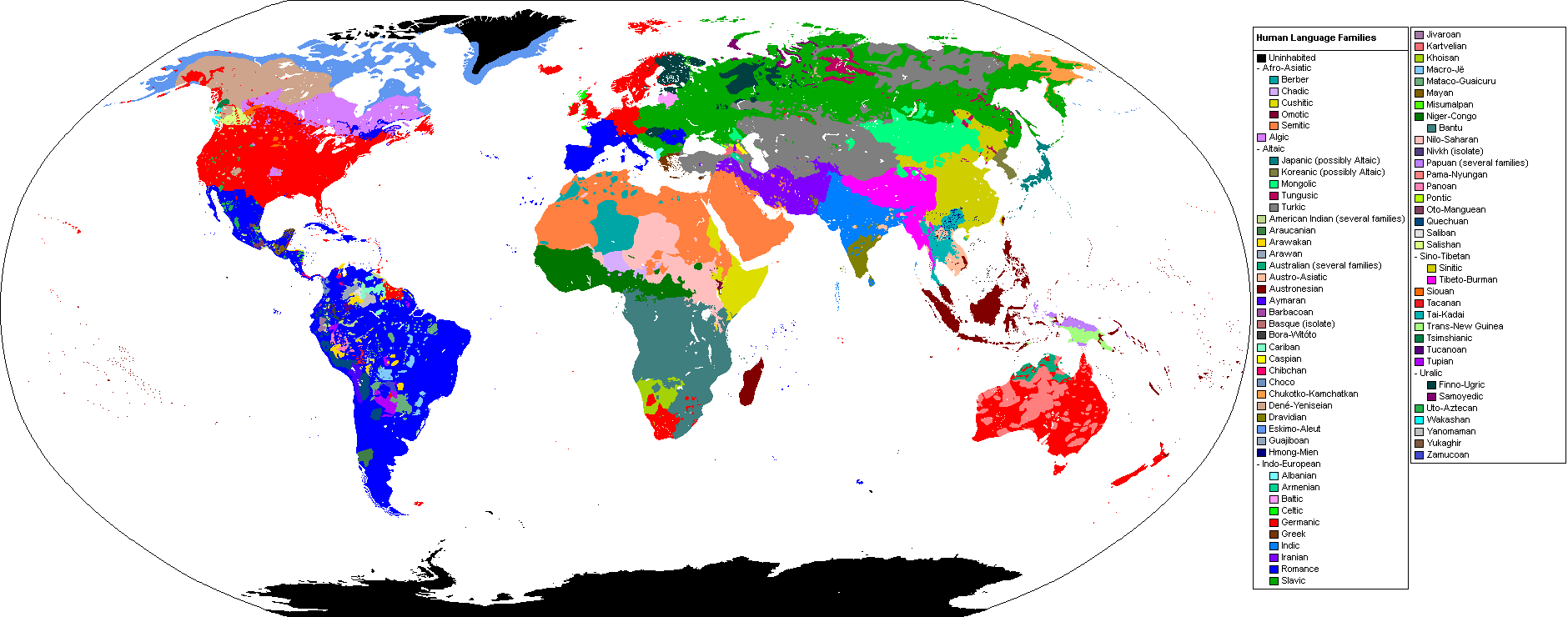
The world by language family. Nothing on this map has an edge where a person stops speaking one thing and starts another — the boundaries are drawn by cartographers, and the boxes we sort our own languages into are drawn the same way.Source: Industrius at English Wikipedia.
Later version(s) were uploaded by Mttll at English Wikipedia. — CC BY-SA 3.0, Wikimedia Commons
Neither assumption describes how language actually sits in a person. And between them they cause a great many learners to undervalue what they already have.
Two words that are not synonyms
The Council of Europe draws a distinction that English usually collapses.
Multilingualism is the coexistence of several languages in a space — a city, a country, a school. It is a fact about geography and policy.
Plurilingualism is the developing linguistic repertoire inside one person. It is a fact about competence.
The difference sounds terminological; the consequences are not. A country can have four official languages while each of its citizens speaks one. Conversely, a person can carry five languages at five different levels while living in an entirely monolingual town.
One repertoire, not compartments
This is the core claim, and the framework states it outright: as a person's experience of language broadens, they do not keep those languages and cultures in strictly separated mental compartments. They build a communicative competence to which all knowledge and experience of language contributes, and in which the languages interrelate and interact.
Daniel Coste, Danièle Moore and Geneviève Zarate, whose preparatory work for the framework laid the foundation, put it more sharply: this is a complex or even composite competence, not a superposition or juxtaposition of distinct competences.
What does that mean in practice? It means your English helps you guess at Spanish. It means having once wrestled with Chinese tones leaves your ear better prepared for Thai. It means the experience of learning one hard language teaches you how to learn a hard language — a real capability, even though no certificate records it.
The bilingual is not two monolinguals
François Grosjean made this argument in 1989, and the way he framed it still does work.
He described two views. The fractional view treats a bilingual as two monolinguals in one body — and so measures them twice against a monolingual yardstick. By that measure, essentially every bilingual on earth comes up short on both sides.
The wholistic view holds that the coexistence of two languages has produced a unique and specific speaker-hearer. Not two imperfect copies, but a different configuration.
Bilinguals use their languages for different purposes, with different people, in different domains. Demanding that they be equally good at everything in both is demanding something their actual lives never asked of them.
An L2 user is not a defective monolingual
Vivian Cook took this further with multi-competence. In 1992 he identified a monolingual bias running through second language research: L2 users described as deficient monolinguals rather than as people in their own right.
And he made a point learners rarely consider: learning a second language changes the first one too. L2 users differ from monolingual native speakers not only in their new language but in their first, and in some of their cognitive processes.
You are not a monolingual plus a partial English. You are a different configuration — and measured with a monolingual ruler, that configuration will always read as a shortfall.
Partial competence is competence
This is the most useful practical consequence, and the most comfortable to hear.
The plurilingual approach assumes that competence across the languages of a repertoire is variable and partial: mastery of the different language activities may be unbalanced, favouring some and disfavouring others.
Read that again and notice what it does not say. It does not say the imbalance is a temporary stage to be corrected. It says the imbalance is the normal shape of a repertoire.
Someone who reads German scientific papers but cannot order lunch has not failed to finish German. They have a profile with a shape, fitted to a purpose. It may be exactly the profile they need. And if it is not, they know precisely which side to build on.
The trouble with the native-speaker standard
In 1999 Cook argued that language teaching would benefit from centring the L2 user rather than treating the native speaker as the only standard.
The reason is not indulgence. It is that the standard is descriptively wrong: L2 users differ from monolingual native speakers in many respects, so measuring them as unfinished versions of native speakers is measuring the wrong thing.
It is also practically wrong. Most conversations in English worldwide now happen between people who are not native speakers — a fact that produced an entire research literature on English as a lingua franca, associated with Jennifer Jenkins and Barbara Seidlhofer. The useful standard in that setting is mutual intelligibility, not resemblance to someone born in Kent.
Using the whole repertoire
If the languages share one repertoire, then drawing on several at once is not contamination — it is how the repertoire works.
Ofelia García and Li Wei call this translanguaging: multilinguals drawing on their full repertoire to make meaning, rather than switching between sealed systems. A student who reads the source in English, argues about it in Vietnamese, then writes in English is not being sloppy. They are using what they have.
For a self-directed learner the implication is concrete: do not feel guilty about looking a word up through your strongest language, taking notes in your first language, or bridging from one language to another. That is not cheating. It is how a repertoire grows.
What this changes about setting a target
Ask for what before to what level.Get good at Japanese has no shape. Read manga without hitting the dictionary more than five times a page has one, and you will know when you arrive.
Permit a lopsided profile. If you need reading, pour it into reading. Speaking lagging behind is not a debt; it is an allocation.
Count the unfinished things. Three years of Chinese mostly forgotten is not zero. It is the characters you still recognise, the tones your ear still hears, the sentence shapes that no longer look alien. Restarting from there is far quicker than starting from nothing.
Change the comparison. Not how far am I from a native speaker but what can I do today that I could not do last year. The first question has one fixed answer — a long way — for almost everyone, forever.
Some honest limits
Language pluralism is not a licence for vagueness, and it is worth saying so plainly.
It changes the shape of the target; it does not abolish standards. Intelligibility still matters — if your listener does not understand you, communication has failed, and no framework rescues that. Register still matters: a job application written in text-message voice is still a mistake. And if you need a certificate, the exam has its own scale and will not be interested in your overall repertoire.
Translanguaging as a classroom pedagogy is itself still argued over among researchers — where it belongs, how much of it, and in which settings it may hinder rather than help.
What survives all the caveats is still worth having: you are not filling a row of empty boxes, each counting only when full. You are building a single repertoire whose parts feed one another, and which is useful at every stage of completeness — including the stages every certificate calls insufficient.
Read the simple version
The same article, told in plain words — for younger readers, or for anyone who wants the point quickly.
Try a question. How many languages do you know?
Most learners hesitate, then produce a number wrapped in apologies. English is okay. I did three years of Chinese but I've forgotten most of it. French I can only read, I can't speak it.
Notice the shape of that answer. It assumes each language is a separate box, and each box either counts or does not. Everything in between gets reported as a failure.
Neither assumption describes how language actually sits in a person.
One repertoire, not compartments
Here is the core claim: as your experience of language broadens, you do not keep those languages in strictly separated mental compartments. You build one communicative ability to which every language you have met contributes, and inside which they interact.
What does that mean in practice?
Your English helps you guess at Spanish.
Having once wrestled with Chinese tones leaves your ear better prepared for Thai.
The experience of learning one hard language teaches you how to learn a hard language — a real capability, even though no certificate records it.
A bilingual is not two monolinguals
There are two ways to see a person who speaks two languages.
The first treats them as two monolinguals in one body — and so measures them twice against a native speaker, and finds them wanting twice.
The second sees a single speaker with one integrated ability, who uses different languages for different parts of life and is therefore not expected to be identical to a monolingual in either.
The first view is why so many capable people describe themselves as bad at languages.
What follows
Permit a lopsided profile. If you need reading, pour it into reading. Speaking lagging behind is not a debt; it is an allocation.
Count the unfinished things. Three years of Chinese mostly forgotten is not zero. It is the characters you still recognise, the tones your ear still hears, the sentence shapes that no longer look alien. Restarting from there is far quicker than starting from nothing.
Change the comparison. Not how far am I from a native speaker but what can I do today that I could not do last year. The first question has one fixed answer — a long way — for almost everyone, forever.
Some honest limits
This is not a licence for vagueness, and it is worth saying so plainly.
It changes the shape of the target; it does not abolish standards. Being understood still matters — if your listener does not follow you, communication has failed, and no framework rescues that. Register still matters: a job application written in text-message voice is still a mistake. And if you need a certificate, the exam has its own scale and will not be interested in your overall repertoire.
What survives all the caveats is still worth having:
You are not filling a row of empty boxes, each counting only when full. You are building a single repertoire whose parts feed one another — and which is useful at every stage of incompleteness, including the stages every certificate calls insufficient.
Sources & further reading
These articles summarize well-established research in learning science and linguistics. Key sources and further reading:
Council of Europe (2001). Common European Framework of Reference for Languages: Learning, Teaching, Assessment. Cambridge: Cambridge University Press — plurilingualism is distinguished from multilingualism: the languages of a repertoire are not kept "in strictly separated mental compartments".
Council of Europe (2020). Common European Framework of Reference for Languages: Companion Volume. Strasbourg: Council of Europe Publishing — descriptors for plurilingual and pluricultural competence.
Coste, D., Moore, D., & Zarate, G. (1997/2009). Plurilingual and Pluricultural Competence: Studies Towards a Common European Framework of Reference for Language Learning and Teaching. Strasbourg: Council of Europe — a "complex or even composite competence", not a juxtaposition of distinct competences.
Grosjean, F. (1989). Neurolinguists, beware! The bilingual is not two monolinguals in one person. Brain and Language, 36(1), 3–15.
Cook, V. (1992). Evidence for multicompetence. Language Learning, 42(4), 557–591.
Cook, V. (1999). Going beyond the native speaker in language teaching. TESOL Quarterly, 33(2), 185–209.
García, O., & Wei, L. (2014). Translanguaging: Language, Bilingualism and Education. Basingstoke: Palgrave Macmillan.
Jenkins, J. (2015). Global Englishes: A Resource Book for Students (3rd ed.). London: Routledge.
Seidlhofer, B. (2011). Understanding English as a Lingua Franca. Oxford: Oxford University Press.