Every method of teaching a language was built for a different job
Grammar-translation, audio-lingual, communicative, apps: four approaches compared as though they chased the same goal. They never chased the same goal.
Grammar-translation, audio-lingual, communicative, apps: four approaches compared as though they chased the same goal. They never chased the same goal.
The argument is usually staged as two camps: copying out words, memorising rules and conjugating verbs on one side; phone apps, conversation and unsubtitled films on the other. But setting the approaches against each other that way quietly assumes they are chasing the same goal. They never were. Each was built to solve a very specific problem of its own time, and knowing what that problem was makes choosing between them far easier.
The oldest of them was inherited directly from how Latin and ancient Greek were taught in nineteenth-century Europe: learn the tables, translate sentences, then translate texts. The goal was perfectly clear — to read the original. Nobody expected a pupil to speak Latin, for the simple reason that there was no one left to speak it with.
So faulting it for not producing speakers is like faulting a hammer for turning screws badly. What it genuinely does still holds its value: for a literate adult, stating the rule out loud is a real shortcut. Explaining the six Russian cases in ten minutes beats leaving a learner to infer them across two hundred hours of listening.
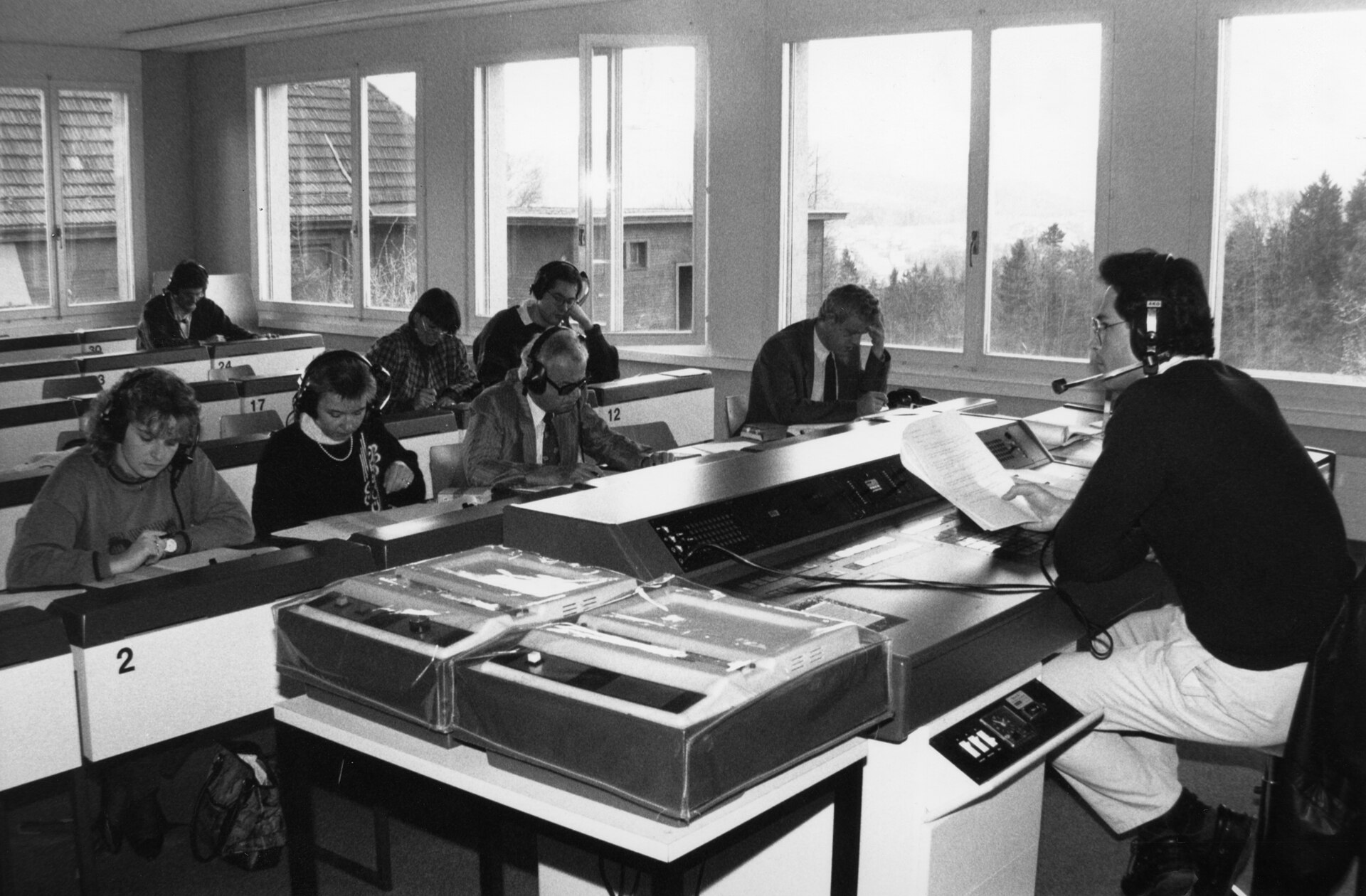
The second approach has a precise date of birth. During the Second World War the US Army needed officers with usable Japanese, German and Chinese in months rather than years. The programme built for that need married two theories then in fashion: behaviourist psychology, which treated language as a chain of habits, and structural linguistics. The result was drilling sentence patterns to reflex, with translation and explanation both forbidden.
In 1959 Chomsky reviewed Skinner's book and put his finger on the crack: people say sentences they have never heard anyone say, and a chain of habits cannot do that. The theoretical floor gave way. But the drill room outlived the theory that built it — it was still running into the 1990s.
It lasted because part of it was right. Drilling to automaticity is real, especially for pronunciation and set phrases. The failure lay elsewhere: a student could drill a hundred patterns perfectly and still not produce the hundred and first.
In the 1970s the Council of Europe faced an entirely different problem: workers moving between countries who needed to get things done in a language, not pass an examination in it. Dell Hymes gave the field communicative competence — knowing the rules is not enough, you also have to know what to say, to whom, when and in what register. So the communicative approach put conveying meaning above being correct.
It is now the default nearly everywhere, and it has earned that place by dragging use to the centre. But it has its own failure, and an easily visible one: learners who speak fluently and stay wrong, year after year. Once communication is getting through, nothing is left to force a correction.
The fourth approach is the phone app, and this is where the word modern misleads most. Their central mechanism — spaced repetition — dates from 1885, when Ebbinghaus measured the curve of his own forgetting. Its concrete form was built by Sebastian Leitner in 1972: a box of five compartments, where a card you remember moves back one compartment and a card you forget returns straight to the first. Today's app is that box plus a reminder.
And it goes further back still. In 1658 Comenius printed the first illustrated schoolbook for children, teaching Latin through pictures and meaning instead of tables. That is precisely the principle the field would name content-based learning three centuries later.

In other words, modern mostly describes the delivery, not the idea. The card box became an app; the woodcut became a video clip.
Three things are, and they deserve to be named properly. First, the sheer quantity of real input available: someone learning Russian in Hanoi in 1990 might reach a few hours of authentic Russian a month, where now there is no ceiling at all. That is a real break, not a rebranding. Second, instant feedback at scale. Third, a machine that will talk back — and about the third, honesty requires saying the evidence is thin and very recent.
What the research converges on is not a blend ratio between old and new. It has its own name: attention to form inside real use. You are doing something genuine in the language, you snag on a point, you stop for a very short beat to look at the rule governing exactly that point, and then you return to what you were doing.

And here is the honest part: when it is measured, this comes out roughly level with teaching a catalogue of rules in textbook order, not clearly ahead of it. Its advantage is not in the figures but in whether people stay with it — sitting with one rule while genuinely snagged on it is far easier than sitting in front of thirty rules laid out in advance.
The practical way to choose, then, is to drop the old-versus-new axis and divide by the nature of what you are learning. Anything rule-shaped that you meet rarely, learn as a rule — exactly what grammar-translation still does well. Anything you meet many times a day, let the input teach. And anything you will have to produce must be practised at the moment of producing it, under time pressure — which is where the audio-lingual approach keeps the part of it that was right.
About the apps, it is worth being blunt: what they optimise is not learning a language but sustaining a habit. That is a genuine contribution, because most learners quit rather than study wrongly. But keeping a habit and teaching are two different jobs, and confusing them is where many people come unstuck.
In the end the question worth asking is not whether a method is old or new, but what job it was built to do, and whether that job is your job today.
The same article, told in plain words — for younger readers, or for anyone who wants the point quickly.
Picture four classrooms, from four different times.
The first is in Europe more than a hundred years ago. Pupils copy out Latin verb tables and translate sentences one by one. The goal is plain: to read old books. Nobody plans to speak Latin, because there is nobody left to speak it with.
So blaming that classroom for not teaching speech is a bit unfair. It never set out to.
The second was born in the Second World War. The US Army needed officers speaking Japanese within months. The method was to repeat sentence patterns until they came out as reflexes. No translating. No explaining.
In 1959 a linguist named Chomsky pointed out the flaw: people say sentences they have never heard anyone say. If language were only repeated habit, that could not happen.
The theory collapsed. But those tape-deck practice rooms kept running for another thirty years, because part of it was true: drill enough and pronunciation and set phrases do become automatic. The trouble was that a student who knew a hundred patterns by heart still could not produce the hundred and first.
The third is Europe in the 1970s. People were working across borders and needed a language to get things done, not to pass a test. So teaching changed: being understood mattered more than being correct.
This is the most common approach today. It has its own flaw, though: plenty of people speak fluently and stay wrong for years. Once the listener understands you, nothing makes you fix anything.
The fourth is the app on your phone. And here is the surprise.
That app runs on spaced repetition, a principle that dates from 1885. Its actual shape was built by a German named Leitner in 1972: a box with five compartments full of paper cards. A card you remember moves back a compartment; a card you forget goes to the front.
Today's app is that box, plus a bell to remind you.
Further back still: in 1658 somebody printed a Latin book for children taught through pictures instead of rule tables. It took three hundred years for the field to give that a name.
In other words, modern usually describes the packaging, not the idea inside it.
So is anything genuinely new? Yes. Once, hearing real Russian meant a couple of hours a month. Now there is as much as you want. That is a real change.
As for the best way to study, researchers name it like this: while you are using the language, when you snag on something, stop and look at the rule for that exact thing, then carry on. Like a master craftsman pointing at one spot while the apprentice is stuck, then stepping back.
Honestly, when it is measured this comes out level with memorising a list of rules, not ahead of it. Its advantage is that people stay with it longer.
So do not ask which method is old and which is new. Ask what kind of thing you are learning. A strange rule you meet rarely — learn it as a rule. Something you meet every day — read and listen a lot and let it soak in. Something you will have to say out loud — practise saying it, while someone is waiting.
And the app is good at a different job entirely: getting you to come back tomorrow. That is genuinely useful, because most learners fail by stopping, not by studying wrongly.
These articles summarize well-established research in learning science and linguistics. Key sources and further reading:
The question assumes focus is a muscle you train. The strongest evidence says the training barely carries over, and the...
No time, no talent, too old — those are explanations, not causes. What can be measured is duller: one sentence with a ti...
Not one event but four, running on clocks a billion-fold apart: a wave at 400 milliseconds, a word locked in overnight,...


