What does it actually mean to be good at a language?
The question how good is your English assumes a single scale exists. It does not. This piece takes the notion apart into components that genuinely separate, explains how three people can disagree about one speaker and all be right, and proposes a different question to ask instead.
Try a small experiment. Think of someone you consider good at English. Then ask: good in what way?
They might speak fluently and write full of errors. They might write precisely and hesitate when speaking. They might read technical material and fail to follow a phone call. They might have an IELTS 8.0 and nothing to say at a party.
All four could be called good at English, and they resemble each other in no important respect.
That is the sign the title question is broken from the start — it presupposes one scale. This piece takes it apart, then proposes a different question.
Not one competence but several separable ones
The foundational work of Canale and Swain (1980) is where applied linguistics formally abandoned the idea of a single competence. They split knowing a language into distinct components:
Sociolinguistic competence — knowing what is appropriate to whom, in which situation. Knowing when a grammatical sentence is still the wrong sentence.
Discourse competence — joining sentences into coherent stretches, holding a topic, using connectives properly.
Strategic competence — what you do when you lack the word you need. Paraphrasing, asking for repetition, rerouting.
Bachman (1990) and then Bachman and Palmer (1996) refined this into the framework used in modern language testing, separating organisational competence (grammatical and textual) from pragmatic competence (what you do with words, and how appropriately).
The point is not the list. The point is that these components are separable: a person can be very strong in one and very weak in another, and that happens constantly.
Strategic competence deserves particular notice, because it is the least taught and makes the largest difference to how a listener perceives you. Someone with two thousand words who can talk around a gap will be judged better than someone with six thousand who falls silent every time they hit one.
Why three people can disagree and all be right
Another framework explains this even more compactly.
Skehan (1998) proposed that language production is judged along three dimensions that trade off against each other — usually shortened to CAF:
Complexity — how rich the structures and vocabulary are.
Accuracy — how many errors you make.
Fluency — how smoothly and quickly you speak.
Skehan’s central claim is that you cannot maximise all three at once, because attention is finite. Aim for accuracy and you slow down. Aim for fluency and you simplify. Reach for complex structures and you make more errors.
Housen and Kuiken (2009) reviewed this line of work and showed the relationships between the three shift with task, level and time conditions.
Now return to the person at the top. Three observers can look at three different dimensions and reach three different verdicts, and none of them is wrong. The teacher notices accuracy. The colleague notices fluency. The writing examiner notices complexity.
Good usually means strong on whichever dimension the judge happened to be attending to.
The native speaker is not a yardstick
The default measure in most learners’ heads is a native speaker. There is an argument here worth reading carefully.
Vivian Cook (1999) argued that measuring second-language users against native speakers is a conceptual error, not merely a harsh standard. The reason is multicompetence: a person who knows two languages is not two monolinguals in one head. The two systems influence each other, and even the first language changes. They are a different kind of language user, not a failed native speaker.
Cook (2002) collected work on L2 users along those lines, and Davies (2003) went further, showing that the notion of native speaker is itself blurrier than assumed: it conflates order of acquisition, identity, and proficiency — three things that need not travel together.
There is a practical consequence worth stating: if the yardstick is the native speaker, then every learner fails permanently by definition. That is a bad measure — not because it is strict, but because it tells you nothing useful.
Accent is not the problem — if you are understood
Here the evidence is unusually clear and unusually little known.
Munro and Derwing (1995) separated three things people habitually collapse into one:
Accentedness — how different from a native speaker it sounds.
Perceived comprehensibility — how much effort the listener feels they are making.
Actual intelligibility — how much the listener genuinely understands.
The key result: these correlate only partially. Speakers with heavy accents were sometimes understood almost perfectly. Accent and communicative success are not the same variable.
Derwing and Munro (2009) reviewed two further decades and concluded that treating accent as a communication barrier is largely an untested assumption — whereas speech rate, prosody and word stress do have real effects.
Levis (2005) named the two positions: the nativeness principle and the intelligibility principle. The first makes the goal accent elimination; the second makes it being understood. He argued only the second is empirically grounded and achievable.
For a Vietnamese learner this means something concrete: final consonants and clusters are worth drilling, because losing them causes real misunderstanding. Sounding American is not worth the investment.
Most English in the world has no native speaker in it
One statistical fact reframes the whole question.
The majority of English conversations happening in the world today take place between non-native speakers. A Vietnamese engineer with a Korean client. A meeting with Germans, Indians and Brazilians in it.
Jenkins (2000) studied exactly this setting and proposed what she called the Lingua Franca Core: the set of pronunciation features genuinely necessary for non-natives to understand each other. The striking finding is that this list does not match the list of things that make you sound native. Some items drilled hard in classrooms — the th sounds among them — turn out to matter little for mutual understanding, while others matter a great deal more.
Seidlhofer (2011) extended the argument beyond pronunciation: English as a lingua franca is developing its own norms, and they are not necessarily British or American ones.
The consequence: if you are learning English for international work, you are optimising for a situation in which no native speaker is in the room. Measuring yourself against a native yardstick there is measuring the wrong thing.
What the CEFR says — and does not
The Common European Framework is the best available tool for this question, and it also needs its limits understood.
What it does well: it describes level in can-do statements rather than scores. Not three thousand words but can describe experiences and events and give reasons for an opinion. North (2014) sets out how the framework was built and how it should be used. The Council of Europe’s Companion Volume (2020) adds scales for mediation, online interaction and plurilingual competence — precisely the things the older model omitted.
What the CEFR does not say, though many assume it does:
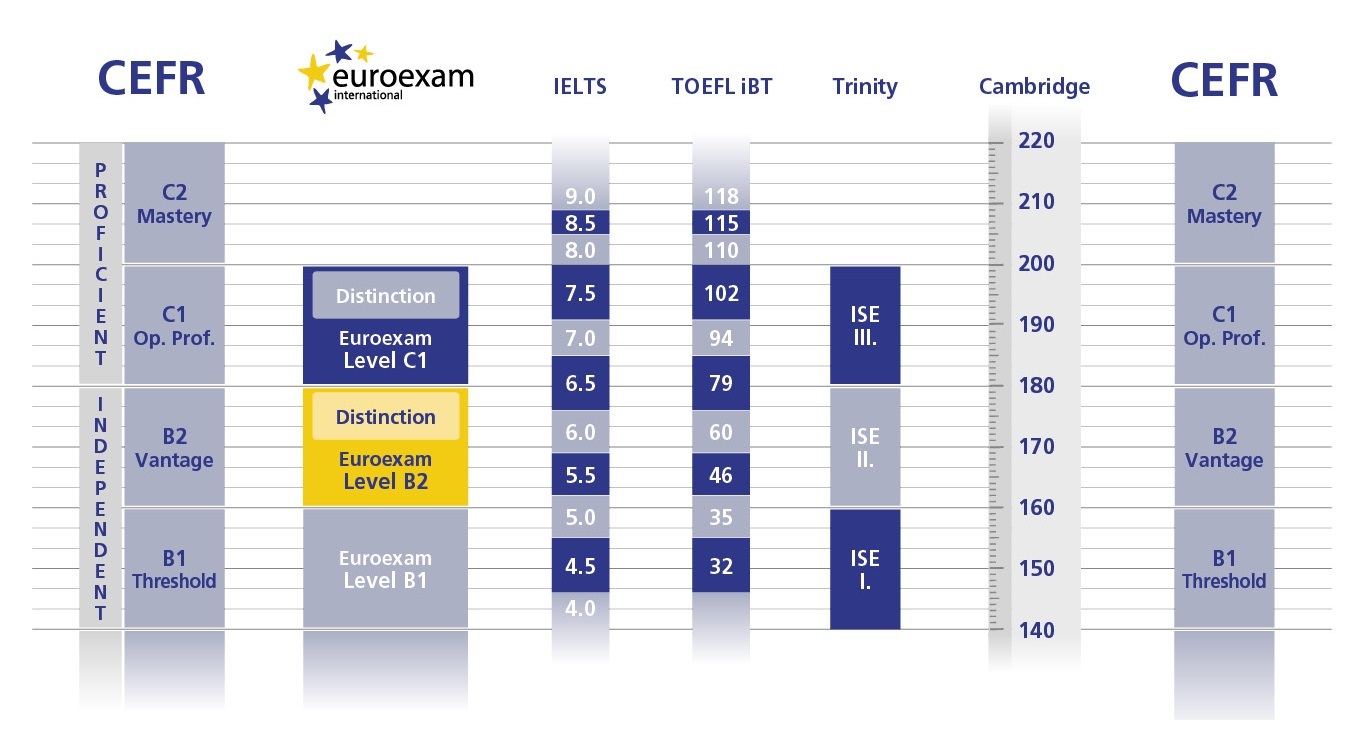
The levels, lined up against the exams that report them. A table like this answers a narrow question well — whether one certificate is comparable to another — and cannot answer the question the article opens with, which is what any of it means about a particular person on a particular day.Source: Euroexam International — CC BY-SA 3.0, Wikimedia Commons
The levels are not equal steps. A1 to A2 does not cost what B2 to C1 costs. The higher bands are far wider.
There is no official hour count. The hour figures usually quoted are estimates from teaching organisations, not part of the framework.
It describes performance, it does not rank people. Someone can be B2 in reading and A2 in speaking. In this framework that is ordinary, not contradictory.
As for exams: a score is a slice of one morning, on specific tasks. It is useful for what it was designed to do — usually predicting whether someone can study through the language. It is not a number that measures a person. The habit of collapsing good at English into a band range obscures precisely the distinctions this article is listing.
The gap between understanding and using
There is an asymmetry every learner experiences and few know has a name.
Laufer and Paribakht (1998) measured receptive vocabulary (recognised on encounter) and productive vocabulary (available when needed) in the same learners, and found the receptive store much larger — with the gap varying by learning context.
Schmitt (2010) places this in the wider picture: aspects of word knowledge develop unevenly, and knowing is a continuum rather than a switch.
This explains a very familiar experience: you read an article and follow nearly all of it, then open your mouth and find a few hundred words available. Nothing has gone wrong. That is the normal shape of knowing a language, and it means good on the input side and good on the output side are always different quantities.
An honest note: you assess yourself poorly, and unevenly
Ross (1998) meta-analysed self-assessment in language testing and found a two-layer result.
First: self-assessment correlates moderately with objective tests. Not useless, not trustworthy.
Second, and this is the interesting part: self-assessment is more accurate for receptive skills — listening and reading — and less accurate for productive skills — speaking and writing.
That is precisely backwards from how people use it. Learners are usually most confident about their speaking (I can communicate) and least sure about academic reading — while the reliability of those two judgements runs the other way.
Good is not a permanent state
Something rarely said in discussions of language proficiency: it can be lost.
Schmid (2011) surveys the field of language attrition — the decline of competence through disuse. It happens to second languages, and under certain conditions to first languages too.
Bardovi-Harlig and Stringer (2010) reviewed the variables governing how much is lost, and a clear pattern emerges: productive ability attrites faster than receptive ability, and what was learned to automaticity survives better than what was learned consciously.
In other words, good is a maintained state rather than an owned asset. It resembles fitness more than it resembles a qualification.
The question to ask instead
After all of the above, how good is my English has no useful answer, because it asks about a quantity that does not exist.
The useful question is: good enough for what?
This is not evasion. It is precisely the logic of the CEFR’s can-do statements, and it produces answers you can check:
Can I read material in my own field without constant dictionary use?
Can I follow a four-person video call, mixed accents, no subtitles?
Can I write a complaint email that is both clear and polite?
Can I talk to a stranger for thirty minutes without feeling wrung out?
When I do not know a word, can I route around it, or do I stop?
Those five measure five different things, and a person can answer yes to one and no to another. That is not a contradiction. That is the real picture.
What is actually being asked
There is a reason the title question persists despite being broken: people ask it not for information but to find out where they stand.
And that is where it does most harm. A single scale creates a ranking, and a ranking invites comparison — with native speakers, with colleagues, with whoever is posting their exam scores online.
Four decades of research on communicative competence say that ranking describes nothing. The person better than you on fluency may be worse on accuracy. The one with the higher score may be silent at the party where you talked all evening.
The most honest answer to the title question is probably this: being good at a language means being able to do the things you need to do in it, with little enough effort that you still want to keep doing them.
That definition gives you no number to display. But it gives you a question you can answer tonight, and a list of things to do tomorrow.
Read the simple version
The same article, told in plain words — for younger readers, or for anyone who wants the point quickly.
Try a small experiment. Think of someone you consider good at English. Then ask: good in what way?
They might speak fluently and write full of errors. They might write precisely and hesitate when speaking. They might read technical material and fail to follow a phone call. They might have an IELTS 8.0 and nothing to say at a party.
All four could be called good at English, and they resemble each other in no important respect.
That is the sign the title question is broken from the start — it presupposes one scale. This piece takes it apart, then proposes a different question.
Not one competence but several separable ones
Canale and Swain (1980) is where applied linguistics formally abandoned the idea of a single competence. They split knowing a language into distinct components:
Grammatical competence — vocabulary, syntax, pronunciation, spelling. Sociolinguistic competence — knowing what is appropriate to whom, in which situation. Knowing when a grammatical sentence is still the wrong sentence. Discourse competence — joining sentences into coherent stretches, holding a topic. Strategic competence — what you do when you lack the word you need. Paraphrasing, asking for repetition, rerouting.
Bachman and Palmer (1996) refined this into the framework used in modern language testing, separating organisational competence from pragmatic competence.
The point is not the list. The point is that these components are separable: a person can be very strong in one and very weak in another, and that happens constantly.
Strategic competence deserves particular notice, because it is the least taught and makes the largest difference to how a listener perceives you. Someone with two thousand words who can talk around a gap will be judged better than someone with six thousand who falls silent every time they hit one.
Why three people can disagree and all be right
Skehan (1998) proposed that language production is judged along three dimensions that trade off against each other:
Complexity — how rich the structures and vocabulary are. Accuracy — how many errors you make. Fluency — how smoothly and quickly you speak.
His central claim is that you cannot maximise all three at once, because attention is finite. Aim for accuracy and you slow down. Aim for fluency and you simplify. Reach for complex structures and you make more errors. Housen and Kuiken (2009) showed the relationships shift with task, level and time conditions.
Now return to the person at the top. Three observers can look at three different dimensions and reach three different verdicts, and none of them is wrong. The teacher notices accuracy. The colleague notices fluency. The writing examiner notices complexity.
Good usually means strong on whichever dimension the judge happened to be attending to.
The native speaker is not a yardstick
Vivian Cook (1999) argued that measuring second-language users against native speakers is a conceptual error, not merely a harsh standard. The reason is multicompetence: a person who knows two languages is not two monolinguals in one head. The two systems influence each other, and even the first language changes. They are a different kind of language user, not a failed native speaker.
Davies (2003) went further, showing that native speaker is itself blurrier than assumed: it conflates order of acquisition, identity, and proficiency — three things that need not travel together.
There is a practical consequence worth stating: if the yardstick is the native speaker, then every learner fails permanently by definition. That is a bad measure — not because it is strict, but because it tells you nothing useful.
Accent is not the problem — if you are understood
Munro and Derwing (1995) separated three things people habitually collapse into one:
Accentedness — how different from a native speaker it sounds. Perceived comprehensibility — how much effort the listener feels they are making. Actual intelligibility — how much the listener genuinely understands.
The key result: these correlate only partially. Speakers with heavy accents were sometimes understood almost perfectly. Accent and communicative success are not the same variable.
Derwing and Munro (2009) reviewed two further decades and concluded that treating accent as a communication barrier is largely an untested assumption — whereas speech rate, prosody and word stress do have real effects.
Levis (2005) named the two positions: the nativeness principle and the intelligibility principle. The first makes the goal accent elimination; the second makes it being understood. He argued only the second is empirically grounded and achievable.
For a Vietnamese learner this means something concrete: final consonants and clusters are worth drilling, because losing them causes real misunderstanding. Sounding American is not worth the investment.
Most English in the world has no native speaker in it
One statistical fact reframes the whole question. The majority of English conversations happening in the world today take place between non-native speakers. A Vietnamese engineer with a Korean client. A meeting with Germans, Indians and Brazilians in it.
Jenkins (2000) studied exactly this setting and proposed the Lingua Franca Core: the set of pronunciation features genuinely necessary for non-natives to understand each other. The striking finding is that this list does not match the list of things that make you sound native. Some items drilled hard in classrooms — the th sounds among them — turn out to matter little for mutual understanding, while others matter a great deal more.
Seidlhofer (2011) extended the argument beyond pronunciation: English as a lingua franca is developing its own norms, and they are not necessarily British or American ones.
The consequence: if you are learning English for international work, you are optimising for a situation in which no native speaker is in the room. Measuring yourself against a native yardstick there is measuring the wrong thing.
What the CEFR says — and does not
The Common European Framework is the best available tool for this question, and it also needs its limits understood.
What it does well: it describes level in can-do statements rather than scores. Not three thousand words but can describe experiences and events and give reasons for an opinion. The Companion Volume (2020) adds scales for mediation, online interaction and plurilingual competence.
What the CEFR does not say, though many assume it does:
The levels are not equal steps. A1 to A2 does not cost what B2 to C1 costs. The higher bands are far wider.
There is no official hour count. The hour figures usually quoted are estimates from teaching organisations, not part of the framework.
It describes performance, it does not rank people. Someone can be B2 in reading and A2 in speaking. In this framework that is ordinary, not contradictory.
As for exams: a score is a slice of one morning, on specific tasks. It is useful for what it was designed to do. It is not a number that measures a person.
The gap between understanding and using
Laufer and Paribakht (1998) measured receptive vocabulary (recognised on encounter) and productive vocabulary (available when needed) in the same learners, and found the receptive store much larger — with the gap varying by learning context. Schmitt (2010) places this in the wider picture: aspects of word knowledge develop unevenly, and knowing is a continuum rather than a switch.
This explains a very familiar experience: you read an article and follow nearly all of it, then open your mouth and find a few hundred words available. Nothing has gone wrong. That is the normal shape of knowing a language — and it means good on the input side and good on the output side are always different quantities.
An honest note: you assess yourself poorly, and unevenly
Ross (1998) meta-analysed self-assessment in language testing and found a two-layer result.
First: self-assessment correlates moderately with objective tests. Not useless, not trustworthy.
Second, and this is the interesting part: self-assessment is more accurate for receptive skills — listening and reading — and less accurate for productive skills — speaking and writing.
That is precisely backwards from how people use it. Learners are usually most confident about their speaking (I can communicate) and least sure about academic reading — while the reliability of those two judgements runs the other way.
Good is not a permanent state
Something rarely said in discussions of proficiency: it can be lost.
Schmid (2011) surveys language attrition — the decline of competence through disuse. It happens to second languages, and under certain conditions to first languages too. Bardovi-Harlig and Stringer (2010) reviewed the variables and a clear pattern emerges: productive ability attrites faster than receptive ability, and what was learned to automaticity survives better than what was learned consciously.
In other words, good is a maintained state rather than an owned asset. It resembles fitness more than it resembles a qualification.
The question to ask instead
After all of the above, how good is my English has no useful answer, because it asks about a quantity that does not exist.
The useful question is: good enough for what?
This is not evasion. It is precisely the logic of the CEFR's can-do statements, and it produces answers you can check:
Can I read material in my own field without constant dictionary use? Can I follow a four-person video call, mixed accents, no subtitles? Can I write a complaint email that is both clear and polite? Can I talk to a stranger for thirty minutes without feeling wrung out? When I do not know a word, can I route around it, or do I stop?
Those five measure five different things, and a person can answer yes to one and no to another. That is not a contradiction. That is the real picture.
What is actually being asked
There is a reason the title question persists despite being broken: people ask it not for information but to find out where they stand.
And that is where it does most harm. A single scale creates a ranking, and a ranking invites comparison — with native speakers, with colleagues, with whoever is posting their exam scores online.
Four decades of research on communicative competence say that ranking describes nothing. The person better than you on fluency may be worse on accuracy. The one with the higher score may be silent at the party where you talked all evening.
The most honest answer to the title question is probably this: being good at a language means being able to do the things you need to do in it, with little enough effort that you still want to keep doing them.
That definition gives you no number to display. But it gives you a question you can answer tonight, and a list of things to do tomorrow.
Sources & further reading
These articles summarize well-established research in learning science and linguistics. Key sources and further reading:
Canale, M., & Swain, M. (1980). Theoretical bases of communicative approaches to second language teaching and testing. Applied Linguistics, 1(1), 1–47.
Bachman, L. F. (1990). Fundamental Considerations in Language Testing. Oxford: Oxford University Press.
Bachman, L. F., & Palmer, A. S. (1996). Language Testing in Practice: Designing and Developing Useful Language Tests. Oxford: Oxford University Press.
Skehan, P. (1998). A Cognitive Approach to Language Learning. Oxford: Oxford University Press.
Housen, A., & Kuiken, F. (2009). Complexity, accuracy, and fluency in second language acquisition. Applied Linguistics, 30(4), 461–473.
Cook, V. (1999). Going beyond the native speaker in language teaching. TESOL Quarterly, 33(2), 185–209.
Cook, V. (Ed.) (2002). Portraits of the L2 User. Clevedon: Multilingual Matters.
Davies, A. (2003). The Native Speaker: Myth and Reality. Clevedon: Multilingual Matters.
Munro, M. J., & Derwing, T. M. (1995). Foreign accent, comprehensibility, and intelligibility in the speech of second language learners. Language Learning, 45(1), 73–97.
Derwing, T. M., & Munro, M. J. (2009). Putting accent in its place: Rethinking obstacles to communication. Language Teaching, 42(4), 476–490.
Levis, J. M. (2005). Changing contexts and shifting paradigms in pronunciation teaching. TESOL Quarterly, 39(3), 369–377.
Jenkins, J. (2000). The Phonology of English as an International Language. Oxford: Oxford University Press.
Seidlhofer, B. (2011). Understanding English as a Lingua Franca. Oxford: Oxford University Press.
Council of Europe (2020). Common European Framework of Reference for Languages: Learning, Teaching, Assessment — Companion Volume. Strasbourg: Council of Europe Publishing.
North, B. (2014). The CEFR in Practice. Cambridge: Cambridge University Press.
Nation, I. S. P. (2006). How large a vocabulary is needed for reading and listening? Canadian Modern Language Review, 63(1), 59–82.
Schmitt, N. (2010). Researching Vocabulary: A Vocabulary Research Manual. Basingstoke: Palgrave Macmillan.
Laufer, B., & Paribakht, T. S. (1998). The relationship between passive and active vocabularies: Effects of language learning context. Language Learning, 48(3), 365–391.
Ross, S. (1998). Self-assessment in second language testing: A meta-analysis and analysis of experiential factors. Language Testing, 15(1), 1–20.
Schmid, M. S. (2011). Language Attrition. Cambridge: Cambridge University Press.
Bardovi-Harlig, K., & Stringer, D. (2010). Variables in second language attrition: Advancing the state of the art. Studies in Second Language Acquisition, 32(1), 1–45.