A History of Chinese, and What Vietnamese Speakers Already Carry
With English, a Vietnamese reader has an analogy. With Chinese it is something else entirely: descent. The Hán-Việt layer in your head is a recording of seventh-century Chinese, and it preserves what modern Mandarin has lost.
You have just heard something an English-speaking learner of Chinese never hears. The Sino-Vietnamese words end in consonants — -t, -p, -c. The Mandarin words end in nothing at all.
That is not a coincidence, and it is not Vietnamese mispronouncing anything. It is Vietnamese keeping what Mandarin lost.
The previous article on this site told the history of English, and the part most useful to a Vietnamese reader was an analogy: Vietnamese has a two-tier structure like the one 1066 gave English. With Chinese the relationship is different in kind. This is not analogy. This is descent.
This piece tells that history, and points at what you are already carrying.
Three thousand years of unbroken writing
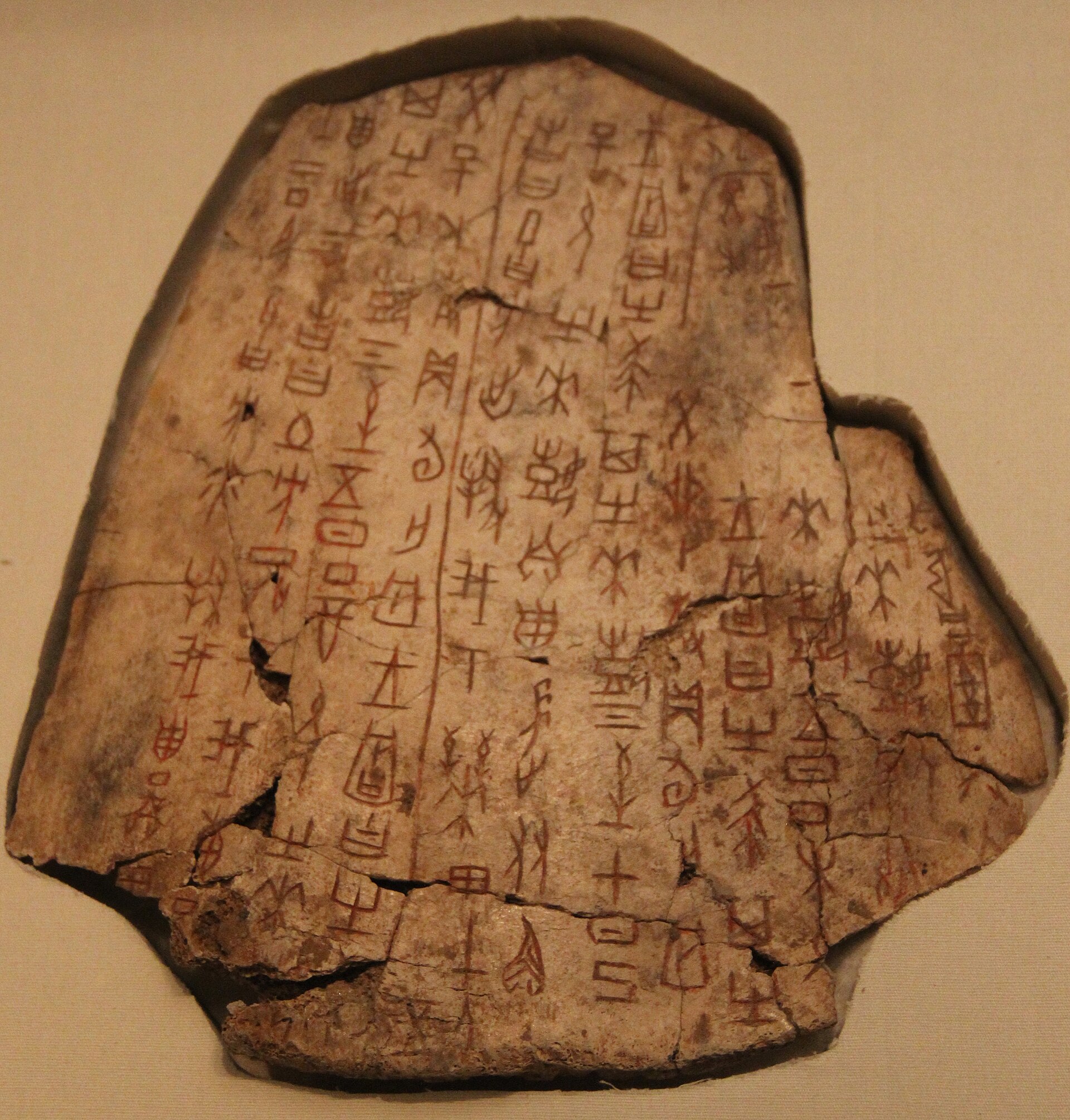
The earliest attested Chinese writing sits on oracle bones — turtle shells and ox shoulder blades used for divination under the Shang, around the thirteenth century BCE. They were only recognised in 1899, when scholars realised that the dragon bone fragments sold in apothecaries carried writing.
A Shang oracle bone. The cracks came first — heat was applied and the answer read from the split; the characters record the question and what happened next.Source: Gary Lee Todd 2011-09-01 12:34:54 https://www.flickr.com/photos/101561334@N08/9830601816/ — CC0, Wikimedia Commons
This is what sets Chinese apart from every other living script: it was never interrupted. Egyptian hieroglyphs died and had to be deciphered. So did cuneiform. Chinese runs continuously from oracle bone to the screen of your phone.
That has a cost, and learners pay it. A script that was never broken is a script that was never redesigned from scratch.
Chinese characters are not pictograms
This is the commonest misconception, and correcting it changes how you study.
Popular accounts describe characters as pictures of things. A few genuinely are — 日 sun, 月 moon, 山 mountain, 木 tree. But they are a small minority.
The great majority of characters are phono-semantic compounds — a component indicating meaning joined to a component indicating sound. The classification goes back to the Shuowen Jiezi of around 100 CE, and Qiu (2000) and Boltz (1994) trace how the system shifted toward that pattern.
Take 媽, 嗎, 罵. All carry 馬 (horse) as the sound element. None has anything to do with horses. The 馬 is there to tell you how to say it.
Shu et al. (2003) analysed the full character inventory of Chinese primary school textbooks and measured how much work the phonetic and semantic components actually do. The phonetic component carries real information, though not reliably in every case, and its usefulness varies with how common the character is.
DeFrancis (1984, 1989) spent two books attacking what he called the ideographic myth: the idea that Chinese characters record meaning while bypassing sound. He argued no human writing system could work that way.
The practical consequence: when you meet a new character, do not try to memorise the shape. Break it apart and ask which part gives meaning and which gives sound. You are not learning a picture. You are learning two pieces you already know.
Old Chinese, and the limits of what is known
The language of the Book of Songs, around 1000 BCE, is called Old Chinese. It was unlike anything spoken in China today.
It probably had no tones at all. It had initial consonant clusters that modern Chinese lacks. The tones likely arose later, out of consonants at the end of the syllable that fell away — a process called tonogenesis.
Honesty is required here. Old Chinese reconstruction remains contested.Karlgren (1957) built the first influential reconstruction; Baxter (1992), then Baxter and Sagart (2014), and Sagart (1999) propose systems that differ substantially on initials, on whether there were prefixes, and on where the tones came from.
So when you see a reconstructed form with an asterisk in front of it, remember that it is a hypothesis, not a recording.
221 BCE: the script was unified, the speech was not
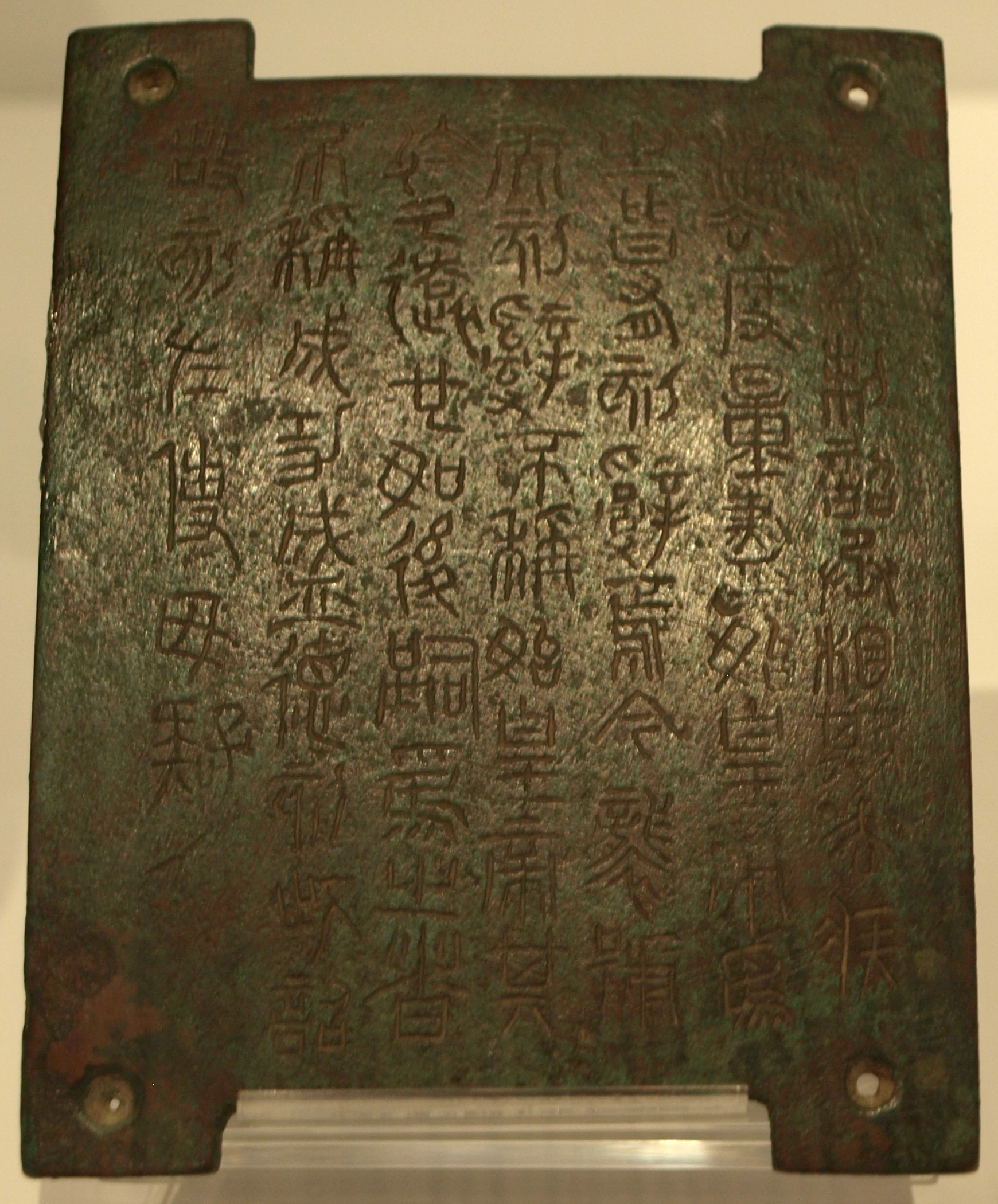
The first Qin emperor unified China and unified the script with it, standardising on small seal script; by the Han, clerical script had settled into the shapes you recognise today.
A Qin imperial edict cast in bronze, in the small seal script the first emperor made standard. Unifying the state and unifying the writing were the same act.Source: User:Captmondo — CC BY-SA 3.0, Wikimedia Commons
That decision created the central paradox of Chinese, and it holds to this day.
The writing was unified. The speech was not, and never has been.
The result is a script readable by people who cannot talk to one another. A Cantonese speaker and a Beijing speaker read the same sentence, understand the same thing, and produce two streams of sound neither can follow.
Two signs in Kowloon, a metre apart, writing Kai Tak with two accepted forms of 啟. The script is shared across speech that is mutually unintelligible — and it was never quite uniform either.Source: Jonashtand — CC BY-SA 4.0, Wikimedia Commons
And it was precisely that property which let the script cross borders — into Vietnam, Korea and Japan. Handel (2019) surveys that whole process of borrowing and adaptation: a script built for Chinese, pressed into service for three languages unrelated to it.
601 CE: the book that explains your Hán-Việt
This is the centre of the article.
In 601, Lu Fayan and a group of scholars compiled the Qieyun (切韻), a rhyme dictionary — characters arranged by rhyme, so that poets could rhyme correctly. It sets out 193 rhyme groups, of which 32 belong to the entering tone.
That book is our principal window onto Middle Chinese — the Chinese of the Sui and Tang.
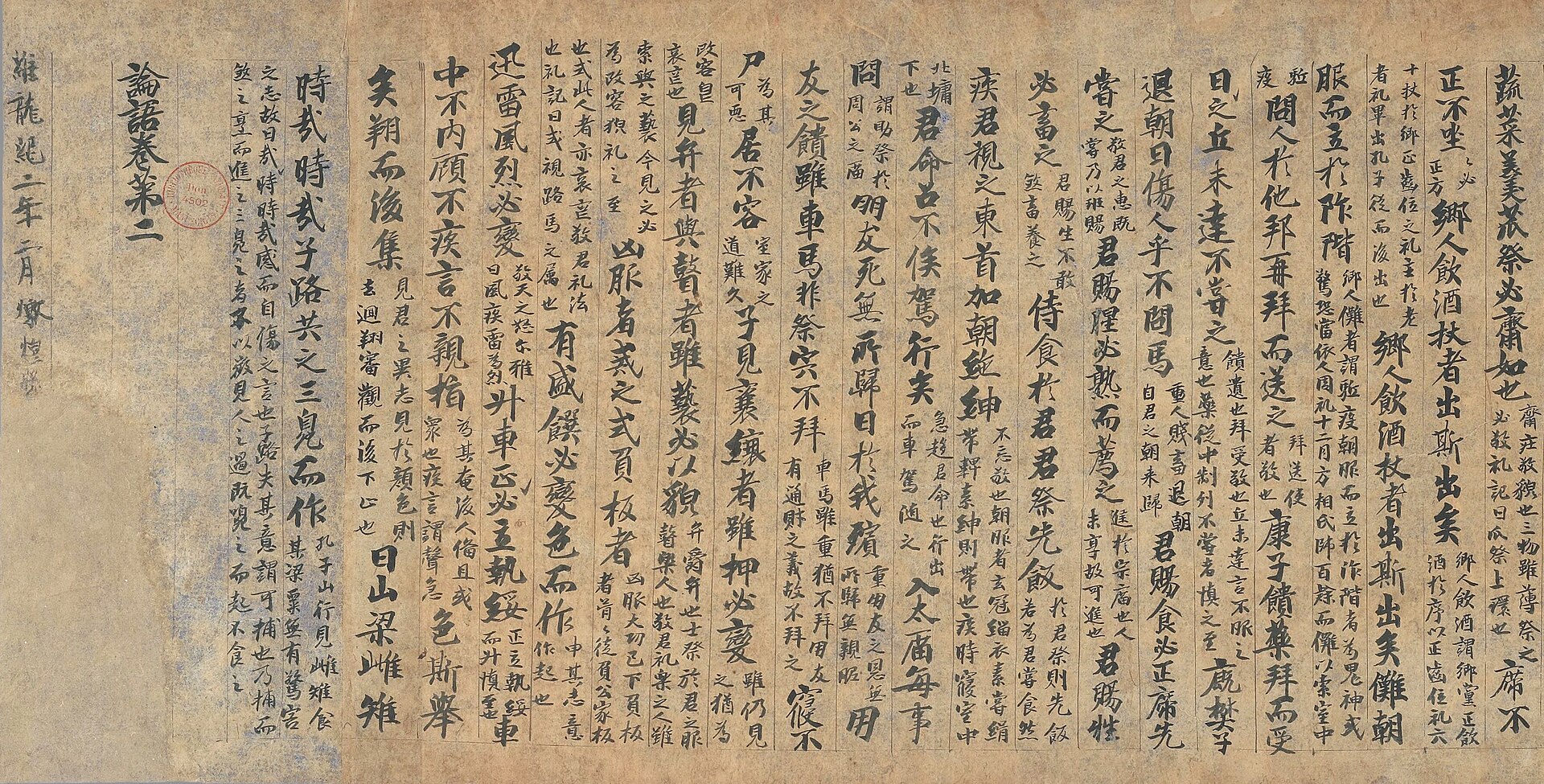
A Tang-era manuscript of the Analects with commentary. This is the period the rhyme books describe — the pronunciation Sino-Vietnamese still preserves.Source: anonymous — Public domain, Wikimedia Commons
And here is why it matters more to you than to almost any other learner of Chinese on earth:
Sino-Vietnamese was borrowed from Middle Chinese. Not from Mandarin. Not from Old Chinese. From the very language the Qieyun records.
So were the on'yomi readings of Japanese. So were the Sino-Korean readings. Those three systems — collectively called the Sino-Xenic readings — are each a photograph of Middle Chinese, taken at slightly different moments and filtered through three different sound systems.
The entering tone: what you kept and Mandarin lost
Middle Chinese had four tones: level, rising, departing and entering.
The first three are pitch contours. The fourth is a different kind of thing altogether. The entering tone was not a melody — it was the set of syllables ending in a stop consonant: -p, -t, -k. Clipped, cut short.
Then history went four ways.
Mandarin lost them completely. Every final stop vanished, and those syllables were redistributed across the four modern tones unpredictably.
Vietnamese kept all three — -p, -t, and -k spelt -c.
Korean kept -k and -p, while -t became -l, because Sino-Korean derives from a northern variety of Late Middle Chinese in which final -t had already weakened.
Japanese turned each final stop into an extra syllable, since Japanese does not permit closed syllables: -k became -ku or -ki, -p became -pu, -t became -chi or -tsu.
Watch a single character move through all four:
一 — Mandarin yī — Sino-Vietnamese nhất — Korean il — Japanese ichi / itsu
十 — Mandarin shí — Sino-Vietnamese thập — Korean sip — Japanese jū / jitsu
國 — Mandarin guó — Sino-Vietnamese quốc — Korean guk — Japanese koku
學 — Mandarin xué — Sino-Vietnamese học — Korean hak — Japanese gaku
法 — Mandarin fǎ — Sino-Vietnamese pháp — Korean beop — Japanese hō / hatsu
Four languages this site teaches, one character, and reading across the row shows you how seventh-century Chinese came apart.
Vietnamese kept it most intact of the four.
Payoff one: Tang poetry rhymes again
A great deal of Tang poetry no longer rhymes when read in Mandarin, because the final consonants that carried the rhyme have dropped away.
Read in Sino-Vietnamese, much of it rhymes again. This is not merely an aesthetic point — it is audible evidence that the sound system in your head sits closer to what the poet used than a Beijing speaker's does today.
Payoff two: phonetic components that fail in Mandarin still work in Hán-Việt
This one you can use daily.
The phonetic components in characters encode Middle Chinese pronunciation. Mandarin then changed a great deal, so many phonetic components now look useless.
But Sino-Vietnamese stands closer to the starting point. Very often, a phonetic series that has scattered in Mandarin still holds together in Hán-Việt.
Which means that when you guess at a new character's reading, you have two routes rather than one: guess from Mandarin, and cross-check against the Hán-Việt you already know. An English-speaking learner has only the first.
How Mandarin became the standard
What we call Mandarin descends from guanhua, the speech of officials, based on the dialect of the Beijing region and used so that the court and the bureaucracy could communicate across the empire.
In the twentieth century it was deliberately standardised — as guoyu, then as putonghua in the People's Republic. Chen (1999) narrates that process; Tsu (2022) tells the technological side, from telegraph codes to keyboards.
One thing that language courses usually skip deserves saying plainly: Mandarin's position is a political fact as much as a linguistic one. It did not win by being simpler or better. It won because the capital was there.
Simplification, and a well-documented failure
The People's Republic issued its first official round of simplifications on 31 January 1956: 515 simplified characters and 54 simplified radicals, to be introduced in four stages. The consolidated general list followed in 1964.
A common misconception needs correcting: most simplified forms were not invented in the 1950s. Many had existed for centuries as cursive, popular or variant forms. The reform largely took handwritten shapes that already existed and gave them official standing.
But the most instructive part is the part that failed.
In 1977 a second round of simplifications was promulgated, going considerably further. It was poorly received, and in 1986 the authorities retracted it completely. That same year they issued a final list, identical to the 1964 one apart from six changes.
It was a national-scale experiment in redesigning a writing system, and it failed in public. Hannas (1997) sets the episode within the wider script-reform debates across East Asia.
The result is today's map: simplified on the mainland and in Singapore, traditional in Taiwan, Hong Kong and Macau.
For a Vietnamese reader one point is worth noting: Sino-Vietnamese tracks the traditional forms more closely. In 國 you can still see the 口 enclosure; in 国 that clue has gone. If you are learning Chinese to read older texts or to link up with your Hán-Việt layer, traditional characters repay the effort.
1958: pinyin
Zhou Youguang began work on Hanyu Pinyin in 1955; it was adopted by the People's Republic in 1958, by the International Organization for Standardization in 1982, and by the United Nations in 1986. He died in 2017 at the age of 111.
Pinyin is not the Chinese writing system. It is a transcription — a ladder to climb, not a house to live in. Learners who linger on it too long build a habit they later have to break.
Three things commonly got wrong
You need fifty thousand characters
No. That figure comes from entries in comprehensive dictionaries, most of them dead forms, variants, or characters used only in old proper names.
The working literacy threshold is around three to three and a half thousand characters. That is the scale measured in general education, and it is the inventory Shu et al. (2003) worked on.
Chinese is one language
Linguistically it is not. Mandarin, Cantonese, Hokkien and Hakka are not mutually intelligible. By the usual criteria those are separate languages within one family.
Mair (1991) addresses this head on and proposes topolect in place of the English word dialect, which implies a closeness that is not there. Norman (1988) and Ramsey (1987) set out the real extent of the diversity.
The shared script conceals the difference. But it is a unity of writing, not of speech.
Characters record meaning, not sound
Addressed above, but worth repeating because it persists. If characters truly recorded meaning while bypassing sound, phonetic components would not exist — and they make up most of the system.
What you are already holding
An American learning Chinese starts from zero. To them 責任 is two unfamiliar shapes and two syllables to memorise.
To you it is trách nhiệm. 環境 is hoàn cảnh. 意識 is ý thức. 準備 is chuẩn bị.
Alves (2001, 2009) surveys the depth of that borrowed layer in Vietnamese and records a proportion of Chinese-derived vocabulary among the highest in the languages compared.
But state the limits honestly, because this advantage is often oversold. The Hán-Việt layer gives you meaning and a second route to guessing pronunciation. It does not give you Mandarin tones, or grammar, or listening ability, and now and then it will mislead you: 困難 is khốn nạn in Sino-Vietnamese, but in Chinese it simply means difficulty.
Even so, what remains is true and rare.
The Hán-Việt layer in your head is a recording of the Chinese that Lu Fayan sat down to codify in 601. You are not setting out to learn an alien system from nothing. You are reconnecting with something your own language has carried for fourteen hundred years.
Read the simple version
The same article, told in plain words — for younger readers, or for anyone who wants the point quickly.
Read these three words aloud: nhất, thập, quốc.
Now hear the Mandarin: yī, shí, guó.
You have just heard something an English-speaking learner of Chinese never hears. The Sino-Vietnamese words end in consonants — -t, -p, -c. The Mandarin words end in nothing at all.
That is not a coincidence, and it is not Vietnamese mispronouncing anything. It is Vietnamese keeping what Mandarin lost.
With English, the part most useful to a Vietnamese reader was an analogy. With Chinese the relationship is different in kind. This is not analogy. This is descent.
Three thousand years of unbroken writing
The earliest attested Chinese writing sits on oracle bones — turtle shells and ox shoulder blades used for divination under the Shang, around the thirteenth century BCE. They were only recognised in 1899, when scholars realised that the dragon bone fragments sold in apothecaries carried writing.
This is what sets Chinese apart from every other living script: it was never interrupted. Egyptian hieroglyphs died and had to be deciphered. So did cuneiform. Chinese runs continuously from oracle bone to the screen of your phone.
That has a cost, and learners pay it. A script that was never broken is a script that was never redesigned from scratch.
Chinese characters are not pictograms
This is the commonest misconception, and correcting it changes how you study.
Popular accounts describe characters as pictures of things. A few genuinely are — 日 sun, 月 moon, 山 mountain, 木 tree. But they are a small minority.
The great majority of characters are phono-semantic compounds — a component indicating meaning joined to a component indicating sound. The classification goes back to the Shuowen Jiezi of around 100 CE, and Qiu (2000) and Boltz (1994) trace how the system shifted toward that pattern.
Take 媽, 嗎, 罵. All carry 馬 (horse) as the sound element. None has anything to do with horses. The 馬 is there to tell you how to say it.
Shu and colleagues (2003) analysed the full character inventory of Chinese primary school textbooks and measured how much work the phonetic and semantic components actually do. The phonetic component carries real information, though not reliably in every case, and its usefulness varies with how common the character is.
DeFrancis (1984, 1989) spent two books attacking what he called the ideographic myth: the idea that Chinese characters record meaning while bypassing sound. He argued no human writing system could work that way.
The practical consequence: when you meet a new character, do not try to memorise the shape. Break it apart and ask which part gives meaning and which gives sound. You are not learning a picture. You are learning two pieces you already know.
Old Chinese, and the limits of what is known
The language of the Book of Songs, around 1000 BCE, is called Old Chinese. It was unlike anything spoken in China today.
It probably had no tones at all. It had initial consonant clusters that modern Chinese lacks. The tones likely arose later, out of consonants at the end of the syllable that fell away — a process called tonogenesis.
Honesty is required here. Old Chinese reconstruction remains contested. Karlgren (1957) built the first influential reconstruction; Baxter (1992), then Baxter and Sagart (2014), and Sagart (1999) propose systems that differ substantially on initials, on whether there were prefixes, and on where the tones came from.
So when you see a reconstructed form with an asterisk in front of it, remember that it is a hypothesis, not a recording.
221 BCE: the script was unified, the speech was not
The first Qin emperor unified China and unified the script with it, standardising on small seal script; by the Han, clerical script had settled into the shapes you recognise today.
That decision created the central paradox of Chinese, and it holds to this day.
The writing was unified. The speech was not, and never has been.
The result is a script readable by people who cannot talk to one another. A Cantonese speaker and a Beijing speaker read the same sentence, understand the same thing, and produce two streams of sound neither can follow.
And it was precisely that property which let the script cross borders — into Vietnam, Korea and Japan. Handel (2019) surveys that whole process of borrowing and adaptation: a script built for Chinese, pressed into service for three languages unrelated to it.
601 CE: the book that explains your Hán-Việt
This is the centre of the article.
In 601, Lu Fayan and a group of scholars compiled the Qieyun (切韻), a rhyme dictionary — characters arranged by rhyme, so that poets could rhyme correctly. It sets out 193 rhyme groups, of which 32 belong to the entering tone.
That book is our principal window onto Middle Chinese — the Chinese of the Sui and Tang.
And here is why it matters more to you than to almost any other learner of Chinese on earth:
Sino-Vietnamese was borrowed from Middle Chinese. Not from Mandarin. Not from Old Chinese. From the very language the Qieyun records.
So were the on'yomi readings of Japanese. So were the Sino-Korean readings. Those three systems — collectively called the Sino-Xenic readings — are each a photograph of Middle Chinese, taken at slightly different moments and filtered through three different sound systems.
The entering tone: what you kept and Mandarin lost
Middle Chinese had four tones: level, rising, departing and entering.
The first three are pitch contours. The fourth is a different kind of thing altogether. The entering tone was not a melody — it was the set of syllables ending in a stop consonant: -p, -t, -k. Clipped, cut short.
Then history went four ways.
Mandarin lost them completely. Every final stop vanished, and those syllables were redistributed across the four modern tones unpredictably.
Vietnamese kept all three — -p, -t, and -k spelt -c.
Korean kept -k and -p, while -t became -l, because Sino-Korean derives from a northern variety of Late Middle Chinese in which final -t had already weakened.
Japanese turned each final stop into an extra syllable, since Japanese does not permit closed syllables: -k became -ku or -ki, -p became -pu, -t became -chi or -tsu.
Watch a single character move through all four:
一 — Mandarin yī — Sino-Vietnamese nhất — Korean il — Japanese ichi / itsu
十 — Mandarin shí — Sino-Vietnamese thập — Korean sip — Japanese jū / jitsu
國 — Mandarin guó — Sino-Vietnamese quốc — Korean guk — Japanese koku
學 — Mandarin xué — Sino-Vietnamese học — Korean hak — Japanese gaku
法 — Mandarin fǎ — Sino-Vietnamese pháp — Korean beop — Japanese hō / hatsu
Four languages this site teaches, one character, and reading across the row shows you how seventh-century Chinese came apart.
Vietnamese kept it most intact of the four.
Payoff one: Tang poetry rhymes again. A great deal of Tang poetry no longer rhymes when read in Mandarin, because the final consonants that carried the rhyme have dropped away. Read in Sino-Vietnamese, much of it rhymes again. This is not merely an aesthetic point — it is audible evidence that the sound system in your head sits closer to what the poet used than a Beijing speaker's does today.
Payoff two: phonetic components that fail in Mandarin still work in Hán-Việt. The phonetic components in characters encode Middle Chinese pronunciation. Mandarin then changed a great deal, so many phonetic components now look useless. But Sino-Vietnamese stands closer to the starting point, and very often a phonetic series that has scattered in Mandarin still holds together in Hán-Việt.
Which means that when you guess at a new character's reading, you have two routes rather than one: guess from Mandarin, and cross-check against the Hán-Việt you already know. An English-speaking learner has only the first.
How Mandarin became the standard
What we call Mandarin descends from guanhua, the speech of officials, based on the dialect of the Beijing region and used so that the court and the bureaucracy could communicate across the empire.
In the twentieth century it was deliberately standardised — as guoyu, then as putonghua in the People's Republic. Chen (1999) narrates that process; Tsu (2022) tells the technological side, from telegraph codes to keyboards.
One thing that language courses usually skip deserves saying plainly: Mandarin's position is a political fact as much as a linguistic one. It did not win by being simpler or better. It won because the capital was there.
Simplification, and a well-documented failure
The People's Republic issued its first official round of simplifications on 31 January 1956: 515 simplified characters and 54 simplified radicals, to be introduced in four stages. The consolidated general list followed in 1964.
A common misconception needs correcting: most simplified forms were not invented in the 1950s. Many had existed for centuries as cursive, popular or variant forms. The reform largely took handwritten shapes that already existed and gave them official standing.
But the most instructive part is the part that failed.
In 1977 a second round of simplifications was promulgated, going considerably further. It was poorly received, and in 1986 the authorities retracted it completely. That same year they issued a final list, identical to the 1964 one apart from six changes.
It was a national-scale experiment in redesigning a writing system, and it failed in public. Hannas (1997) sets the episode within the wider script-reform debates across East Asia.
The result is today's map: simplified on the mainland and in Singapore, traditional in Taiwan, Hong Kong and Macau.
For a Vietnamese reader one point is worth noting: Sino-Vietnamese tracks the traditional forms more closely. In 國 you can still see the 口 enclosure; in 国 that clue has gone. If you are learning Chinese to read older texts or to link up with your Hán-Việt layer, traditional characters repay the effort.
1958: pinyin
Zhou Youguang began work on Hanyu Pinyin in 1955; it was adopted by the People's Republic in 1958, by the International Organization for Standardization in 1982, and by the United Nations in 1986. He died in 2017 at the age of 111.
Pinyin is not the Chinese writing system. It is a transcription — a ladder to climb, not a house to live in. Learners who linger on it too long build a habit they later have to break.
Three things commonly got wrong
You need fifty thousand characters. No. That figure comes from entries in comprehensive dictionaries, most of them dead forms, variants, or characters used only in old proper names. The working literacy threshold is around three to three and a half thousand characters. That is the scale measured in general education, and it is the inventory Shu and colleagues (2003) worked on.
Chinese is one language. Linguistically it is not. Mandarin, Cantonese, Hokkien and Hakka are not mutually intelligible. By the usual criteria those are separate languages within one family. Mair (1991) addresses this head on and proposes topolect in place of the English word dialect, which implies a closeness that is not there. Norman (1988) and Ramsey (1987) set out the real extent of the diversity. The shared script conceals the difference. But it is a unity of writing, not of speech.
Characters record meaning, not sound. Addressed above, but worth repeating because it persists. If characters truly recorded meaning while bypassing sound, phonetic components would not exist — and they make up most of the system.
What you are already holding
An American learning Chinese starts from zero. To them 責任 is two unfamiliar shapes and two syllables to memorise.
To you it is trách nhiệm. 環境 is hoàn cảnh. 意識 is ý thức. 準備 is chuẩn bị.
Alves (2001, 2009) surveys the depth of that borrowed layer in Vietnamese and records a proportion of Chinese-derived vocabulary among the highest in the languages compared.
But state the limits honestly, because this advantage is often oversold. The Hán-Việt layer gives you meaning and a second route to guessing pronunciation. It does not give you Mandarin tones, or grammar, or listening ability, and now and then it will mislead you: 困難 is khốn nạn in Sino-Vietnamese, but in Chinese it simply means difficulty.
Even so, what remains is true and rare.
The Hán-Việt layer in your head is a recording of the Chinese that Lu Fayan sat down to codify in 601. You are not setting out to learn an alien system from nothing. You are reconnecting with something your own language has carried for fourteen hundred years.
Sources & further reading
These articles summarize well-established research in learning science and linguistics. Key sources and further reading:
Norman, J. (1988). Chinese. Cambridge: Cambridge University Press.
Ramsey, S. R. (1987). The Languages of China. Princeton, NJ: Princeton University Press.
Baxter, W. H. (1992). A Handbook of Old Chinese Phonology. Berlin: Mouton de Gruyter.
Baxter, W. H., & Sagart, L. (2014). Old Chinese: A New Reconstruction. Oxford: Oxford University Press.
Sagart, L. (1999). The Roots of Old Chinese. Amsterdam: John Benjamins.
Pulleyblank, E. G. (1984). Middle Chinese: A Study in Historical Phonology. Vancouver: University of British Columbia Press.
Karlgren, B. (1957). Grammata Serica Recensa. Stockholm: Museum of Far Eastern Antiquities.
Shen, Z. (2020). A Phonological History of Chinese. Cambridge: Cambridge University Press.
Branner, D. P. (Ed.) (2006). The Chinese Rime Tables: Linguistic Philosophy and Historical-Comparative Phonology. Amsterdam: John Benjamins.
Boltz, W. G. (1994). The Origin and Early Development of the Chinese Writing System. New Haven, CT: American Oriental Society.
Qiu, X. (2000). Chinese Writing (trans. G. L. Mattos & J. Norman). Berkeley, CA: Society for the Study of Early China.
DeFrancis, J. (1984). The Chinese Language: Fact and Fantasy. Honolulu: University of Hawaii Press.
DeFrancis, J. (1989). Visible Speech: The Diverse Oneness of Writing Systems. Honolulu: University of Hawaii Press.
Handel, Z. (2019). Sinography: The Borrowing and Adaptation of the Chinese Script. Leiden: Brill.
Shu, H., Chen, X., Anderson, R. C., Wu, N., & Xuan, Y. (2003). Properties of school Chinese: Implications for learning to read. Child Development, 74(1), 27–47.
Chen, P. (1999). Modern Chinese: History and Sociolinguistics. Cambridge: Cambridge University Press.
Mair, V. H. (1991). What is a Chinese "dialect/topolect"? Reflections on some key Sino-English linguistic terms. Sino-Platonic Papers, 29.
Tsu, J. (2022). Kingdom of Characters: The Language Revolution That Made China Modern. New York: Riverhead Books.
Hannas, W. C. (1997). Asia’s Orthographic Dilemma. Honolulu: University of Hawaii Press.
Zhou, Y. (2003). The Historical Evolution of Chinese Languages and Scripts. Columbus, OH: National East Asian Languages Resource Center.
Alves, M. J. (2001). What’s so Chinese about Vietnamese? In G. W. Thurgood (Ed.), Papers from the Ninth Annual Meeting of the Southeast Asian Linguistics Society. Tempe, AZ: Arizona State University.
Alves, M. J. (2009). Loanwords in Vietnamese. In M. Haspelmath & U. Tadmor (Eds.), Loanwords in the World’s Languages: A Comparative Handbook. Berlin: De Gruyter Mouton.
Nguyễn, Đ. H. (1997). Vietnamese. Amsterdam: John Benjamins.
Thompson, L. C. (1965). A Vietnamese Grammar. Seattle: University of Washington Press.
Miyake, M. H. (2004). Old Japanese: A Phonetic Reconstruction. London: RoutledgeCurzon.
Nation, I. S. P. (2013). Learning Vocabulary in Another Language (2nd ed.). Cambridge: Cambridge University Press.

.jpg)


