A History of Vietnamese: The Language That Measured the Others
The previous six articles in this series all used Vietnamese as the measuring stick. This one turns the instrument on itself. And the most surprising fact belongs at the front: Vietnamese did not always have tones.
The previous six articles in this series all used Vietnamese as a measuring stick.
The English article used it to explain vocabulary registers. The Chinese article used it to hear seventh-century Chinese. The Spanish, Greek, Korean and Japanese articles all took it as their reference point.
This one turns the instrument on itself.
And the most surprising fact belongs at the front: Vietnamese did not always have tones.
The family question, and how it was settled
For a long time, scholars argued about which family Vietnamese belonged to.
The case for placing it beside Chinese looked strong. Vietnamese has an enormous layer of Chinese vocabulary. Vietnamese has tones. Vietnamese is isolating and syllable-based. On every visible measure it resembled Chinese.
The case against lay somewhere less visible: the basic vocabulary. The words languages rarely borrow — body parts, low numbers, kinship terms, everyday actions — matched Khmer and the other Mon-Khmer languages, not Chinese.
But what about the tones? The other Mon-Khmer languages have none. If Vietnamese belonged with them, why did it have six?
In 1954, André-Georges Haudricourt answered that in a paper in the Journal Asiatique, and the answer is one of the finest results in historical linguistics.
He showed that Vietnamese tones correspond regularly to final consonants still present in atonal Austroasiatic languages.
Which means early Vietnamese had no tones. It had final consonants — traces of a glottal stop and a final -h. As those consonants eroded away, they left their mark on the pitch of the syllable. That mark became tone.
The process is called tonogenesis.
The result settled the family question. Vietnamese is Austroasiatic, in the Mon-Khmer branch. Its closest relative is Mường; further out lie Khmer and the languages of the central highlands.
And the resemblance to Chinese was explained for what it is: not kinship but convergence — two neighbouring languages, in contact for two thousand years, arriving at similar features by separate routes.
Here is the loveliest part. This site's Chinese article noted that Old Chinese probably had no tones either, and that Chinese tones likewise arose from final consonants that fell away.
Two unrelated languages, side by side, underwent the same process independently. And that coincidence is precisely what made people think for centuries that they were relatives.
A thousand years, and the Hán-Việt layer
From 111 BCE to 938 CE, much of what is now northern Vietnam lay under Chinese dynastic rule. Chinese characters were the script of administration, and Chinese was the language of learning.
The result is the Sino-Vietnamese layer this series has returned to again and again.
Alves (2001, 2009) shows the borrowing happened not once but in waves. There is an early Sino-Vietnamese layer, absorbed so long ago that it now sounds native — buồng from 房, mùa from 務.
Then there is the formal Hán-Việt layer, borrowed from Middle Chinese in the Tang period, systematic and regular. That is the layer the Chinese article examined, and the reason quốc keeps a final consonant that guó has lost.
The point to hold onto: no amount of borrowing changes a language's ancestry. English took more than half its vocabulary from French and Latin and remains Germanic. Vietnamese is the same case.
Chữ Nôm, and a loss worth naming
The Korean article set chữ Nôm beside Hangul: two answers to one problem.
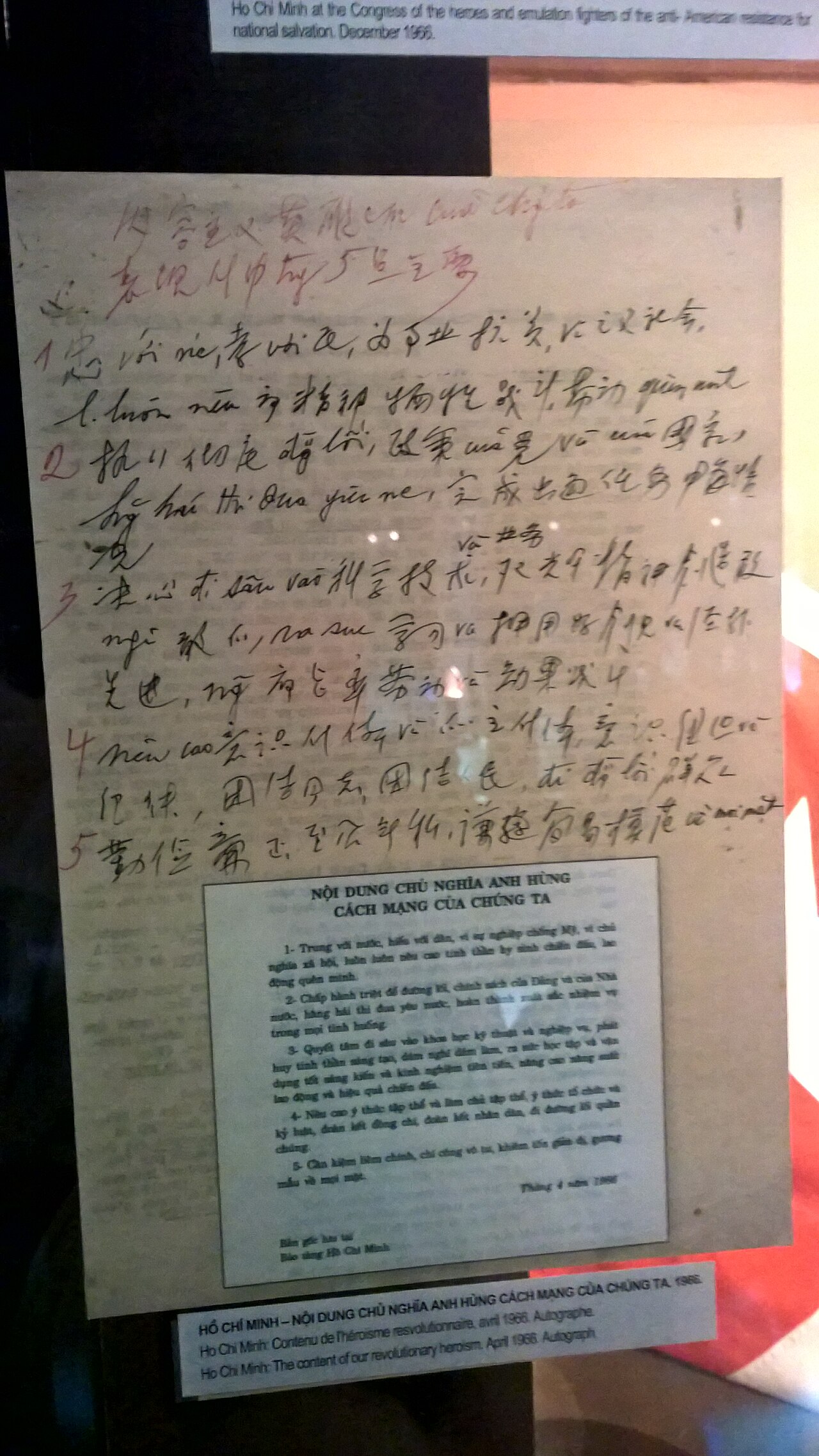
Chữ Nôm combined Chinese character components to write Vietnamese sounds and meanings. It required its readers to know Chinese characters first, then several thousand more. Handel (2019) places it among East Asia's other derived scripts.
Chữ Nôm: Chinese character parts recombined to write Vietnamese. Reading it required knowing Chinese first, which kept literacy in it small and made it easy to replace.Source: Cookie Nguyen — CC BY-SA 4.0, Wikimedia Commons
It also produced Truyện Kiều.
And here something needs saying plainly that celebrations of quốc ngữ usually skip: the loss of chữ Nôm was a genuine loss.
The scripts Vietnamese has been written in. Quốc ngữ made literacy fast to acquire; it also put a thousand years of writing out of reach of anyone who has not been taught to read the older hand.Source: Lachy70 — CC BY-SA 4.0, Wikimedia Commons
A Vietnamese person today cannot directly read what their own ancestors wrote. The entire corpus in chữ Nôm and literary Chinese — poetry, histories, family records, stone inscriptions, royal edicts — reaches the ordinary reader only through specialists' transcription and annotation.
That is the cost. It does not cancel what quốc ngữ bought, but it is real and it should be stated.
Quốc ngữ, and a story that is not simple
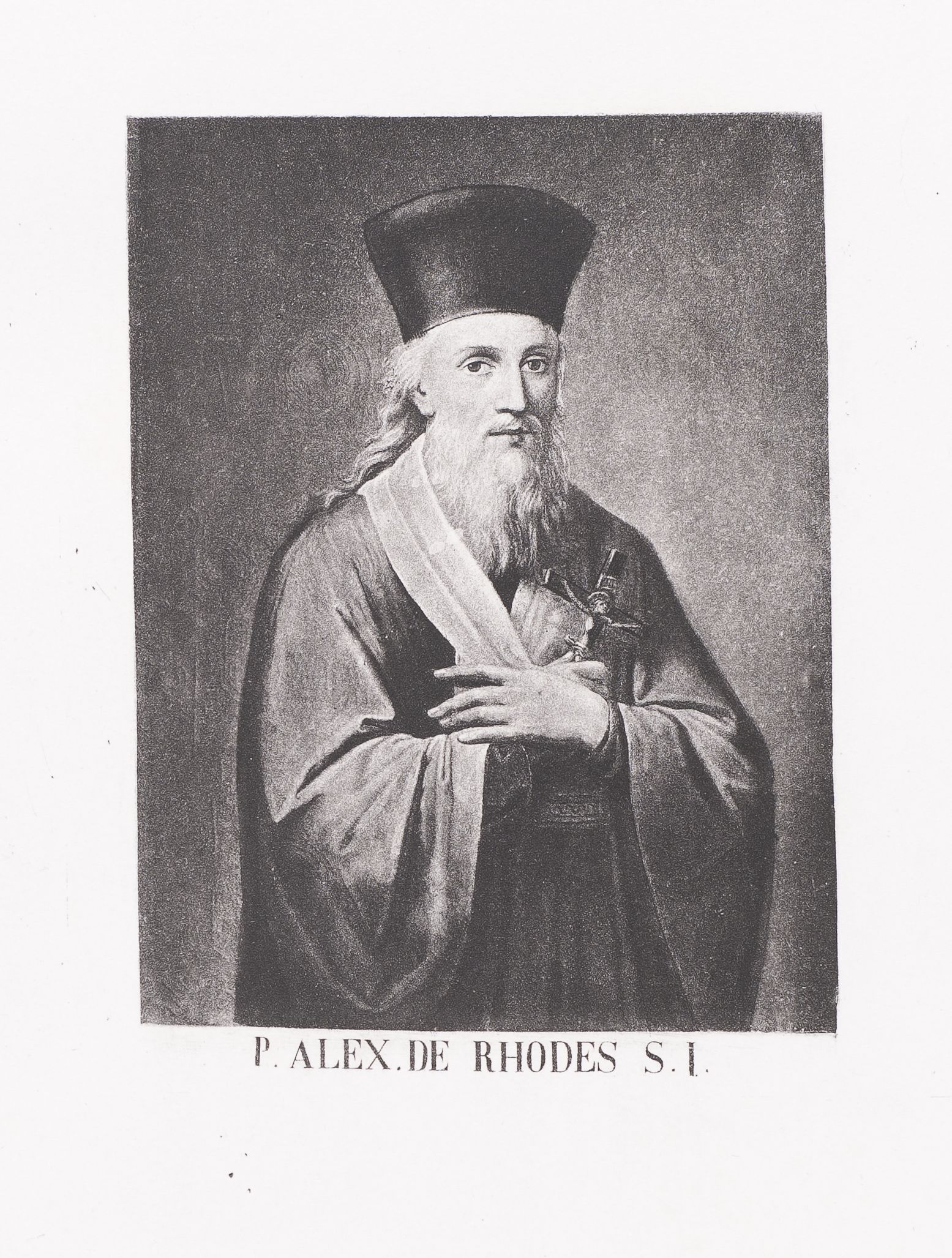
The Spanish article told the first half: quốc ngữ was built by Iberian Jesuits. Jacques (2002) restores the credit due to Francisco de Pina and the Portuguese who came before; Alexandre de Rhodes's printed dictionary of 1651 is the Dictionarium Annamiticum Lusitanum et Latinum.
Alexandre de Rhodes, whose 1651 dictionary printed the system. He assembled it rather than invented it — the Portuguese missionaries before him had already done most of the listening.Source: Unknown — Public domain, Wikimedia Commons
But the second half is the part usually told wrong, in both directions.
Some accounts present quốc ngữ as a gift from the West. Others present it as a colonial imposition. Both are too simple.
The truth has three parts, and all three are true at once:
Missionaries built it to spread a religion, not to raise literacy.
The French colonial administration promoted it, partly in order to cut Vietnamese scholars off from the classical Chinese tradition and from Chinese influence. DeFrancis (1977) examines that policy.
Then Vietnamese nationalists seized it. The Đông Kinh Nghĩa Thục movement and the intellectuals of the early twentieth century saw what the colonists had not: a script learnable in weeks was the most powerful instrument available for putting knowledge into millions of hands. Marr (1971, 1981) describes that turn. After 1945 the Bình dân học vụ campaign took it nationwide.
The same script served both sides. That is the lesson recurring through this whole series: a writing system holds no politics of its own; the people using it do.
The three remaining layers
After Chinese, Vietnamese took on three more layers, and you use all three daily.
The French layer — as the Spanish article noted: ga, cà phê, xà phòng, sơ mi, va li, bơ, ban công, xi măng, bít tết.
The Japanese-made layer — as the Japanese article told it: cách mạng, tư bản, thời gian, dân chủ, kinh tế, khoa học. Cast in Tokyo, routed through China, arriving with the Tân thư and the students of the Đông Du years.
The English layer — happening right now, mostly in technology and business.
Four major sources of borrowing, each matching a historical period. You can date every stratum of your own vocabulary.
North and South, and a surprise about spelling
Learners of Vietnamese ask which accent is standard. The answer is more interesting than they expect.
Northern and southern speech differ in both tones and consonants. In the south, the hỏi and ngã tones typically merge. In the north, the initials tr and ch, s and x, and r, d and gi have largely merged. Brunelle (2009) measures the difference in tone perception between the regions.
Now notice this.
The writing system distinguishes both sets. It has separate marks for hỏi and ngã. It has separate tr and ch, separate s and x.
Which means: Vietnamese orthography records distinctions that no single modern variety still keeps intact. Northerners keep hỏi–ngã but have lost tr–ch. Southerners keep tr–ch but have lost hỏi–ngã.
The spelling is older than both. It photographs a sound system that both regions have since moved past.
So neither accent is wrong. And this is also why spelling is hard for everyone — every speaker must memorise some distinctions their own ear does not hear.
Two things commonly got wrong
Vietnamese is a dialect of Chinese
Addressed above, but worth repeating because it circulates. Borrowed vocabulary does not create kinship. Vietnamese is Austroasiatic. Haudricourt (1953, 1954) is where the matter was settled.
Vietnamese is hard because of the tones
Tones are genuinely difficult for speakers of non-tonal languages, but they are overstated. Tone is a finite, rule-governed system, and it is learnable.
What is actually hardest for foreigners lies elsewhere, and Vietnamese speakers rarely notice it because it feels so natural:
The classifier system.Con, cái, chiếc, quả, tấm, bức, ngôi, cây — pick the wrong one and the sentence sounds immediately off, yet the rules are largely conventional.
The kinship-based pronoun system. This is where learners suffer most. To say I and you in Vietnamese, you must first decide where you stand relative to the other person in age, rank and closeness. Anh, chị, em, cô, chú, bác, ông, bà, cháu, con — and choosing wrongly is not merely ungrammatical, it is rude.
In other words: the difficulty of Vietnamese is not in its sounds but in the social relations encoded into its grammar.
Seven articles, one conclusion
This series began with English and passed through Chinese, Spanish, Greek, Korean and Japanese to arrive here.
If one thing emerges from all seven, it is this: none of these languages is pure, and what gets called the standard in each place is the outcome of a fight.
English lost its case system and gained three tiers of vocabulary. Chinese unified its script and never unified its speech. Spanish carries four thousand Arabic words. Greek had eight people die over a translation. Hangul was banned. Japanese kept everything it ever borrowed.
And Vietnamese — the language used to measure the other six — turns out to be an Austroasiatic language that grew its own tones, absorbed a thousand years of Chinese, invented a script of its own and then lost it, took a missionary alphabet and turned it into its own instrument, and went on importing vocabulary from Paris and Tokyo.
That is not a mongrel language. It is a language with a biography — and every layer in it can be dated.
For six articles, you were the ruler.
This is what you have been standing on.
Read the simple version
The same article, told in plain words — for younger readers, or for anyone who wants the point quickly.
The previous six articles in this series all used Vietnamese as a measuring stick. The English article used it to explain vocabulary registers. The Chinese article used it to hear seventh-century Chinese. The Spanish, Greek, Korean and Japanese articles all took it as their reference point.
This one turns the instrument on itself.
And the most surprising fact belongs at the front: Vietnamese did not always have tones.
The family question, and how it was settled
For a long time, scholars argued about which family Vietnamese belonged to.
The case for placing it beside Chinese looked strong. Vietnamese has an enormous layer of Chinese vocabulary. Vietnamese has tones. Vietnamese is isolating and syllable-based. On every visible measure it resembled Chinese.
The case against lay somewhere less visible: the basic vocabulary. The words languages rarely borrow — body parts, low numbers, kinship terms, everyday actions — matched Khmer and the other Mon-Khmer languages, not Chinese.
But what about the tones? The other Mon-Khmer languages have none. If Vietnamese belonged with them, why did it have six?
In 1954, André-Georges Haudricourt answered that in the Journal Asiatique, and the answer is one of the finest results in historical linguistics.
He showed that Vietnamese tones correspond regularly to final consonants still present in atonal Austroasiatic languages.
Which means early Vietnamese had no tones. It had final consonants — traces of a glottal stop and a final -h. As those consonants eroded away, they left their mark on the pitch of the syllable. That mark became tone. The process is called tonogenesis.
The result settled the family question. Vietnamese is Austroasiatic, in the Mon-Khmer branch. Its closest relative is Mường; further out lie Khmer and the languages of the central highlands.
And the resemblance to Chinese was explained for what it is: not kinship but convergence — two neighbouring languages, in contact for two thousand years, arriving at similar features by separate routes.
Here is the loveliest part. Old Chinese probably had no tones either, and Chinese tones likewise arose from final consonants that fell away.
Two unrelated languages, side by side, underwent the same process independently. And that coincidence is precisely what made people think for centuries that they were relatives.
A thousand years, and the Hán-Việt layer
From 111 BCE to 938 CE, much of what is now northern Vietnam lay under Chinese dynastic rule. Chinese characters were the script of administration, and Chinese was the language of learning.
Alves (2001, 2009) shows the borrowing happened not once but in waves. There is an early Sino-Vietnamese layer, absorbed so long ago that it now sounds native — buồng from 房, mùa from 務.
Then there is the formal Hán-Việt layer, borrowed from Middle Chinese in the Tang period, systematic and regular. That is the layer that explains why quốc keeps a final consonant that guó has lost.
The point to hold onto: no amount of borrowing changes a language's ancestry. English took more than half its vocabulary from French and Latin and remains Germanic. Vietnamese is the same case.
Chữ Nôm, and a loss worth naming
Chữ Nôm combined Chinese character components to write Vietnamese sounds and meanings. It required its readers to know Chinese characters first, then several thousand more. Handel (2019) places it among East Asia's other derived scripts.
It also produced Truyện Kiều.
And here something needs saying plainly that celebrations of quốc ngữ usually skip: the loss of chữ Nôm was a genuine loss.
A Vietnamese person today cannot directly read what their own ancestors wrote. The entire corpus in chữ Nôm and literary Chinese — poetry, histories, family records, stone inscriptions, royal edicts — reaches the ordinary reader only through specialists' transcription and annotation.
That is the cost. It does not cancel what quốc ngữ bought, but it is real and it should be stated.
Quốc ngữ, and a story that is not simple
Quốc ngữ was built by Iberian Jesuits. Jacques (2002) restores the credit due to Francisco de Pina and the Portuguese who came before; Alexandre de Rhodes's printed dictionary of 1651 is the Dictionarium Annamiticum Lusitanum et Latinum.
But the second half is the part usually told wrong, in both directions. Some accounts present quốc ngữ as a gift from the West. Others present it as a colonial imposition. Both are too simple.
The truth has three parts, and all three are true at once:
Missionaries built it to spread a religion, not to raise literacy.
The French colonial administration promoted it, partly in order to cut Vietnamese scholars off from the classical Chinese tradition and from Chinese influence. DeFrancis (1977) examines that policy.
Then Vietnamese nationalists seized it. The Đông Kinh Nghĩa Thục movement and the intellectuals of the early twentieth century saw what the colonists had not: a script learnable in weeks was the most powerful instrument available for putting knowledge into millions of hands. Marr (1971, 1981) describes that turn. After 1945 the Bình dân học vụ campaign took it nationwide.
The same script served both sides. That is the lesson recurring through this whole series: a writing system holds no politics of its own; the people using it do.
The three remaining layers
After Chinese, Vietnamese took on three more layers, and a Vietnamese speaker uses all three daily.
The French layer — ga, cà phê, xà phòng, sơ mi, va li, bơ, ban công, xi măng, bít tết. The Japanese-made layer — cách mạng, tư bản, thời gian, dân chủ, kinh tế, khoa học. Cast in Tokyo, routed through China, arriving with the Tân thư and the students of the Đông Du years. The English layer — happening right now, mostly in technology and business.
Four major sources of borrowing, each matching a historical period. You can date every stratum of the vocabulary.
North and South, and a surprise about spelling
Learners ask which accent is standard. The answer is more interesting than they expect.
Northern and southern speech differ in both tones and consonants. In the south, the hỏi and ngã tones typically merge. In the north, the initials tr and ch, s and x, and r, d and gi have largely merged. Brunelle (2009) measures the difference in tone perception between the regions.
Now notice this. The writing system distinguishes both sets. It has separate marks for hỏi and ngã. It has separate tr and ch, separate s and x.
Which means Vietnamese spelling records distinctions that no single modern variety still keeps intact. Northerners keep hỏi–ngã but have lost tr–ch. Southerners keep tr–ch but have lost hỏi–ngã.
The spelling is older than both. It photographs a sound system that both regions have since moved past.
So neither accent is wrong. And this is also why spelling is hard for everyone — every speaker must memorise some distinctions their own ear does not hear.
Two things commonly got wrong
Vietnamese is a dialect of Chinese. Borrowed vocabulary does not create kinship. Vietnamese is Austroasiatic. Haudricourt (1953, 1954) is where the matter was settled.
Vietnamese is hard because of the tones. Tones are genuinely difficult for speakers of non-tonal languages, but they are overstated. Tone is a finite, rule-governed system, and it is learnable.
What is actually hardest for foreigners lies elsewhere, and Vietnamese speakers rarely notice it because it feels so natural:
The classifier system. Con, cái, chiếc, quả, tấm, bức, ngôi, cây — pick the wrong one and the sentence sounds immediately off, yet the rules are largely conventional.
The kinship-based pronoun system. This is where learners suffer most. To say I and you in Vietnamese, you must first decide where you stand relative to the other person in age, rank and closeness. Anh, chị, em, cô, chú, bác, ông, bà, cháu, con — and choosing wrongly is not merely ungrammatical, it is rude.
In other words: the difficulty of Vietnamese is not in its sounds but in the social relations encoded into its grammar.
Seven articles, one conclusion
This series began with English and passed through Chinese, Spanish, Greek, Korean and Japanese to arrive here.
If one thing emerges from all seven, it is this: none of these languages is pure, and what gets called the standard in each place is the outcome of a fight.
English lost its case system and gained three tiers of vocabulary. Chinese unified its script and never unified its speech. Spanish carries four thousand Arabic words. Greek had eight people die over a translation. Hangul was banned. Japanese kept everything it ever borrowed.
And Vietnamese — the language used to measure the other six — turns out to be an Austroasiatic language that grew its own tones, absorbed a thousand years of Chinese, invented a script of its own and then lost it, took a missionary alphabet and turned it into its own instrument, and went on importing vocabulary from Paris and Tokyo.
That is not a mongrel language. It is a language with a biography — and every layer in it can be dated.
For six articles, it was the ruler.
This is what it was standing on.
Sources & further reading
These articles summarize well-established research in learning science and linguistics. Key sources and further reading:
Haudricourt, A.-G. (1954). De l’origine des tons en vietnamien. Journal Asiatique, 242, 69–82.
Haudricourt, A.-G. (1953). La place du vietnamien dans les langues austroasiatiques. Bulletin de la Société de Linguistique de Paris, 49, 122–128.
Thompson, L. C. (1965). A Vietnamese Grammar. Seattle: University of Washington Press.
Nguyễn, Đ. H. (1997). Vietnamese. Amsterdam: John Benjamins.
Alves, M. J. (2001). What’s so Chinese about Vietnamese? In G. W. Thurgood (Ed.), Papers from the Ninth Annual Meeting of the Southeast Asian Linguistics Society. Tempe, AZ: Arizona State University.
Alves, M. J. (2009). Loanwords in Vietnamese. In M. Haspelmath & U. Tadmor (Eds.), Loanwords in the World’s Languages. Berlin: De Gruyter Mouton.
Sidwell, P., & Jenny, M. (Eds.) (2021). The Languages and Linguistics of Mainland Southeast Asia. Berlin: De Gruyter Mouton.
Diffloth, G. (2005). The contribution of linguistic palaeontology to the homeland of Austroasiatic. In L. Sagart, R. Blench & A. Sanchez-Mazas (Eds.), The Peopling of East Asia. London: RoutledgeCurzon.
Ferlus, M. (1992). Histoire abrégée de l’évolution des consonnes initiales du vietnamien et du sino-vietnamien. Mon-Khmer Studies, 20, 111–125.
Michaud, A. (2004). Final consonants and glottalization: New perspectives from Hanoi Vietnamese. Phonetica, 61(2–3), 119–146.
Kirby, J. P. (2011). Vietnamese (Hanoi Vietnamese). Journal of the International Phonetic Association, 41(3), 381–392.
Brunelle, M. (2009). Tone perception in Northern and Southern Vietnamese. Journal of Phonetics, 37(1), 79–96.
Brunelle, M., & Kirby, J. (2016). Tone and phonation in Southeast Asian languages. Language and Linguistics Compass, 10(4), 191–207.
Jacques, R. (2002). Portuguese Pioneers of Vietnamese Linguistics Prior to 1650. Bangkok: Orchid Press.
Rhodes, A. de (1651). Dictionarium Annamiticum Lusitanum et Latinum. Rome: Sacra Congregatio de Propaganda Fide.
DeFrancis, J. (1977). Colonialism and Language Policy in Viet Nam. The Hague: Mouton.
Marr, D. G. (1971). Vietnamese Anticolonialism, 1885–1925. Berkeley: University of California Press.
Marr, D. G. (1981). Vietnamese Tradition on Trial, 1920–1945. Berkeley: University of California Press.
Woodside, A. B. (1971). Vietnam and the Chinese Model. Cambridge, MA: Harvard University Press.
Taylor, K. W. (2013). A History of the Vietnamese. Cambridge: Cambridge University Press.
Handel, Z. (2019). Sinography: The Borrowing and Adaptation of the Chinese Script. Leiden: Brill.
Masini, F. (1993). The Formation of Modern Chinese Lexicon and its Evolution toward a National Language. Journal of Chinese Linguistics Monograph Series, 6.
Liu, L. H. (1995). Translingual Practice: Literature, National Culture, and Translated Modernity — China, 1900–1937. Stanford, CA: Stanford University Press.
Ferguson, C. A. (1959). Diglossia. Word, 15(2), 325–340.
Ringbom, H. (2007). Cross-linguistic Similarity in Foreign Language Learning. Clevedon: Multilingual Matters.
Nation, I. S. P. (2013). Learning Vocabulary in Another Language (2nd ed.). Cambridge: Cambridge University Press.